THE PRESENT PERFECT:
FOR and SINCE.
THE PRESENT PERFECT: FOR and SINCE.
The present perfect has two
important elements:
THE PRESENT PERFECT: FOR and SINCE.
The present perfect has two
important elements:
The Auxiliary Verb “To Have”
THE PRESENT PERFECT: FOR and SINCE.
The present perfect has two
important elements:
The Auxiliary Verb “To Have” The main verb in PAST PARTICIPLE
THE PRESENT PERFECT: FOR and SINCE.
The Auxiliary Verb
“To Have”
THE PRESENT PERFECT: FOR and SINCE.
The Auxiliary Verb
“To Have”
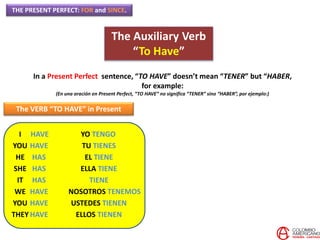
In a Present Perfect sentence, “TO HAVE” doesn’t mean “TENER” but “HABER,
for example:
(En una oración en Present Perfect, “TO HAVE” no significa “TENER” sino “HABER”, por ejemplo:)
The VERB “TO HAVE” in Present
I
YOU
HE
SHE
IT
WE
YOU
THEY
HAVE
HAVE
HAS
HAS
HAS
HAVE
HAVE
HAVE
YO TENGO
TU TIENES
EL TIENE
ELLA TIENE
TIENE
NOSOTROS TENEMOS
USTEDES TIENEN
ELLOS TIENEN
THE PRESENT PERFECT: FOR and SINCE.
The Auxiliary Verb
“To Have”
In a Present Perfect sentence, “TO HAVE” doesn’t mean “TENER” but “HABER,
for example:
(En una oración en Present Perfect, “TO HAVE” no significa “TENER” sino “HABER”, por ejemplo:)
The VERB “TO HAVE” in Present
I
YOU
HE
SHE
IT
WE
YOU
THEY
HAVE
HAVE
HAS
HAS
HAS
HAVE
HAVE
HAVE
YO TENGO
TU TIENES
EL TIENE
ELLA TIENE
TIENE
NOSOTROS TENEMOS
USTEDES TIENEN
ELLOS TIENEN
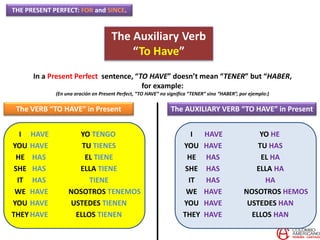
The AUXILIARY VERB “TO HAVE” in Present
I
YOU
HE
SHE
IT
WE
YOU
THEY
HAVE
HAVE
HAS
HAS
HAS
HAVE
HAVE
HAVE
YO HE
TU HAS
EL HA
ELLA HA
HA
NOSOTROS HEMOS
USTEDES HAN
ELLOS HAN
THE PRESENT PERFECT: FOR and SINCE.
The verb in
“Past Participle”
The Past Participle of a verb and its equivalence in Spanish:
(El Pasado Participio de un verbo y su equivalencia en Español)
THE PRESENT PERFECT: FOR and SINCE.
The verb in
“Past Participle”
The Past Participle of a verb and its equivalence in Spanish:
(El Pasado Participio de un verbo y su equivalencia en Español)
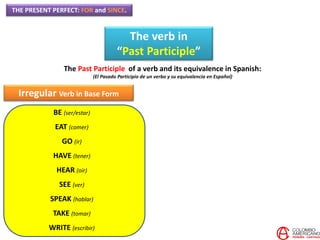
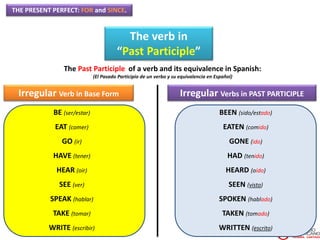
Irregular Verb in Base Form
BE (ser/estar)
EAT (comer)
GO (ir)
HAVE (tener)
HEAR (oír)
SEE (ver)
SPEAK (hablar)
TAKE (tomar)
WRITE (escribir)
THE PRESENT PERFECT: FOR and SINCE.
The verb in
“Past Participle”
The Past Participle of a verb and its equivalence in Spanish:
(El Pasado Participio de un verbo y su equivalencia en Español)
Irregular Verb in Base Form
BE (ser/estar)
EAT (comer)
GO (ir)
HAVE (tener)
HEAR (oír)
SEE (ver)
SPEAK (hablar)
TAKE (tomar)
WRITE (escribir)
Irregular Verbs in PAST PARTICIPLE
BEEN (sido/estado)
EATEN (comido)
GONE (ido)
HAD (tenido)
HEARD (oído)
SEEN (visto)
SPOKEN (hablado)
TAKEN (tomado)
WRITTEN (escrito)
THE PRESENT PERFECT: FOR and SINCE.
The verb in
“Past Participle”
The Past Participle of a verb and its equivalence in Spanish:
(El Pasado Participio de un verbo y su equivalencia en Español)
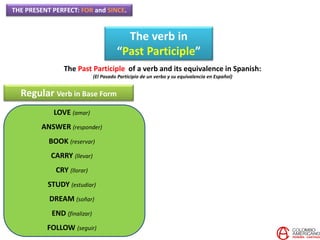
Regular Verb in Base Form
LOVE (amar)
ANSWER (responder)
BOOK (reservar)
CARRY (llevar)
CRY (llorar)
STUDY (estudiar)
DREAM (soñar)
END (finalizar)
FOLLOW (seguir)
THE PRESENT PERFECT: FOR and SINCE.
The verb in
“Past Participle”
The Past Participle of a verb and its equivalence in Spanish:
(El Pasado Participio de un verbo y su equivalencia en Español)
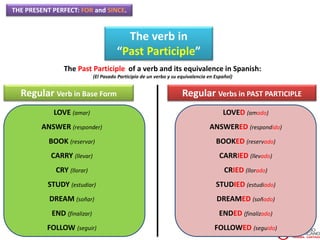
Regular Verb in Base Form
LOVE (amar)
ANSWER (responder)
BOOK (reservar)
CARRY (llevar)
CRY (llorar)
STUDY (estudiar)
DREAM (soñar)
END (finalizar)
FOLLOW (seguir)
Regular Verbs in PAST PARTICIPLE
LOVED (amado)
ANSWERED (respondido)
BOOKED (reservado)
CARRIED (llevado)
CRIED (llorado)
STUDIED (estudiado)
DREAMED (soñado)
ENDED (finalizado)
FOLLOWED (seguido)
THE PRESENT PERFECT: FOR and SINCE.
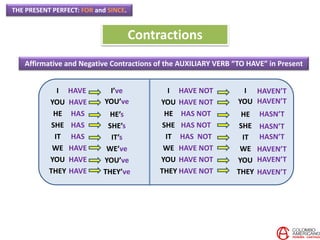
Contractions
Affirmative and Negative Contractions of the AUXILIARY VERB “TO HAVE” in Present
I
YOU
HE
SHE
IT
WE
YOU
THEY
HAVE
HAVE
HAS
HAS
HAS
HAVE
HAVE
HAVE
I’ve
YOU’ve
HE’s
SHE’s
IT’s
WE’ve
YOU’ve
THEY’ve
I
YOU
HE
SHE
IT
WE
YOU
THEY
HAVE NOT
HAVE NOT
HAS NOT
HAS NOT
HAS NOT
HAVE NOT
HAVE NOT
HAVE NOT
I
YOU
HE
SHE
IT
WE
YOU
THEY
HAVEN’T
HAVEN’T
HASN’T
HASN’T
HASN’T
HAVEN’T
HAVEN’T
HAVEN’T
THE PRESENT PERFECT: FOR and SINCE.
Contractions
Affirmative and Negative Contractions of the AUXILIARY VERB “TO HAVE” in Present
I
YOU
HE
SHE
IT
WE
YOU
THEY
HAVE
HAVE
HAS
HAS
HAS
HAVE
HAVE
HAVE
I’ve
YOU’ve
HE’s
SHE’s
IT’s
WE’ve
YOU’ve
THEY’ve
I
YOU
HE
SHE
IT
WE
YOU
THEY
HAVE NOT
HAVE NOT
HAS NOT
HAS NOT
HAS NOT
HAVE NOT
HAVE NOT
HAVE NOT
I
YOU
HE
SHE
IT
WE
YOU
THEY
HAVEN’T
HAVEN’T
HASN’T
HASN’T
HASN’T
HAVEN’T
HAVEN’T
HAVEN’T
Do not confuse with
He’s He is
She’s  She is
It’s  It is
He’s [he is] a teacher.
He’s [he has] been a teacher for 6 years.
THE PRESENT PERFECT: FOR and SINCE.
Let’s see one example…
THE PRESENT PERFECT: FOR and SINCE.
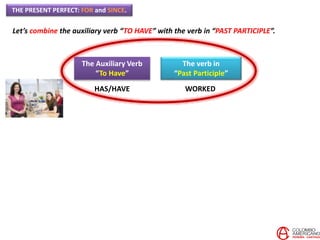
Let’s combine the auxiliary verb “TO HAVE” with the verb in “PAST PARTICIPLE”.
THE PRESENT PERFECT: FOR and SINCE.
Let’s combine the auxiliary verb “TO HAVE” with the verb in “PAST PARTICIPLE”.
The Auxiliary Verb
“To Have”
The verb in
“Past Participle”
HAS/HAVE WORKED
THE PRESENT PERFECT: FOR and SINCE.
Let’s combine the auxiliary verb “TO HAVE” with the verb in “PAST PARTICIPLE”.
The Auxiliary Verb
“To Have”
The verb in
“Past Participle”
HAS/HAVE WORKED
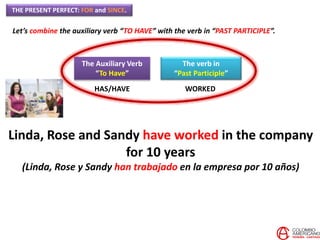
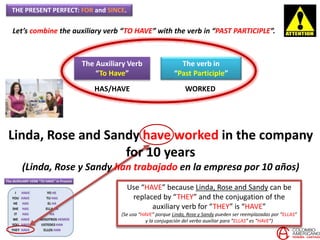
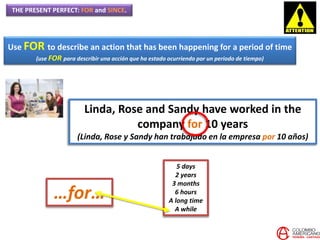
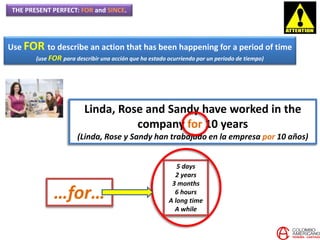
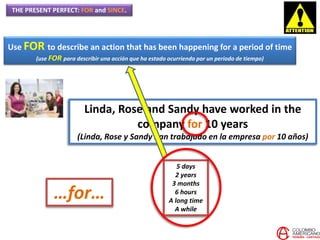
Linda, Rose and Sandy have worked in the company
for 10 years
(Linda, Rose y Sandy han trabajado en la empresa por 10 años)
THE PRESENT PERFECT: FOR and SINCE.
Let’s combine the auxiliary verb “TO HAVE” with the verb in “PAST PARTICIPLE”.
The Auxiliary Verb
“To Have”
The verb in
“Past Participle”
HAS/HAVE WORKED
Use “HAVE” because Linda, Rose and Sandy can be
replaced by “THEY” and the conjugation of the
auxiliary verb for “THEY” is “HAVE”
(Se usa “HAVE” porque Linda, Rose y Sandy pueden ser reemplazadas por “ELLAS”
y la conjugación del verbo auxiliar para “ELLAS” es “HAVE”)
Linda, Rose and Sandy have worked in the company
for 10 years
(Linda, Rose y Sandy han trabajado en la empresa por 10 años)
THE PRESENT PERFECT: FOR and SINCE.
Let’s see one more example…
THE PRESENT PERFECT: FOR and SINCE.
Let’s combine the auxiliary verb “TO HAVE” with the verb in “PAST PARTICIPLE”.
THE PRESENT PERFECT: FOR and SINCE.
Let’s combine the auxiliary verb “TO HAVE” with the verb in “PAST PARTICIPLE”.
The Auxiliary Verb
“To Have”
The verb in
“Past Participle”
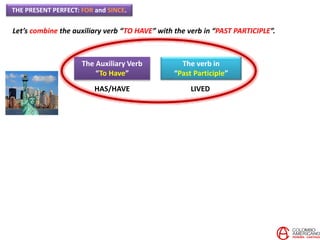
HAS/HAVE LIVED
THE PRESENT PERFECT: FOR and SINCE.
Let’s combine the auxiliary verb “TO HAVE” with the verb in “PAST PARTICIPLE”.
The Auxiliary Verb
“To Have”
The verb in
“Past Participle”
HAS/HAVE LIVED
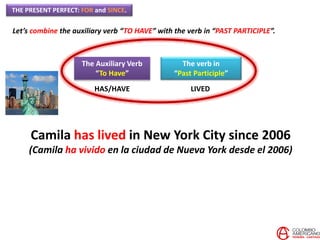
Camila has lived in New York City since 2006
(Camila ha vivido en la ciudad de Nueva York desde el 2006)
THE PRESENT PERFECT: FOR and SINCE.
Let’s combine the auxiliary verb “TO HAVE” with the verb in “PAST PARTICIPLE”.
The Auxiliary Verb
“To Have”
The verb in
“Past Participle”
HAS/HAVE LIVED
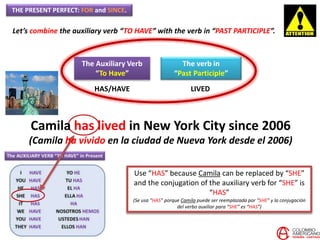
Use “HAS” because Camila can be replaced by “SHE”
and the conjugation of the auxiliary verb for “SHE” is
“HAS”
(Se usa “HAS” porque Camila puede ser reemplazada por “SHE” y la conjugación
del verbo auxiliar para “SHE” es “HAS”)
Camila has lived in New York City since 2006
(Camila ha vivido en la ciudad de Nueva York desde el 2006)
THE PRESENT PERFECT: FOR and SINCE.
Use FOR to describe an action that has been happening for a period of time
(use FOR para describir una acción que ha estado ocurriendo por un periodo de tiempo)
THE PRESENT PERFECT: FOR and SINCE.
Use FOR to describe an action that has been happening for a period of time
(use FOR para describir una acción que ha estado ocurriendo por un periodo de tiempo)
Example
THE PRESENT PERFECT: FOR and SINCE.
Use FOR to describe an action that has been happening for a period of time
(use FOR para describir una acción que ha estado ocurriendo por un periodo de tiempo)
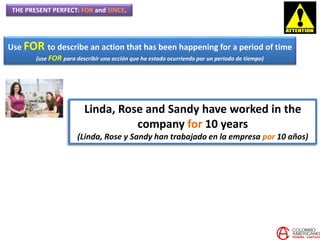
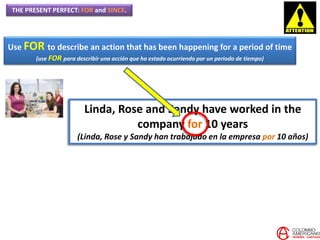
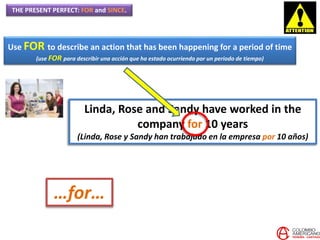
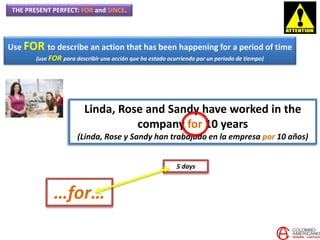
Linda, Rose and Sandy have worked in the
company for 10 years
(Linda, Rose y Sandy han trabajado en la empresa por 10 años)
THE PRESENT PERFECT: FOR and SINCE.
Use FOR to describe an action that has been happening for a period of time
(use FOR para describir una acción que ha estado ocurriendo por un periodo de tiempo)
Linda, Rose and Sandy have worked in the
company for 10 years
(Linda, Rose y Sandy han trabajado en la empresa por 10 años)
THE PRESENT PERFECT: FOR and SINCE.
Use FOR to describe an action that has been happening for a period of time
(use FOR para describir una acción que ha estado ocurriendo por un periodo de tiempo)
Linda, Rose and Sandy have worked in the
company for 10 years
(Linda, Rose y Sandy han trabajado en la empresa por 10 años)
…for…
THE PRESENT PERFECT: FOR and SINCE.
Use FOR to describe an action that has been happening for a period of time
(use FOR para describir una acción que ha estado ocurriendo por un periodo de tiempo)
Linda, Rose and Sandy have worked in the
company for 10 years
(Linda, Rose y Sandy han trabajado en la empresa por 10 años)
…for…
5 days
THE PRESENT PERFECT: FOR and SINCE.
Use FOR to describe an action that has been happening for a period of time
(use FOR para describir una acción que ha estado ocurriendo por un periodo de tiempo)
Linda, Rose and Sandy have worked in the
company for 10 years
(Linda, Rose y Sandy han trabajado en la empresa por 10 años)
…for…
5 days
2 years
THE PRESENT PERFECT: FOR and SINCE.
Use FOR to describe an action that has been happening for a period of time
(use FOR para describir una acción que ha estado ocurriendo por un periodo de tiempo)
Linda, Rose and Sandy have worked in the
company for 10 years
(Linda, Rose y Sandy han trabajado en la empresa por 10 años)
…for…
5 days
2 years
3 months
THE PRESENT PERFECT: FOR and SINCE.
Use FOR to describe an action that has been happening for a period of time
(use FOR para describir una acción que ha estado ocurriendo por un periodo de tiempo)
Linda, Rose and Sandy have worked in the
company for 10 years
(Linda, Rose y Sandy han trabajado en la empresa por 10 años)
…for…
5 days
2 years
3 months
6 hours
THE PRESENT PERFECT: FOR and SINCE.
Use FOR to describe an action that has been happening for a period of time
(use FOR para describir una acción que ha estado ocurriendo por un periodo de tiempo)
Linda, Rose and Sandy have worked in the
company for 10 years
(Linda, Rose y Sandy han trabajado en la empresa por 10 años)
…for…
5 days
2 years
3 months
6 hours
A long time
THE PRESENT PERFECT: FOR and SINCE.
Use FOR to describe an action that has been happening for a period of time
(use FOR para describir una acción que ha estado ocurriendo por un periodo de tiempo)
Linda, Rose and Sandy have worked in the
company for 10 years
(Linda, Rose y Sandy han trabajado en la empresa por 10 años)
…for…
5 days
2 years
3 months
6 hours
A long time
A while
THE PRESENT PERFECT: FOR and SINCE.
Use FOR to describe an action that has been happening for a period of time
(use FOR para describir una acción que ha estado ocurriendo por un periodo de tiempo)
Linda, Rose and Sandy have worked in the
company for 10 years
(Linda, Rose y Sandy han trabajado en la empresa por 10 años)
…for…
5 days
2 years
3 months
6 hours
A long time
A while
THE PRESENT PERFECT: FOR and SINCE.
Use FOR to describe an action that has been happening for a period of time
(use FOR para describir una acción que ha estado ocurriendo por un periodo de tiempo)
Linda, Rose and Sandy have worked in the
company for 10 years
(Linda, Rose y Sandy han trabajado en la empresa por 10 años)
…for…
5 days
2 years
3 months
6 hours
A long time
A while
THE PRESENT PERFECT: FOR and SINCE.
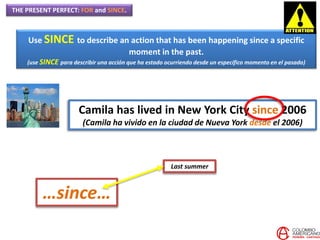
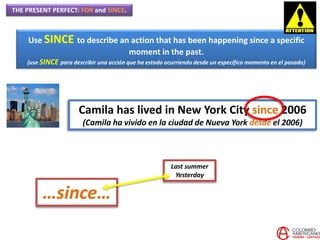
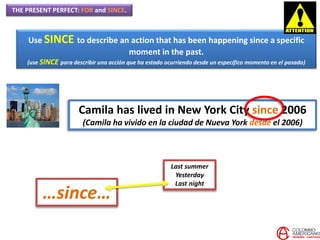
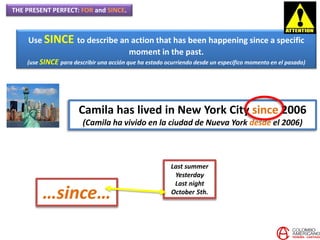
Use SINCE to describe an action that has been happening since a specific
moment in the past.
(use SINCE para describir una acción que ha estado ocurriendo desde un específico momento en el pasado)
THE PRESENT PERFECT: FOR and SINCE.
Example
Use SINCE to describe an action that has been happening since a specific
moment in the past.
(use SINCE para describir una acción que ha estado ocurriendo desde un específico momento en el pasado)
THE PRESENT PERFECT: FOR and SINCE.
Use SINCE to describe an action that has been happening since a specific
moment in the past.
(use SINCE para describir una acción que ha estado ocurriendo desde un específico momento en el pasado)
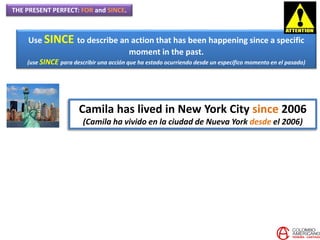
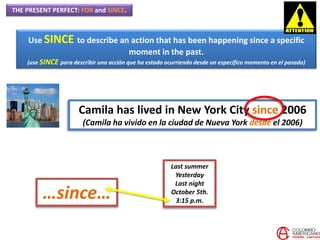
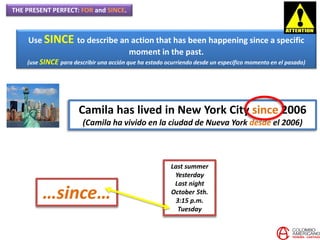
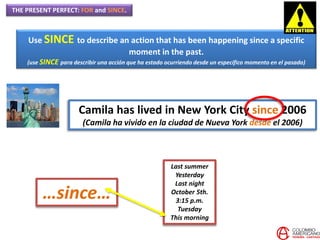
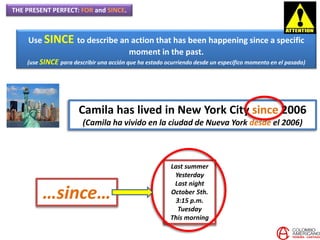
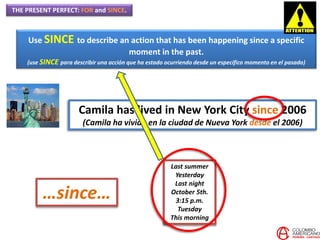
Camila has lived in New York City since 2006
(Camila ha vivido en la ciudad de Nueva York desde el 2006)
THE PRESENT PERFECT: FOR and SINCE.
Use SINCE to describe an action that has been happening since a specific
moment in the past.
(use SINCE para describir una acción que ha estado ocurriendo desde un específico momento en el pasado)
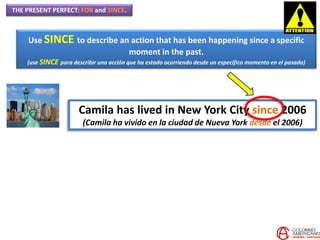
Camila has lived in New York City since 2006
(Camila ha vivido en la ciudad de Nueva York desde el 2006)
THE PRESENT PERFECT: FOR and SINCE.
Use SINCE to describe an action that has been happening since a specific
moment in the past.
(use SINCE para describir una acción que ha estado ocurriendo desde un específico momento en el pasado)
Camila has lived in New York City since 2006
(Camila ha vivido en la ciudad de Nueva York desde el 2006)
…since…
THE PRESENT PERFECT: FOR and SINCE.
Use SINCE to describe an action that has been happening since a specific
moment in the past.
(use SINCE para describir una acción que ha estado ocurriendo desde un específico momento en el pasado)
Camila has lived in New York City since 2006
(Camila ha vivido en la ciudad de Nueva York desde el 2006)
…since…
Last summer
THE PRESENT PERFECT: FOR and SINCE.
Use SINCE to describe an action that has been happening since a specific
moment in the past.
(use SINCE para describir una acción que ha estado ocurriendo desde un específico momento en el pasado)
Camila has lived in New York City since 2006
(Camila ha vivido en la ciudad de Nueva York desde el 2006)
Last summer
Yesterday
…since…
THE PRESENT PERFECT: FOR and SINCE.
Use SINCE to describe an action that has been happening since a specific
moment in the past.
(use SINCE para describir una acción que ha estado ocurriendo desde un específico momento en el pasado)
Camila has lived in New York City since 2006
(Camila ha vivido en la ciudad de Nueva York desde el 2006)
Last summer
Yesterday
Last night
…since…
THE PRESENT PERFECT: FOR and SINCE.
Use SINCE to describe an action that has been happening since a specific
moment in the past.
(use SINCE para describir una acción que ha estado ocurriendo desde un específico momento en el pasado)
Camila has lived in New York City since 2006
(Camila ha vivido en la ciudad de Nueva York desde el 2006)
Last summer
Yesterday
Last night
October 5th.
…since…
THE PRESENT PERFECT: FOR and SINCE.
Use SINCE to describe an action that has been happening since a specific
moment in the past.
(use SINCE para describir una acción que ha estado ocurriendo desde un específico momento en el pasado)
Camila has lived in New York City since 2006
(Camila ha vivido en la ciudad de Nueva York desde el 2006)
Last summer
Yesterday
Last night
October 5th.
3:15 p.m.
…since…
THE PRESENT PERFECT: FOR and SINCE.
Use SINCE to describe an action that has been happening since a specific
moment in the past.
(use SINCE para describir una acción que ha estado ocurriendo desde un específico momento en el pasado)
Camila has lived in New York City since 2006
(Camila ha vivido en la ciudad de Nueva York desde el 2006)
Last summer
Yesterday
Last night
October 5th.
3:15 p.m.
Tuesday
…since…
THE PRESENT PERFECT: FOR and SINCE.
Use SINCE to describe an action that has been happening since a specific
moment in the past.
(use SINCE para describir una acción que ha estado ocurriendo desde un específico momento en el pasado)
Camila has lived in New York City since 2006
(Camila ha vivido en la ciudad de Nueva York desde el 2006)
Last summer
Yesterday
Last night
October 5th.
3:15 p.m.
Tuesday
This morning
…since…
THE PRESENT PERFECT: FOR and SINCE.
Use SINCE to describe an action that has been happening since a specific
moment in the past.
(use SINCE para describir una acción que ha estado ocurriendo desde un específico momento en el pasado)
Camila has lived in New York City since 2006
(Camila ha vivido en la ciudad de Nueva York desde el 2006)
Last summer
Yesterday
Last night
October 5th.
3:15 p.m.
Tuesday
This morning
…since…
THE PRESENT PERFECT: FOR and SINCE.
Use SINCE to describe an action that has been happening since a specific
moment in the past.
(use SINCE para describir una acción que ha estado ocurriendo desde un específico momento en el pasado)
Camila has lived in New York City since 2006
(Camila ha vivido en la ciudad de Nueva York desde el 2006)
Last summer
Yesterday
Last night
October 5th.
3:15 p.m.
Tuesday
This morning
…since…
THE PRESENT PERFECT: FOR and SINCE.
Example using
for
THE PRESENT PERFECT: FOR and SINCE.
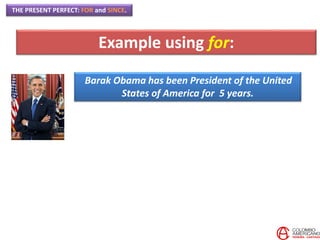
Example using for:
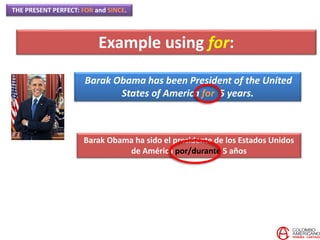
Barak Obama has been President of the United
States of America for 5 years.
THE PRESENT PERFECT: FOR and SINCE.
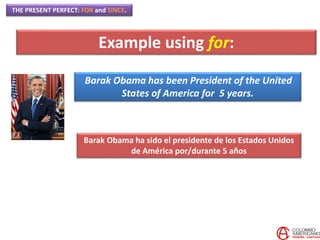
Barak Obama has been President of the United
States of America for 5 years.
Barak Obama ha sido el presidente de los Estados Unidos
de América por/durante 5 años
Example using for:
THE PRESENT PERFECT: FOR and SINCE.
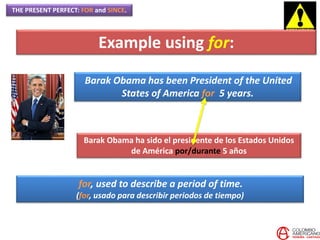
Barak Obama has been President of the United
States of America for 5 years.
Barak Obama ha sido el presidente de los Estados Unidos
de América por/durante 5 años
Example using for:
THE PRESENT PERFECT: FOR and SINCE.
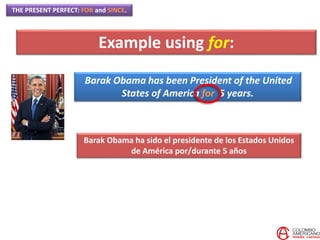
Barak Obama has been President of the United
States of America for 5 years.
Barak Obama ha sido el presidente de los Estados Unidos
de América por/durante 5 años
Example using for:
THE PRESENT PERFECT: FOR and SINCE.
Barak Obama has been President of the United
States of America for 5 years.
Barak Obama ha sido el presidente de los Estados Unidos
de América por/durante 5 años
for, used to describe a period of time.
(for, usado para describir periodos de tiempo)
Example using for:
THE PRESENT PERFECT: FOR and SINCE.
Example using
since
THE PRESENT PERFECT: FOR and SINCE.
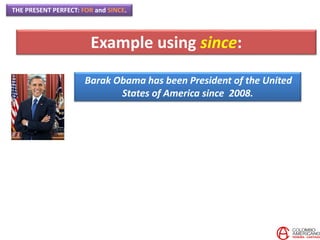
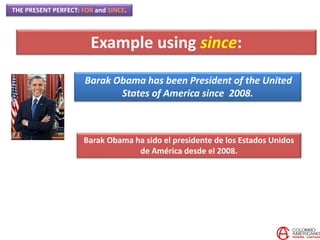
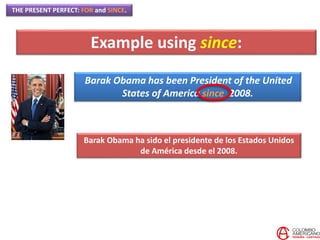
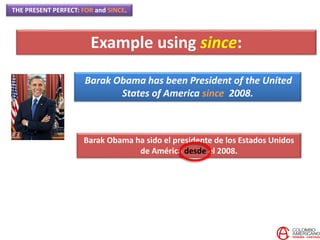
Barak Obama has been President of the United
States of America since 2008.
Example using since:
THE PRESENT PERFECT: FOR and SINCE.
Barak Obama has been President of the United
States of America since 2008.
Example using since:
Barak Obama ha sido el presidente de los Estados Unidos
de América desde el 2008.
THE PRESENT PERFECT: FOR and SINCE.
Barak Obama has been President of the United
States of America since 2008.
Barak Obama ha sido el presidente de los Estados Unidos
de América desde el 2008.
Example using since:
THE PRESENT PERFECT: FOR and SINCE.
Barak Obama has been President of the United
States of America since 2008.
Barak Obama ha sido el presidente de los Estados Unidos
de América desde el 2008.
Example using since:
THE PRESENT PERFECT: FOR and SINCE.
Examples:
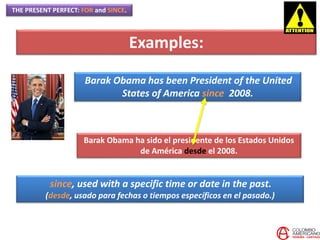
Barak Obama has been President of the United
States of America since 2008.
Barak Obama ha sido el presidente de los Estados Unidos
de América desde el 2008.
since, used with a specific time or date in the past.
(desde, usado para fechas o tiempos específicos en el pasado.)
THE PRESENT PERFECT: FOR and SINCE.
Thank you!!!

C8 U2 Project present perfect. for and since.

  • 1.
  • 2.
    THE PRESENT PERFECT:FOR and SINCE.
  • 3.
    THE PRESENT PERFECT:FOR and SINCE. The present perfect has two important elements:
  • 4.
    THE PRESENT PERFECT:FOR and SINCE. The present perfect has two important elements: The Auxiliary Verb “To Have”
  • 5.
    THE PRESENT PERFECT:FOR and SINCE. The present perfect has two important elements: The Auxiliary Verb “To Have” The main verb in PAST PARTICIPLE
  • 6.
    THE PRESENT PERFECT:FOR and SINCE. The Auxiliary Verb “To Have”
  • 7.
    THE PRESENT PERFECT:FOR and SINCE. The Auxiliary Verb “To Have” In a Present Perfect sentence, “TO HAVE” doesn’t mean “TENER” but “HABER, for example: (En una oración en Present Perfect, “TO HAVE” no significa “TENER” sino “HABER”, por ejemplo:) The VERB “TO HAVE” in Present I YOU HE SHE IT WE YOU THEY HAVE HAVE HAS HAS HAS HAVE HAVE HAVE YO TENGO TU TIENES EL TIENE ELLA TIENE TIENE NOSOTROS TENEMOS USTEDES TIENEN ELLOS TIENEN
  • 8.
    THE PRESENT PERFECT:FOR and SINCE. The Auxiliary Verb “To Have” In a Present Perfect sentence, “TO HAVE” doesn’t mean “TENER” but “HABER, for example: (En una oración en Present Perfect, “TO HAVE” no significa “TENER” sino “HABER”, por ejemplo:) The VERB “TO HAVE” in Present I YOU HE SHE IT WE YOU THEY HAVE HAVE HAS HAS HAS HAVE HAVE HAVE YO TENGO TU TIENES EL TIENE ELLA TIENE TIENE NOSOTROS TENEMOS USTEDES TIENEN ELLOS TIENEN The AUXILIARY VERB “TO HAVE” in Present I YOU HE SHE IT WE YOU THEY HAVE HAVE HAS HAS HAS HAVE HAVE HAVE YO HE TU HAS EL HA ELLA HA HA NOSOTROS HEMOS USTEDES HAN ELLOS HAN
  • 9.
    THE PRESENT PERFECT:FOR and SINCE. The verb in “Past Participle” The Past Participle of a verb and its equivalence in Spanish: (El Pasado Participio de un verbo y su equivalencia en Español)
  • 10.
    THE PRESENT PERFECT:FOR and SINCE. The verb in “Past Participle” The Past Participle of a verb and its equivalence in Spanish: (El Pasado Participio de un verbo y su equivalencia en Español) Irregular Verb in Base Form BE (ser/estar) EAT (comer) GO (ir) HAVE (tener) HEAR (oír) SEE (ver) SPEAK (hablar) TAKE (tomar) WRITE (escribir)
  • 11.
    THE PRESENT PERFECT:FOR and SINCE. The verb in “Past Participle” The Past Participle of a verb and its equivalence in Spanish: (El Pasado Participio de un verbo y su equivalencia en Español) Irregular Verb in Base Form BE (ser/estar) EAT (comer) GO (ir) HAVE (tener) HEAR (oír) SEE (ver) SPEAK (hablar) TAKE (tomar) WRITE (escribir) Irregular Verbs in PAST PARTICIPLE BEEN (sido/estado) EATEN (comido) GONE (ido) HAD (tenido) HEARD (oído) SEEN (visto) SPOKEN (hablado) TAKEN (tomado) WRITTEN (escrito)
  • 12.
    THE PRESENT PERFECT:FOR and SINCE. The verb in “Past Participle” The Past Participle of a verb and its equivalence in Spanish: (El Pasado Participio de un verbo y su equivalencia en Español) Regular Verb in Base Form LOVE (amar) ANSWER (responder) BOOK (reservar) CARRY (llevar) CRY (llorar) STUDY (estudiar) DREAM (soñar) END (finalizar) FOLLOW (seguir)
  • 13.
    THE PRESENT PERFECT:FOR and SINCE. The verb in “Past Participle” The Past Participle of a verb and its equivalence in Spanish: (El Pasado Participio de un verbo y su equivalencia en Español) Regular Verb in Base Form LOVE (amar) ANSWER (responder) BOOK (reservar) CARRY (llevar) CRY (llorar) STUDY (estudiar) DREAM (soñar) END (finalizar) FOLLOW (seguir) Regular Verbs in PAST PARTICIPLE LOVED (amado) ANSWERED (respondido) BOOKED (reservado) CARRIED (llevado) CRIED (llorado) STUDIED (estudiado) DREAMED (soñado) ENDED (finalizado) FOLLOWED (seguido)
  • 14.
    THE PRESENT PERFECT:FOR and SINCE. Contractions Affirmative and Negative Contractions of the AUXILIARY VERB “TO HAVE” in Present I YOU HE SHE IT WE YOU THEY HAVE HAVE HAS HAS HAS HAVE HAVE HAVE I’ve YOU’ve HE’s SHE’s IT’s WE’ve YOU’ve THEY’ve I YOU HE SHE IT WE YOU THEY HAVE NOT HAVE NOT HAS NOT HAS NOT HAS NOT HAVE NOT HAVE NOT HAVE NOT I YOU HE SHE IT WE YOU THEY HAVEN’T HAVEN’T HASN’T HASN’T HASN’T HAVEN’T HAVEN’T HAVEN’T
  • 15.
    THE PRESENT PERFECT:FOR and SINCE. Contractions Affirmative and Negative Contractions of the AUXILIARY VERB “TO HAVE” in Present I YOU HE SHE IT WE YOU THEY HAVE HAVE HAS HAS HAS HAVE HAVE HAVE I’ve YOU’ve HE’s SHE’s IT’s WE’ve YOU’ve THEY’ve I YOU HE SHE IT WE YOU THEY HAVE NOT HAVE NOT HAS NOT HAS NOT HAS NOT HAVE NOT HAVE NOT HAVE NOT I YOU HE SHE IT WE YOU THEY HAVEN’T HAVEN’T HASN’T HASN’T HASN’T HAVEN’T HAVEN’T HAVEN’T Do not confuse with He’s He is She’s  She is It’s  It is He’s [he is] a teacher. He’s [he has] been a teacher for 6 years.
  • 16.
    THE PRESENT PERFECT:FOR and SINCE. Let’s see one example…
  • 17.
    THE PRESENT PERFECT:FOR and SINCE. Let’s combine the auxiliary verb “TO HAVE” with the verb in “PAST PARTICIPLE”.
  • 18.
    THE PRESENT PERFECT:FOR and SINCE. Let’s combine the auxiliary verb “TO HAVE” with the verb in “PAST PARTICIPLE”. The Auxiliary Verb “To Have” The verb in “Past Participle” HAS/HAVE WORKED
  • 19.
    THE PRESENT PERFECT:FOR and SINCE. Let’s combine the auxiliary verb “TO HAVE” with the verb in “PAST PARTICIPLE”. The Auxiliary Verb “To Have” The verb in “Past Participle” HAS/HAVE WORKED Linda, Rose and Sandy have worked in the company for 10 years (Linda, Rose y Sandy han trabajado en la empresa por 10 años)
  • 20.
    THE PRESENT PERFECT:FOR and SINCE. Let’s combine the auxiliary verb “TO HAVE” with the verb in “PAST PARTICIPLE”. The Auxiliary Verb “To Have” The verb in “Past Participle” HAS/HAVE WORKED Use “HAVE” because Linda, Rose and Sandy can be replaced by “THEY” and the conjugation of the auxiliary verb for “THEY” is “HAVE” (Se usa “HAVE” porque Linda, Rose y Sandy pueden ser reemplazadas por “ELLAS” y la conjugación del verbo auxiliar para “ELLAS” es “HAVE”) Linda, Rose and Sandy have worked in the company for 10 years (Linda, Rose y Sandy han trabajado en la empresa por 10 años)
  • 21.
    THE PRESENT PERFECT:FOR and SINCE. Let’s see one more example…
  • 22.
    THE PRESENT PERFECT:FOR and SINCE. Let’s combine the auxiliary verb “TO HAVE” with the verb in “PAST PARTICIPLE”.
  • 23.
    THE PRESENT PERFECT:FOR and SINCE. Let’s combine the auxiliary verb “TO HAVE” with the verb in “PAST PARTICIPLE”. The Auxiliary Verb “To Have” The verb in “Past Participle” HAS/HAVE LIVED
  • 24.
    THE PRESENT PERFECT:FOR and SINCE. Let’s combine the auxiliary verb “TO HAVE” with the verb in “PAST PARTICIPLE”. The Auxiliary Verb “To Have” The verb in “Past Participle” HAS/HAVE LIVED Camila has lived in New York City since 2006 (Camila ha vivido en la ciudad de Nueva York desde el 2006)
  • 25.
    THE PRESENT PERFECT:FOR and SINCE. Let’s combine the auxiliary verb “TO HAVE” with the verb in “PAST PARTICIPLE”. The Auxiliary Verb “To Have” The verb in “Past Participle” HAS/HAVE LIVED Use “HAS” because Camila can be replaced by “SHE” and the conjugation of the auxiliary verb for “SHE” is “HAS” (Se usa “HAS” porque Camila puede ser reemplazada por “SHE” y la conjugación del verbo auxiliar para “SHE” es “HAS”) Camila has lived in New York City since 2006 (Camila ha vivido en la ciudad de Nueva York desde el 2006)
  • 26.
    THE PRESENT PERFECT:FOR and SINCE. Use FOR to describe an action that has been happening for a period of time (use FOR para describir una acción que ha estado ocurriendo por un periodo de tiempo)
  • 27.
    THE PRESENT PERFECT:FOR and SINCE. Use FOR to describe an action that has been happening for a period of time (use FOR para describir una acción que ha estado ocurriendo por un periodo de tiempo) Example
  • 28.
    THE PRESENT PERFECT:FOR and SINCE. Use FOR to describe an action that has been happening for a period of time (use FOR para describir una acción que ha estado ocurriendo por un periodo de tiempo) Linda, Rose and Sandy have worked in the company for 10 years (Linda, Rose y Sandy han trabajado en la empresa por 10 años)
  • 29.
    THE PRESENT PERFECT:FOR and SINCE. Use FOR to describe an action that has been happening for a period of time (use FOR para describir una acción que ha estado ocurriendo por un periodo de tiempo) Linda, Rose and Sandy have worked in the company for 10 years (Linda, Rose y Sandy han trabajado en la empresa por 10 años)
  • 30.
    THE PRESENT PERFECT:FOR and SINCE. Use FOR to describe an action that has been happening for a period of time (use FOR para describir una acción que ha estado ocurriendo por un periodo de tiempo) Linda, Rose and Sandy have worked in the company for 10 years (Linda, Rose y Sandy han trabajado en la empresa por 10 años) …for…
  • 31.
    THE PRESENT PERFECT:FOR and SINCE. Use FOR to describe an action that has been happening for a period of time (use FOR para describir una acción que ha estado ocurriendo por un periodo de tiempo) Linda, Rose and Sandy have worked in the company for 10 years (Linda, Rose y Sandy han trabajado en la empresa por 10 años) …for… 5 days
  • 32.
    THE PRESENT PERFECT:FOR and SINCE. Use FOR to describe an action that has been happening for a period of time (use FOR para describir una acción que ha estado ocurriendo por un periodo de tiempo) Linda, Rose and Sandy have worked in the company for 10 years (Linda, Rose y Sandy han trabajado en la empresa por 10 años) …for… 5 days 2 years
  • 33.
    THE PRESENT PERFECT:FOR and SINCE. Use FOR to describe an action that has been happening for a period of time (use FOR para describir una acción que ha estado ocurriendo por un periodo de tiempo) Linda, Rose and Sandy have worked in the company for 10 years (Linda, Rose y Sandy han trabajado en la empresa por 10 años) …for… 5 days 2 years 3 months
  • 34.
    THE PRESENT PERFECT:FOR and SINCE. Use FOR to describe an action that has been happening for a period of time (use FOR para describir una acción que ha estado ocurriendo por un periodo de tiempo) Linda, Rose and Sandy have worked in the company for 10 years (Linda, Rose y Sandy han trabajado en la empresa por 10 años) …for… 5 days 2 years 3 months 6 hours
  • 35.
    THE PRESENT PERFECT:FOR and SINCE. Use FOR to describe an action that has been happening for a period of time (use FOR para describir una acción que ha estado ocurriendo por un periodo de tiempo) Linda, Rose and Sandy have worked in the company for 10 years (Linda, Rose y Sandy han trabajado en la empresa por 10 años) …for… 5 days 2 years 3 months 6 hours A long time
  • 36.
    THE PRESENT PERFECT:FOR and SINCE. Use FOR to describe an action that has been happening for a period of time (use FOR para describir una acción que ha estado ocurriendo por un periodo de tiempo) Linda, Rose and Sandy have worked in the company for 10 years (Linda, Rose y Sandy han trabajado en la empresa por 10 años) …for… 5 days 2 years 3 months 6 hours A long time A while
  • 37.
    THE PRESENT PERFECT:FOR and SINCE. Use FOR to describe an action that has been happening for a period of time (use FOR para describir una acción que ha estado ocurriendo por un periodo de tiempo) Linda, Rose and Sandy have worked in the company for 10 years (Linda, Rose y Sandy han trabajado en la empresa por 10 años) …for… 5 days 2 years 3 months 6 hours A long time A while
  • 38.
    THE PRESENT PERFECT:FOR and SINCE. Use FOR to describe an action that has been happening for a period of time (use FOR para describir una acción que ha estado ocurriendo por un periodo de tiempo) Linda, Rose and Sandy have worked in the company for 10 years (Linda, Rose y Sandy han trabajado en la empresa por 10 años) …for… 5 days 2 years 3 months 6 hours A long time A while
  • 39.
    THE PRESENT PERFECT:FOR and SINCE. Use SINCE to describe an action that has been happening since a specific moment in the past. (use SINCE para describir una acción que ha estado ocurriendo desde un específico momento en el pasado)
  • 40.
    THE PRESENT PERFECT:FOR and SINCE. Example Use SINCE to describe an action that has been happening since a specific moment in the past. (use SINCE para describir una acción que ha estado ocurriendo desde un específico momento en el pasado)
  • 41.
    THE PRESENT PERFECT:FOR and SINCE. Use SINCE to describe an action that has been happening since a specific moment in the past. (use SINCE para describir una acción que ha estado ocurriendo desde un específico momento en el pasado) Camila has lived in New York City since 2006 (Camila ha vivido en la ciudad de Nueva York desde el 2006)
  • 42.
    THE PRESENT PERFECT:FOR and SINCE. Use SINCE to describe an action that has been happening since a specific moment in the past. (use SINCE para describir una acción que ha estado ocurriendo desde un específico momento en el pasado) Camila has lived in New York City since 2006 (Camila ha vivido en la ciudad de Nueva York desde el 2006)
  • 43.
    THE PRESENT PERFECT:FOR and SINCE. Use SINCE to describe an action that has been happening since a specific moment in the past. (use SINCE para describir una acción que ha estado ocurriendo desde un específico momento en el pasado) Camila has lived in New York City since 2006 (Camila ha vivido en la ciudad de Nueva York desde el 2006) …since…
  • 44.
    THE PRESENT PERFECT:FOR and SINCE. Use SINCE to describe an action that has been happening since a specific moment in the past. (use SINCE para describir una acción que ha estado ocurriendo desde un específico momento en el pasado) Camila has lived in New York City since 2006 (Camila ha vivido en la ciudad de Nueva York desde el 2006) …since… Last summer
  • 45.
    THE PRESENT PERFECT:FOR and SINCE. Use SINCE to describe an action that has been happening since a specific moment in the past. (use SINCE para describir una acción que ha estado ocurriendo desde un específico momento en el pasado) Camila has lived in New York City since 2006 (Camila ha vivido en la ciudad de Nueva York desde el 2006) Last summer Yesterday …since…
  • 46.
    THE PRESENT PERFECT:FOR and SINCE. Use SINCE to describe an action that has been happening since a specific moment in the past. (use SINCE para describir una acción que ha estado ocurriendo desde un específico momento en el pasado) Camila has lived in New York City since 2006 (Camila ha vivido en la ciudad de Nueva York desde el 2006) Last summer Yesterday Last night …since…
  • 47.
    THE PRESENT PERFECT:FOR and SINCE. Use SINCE to describe an action that has been happening since a specific moment in the past. (use SINCE para describir una acción que ha estado ocurriendo desde un específico momento en el pasado) Camila has lived in New York City since 2006 (Camila ha vivido en la ciudad de Nueva York desde el 2006) Last summer Yesterday Last night October 5th. …since…
  • 48.
    THE PRESENT PERFECT:FOR and SINCE. Use SINCE to describe an action that has been happening since a specific moment in the past. (use SINCE para describir una acción que ha estado ocurriendo desde un específico momento en el pasado) Camila has lived in New York City since 2006 (Camila ha vivido en la ciudad de Nueva York desde el 2006) Last summer Yesterday Last night October 5th. 3:15 p.m. …since…
  • 49.
    THE PRESENT PERFECT:FOR and SINCE. Use SINCE to describe an action that has been happening since a specific moment in the past. (use SINCE para describir una acción que ha estado ocurriendo desde un específico momento en el pasado) Camila has lived in New York City since 2006 (Camila ha vivido en la ciudad de Nueva York desde el 2006) Last summer Yesterday Last night October 5th. 3:15 p.m. Tuesday …since…
  • 50.
    THE PRESENT PERFECT:FOR and SINCE. Use SINCE to describe an action that has been happening since a specific moment in the past. (use SINCE para describir una acción que ha estado ocurriendo desde un específico momento en el pasado) Camila has lived in New York City since 2006 (Camila ha vivido en la ciudad de Nueva York desde el 2006) Last summer Yesterday Last night October 5th. 3:15 p.m. Tuesday This morning …since…
  • 51.
    THE PRESENT PERFECT:FOR and SINCE. Use SINCE to describe an action that has been happening since a specific moment in the past. (use SINCE para describir una acción que ha estado ocurriendo desde un específico momento en el pasado) Camila has lived in New York City since 2006 (Camila ha vivido en la ciudad de Nueva York desde el 2006) Last summer Yesterday Last night October 5th. 3:15 p.m. Tuesday This morning …since…
  • 52.
    THE PRESENT PERFECT:FOR and SINCE. Use SINCE to describe an action that has been happening since a specific moment in the past. (use SINCE para describir una acción que ha estado ocurriendo desde un específico momento en el pasado) Camila has lived in New York City since 2006 (Camila ha vivido en la ciudad de Nueva York desde el 2006) Last summer Yesterday Last night October 5th. 3:15 p.m. Tuesday This morning …since…
  • 53.
    THE PRESENT PERFECT:FOR and SINCE. Example using for
  • 54.
    THE PRESENT PERFECT:FOR and SINCE. Example using for: Barak Obama has been President of the United States of America for 5 years.
  • 55.
    THE PRESENT PERFECT:FOR and SINCE. Barak Obama has been President of the United States of America for 5 years. Barak Obama ha sido el presidente de los Estados Unidos de América por/durante 5 años Example using for:
  • 56.
    THE PRESENT PERFECT:FOR and SINCE. Barak Obama has been President of the United States of America for 5 years. Barak Obama ha sido el presidente de los Estados Unidos de América por/durante 5 años Example using for:
  • 57.
    THE PRESENT PERFECT:FOR and SINCE. Barak Obama has been President of the United States of America for 5 years. Barak Obama ha sido el presidente de los Estados Unidos de América por/durante 5 años Example using for:
  • 58.
    THE PRESENT PERFECT:FOR and SINCE. Barak Obama has been President of the United States of America for 5 years. Barak Obama ha sido el presidente de los Estados Unidos de América por/durante 5 años for, used to describe a period of time. (for, usado para describir periodos de tiempo) Example using for:
  • 59.
    THE PRESENT PERFECT:FOR and SINCE. Example using since
  • 60.
    THE PRESENT PERFECT:FOR and SINCE. Barak Obama has been President of the United States of America since 2008. Example using since:
  • 61.
    THE PRESENT PERFECT:FOR and SINCE. Barak Obama has been President of the United States of America since 2008. Example using since: Barak Obama ha sido el presidente de los Estados Unidos de América desde el 2008.
  • 62.
    THE PRESENT PERFECT:FOR and SINCE. Barak Obama has been President of the United States of America since 2008. Barak Obama ha sido el presidente de los Estados Unidos de América desde el 2008. Example using since:
  • 63.
    THE PRESENT PERFECT:FOR and SINCE. Barak Obama has been President of the United States of America since 2008. Barak Obama ha sido el presidente de los Estados Unidos de América desde el 2008. Example using since:
  • 64.
    THE PRESENT PERFECT:FOR and SINCE. Examples: Barak Obama has been President of the United States of America since 2008. Barak Obama ha sido el presidente de los Estados Unidos de América desde el 2008. since, used with a specific time or date in the past. (desde, usado para fechas o tiempos específicos en el pasado.)
  • 65.
    THE PRESENT PERFECT:FOR and SINCE. Thank you!!!