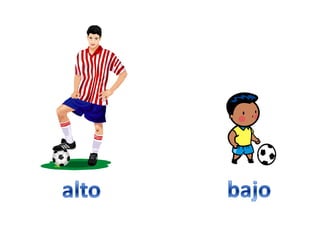






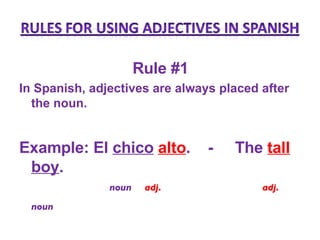


Rule #1  In Spanish, adjectives are always placed after the noun. Example: El  chico   alto .  -  The   tall   boy .   noun  adj.   adj.  noun  
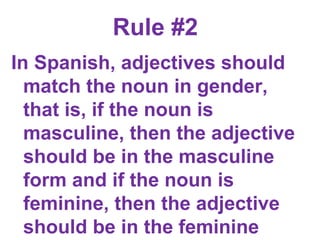
Rule #2  In Spanish, adjectives should match the noun in gender, that is, if the noun is masculine, then the adjective should be in the masculine form and if the noun is feminine, then the adjective should be in the feminine form.     
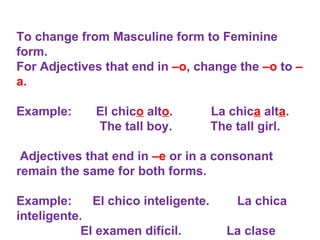
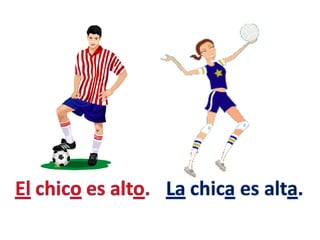
To change from Masculine form to Feminine form. For Adjectives that end in  –o , change the  –o  to  –a .   Example:  El chic o  alt o .  La chic a  alt a . The tall boy.  The tall girl.   Adjectives that end in  –e  or in a consonant remain the same for both forms.   Example:  El chico inteligente.  La chica inteligente. El examen difícil.  La clase difícil.
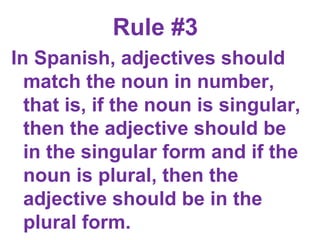
Rule #3  In Spanish, adjectives should match the noun in number, that is, if the noun is singular, then the adjective should be in the singular form and if the noun is plural, then the adjective should be in the plural form.     
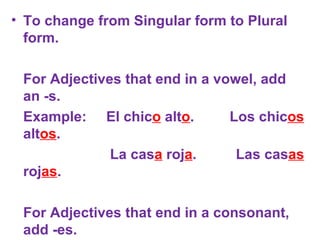
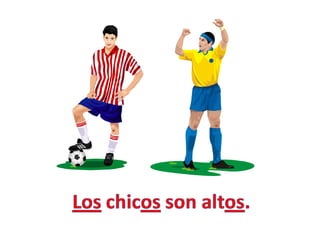
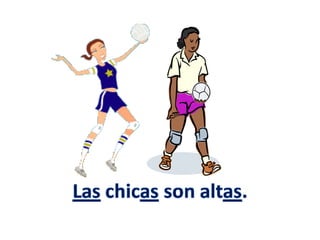
To change from Singular form to Plural form. For Adjectives that end in a vowel, add an -s.   Example:  El chic o  alt o .  Los chic os  alt os .   La cas a  roj a .  Las cas as  roj as . For Adjectives that end in a consonant, add -es.   Example:  El libro azul.  Los libros azules.   La clase difícil.  Las clases difíciles.     


Los adjetivos

  • 1.
  • 2.
  • 3.
  • 4.
  • 5.
  • 6.
  • 7.
  • 8.
  • 9.
  • 10.
  • 11.
  • 12.
  • 13.
  • 14.
  • 15.
  • 16.
  • 17.
  • 18.
  • 19.
  • 20.
  • 21.
  • 22.
  • 23.
  • 24.
  • 25.
  • 26.
  • 27.
  • 28.
  • 29.
  • 30.
  • 31.
  • 32.
  • 33.
  • 34.
  • 35.
    Rule #1 In Spanish, adjectives are always placed after the noun. Example: El chico alto . - The tall boy . noun adj. adj. noun  
  • 36.
    Rule #2 In Spanish, adjectives should match the noun in gender, that is, if the noun is masculine, then the adjective should be in the masculine form and if the noun is feminine, then the adjective should be in the feminine form.    
  • 37.
    To change fromMasculine form to Feminine form. For Adjectives that end in –o , change the –o to –a .   Example: El chic o alt o . La chic a alt a . The tall boy. The tall girl.   Adjectives that end in –e or in a consonant remain the same for both forms.   Example: El chico inteligente. La chica inteligente. El examen difícil. La clase difícil.
  • 38.
    Rule #3 In Spanish, adjectives should match the noun in number, that is, if the noun is singular, then the adjective should be in the singular form and if the noun is plural, then the adjective should be in the plural form.    
  • 39.
    To change fromSingular form to Plural form. For Adjectives that end in a vowel, add an -s.   Example: El chic o alt o . Los chic os alt os . La cas a roj a . Las cas as roj as . For Adjectives that end in a consonant, add -es.   Example: El libro azul. Los libros azules. La clase difícil. Las clases difíciles.    
  • 40.
  • 41.
  • 42.
  • 43.
  • 44.
  • 45.
  • 46.