Grammar Review
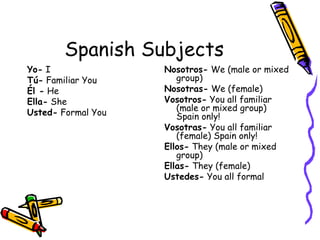
Spanish Subjects Yo-  I Tú-  Familiar You Él -  He Ella-  She Usted-  Formal You Nosotros-  We (male or mixed group) Nosotras-  We (female) Vosotros-  You all familiar (male or mixed group) Spain only! Vosotras-  You all familiar (female) Spain only! Ellos-  They (male or mixed group)  Ellas-  They (female) Ustedes-  You all formal
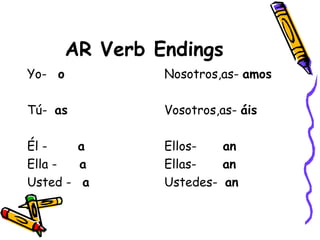
AR Verb Endings Yo-  o Tú-  as Él -    a Ella -  a Usted -  a Nosotros,as-  amos Vosotros,as-  áis Ellos-  an Ellas-  an Ustedes-  an
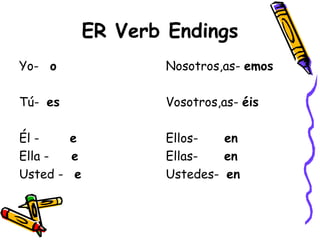
ER Verb Endings Yo-  o Tú-  es Él -    e Ella -  e Usted -  e Nosotros,as-  emos Vosotros,as-  éis Ellos-  en Ellas-  en Ustedes-  en
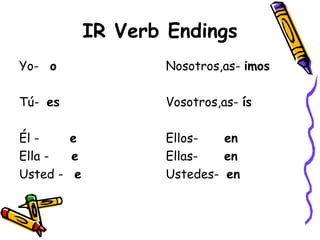
IR Verb Endings Yo-  o Tú-  es Él -    e Ella -  e Usted -  e Nosotros,as-  imos Vosotros,as-  ís Ellos-  en Ellas-  en Ustedes-  en
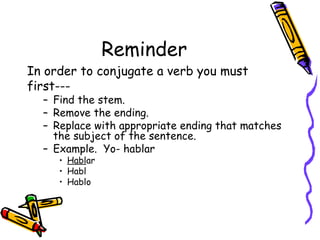
Reminder In order to conjugate a verb you must  first--- Find the stem. Remove the ending. Replace with appropriate ending that matches the subject of the sentence. Example.  Yo- hablar  Habl ar Habl Hablo
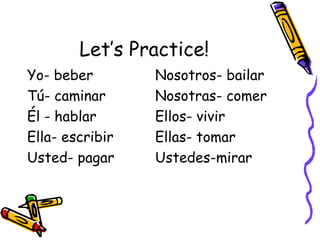
Let’s Practice! Yo- beber Nosotros- bailar Tú- caminar Nosotras- comer Él - hablar Ellos- vivir Ella- escribir Ellas- tomar Usted- pagar Ustedes-mirar
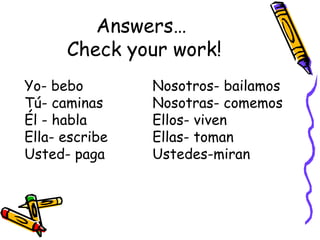
Answers…  Check your work! Yo- bebo Nosotros- bailamos Tú- caminas Nosotras- comemos Él - habla Ellos- viven Ella- escribe Ellas- toman Usted- paga Ustedes-miran
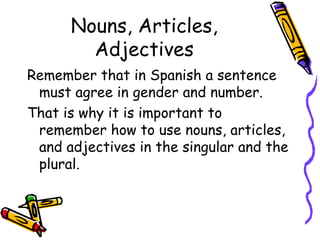
Nouns, Articles, Adjectives Remember that in Spanish a sentence must agree in gender and number.  That is why it is important to remember how to use nouns, articles, and adjectives in the singular and the plural.
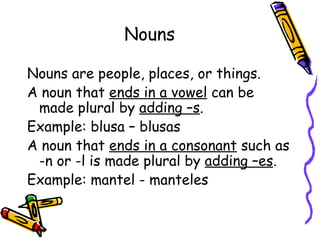
Nouns Nouns are people, places, or things. A noun that  ends in a vowel  can be made plural by  adding –s . Example: blusa – blusas A noun that  ends in a consonant  such as -n or -l is made plural by  adding –es . Example: mantel - manteles

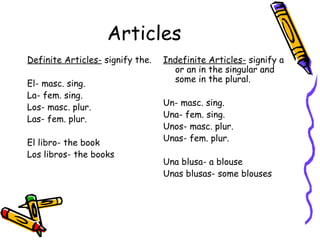
Articles Definite Articles-  signify the. El- masc. sing. La- fem. sing. Los- masc. plur. Las- fem. plur. El libro- the book Los libros- the books Indefinite Articles-  signify a or an in the singular and some in the plural. Un- masc. sing. Una- fem. sing. Unos- masc. plur. Unas- fem. plur. Una blusa- a blouse Unas blusas- some blouses
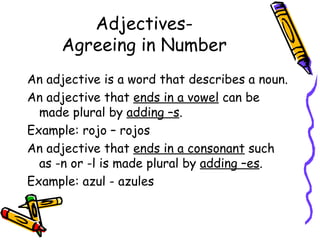
Adjectives- Agreeing in Number An adjective is a word that describes a noun.  An adjective that  ends in a vowel  can be made plural by  adding –s . Example: rojo – rojos An adjective that  ends in a consonant  such as -n or -l is made plural by  adding –es . Example: azul - azules
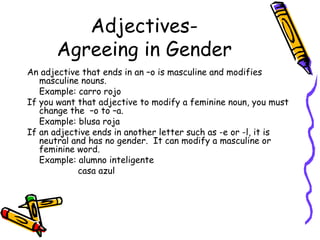
Adjectives- Agreeing in Gender An adjective that ends in an –o is masculine and modifies masculine nouns. Example: carro rojo If you want that adjective to modify a feminine noun, you must change the  –o to –a. Example: blusa roja If an adjective ends in another letter such as -e or -l, it is neutral and has no gender.  It can modify a masculine or feminine word. Example: alumno inteligente   casa azul
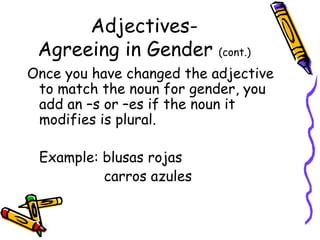
Adjectives- Agreeing in Gender  (cont.) Once you have changed the adjective to match the noun for gender, you add an –s or –es if the noun it modifies is plural. Example: blusas rojas   carros azules
Irregular Verbs...
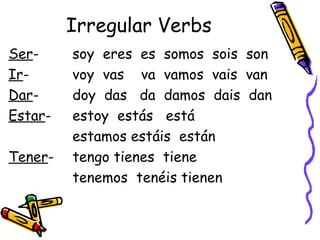
Irregular Verbs Ser -  soy  eres  es  somos  sois  son Ir -  voy  vas  va  vamos  vais  van Dar -  doy  das  da  damos  dais  dan Estar -  estoy  estás  está  estamos estáis  están Tener -  tengo tienes  tiene  tenemos  tenéis tienen
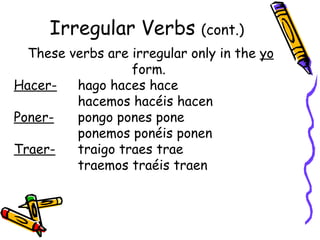
Irregular Verbs  (cont.) These verbs are irregular only in the  yo  form.  Hacer-   hago haces hace  hacemos hacéis hacen Poner-   pongo pones pone  ponemos ponéis ponen Traer-   traigo traes trae  traemos traéis traen
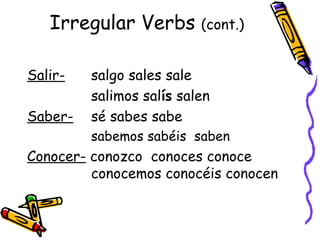
Irregular Verbs  (cont.) Salir-   salgo sales sale  salimos sal ís  salen Saber-   sé sabes sabe  sabemos sabéis  saben Conocer-  conozco  conoces conoce  conocemos conocéis conocen
Stem Changing Verbs... Present Tense
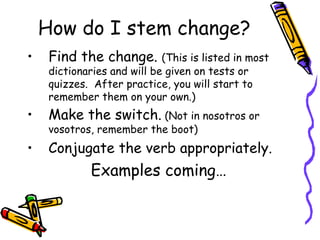
How do I stem change? Find the change.  (This is listed in most dictionaries and will be given on tests or quizzes.  After practice, you will start to remember them on your own.) Make the switch.  (Not in nosotros or vosotros, remember the boot) Conjugate the verb appropriately. Examples coming…
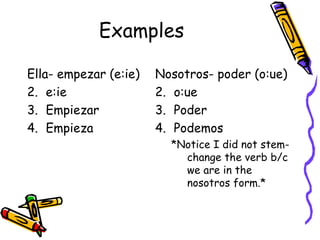
Examples Ella- empezar (e:ie) e:ie Empiezar Empieza Nosotros- poder (o:ue) o:ue Poder Podemos *Notice I did not stem-change the verb b/c we are in the nosotros form.*
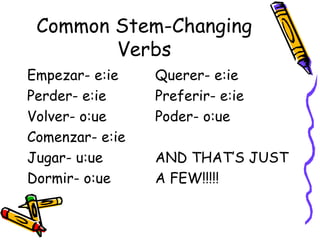
Common Stem-Changing Verbs Empezar- e:ie Querer- e:ie Perder- e:ie Preferir- e:ie Volver- o:ue Poder- o:ue Comenzar- e:ie Jugar- u:ue AND THAT’S JUST  Dormir- o:ue A FEW!!!!!
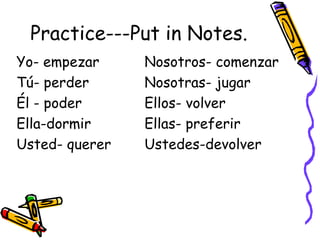
Practice---Put in Notes. Yo- empezar Nosotros- comenzar Tú- perder Nosotras- jugar Él - poder Ellos- volver Ella-dormir Ellas- preferir Usted- querer Ustedes-devolver
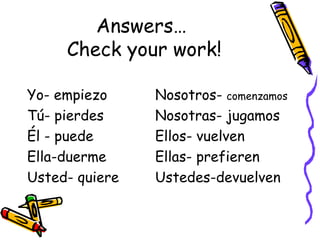
Answers…  Check your work! Yo- empiezo Nosotros-  comenzamos Tú- pierdes Nosotras- jugamos Él - puede Ellos- vuelven Ella-duerme Ellas- prefieren Usted- quiere Ustedes-devuelven
Possessive Adjectives
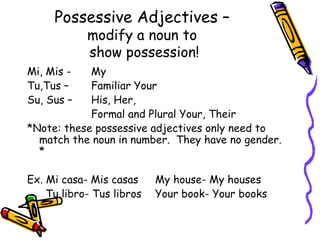
Possessive Adjectives –   modify a noun to  show possession! Mi, Mis -  My Tu,Tus –  Familiar Your Su, Sus –  His, Her,  Formal and Plural Your, Their  *Note: these possessive adjectives only need to match the noun in number.  They have no gender. * Ex. Mi casa- Mis casas  My house- My houses   Tu libro- Tus libros  Your book- Your books
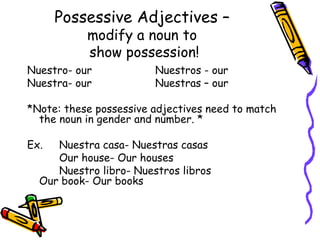
Possessive Adjectives –   modify a noun to  show possession! Nuestro- our Nuestros - our Nuestra- our Nuestras – our *Note: these possessive adjectives need to match the noun in gender and number. * Ex.  Nuestra casa- Nuestras casas  Our house- Our houses   Nuestro libro- Nuestros libros  Our book- Our books
Gustar Verbs
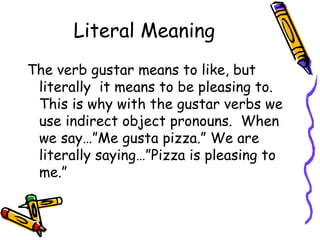
Literal Meaning The verb gustar means to like, but literally  it means to be pleasing to.  This is why with the gustar verbs we use indirect object pronouns.  When we say…”Me gusta pizza.” We are literally saying…”Pizza is pleasing to me.”
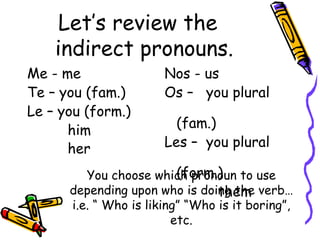
Let’s review the  indirect pronouns. Me - me Te – you (fam.) Le – you (form.)   him   her Nos - us Os –  you plural  (fam.) Les –  you plural  (form.)   them  You choose which pronoun to use depending upon who is doing the verb…i.e. “ Who is liking” “Who is it boring”, etc.
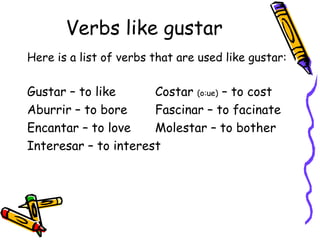
Verbs like gustar Here is a list of verbs that are used like gustar: Gustar – to like Costar  (o:ue)  – to cost Aburrir – to bore Fascinar – to facinate Encantar – to love Molestar – to bother Interesar – to interest
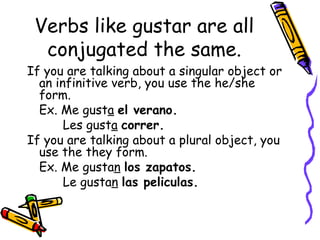
Verbs like gustar are all conjugated the same. If you are talking about a singular object or an infinitive verb, you use the he/she form. Ex. Me gust a   el verano.   Les gust a   correr. If you are talking about a plural object, you use the they form. Ex. Me gusta n   los zapatos.   Le gusta n   las peliculas.
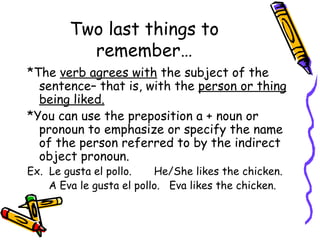
Two last things to remember… *The  verb agrees with  the subject of the sentence– that is, with the  person or thing being liked.   *You can use the preposition a + noun or pronoun to emphasize or specify the name of the person referred to by the indirect object pronoun.  Ex.  Le gusta el pollo.  He/She likes the chicken.    A Eva le gusta el pollo.  Eva likes the chicken.
Ser vs Estar
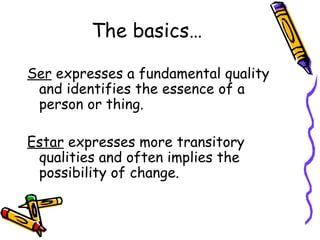
The basics… Ser  expresses a fundamental quality and identifies the essence of a person or thing. Estar  expresses more transitory qualities and often implies the possibility of change.
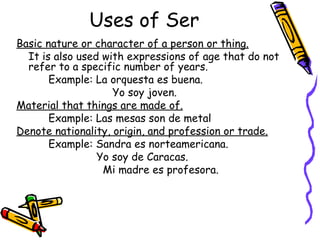
Uses of Ser Basic nature or character of a person or thing.   It is also used with expressions of age that do not refer to a specific number of years. Example: La orquesta es buena.  Yo soy joven. Material that things are made of. Example: Las mesas son de metal Denote nationality, origin, and profession or trade. Example: Sandra es norteamericana.   Yo soy de Caracas.   Mi madre es profesora.
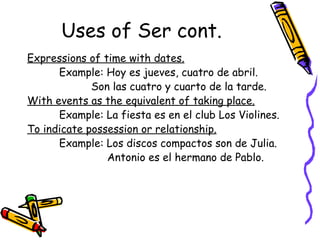
Uses of Ser cont. Expressions of time with dates. Example: Hoy es jueves, cuatro de abril. Son las cuatro y cuarto de la tarde. With events as the equivalent of taking place. Example: La fiesta es en el club Los Violines. To indicate possession or relationship. Example: Los discos compactos son de Julia.   Antonio es el hermano de Pablo.
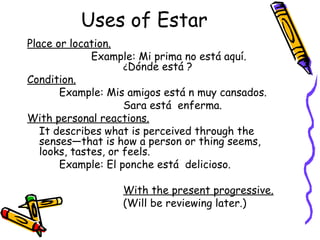
Uses of Estar Place or location.   Example: Mi prima no está aquí.  ¿ Dónde está ?  Condition. Example: Mis amigos está n muy cansados. Sara está  enferma. With personal reactions. It describes what is perceived through the senses—that is how a person or thing seems, looks, tastes, or feels. Example: El ponche está  delicioso. With the present progressive.   (Will be reviewing later.)
Pronouns
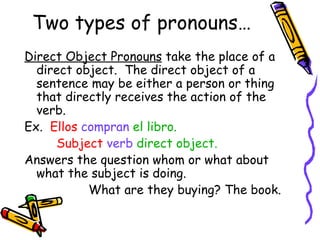
Two types of pronouns… Direct Object Pronouns  take the place of a direct object.  The direct object of a sentence may be either a person or thing that directly receives the action of the verb. Ex.  Ellos   compran   el libro. Subject   verb  direct object. Answers the question whom or what about  what the subject is doing.  What are they buying? The book.
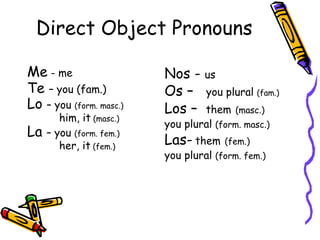
Direct Object Pronouns Me  - me Te  – you (fam.) Lo  – you  (form. masc.) him, it  (masc.) La  – you  (form. fem.) her, it  (fem.) Nos -  us Os –  you plural  (fam.) Los –  them   (masc.) you plural  (form. masc.) Las-   them   (fem.) you plural  (form. fem.)
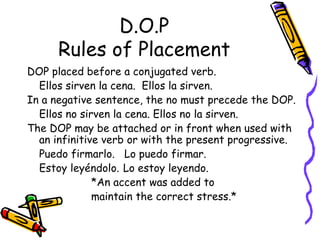
D.O.P Rules of Placement DOP placed before a conjugated verb.  Ellos sirven la cena.  Ellos la sirven. In a negative sentence, the no must precede the DOP.  Ellos no sirven la cena. Ellos no la sirven. The DOP may be attached or in front when used with an infinitive verb or with the present progressive. Puedo firmarlo.  Lo puedo firmar. Estoy leyéndolo. Lo estoy leyendo.  *An accent was added to  maintain the correct stress.*
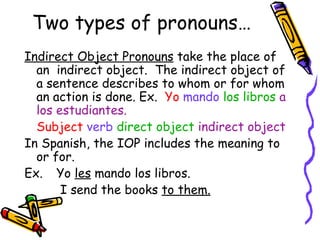
Two types of pronouns… Indirect Object Pronouns  take the place of an  indirect object.  The indirect object of a sentence describes to whom or for whom an action is done. Ex.  Yo   mando   los libros  a los estudiantes. Subject   verb  direct object  indirect object   In Spanish, the IOP includes the meaning to or for.  Ex.  Yo  les  mando los libros.    I send the books  to them.
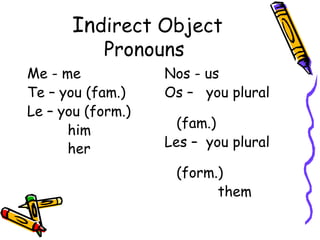
  In direct Object Pronouns Me - me Te – you (fam.) Le – you (form.)   him   her Nos - us Os –  you plural  (fam.) Les –  you plural  (form.)   them
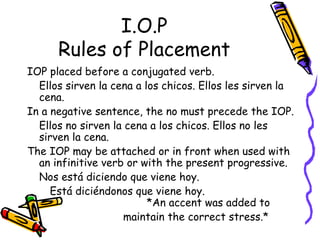
I.O.P Rules of Placement IOP placed before a conjugated verb.  Ellos sirven la cena a los chicos. Ellos les sirven la cena. In a negative sentence, the no must precede the IOP.  Ellos no sirven la cena a los chicos. Ellos no les sirven la cena. The IOP may be attached or in front when used with an infinitive verb or with the present progressive. Nos está diciendo que viene hoy.   Está diciéndonos que viene hoy. *An accent was added to  maintain the correct stress.*
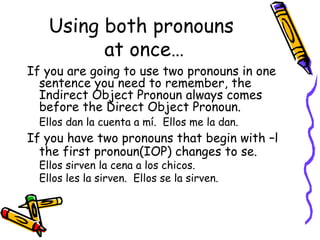
Using both pronouns  at once… If you are going to use two pronouns in one sentence you need to remember, the Indirect Object Pronoun always comes before the Direct Object Pronoun. Ellos dan la cuenta a mí.  Ellos me la dan. If you have two pronouns that begin with –l the first pronoun(IOP) changes to se. Ellos sirven la cena a los chicos.  Ellos les la sirven.  Ellos se la sirven.
Present Progressive
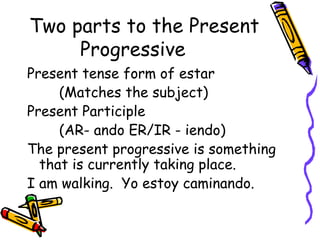
Two parts to the Present Progressive Present tense form of estar  (Matches the subject) Present Participle  (AR- ando ER/IR - iendo) The present progressive is something that is currently taking place. I am walking.  Yo estoy caminando.
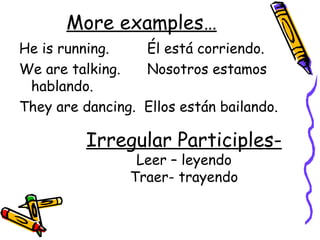
More examples… He is running.  Él está corriendo. We are talking. Nosotros estamos hablando. They are dancing.  Ellos están bailando. Irregular Participles- Leer – leyendo Traer- trayendo
Try a couple on your own. We are singing. (cantar) They are writing. (escribir) I am reading. (leer) He is bringing a book. (traer)
Answers… Nosotros estamos cantando. Ellos están escribiendo. Yo estoy leyendo. Él está trayendo un libro.
Reflexive Verbs
Reflexive Verbs The subject of a reflexive verb both performs and receives the action. Each subject has its corresponding pronoun.  Reflexive verbs follow the conjugation rules (i.e. regular ar, er, ir verbs, stem-changers, etc.)
Pronouns and Examples Yo-  me Tú-  te Él, Ella, Usted -  se Nosotros,as-  nos Vosotros,as-  os Ellos, Ellas,  Ustedes-  se
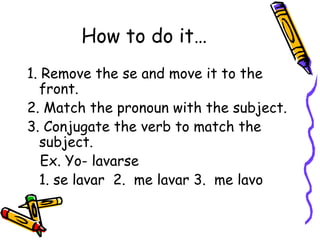
How to do it… 1. Remove the se and move it to the front.  2. Match the pronoun with the subject. 3. Conjugate the verb to match the subject. Ex. Yo- lavarse  1. se lavar  2.  me lavar 3.  me lavo
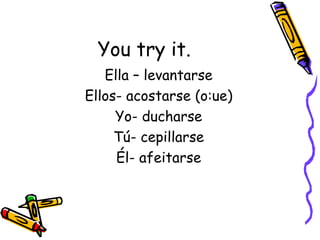
You try it. Ella – levantarse Ellos- acostarse (o:ue) Yo- ducharse Tú- cepillarse Él- afeitarse
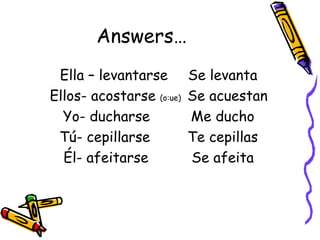
Answers… Ella – levantarse Se levanta Ellos- acostarse  (o:ue)   Se acuestan Yo- ducharse Me ducho Tú- cepillarse Te cepillas Él- afeitarse  Se afeita
El Fin

Grammar Review

  • 1.
  • 2.
    Spanish Subjects Yo- I Tú- Familiar You Él - He Ella- She Usted- Formal You Nosotros- We (male or mixed group) Nosotras- We (female) Vosotros- You all familiar (male or mixed group) Spain only! Vosotras- You all familiar (female) Spain only! Ellos- They (male or mixed group) Ellas- They (female) Ustedes- You all formal
  • 3.
    AR Verb EndingsYo- o Tú- as Él - a Ella - a Usted - a Nosotros,as- amos Vosotros,as- áis Ellos- an Ellas- an Ustedes- an
  • 4.
    ER Verb EndingsYo- o Tú- es Él - e Ella - e Usted - e Nosotros,as- emos Vosotros,as- éis Ellos- en Ellas- en Ustedes- en
  • 5.
    IR Verb EndingsYo- o Tú- es Él - e Ella - e Usted - e Nosotros,as- imos Vosotros,as- ís Ellos- en Ellas- en Ustedes- en
  • 6.
    Reminder In orderto conjugate a verb you must first--- Find the stem. Remove the ending. Replace with appropriate ending that matches the subject of the sentence. Example. Yo- hablar Habl ar Habl Hablo
  • 7.
    Let’s Practice! Yo-beber Nosotros- bailar Tú- caminar Nosotras- comer Él - hablar Ellos- vivir Ella- escribir Ellas- tomar Usted- pagar Ustedes-mirar
  • 8.
    Answers… Checkyour work! Yo- bebo Nosotros- bailamos Tú- caminas Nosotras- comemos Él - habla Ellos- viven Ella- escribe Ellas- toman Usted- paga Ustedes-miran
  • 9.
    Nouns, Articles, AdjectivesRemember that in Spanish a sentence must agree in gender and number. That is why it is important to remember how to use nouns, articles, and adjectives in the singular and the plural.
  • 10.
    Nouns Nouns arepeople, places, or things. A noun that ends in a vowel can be made plural by adding –s . Example: blusa – blusas A noun that ends in a consonant such as -n or -l is made plural by adding –es . Example: mantel - manteles
  • 11.
    Articles Definite Articles- signify the. El- masc. sing. La- fem. sing. Los- masc. plur. Las- fem. plur. El libro- the book Los libros- the books Indefinite Articles- signify a or an in the singular and some in the plural. Un- masc. sing. Una- fem. sing. Unos- masc. plur. Unas- fem. plur. Una blusa- a blouse Unas blusas- some blouses
  • 12.
    Adjectives- Agreeing inNumber An adjective is a word that describes a noun. An adjective that ends in a vowel can be made plural by adding –s . Example: rojo – rojos An adjective that ends in a consonant such as -n or -l is made plural by adding –es . Example: azul - azules
  • 13.
    Adjectives- Agreeing inGender An adjective that ends in an –o is masculine and modifies masculine nouns. Example: carro rojo If you want that adjective to modify a feminine noun, you must change the –o to –a. Example: blusa roja If an adjective ends in another letter such as -e or -l, it is neutral and has no gender. It can modify a masculine or feminine word. Example: alumno inteligente casa azul
  • 14.
    Adjectives- Agreeing inGender (cont.) Once you have changed the adjective to match the noun for gender, you add an –s or –es if the noun it modifies is plural. Example: blusas rojas carros azules
  • 15.
  • 16.
    Irregular Verbs Ser- soy eres es somos sois son Ir - voy vas va vamos vais van Dar - doy das da damos dais dan Estar - estoy estás está estamos estáis están Tener - tengo tienes tiene tenemos tenéis tienen
  • 17.
    Irregular Verbs (cont.) These verbs are irregular only in the yo form. Hacer- hago haces hace hacemos hacéis hacen Poner- pongo pones pone ponemos ponéis ponen Traer- traigo traes trae traemos traéis traen
  • 18.
    Irregular Verbs (cont.) Salir- salgo sales sale salimos sal ís salen Saber- sé sabes sabe sabemos sabéis saben Conocer- conozco conoces conoce conocemos conocéis conocen
  • 19.
  • 20.
    How do Istem change? Find the change. (This is listed in most dictionaries and will be given on tests or quizzes. After practice, you will start to remember them on your own.) Make the switch. (Not in nosotros or vosotros, remember the boot) Conjugate the verb appropriately. Examples coming…
  • 21.
    Examples Ella- empezar(e:ie) e:ie Empiezar Empieza Nosotros- poder (o:ue) o:ue Poder Podemos *Notice I did not stem-change the verb b/c we are in the nosotros form.*
  • 22.
    Common Stem-Changing VerbsEmpezar- e:ie Querer- e:ie Perder- e:ie Preferir- e:ie Volver- o:ue Poder- o:ue Comenzar- e:ie Jugar- u:ue AND THAT’S JUST Dormir- o:ue A FEW!!!!!
  • 23.
    Practice---Put in Notes.Yo- empezar Nosotros- comenzar Tú- perder Nosotras- jugar Él - poder Ellos- volver Ella-dormir Ellas- preferir Usted- querer Ustedes-devolver
  • 24.
    Answers… Checkyour work! Yo- empiezo Nosotros- comenzamos Tú- pierdes Nosotras- jugamos Él - puede Ellos- vuelven Ella-duerme Ellas- prefieren Usted- quiere Ustedes-devuelven
  • 25.
  • 26.
    Possessive Adjectives – modify a noun to show possession! Mi, Mis - My Tu,Tus – Familiar Your Su, Sus – His, Her, Formal and Plural Your, Their *Note: these possessive adjectives only need to match the noun in number. They have no gender. * Ex. Mi casa- Mis casas My house- My houses Tu libro- Tus libros Your book- Your books
  • 27.
    Possessive Adjectives – modify a noun to show possession! Nuestro- our Nuestros - our Nuestra- our Nuestras – our *Note: these possessive adjectives need to match the noun in gender and number. * Ex. Nuestra casa- Nuestras casas Our house- Our houses Nuestro libro- Nuestros libros Our book- Our books
  • 28.
  • 29.
    Literal Meaning Theverb gustar means to like, but literally it means to be pleasing to. This is why with the gustar verbs we use indirect object pronouns. When we say…”Me gusta pizza.” We are literally saying…”Pizza is pleasing to me.”
  • 30.
    Let’s review the indirect pronouns. Me - me Te – you (fam.) Le – you (form.) him her Nos - us Os – you plural (fam.) Les – you plural (form.) them You choose which pronoun to use depending upon who is doing the verb…i.e. “ Who is liking” “Who is it boring”, etc.
  • 31.
    Verbs like gustarHere is a list of verbs that are used like gustar: Gustar – to like Costar (o:ue) – to cost Aburrir – to bore Fascinar – to facinate Encantar – to love Molestar – to bother Interesar – to interest
  • 32.
    Verbs like gustarare all conjugated the same. If you are talking about a singular object or an infinitive verb, you use the he/she form. Ex. Me gust a el verano. Les gust a correr. If you are talking about a plural object, you use the they form. Ex. Me gusta n los zapatos. Le gusta n las peliculas.
  • 33.
    Two last thingsto remember… *The verb agrees with the subject of the sentence– that is, with the person or thing being liked. *You can use the preposition a + noun or pronoun to emphasize or specify the name of the person referred to by the indirect object pronoun. Ex. Le gusta el pollo. He/She likes the chicken. A Eva le gusta el pollo. Eva likes the chicken.
  • 34.
  • 35.
    The basics… Ser expresses a fundamental quality and identifies the essence of a person or thing. Estar expresses more transitory qualities and often implies the possibility of change.
  • 36.
    Uses of SerBasic nature or character of a person or thing. It is also used with expressions of age that do not refer to a specific number of years. Example: La orquesta es buena. Yo soy joven. Material that things are made of. Example: Las mesas son de metal Denote nationality, origin, and profession or trade. Example: Sandra es norteamericana. Yo soy de Caracas. Mi madre es profesora.
  • 37.
    Uses of Sercont. Expressions of time with dates. Example: Hoy es jueves, cuatro de abril. Son las cuatro y cuarto de la tarde. With events as the equivalent of taking place. Example: La fiesta es en el club Los Violines. To indicate possession or relationship. Example: Los discos compactos son de Julia. Antonio es el hermano de Pablo.
  • 38.
    Uses of EstarPlace or location. Example: Mi prima no está aquí. ¿ Dónde está ? Condition. Example: Mis amigos está n muy cansados. Sara está enferma. With personal reactions. It describes what is perceived through the senses—that is how a person or thing seems, looks, tastes, or feels. Example: El ponche está delicioso. With the present progressive. (Will be reviewing later.)
  • 39.
  • 40.
    Two types ofpronouns… Direct Object Pronouns take the place of a direct object. The direct object of a sentence may be either a person or thing that directly receives the action of the verb. Ex. Ellos compran el libro. Subject verb direct object. Answers the question whom or what about what the subject is doing. What are they buying? The book.
  • 41.
    Direct Object PronounsMe - me Te – you (fam.) Lo – you (form. masc.) him, it (masc.) La – you (form. fem.) her, it (fem.) Nos - us Os – you plural (fam.) Los – them (masc.) you plural (form. masc.) Las- them (fem.) you plural (form. fem.)
  • 42.
    D.O.P Rules ofPlacement DOP placed before a conjugated verb. Ellos sirven la cena. Ellos la sirven. In a negative sentence, the no must precede the DOP. Ellos no sirven la cena. Ellos no la sirven. The DOP may be attached or in front when used with an infinitive verb or with the present progressive. Puedo firmarlo. Lo puedo firmar. Estoy leyéndolo. Lo estoy leyendo. *An accent was added to maintain the correct stress.*
  • 43.
    Two types ofpronouns… Indirect Object Pronouns take the place of an indirect object. The indirect object of a sentence describes to whom or for whom an action is done. Ex. Yo mando los libros a los estudiantes. Subject verb direct object indirect object In Spanish, the IOP includes the meaning to or for. Ex. Yo les mando los libros. I send the books to them.
  • 44.
    Indirect Object Pronouns Me - me Te – you (fam.) Le – you (form.) him her Nos - us Os – you plural (fam.) Les – you plural (form.) them
  • 45.
    I.O.P Rules ofPlacement IOP placed before a conjugated verb. Ellos sirven la cena a los chicos. Ellos les sirven la cena. In a negative sentence, the no must precede the IOP. Ellos no sirven la cena a los chicos. Ellos no les sirven la cena. The IOP may be attached or in front when used with an infinitive verb or with the present progressive. Nos está diciendo que viene hoy. Está diciéndonos que viene hoy. *An accent was added to maintain the correct stress.*
  • 46.
    Using both pronouns at once… If you are going to use two pronouns in one sentence you need to remember, the Indirect Object Pronoun always comes before the Direct Object Pronoun. Ellos dan la cuenta a mí. Ellos me la dan. If you have two pronouns that begin with –l the first pronoun(IOP) changes to se. Ellos sirven la cena a los chicos. Ellos les la sirven. Ellos se la sirven.
  • 47.
  • 48.
    Two parts tothe Present Progressive Present tense form of estar (Matches the subject) Present Participle (AR- ando ER/IR - iendo) The present progressive is something that is currently taking place. I am walking. Yo estoy caminando.
  • 49.
    More examples… Heis running. Él está corriendo. We are talking. Nosotros estamos hablando. They are dancing. Ellos están bailando. Irregular Participles- Leer – leyendo Traer- trayendo
  • 50.
    Try a coupleon your own. We are singing. (cantar) They are writing. (escribir) I am reading. (leer) He is bringing a book. (traer)
  • 51.
    Answers… Nosotros estamoscantando. Ellos están escribiendo. Yo estoy leyendo. Él está trayendo un libro.
  • 52.
  • 53.
    Reflexive Verbs Thesubject of a reflexive verb both performs and receives the action. Each subject has its corresponding pronoun. Reflexive verbs follow the conjugation rules (i.e. regular ar, er, ir verbs, stem-changers, etc.)
  • 54.
    Pronouns and ExamplesYo- me Tú- te Él, Ella, Usted - se Nosotros,as- nos Vosotros,as- os Ellos, Ellas, Ustedes- se
  • 55.
    How to doit… 1. Remove the se and move it to the front. 2. Match the pronoun with the subject. 3. Conjugate the verb to match the subject. Ex. Yo- lavarse 1. se lavar 2. me lavar 3. me lavo
  • 56.
    You try it.Ella – levantarse Ellos- acostarse (o:ue) Yo- ducharse Tú- cepillarse Él- afeitarse
  • 57.
    Answers… Ella –levantarse Se levanta Ellos- acostarse (o:ue) Se acuestan Yo- ducharse Me ducho Tú- cepillarse Te cepillas Él- afeitarse Se afeita
  • 58.