By: Hailey Abell
Table of Contents
1. Nationalities
2. Stem Changing Verbs
3. Para
4. Indirect Object Pronouns
5. Pronoun Placement
6. Gustar
7.Affirmative/Negative Words
8. Superlatives
9. Reflexives
10. Affirmative Tú Commands/ Irregulars/ Pronoun Placement
11. Negative Tú Commands/ Irregulars/ Pronoun Placement
12. Sequencing Events
Nationalities
Stem Changers
O-UE
                 E-I


   E-IE

                 U-UE
Para
   Use para (for, in order to) to indicate:
      the recipient of items
                  ….el regalo para tú mamá

       purpose
                  Vamos al restaurante para comer.

       implied purpose
                  Tengo dinero para (comprar) algo.
IOP
 Indirect objects are nouns that tell to
  whom/what or for whom/what. IOPs
  replace or accompany indirect objects.
 Notice that indirect object pronouns use
  the same words as direct object
  pronouns except for le and les.
         Singular                   Plural
         Me                         Nos
         (me)                       (us)
         Te                         Os
         (you familiar)             (you familiar)
         Le                         Les
         (you formal), him or her   (you, them)
Object Pronoun Placement
 1. attach the pronoun to the infinitive.
 2. attach the pronoun to a progressive
  tense
 3. attach the pronoun to an affirmative
  command
 4. place the pronoun before a
  conjugated verb.
Gustar
Me                                 Nos
Te                                 Os
Le                                 Les


• No goes before conjugated verb.
• The indirect object pronoun and gustar are “married.” They always stay
  together in the sentence.
• They refer back.
• A mi/ a ti is used for emphasis.
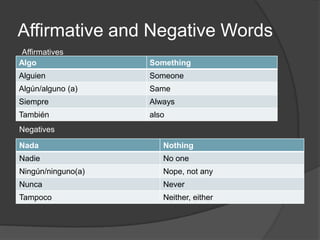
Affirmative and Negative Words
 Affirmatives
Algo                Something
Alguien             Someone
Algún/alguno (a)    Same
Siempre             Always
También             also
Negatives

Nada                   Nothing
Nadie                  No one
Ningún/ninguno(a)      Nope, not any
Nunca                  Never
Tampoco                Neither, either
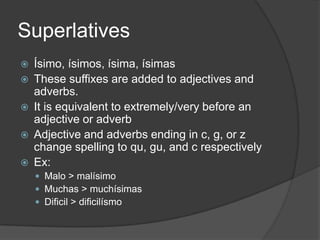
Superlatives
   Ísimo, ísimos, ísima, ísimas
   These suffixes are added to adjectives and
    adverbs.
   It is equivalent to extremely/very before an
    adjective or adverb
   Adjective and adverbs ending in c, g, or z
    change spelling to qu, gu, and c respectively
   Ex:
     Malo > malísimo
     Muchas > muchísimas
     Dificil > dificilísmo
Reflexives
   Reflexive pronouns are used with
    reflective verbs to indicate that the
    subject of the sentence recieves the
    action of the verb.        Me         Nos
                                              Te                  Os
                                              Se                  Se

    Many verbs can be used with or without reflexive pronouns. When
    there is no reflexive pronoun, the person doing the action does not
    receive the action.Reflexive

                          Papa se lava
                       Papa washes himself.
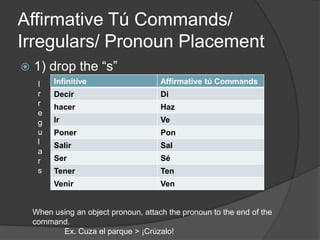
Affirmative Tú Commands/
Irregulars/ Pronoun Placement
   1) drop the “s”
     I   Infinitive                    Affirmative tú Commands
     r   Decir                         Di
     r   hacer                         Haz
     e
     g   Ir                            Ve
     u   Poner                         Pon
     l   Salir                         Sal
     a
     r   Ser                           Sé
     s   Tener                         Ten
         Venir                         Ven


    When using an object pronoun, attach the pronoun to the end of the
    command.
           Ex. Cuza el parque > ¡Crúzalo!
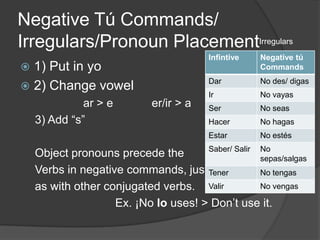
Negative Tú Commands/
Irregulars/Pronoun PlacementIrregulars
                                         Infintive   Negative tú
 1) Put in yo                                       Commands
                                         Dar         No des/ digas
 2) Change vowel
                                         Ir          No vayas
              ar > e         er/ir > a   Ser         No seas
    3) Add “s”                           Hacer       No hagas
                                         Estar       No estés
                                      Saber/ Salir No
    Object pronouns precede the                    sepas/salgas
    Verbs in negative commands, just Tener         No tengas
    as with other conjugated verbs. Valir          No vengas

                    Ex. ¡No lo uses! > Don’t use it.
Sequencing Events
Primero            Entonces       Luego/         Por fin
                                  Después
First              Then           Later/ after   finally

          Antes de/ después de
          Before/ After

          Por la manaña/ tarde/ noche
          In/ during the…
               (NO SPECIFIC TIME GIVEN)

        Los lunes, etc.
        On Monday…

Grammar Book

  • 1.
  • 2.
    Table of Contents 1.Nationalities 2. Stem Changing Verbs 3. Para 4. Indirect Object Pronouns 5. Pronoun Placement 6. Gustar 7.Affirmative/Negative Words 8. Superlatives 9. Reflexives 10. Affirmative Tú Commands/ Irregulars/ Pronoun Placement 11. Negative Tú Commands/ Irregulars/ Pronoun Placement 12. Sequencing Events
  • 3.
  • 4.
    Stem Changers O-UE E-I E-IE U-UE
  • 5.
    Para  Use para (for, in order to) to indicate: the recipient of items ….el regalo para tú mamá purpose Vamos al restaurante para comer. implied purpose Tengo dinero para (comprar) algo.
  • 6.
    IOP  Indirect objectsare nouns that tell to whom/what or for whom/what. IOPs replace or accompany indirect objects.  Notice that indirect object pronouns use the same words as direct object pronouns except for le and les. Singular Plural Me Nos (me) (us) Te Os (you familiar) (you familiar) Le Les (you formal), him or her (you, them)
  • 7.
    Object Pronoun Placement 1. attach the pronoun to the infinitive.  2. attach the pronoun to a progressive tense  3. attach the pronoun to an affirmative command  4. place the pronoun before a conjugated verb.
  • 8.
    Gustar Me Nos Te Os Le Les • No goes before conjugated verb. • The indirect object pronoun and gustar are “married.” They always stay together in the sentence. • They refer back. • A mi/ a ti is used for emphasis.
  • 9.
    Affirmative and NegativeWords Affirmatives Algo Something Alguien Someone Algún/alguno (a) Same Siempre Always También also Negatives Nada Nothing Nadie No one Ningún/ninguno(a) Nope, not any Nunca Never Tampoco Neither, either
  • 10.
    Superlatives  Ísimo, ísimos, ísima, ísimas  These suffixes are added to adjectives and adverbs.  It is equivalent to extremely/very before an adjective or adverb  Adjective and adverbs ending in c, g, or z change spelling to qu, gu, and c respectively  Ex:  Malo > malísimo  Muchas > muchísimas  Dificil > dificilísmo
  • 11.
    Reflexives  Reflexive pronouns are used with reflective verbs to indicate that the subject of the sentence recieves the action of the verb. Me Nos Te Os Se Se Many verbs can be used with or without reflexive pronouns. When there is no reflexive pronoun, the person doing the action does not receive the action.Reflexive Papa se lava Papa washes himself.
  • 12.
    Affirmative Tú Commands/ Irregulars/Pronoun Placement  1) drop the “s” I Infinitive Affirmative tú Commands r Decir Di r hacer Haz e g Ir Ve u Poner Pon l Salir Sal a r Ser Sé s Tener Ten Venir Ven When using an object pronoun, attach the pronoun to the end of the command. Ex. Cuza el parque > ¡Crúzalo!
  • 13.
    Negative Tú Commands/ Irregulars/PronounPlacementIrregulars Infintive Negative tú  1) Put in yo Commands Dar No des/ digas  2) Change vowel Ir No vayas ar > e er/ir > a Ser No seas 3) Add “s” Hacer No hagas Estar No estés Saber/ Salir No Object pronouns precede the sepas/salgas Verbs in negative commands, just Tener No tengas as with other conjugated verbs. Valir No vengas Ex. ¡No lo uses! > Don’t use it.
  • 14.
    Sequencing Events Primero Entonces Luego/ Por fin Después First Then Later/ after finally Antes de/ después de Before/ After Por la manaña/ tarde/ noche In/ during the… (NO SPECIFIC TIME GIVEN) Los lunes, etc. On Monday…