Maria Lind
2nd period
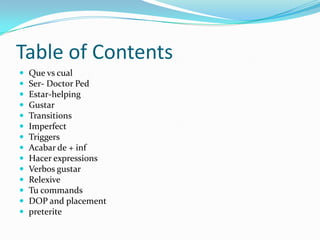
Table of Contents
   Que vs cual
   Ser- Doctor Ped
   Estar-helping
   Gustar
   Transitions
   Imperfect
   Triggers
   Acabar de + inf
   Hacer expressions
   Verbos gustar
   Relexive
   Tu commands
   DOP and placement
   preterite
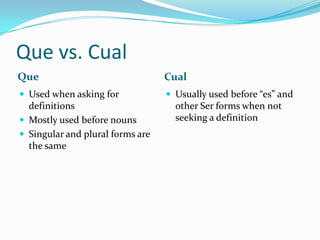
Que vs. Cual
Que                               Cual
 Used when asking for             Usually used before “es” and
  definitions                       other Ser forms when not
 Mostly used before nouns          seeking a definition
 Singular and plural forms are
  the same
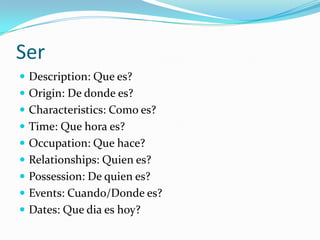
Ser
 Description: Que es?
 Origin: De donde es?
 Characteristics: Como es?
 Time: Que hora es?
 Occupation: Que hace?
 Relationships: Quien es?
 Possession: De quien es?
 Events: Cuando/Donde es?
 Dates: Que dia es hoy?
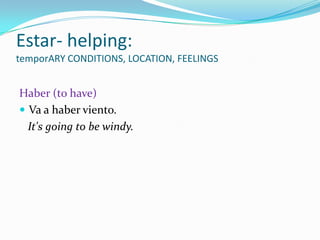
Estar- helping:
temporARY CONDITIONS, LOCATION, FEELINGS


Haber (to have)
 Va a haber viento.
  It's going to be windy.
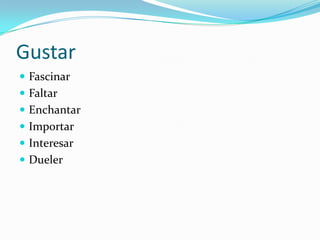
Gustar
 Fascinar
 Faltar
 Enchantar
 Importar
 Interesar
 Dueler
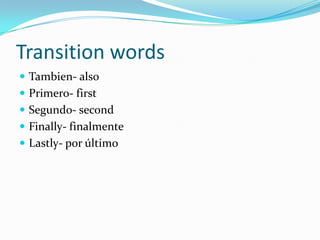
Transition words
 Tambien- also
 Primero- first
 Segundo- second
 Finally- finalmente
 Lastly- por último
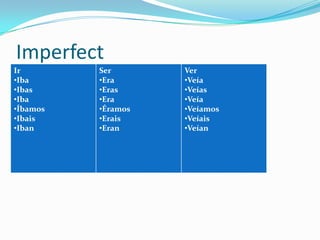
Imperfect
Ir        Ser       Ver
•Iba      •Era      •Veía
•Ibas     •Eras     •Veías
•Iba      •Era      •Veía
•Íbamos   •Éramos   •Veíamos
•Ibais    •Erais    •Veíais
•Iban     •Eran     •Veían
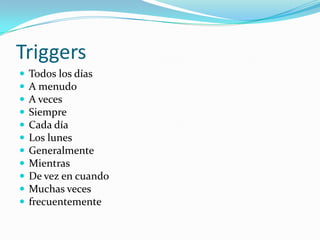
Triggers
   Todos los días
   A menudo
   A veces
   Siempre
   Cada día
   Los lunes
   Generalmente
   Mientras
   De vez en cuando
   Muchas veces
   frecuentemente
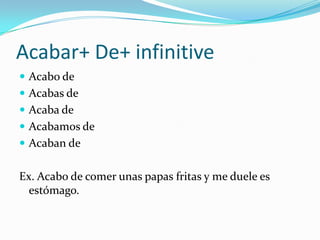
Acabar+ De+ infinitive
 Acabo de
 Acabas de
 Acaba de
 Acabamos de
 Acaban de


Ex. Acabo de comer unas papas fritas y me duele es
  estómago.
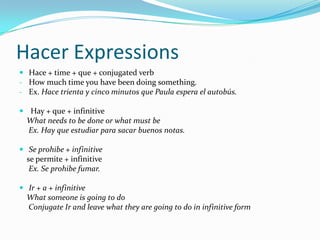
Hacer Expressions
 Hace + time + que + conjugated verb
- How much time you have been doing something.
- Ex. Hace trienta y cinco minutos que Paula espera el autobús.

 Hay + que + infinitive
 What needs to be done or what must be
  Ex. Hay que estudiar para sacar buenos notas.

 Se prohibe + infinitive
  se permite + infinitive
   Ex. Se prohibe fumar.

 Ir + a + infinitive
  What someone is going to do
  Conjugate Ir and leave what they are going to do in infinitive form
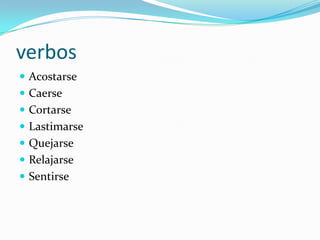
verbos
 Acostarse
 Caerse
 Cortarse
 Lastimarse
 Quejarse
 Relajarse
 Sentirse
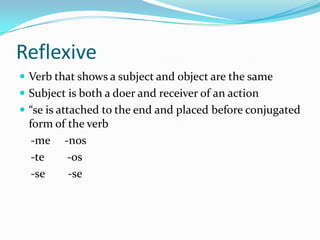
Reflexive
 Verb that shows a subject and object are the same
 Subject is both a doer and receiver of an action
 “se is attached to the end and placed before conjugated
  form of the verb
   -me -nos
   -te    -os
   -se    -se
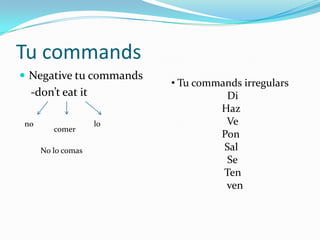
Tu commands
 Negative tu commands
                         • Tu commands irregulars
  -don’t eat it                     Di
                                  Haz
no                 lo              Ve
        comer
                                  Pon
     No lo comas                   Sal
                                    Se
                                   Ten
                                   ven
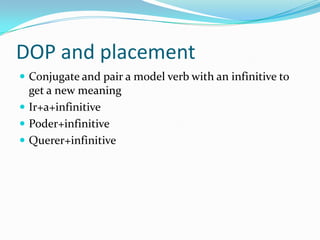
DOP and placement
 Conjugate and pair a model verb with an infinitive to
  get a new meaning
 Ir+a+infinitive
 Poder+infinitive
 Querer+infinitive
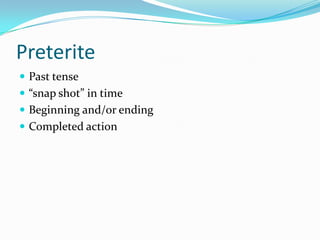
Preterite
 Past tense
 “snap shot” in time
 Beginning and/or ending
 Completed action

Grammar book final

  • 1.
  • 2.
    Table of Contents  Que vs cual  Ser- Doctor Ped  Estar-helping  Gustar  Transitions  Imperfect  Triggers  Acabar de + inf  Hacer expressions  Verbos gustar  Relexive  Tu commands  DOP and placement  preterite
  • 3.
    Que vs. Cual Que Cual  Used when asking for  Usually used before “es” and definitions other Ser forms when not  Mostly used before nouns seeking a definition  Singular and plural forms are the same
  • 4.
    Ser  Description: Quees?  Origin: De donde es?  Characteristics: Como es?  Time: Que hora es?  Occupation: Que hace?  Relationships: Quien es?  Possession: De quien es?  Events: Cuando/Donde es?  Dates: Que dia es hoy?
  • 5.
    Estar- helping: temporARY CONDITIONS,LOCATION, FEELINGS Haber (to have)  Va a haber viento. It's going to be windy.
  • 6.
    Gustar  Fascinar  Faltar Enchantar  Importar  Interesar  Dueler
  • 7.
    Transition words  Tambien-also  Primero- first  Segundo- second  Finally- finalmente  Lastly- por último
  • 8.
    Imperfect Ir Ser Ver •Iba •Era •Veía •Ibas •Eras •Veías •Iba •Era •Veía •Íbamos •Éramos •Veíamos •Ibais •Erais •Veíais •Iban •Eran •Veían
  • 9.
    Triggers  Todos los días  A menudo  A veces  Siempre  Cada día  Los lunes  Generalmente  Mientras  De vez en cuando  Muchas veces  frecuentemente
  • 10.
    Acabar+ De+ infinitive Acabo de  Acabas de  Acaba de  Acabamos de  Acaban de Ex. Acabo de comer unas papas fritas y me duele es estómago.
  • 11.
    Hacer Expressions  Hace+ time + que + conjugated verb - How much time you have been doing something. - Ex. Hace trienta y cinco minutos que Paula espera el autobús.  Hay + que + infinitive What needs to be done or what must be Ex. Hay que estudiar para sacar buenos notas.  Se prohibe + infinitive se permite + infinitive Ex. Se prohibe fumar.  Ir + a + infinitive What someone is going to do Conjugate Ir and leave what they are going to do in infinitive form
  • 12.
    verbos  Acostarse  Caerse Cortarse  Lastimarse  Quejarse  Relajarse  Sentirse
  • 13.
    Reflexive  Verb thatshows a subject and object are the same  Subject is both a doer and receiver of an action  “se is attached to the end and placed before conjugated form of the verb -me -nos -te -os -se -se
  • 14.
    Tu commands  Negativetu commands • Tu commands irregulars -don’t eat it Di Haz no lo Ve comer Pon No lo comas Sal Se Ten ven
  • 15.
    DOP and placement Conjugate and pair a model verb with an infinitive to get a new meaning  Ir+a+infinitive  Poder+infinitive  Querer+infinitive
  • 16.
    Preterite  Past tense “snap shot” in time  Beginning and/or ending  Completed action