Alicia Booth
  2nd period
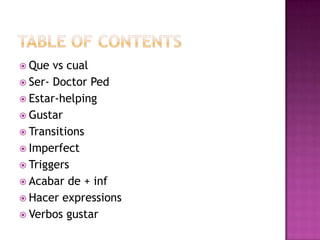
 Que  vs cual
 Ser- Doctor Ped
 Estar-helping
 Gustar
 Transitions
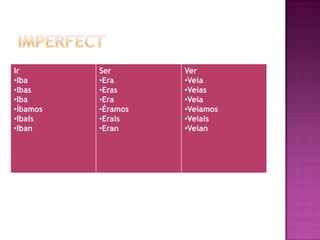
 Imperfect
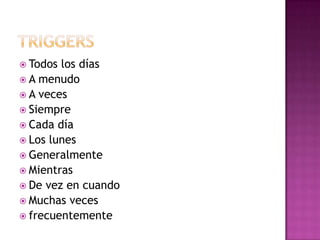
 Triggers
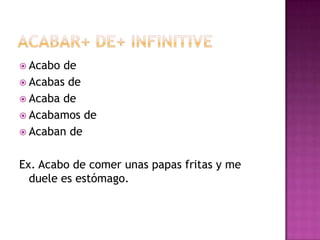
 Acabar de + inf
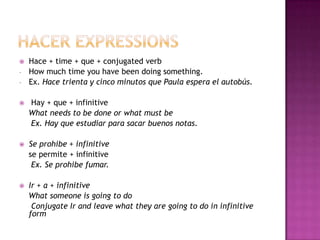
 Hacer expressions
 Verbos gustar
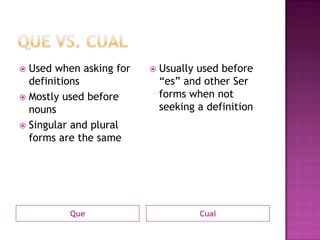
 Used when asking for      Usually used before
  definitions                “es” and other Ser
 Mostly used before         forms when not
  nouns                      seeking a definition
 Singular and plural
  forms are the same


          Que                        Cual
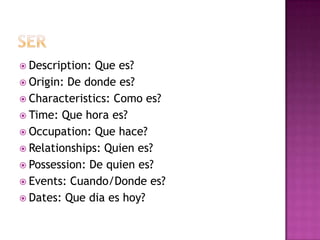
 Description: Que es?
 Origin: De donde es?
 Characteristics: Como es?
 Time: Que hora es?
 Occupation: Que hace?
 Relationships: Quien es?
 Possession: De quien es?
 Events: Cuando/Donde es?
 Dates: Que dia es hoy?
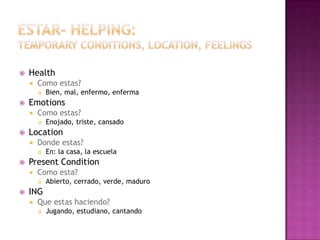
   Health
       Como estas?
           Bien, mal, enfermo, enferma
   Emotions
       Como estas?
           Enojado, triste, cansado
   Location
       Donde estas?
           En: la casa, la escuela
   Present Condition
       Como esta?
           Abierto, cerrado, verde, maduro
   ING
       Que estas haciendo?
           Jugando, estudiano, cantando
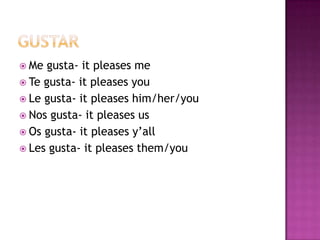
 Me  gusta- it pleases me
 Te gusta- it pleases you
 Le gusta- it pleases him/her/you
 Nos gusta- it pleases us
 Os gusta- it pleases y’all
 Les gusta- it pleases them/you
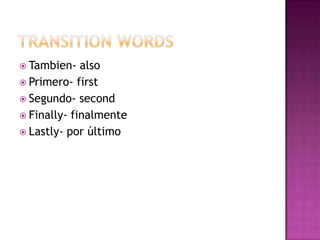
 Tambien-   also
 Primero- first
 Segundo- second
 Finally- finalmente
 Lastly- por último
Ir        Ser       Ver
•Iba      •Era      •Veía
•Ibas     •Eras     •Veías
•Iba      •Era      •Veía
•Íbamos   •Éramos   •Veíamos
•Ibais    •Erais    •Veíais
•Iban     •Eran     •Veían
 Todos los días
 A menudo
 A veces
 Siempre
 Cada día
 Los lunes
 Generalmente
 Mientras
 De vez en cuando
 Muchas veces
 frecuentemente
 Acabo de
 Acabas de
 Acaba de
 Acabamos de
 Acaban de


Ex. Acabo de comer unas papas fritas y me
  duele es estómago.
   Hace + time + que + conjugated verb
-   How much time you have been doing something.
-   Ex. Hace trienta y cinco minutos que Paula espera el autobús.

   Hay + que + infinitive
    What needs to be done or what must be
    Ex. Hay que estudiar para sacar buenos notas.

   Se prohibe + infinitive
    se permite + infinitive
     Ex. Se prohibe fumar.

   Ir + a + infinitive
    What someone is going to do
     Conjugate Ir and leave what they are going to do in infinitive
    form
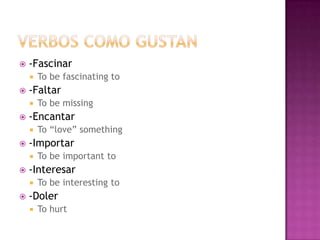
   -Fascinar
       To be fascinating to
   -Faltar
       To be missing
   -Encantar
       To “love” something
   -Importar
       To be important to
   -Interesar
       To be interesting to
   -Doler
       To hurt

Grammar book[1][1]

  • 1.
    Alicia Booth 2nd period
  • 2.
     Que vs cual  Ser- Doctor Ped  Estar-helping  Gustar  Transitions  Imperfect  Triggers  Acabar de + inf  Hacer expressions  Verbos gustar
  • 3.
     Used whenasking for  Usually used before definitions “es” and other Ser  Mostly used before forms when not nouns seeking a definition  Singular and plural forms are the same Que Cual
  • 4.
     Description: Quees?  Origin: De donde es?  Characteristics: Como es?  Time: Que hora es?  Occupation: Que hace?  Relationships: Quien es?  Possession: De quien es?  Events: Cuando/Donde es?  Dates: Que dia es hoy?
  • 5.
    Health  Como estas?  Bien, mal, enfermo, enferma  Emotions  Como estas?  Enojado, triste, cansado  Location  Donde estas?  En: la casa, la escuela  Present Condition  Como esta?  Abierto, cerrado, verde, maduro  ING  Que estas haciendo?  Jugando, estudiano, cantando
  • 6.
     Me gusta- it pleases me  Te gusta- it pleases you  Le gusta- it pleases him/her/you  Nos gusta- it pleases us  Os gusta- it pleases y’all  Les gusta- it pleases them/you
  • 7.
     Tambien- also  Primero- first  Segundo- second  Finally- finalmente  Lastly- por último
  • 8.
    Ir Ser Ver •Iba •Era •Veía •Ibas •Eras •Veías •Iba •Era •Veía •Íbamos •Éramos •Veíamos •Ibais •Erais •Veíais •Iban •Eran •Veían
  • 9.
     Todos losdías  A menudo  A veces  Siempre  Cada día  Los lunes  Generalmente  Mientras  De vez en cuando  Muchas veces  frecuentemente
  • 10.
     Acabo de Acabas de  Acaba de  Acabamos de  Acaban de Ex. Acabo de comer unas papas fritas y me duele es estómago.
  • 11.
    Hace + time + que + conjugated verb - How much time you have been doing something. - Ex. Hace trienta y cinco minutos que Paula espera el autobús.  Hay + que + infinitive What needs to be done or what must be Ex. Hay que estudiar para sacar buenos notas.  Se prohibe + infinitive se permite + infinitive Ex. Se prohibe fumar.  Ir + a + infinitive What someone is going to do Conjugate Ir and leave what they are going to do in infinitive form
  • 12.
    -Fascinar  To be fascinating to  -Faltar  To be missing  -Encantar  To “love” something  -Importar  To be important to  -Interesar  To be interesting to  -Doler  To hurt