Grammar Book

    By: Brenda Armistead
Table of Contents
 1 – nationalities
 2 stem changer
 3- Para
 4- IOP
 5- Pronoun Placement
 6-Gustar
 7- Affirmative and Negative words
 8- Superlatives
 9- Reflexives
 10- Affirmative tu commands + irregulars + pronoun
 placement
 11- Negative tu commands + irregulars +pronoun placement
 12- sequencing words
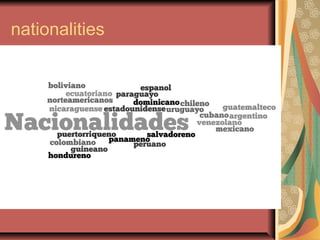
nationalities
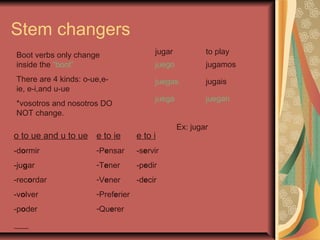
Stem changers
Boot verbs only change                  jugar           to play
inside the “boot”                       juego           jugamos
There are 4 kinds: o-ue,e-              juegas          jugais
ie, e-i,and u-ue
                                        juega           juegan
*vosotros and nosotros DO
NOT change.
                                                Ex: jugar
o to ue and u to ue e to ie        e to i
-dormir               -Pensar      -servir
-jugar                -Tener       -pedir
-recordar             -Vener       -decir
-volver               -Preferier
-poder                -Querer
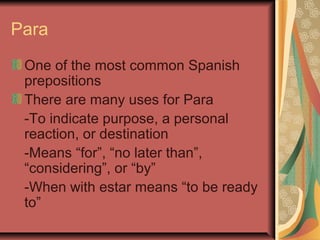
Para
 One of the most common Spanish
 prepositions
 There are many uses for Para
 -To indicate purpose, a personal
 reaction, or destination
 -Means “for”, “no later than”,
 “considering”, or “by”
 -When with estar means “to be ready
 to”
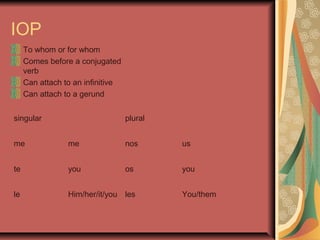
IOP
     To whom or for whom
     Comes before a conjugated
     verb
     Can attach to an infinitive
     Can attach to a gerund


singular                           plural


me               me                nos      us


te               you               os       you


le               Him/her/it/you les         You/them
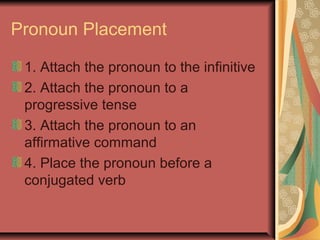
Pronoun Placement

 1. Attach the pronoun to the infinitive
 2. Attach the pronoun to a
 progressive tense
 3. Attach the pronoun to an
 affirmative command
 4. Place the pronoun before a
 conjugated verb
Gustar to like or to please
                                                  To say you do
me nos                                              NOT like
                     A mi- me gusta              something, you
te    os             A ti- te gusta
                                                put a NO before
                                               the me,te, le, nos,
                     A usted/el/ella- le gusta      os, or les.
le    se
                      A Nosotros – nos gusta
                     A ustedes/ellas/ellos- les gusta

     Plural:
     Use the plural form when the object following gustar
     is also plural.
     Ex. Me gustan los bibligrafas.
     Singular:
     The singular forms of gustar are used when the
     object that follows is singular.
     Ex. Me gusta el boligrafa
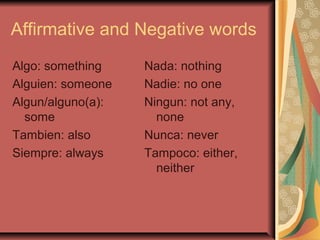
Affirmative and Negative words
Algo: something    Nada: nothing
Alguien: someone   Nadie: no one
Algun/alguno(a):   Ningun: not any,
  some               none
Tambien: also      Nunca: never
Siempre: always    Tampoco: either,
                     neither
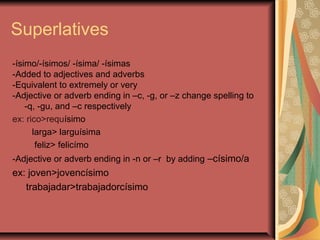
Superlatives
-ísimo/-ísimos/ -ísima/ -ísimas
-Added to adjectives and adverbs
-Equivalent to extremely or very
-Adjective or adverb ending in –c, -g, or –z change spelling to
    -q, -gu, and –c respectively
ex: rico>requísimo
      larga> larguísima
       feliz> felicímo
-Adjective or adverb ending in -n or –r by adding –císimo/a
ex: joven>jovencísimo
   trabajadar>trabajadorcísimo
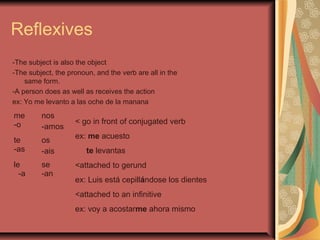
Reflexives
-The subject is also the object
-The subject, the pronoun, and the verb are all in the
    same form.
-A person does as well as receives the action
ex: Yo me levanto a las oche de la manana
me       nos
-o                  < go in front of conjugated verb
         -amos
                    ex: me acuesto
te       os
-as      -ais           te levantas
le       se         <attached to gerund
  -a     -an
                    ex: Luis está cepillándose los dientes
                    <attached to an infinitive
                    ex: voy a acostarme ahora mismo
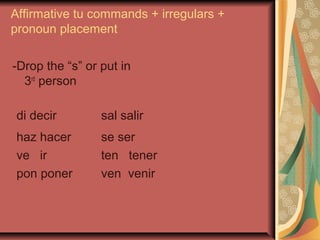
Affirmative tu commands + irregulars +
pronoun placement

-Drop the “s” or put in
  3rd person

 di decir        sal salir
 haz hacer       se ser
 ve ir           ten tener
 pon poner       ven venir
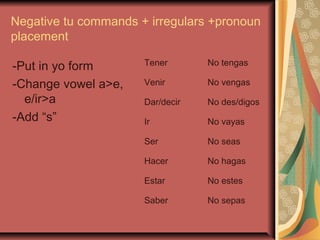
Negative tu commands + irregulars +pronoun
placement

-Put in yo form       Tener       No tengas

-Change vowel a>e,    Venir       No vengas
  e/ir>a              Dar/decir   No des/digos
-Add “s”              Ir          No vayas

                      Ser         No seas

                      Hacer       No hagas

                      Estar       No estes

                      Saber       No sepas
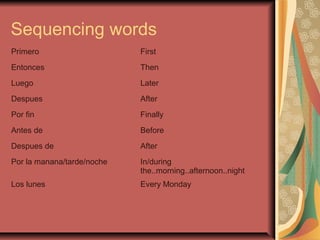
Sequencing words
Primero                     First
Entonces                    Then
Luego                       Later
Despues                     After
Por fin                     Finally
Antes de                    Before
Despues de                  After
Por la manana/tarde/noche   In/during
                            the..morning..afternoon..night
Los lunes                   Every Monday

Grammer book brenda armistead

  • 1.
    Grammar Book By: Brenda Armistead
  • 2.
    Table of Contents 1 – nationalities 2 stem changer 3- Para 4- IOP 5- Pronoun Placement 6-Gustar 7- Affirmative and Negative words 8- Superlatives 9- Reflexives 10- Affirmative tu commands + irregulars + pronoun placement 11- Negative tu commands + irregulars +pronoun placement 12- sequencing words
  • 3.
  • 4.
    Stem changers Boot verbsonly change jugar to play inside the “boot” juego jugamos There are 4 kinds: o-ue,e- juegas jugais ie, e-i,and u-ue juega juegan *vosotros and nosotros DO NOT change. Ex: jugar o to ue and u to ue e to ie e to i -dormir -Pensar -servir -jugar -Tener -pedir -recordar -Vener -decir -volver -Preferier -poder -Querer
  • 5.
    Para One ofthe most common Spanish prepositions There are many uses for Para -To indicate purpose, a personal reaction, or destination -Means “for”, “no later than”, “considering”, or “by” -When with estar means “to be ready to”
  • 6.
    IOP To whom or for whom Comes before a conjugated verb Can attach to an infinitive Can attach to a gerund singular plural me me nos us te you os you le Him/her/it/you les You/them
  • 7.
    Pronoun Placement 1.Attach the pronoun to the infinitive 2. Attach the pronoun to a progressive tense 3. Attach the pronoun to an affirmative command 4. Place the pronoun before a conjugated verb
  • 8.
    Gustar to likeor to please To say you do me nos NOT like A mi- me gusta something, you te os A ti- te gusta put a NO before the me,te, le, nos, A usted/el/ella- le gusta os, or les. le se A Nosotros – nos gusta A ustedes/ellas/ellos- les gusta Plural: Use the plural form when the object following gustar is also plural. Ex. Me gustan los bibligrafas. Singular: The singular forms of gustar are used when the object that follows is singular. Ex. Me gusta el boligrafa
  • 9.
    Affirmative and Negativewords Algo: something Nada: nothing Alguien: someone Nadie: no one Algun/alguno(a): Ningun: not any, some none Tambien: also Nunca: never Siempre: always Tampoco: either, neither
  • 10.
    Superlatives -ísimo/-ísimos/ -ísima/ -ísimas -Addedto adjectives and adverbs -Equivalent to extremely or very -Adjective or adverb ending in –c, -g, or –z change spelling to -q, -gu, and –c respectively ex: rico>requísimo larga> larguísima feliz> felicímo -Adjective or adverb ending in -n or –r by adding –císimo/a ex: joven>jovencísimo trabajadar>trabajadorcísimo
  • 11.
    Reflexives -The subject isalso the object -The subject, the pronoun, and the verb are all in the same form. -A person does as well as receives the action ex: Yo me levanto a las oche de la manana me nos -o < go in front of conjugated verb -amos ex: me acuesto te os -as -ais te levantas le se <attached to gerund -a -an ex: Luis está cepillándose los dientes <attached to an infinitive ex: voy a acostarme ahora mismo
  • 12.
    Affirmative tu commands+ irregulars + pronoun placement -Drop the “s” or put in 3rd person di decir sal salir haz hacer se ser ve ir ten tener pon poner ven venir
  • 13.
    Negative tu commands+ irregulars +pronoun placement -Put in yo form Tener No tengas -Change vowel a>e, Venir No vengas e/ir>a Dar/decir No des/digos -Add “s” Ir No vayas Ser No seas Hacer No hagas Estar No estes Saber No sepas
  • 14.
    Sequencing words Primero First Entonces Then Luego Later Despues After Por fin Finally Antes de Before Despues de After Por la manana/tarde/noche In/during the..morning..afternoon..night Los lunes Every Monday