Grammar Book

 Ashley Carson
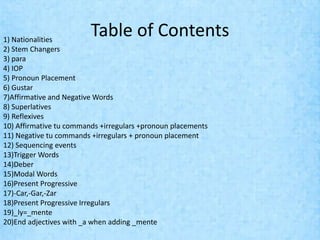
1) Nationalities
                         Table of Contents
2) Stem Changers
3) para
4) IOP
5) Pronoun Placement
6) Gustar
7)Affirmative and Negative Words
8) Superlatives
9) Reflexives
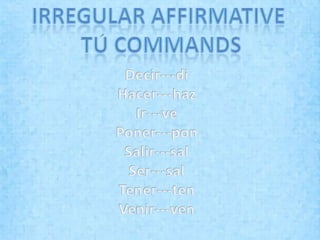
10) Affirmative tu commands +irregulars +pronoun placements
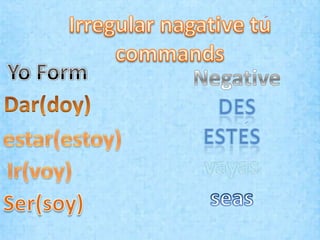
11) Negative tu commands +irregulars + pronoun placement
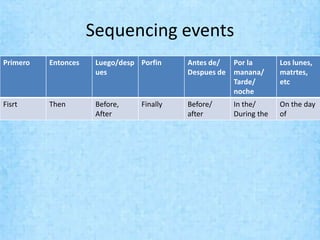
12) Sequencing events
13)Trigger Words
14)Deber
15)Modal Words
16)Present Progressive
17)-Car,-Gar,-Zar
18)Present Progressive Irregulars
19)_ly=_mente
20)End adjectives with _a when adding _mente
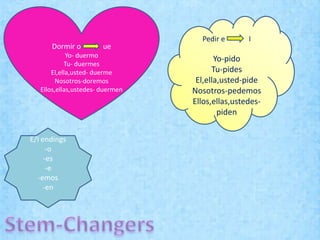
Pedir e       I
      Dormir o          ue
             Yo- duermo
                                         Yo-pido
            Tu- duermes
       El,ella,usted- duerme            Tu-pides
        Nosotros-doremos           El,ella,usted-pide
   Ellos,ellas,ustedes- duermen   Nosotros-pedemos
                                  Ellos,ellas,ustedes-
                                          piden


E/I endings
      -o
     -es
      -e
  -emos
    -en
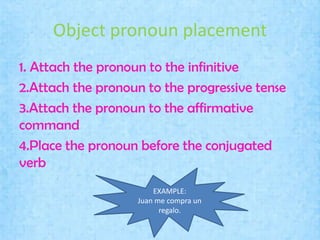
Object pronoun placement
1. Attach the pronoun to the infinitive
2.Attach the pronoun to the progressive tense
3.Attach the pronoun to the affirmative
command
4.Place the pronoun before the conjugated
verb
                        EXAMPLE:
                    Juan me compra un
                          regalo.
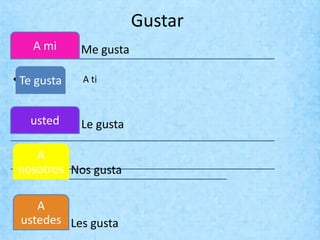
Gustar
    A mi     Me gusta

• Te gusta   A ti


   usted     Le gusta

    A
 nosotros Nos gusta

    A
 ustedes Les gusta
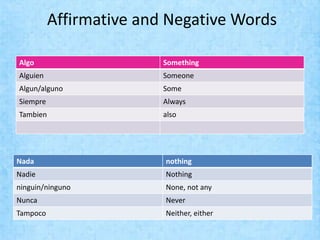
Affirmative and Negative Words

Algo                     Something
Alguien                  Someone
Algun/alguno             Some
Siempre                  Always
Tambien                  also


Nada                     nothing
Nadie                    Nothing
ninguin/ninguno          None, not any
Nunca                    Never
Tampoco                  Neither, either
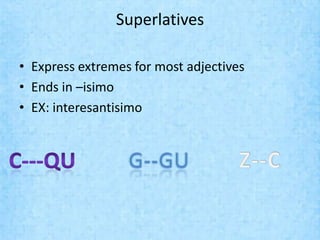
Superlatives

• Express extremes for most adjectives
• Ends in –isimo
• EX: interesantisimo
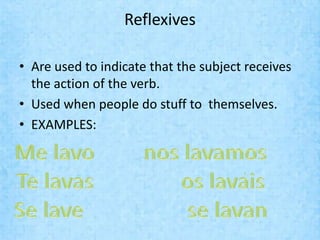
Reflexives

• Are used to indicate that the subject receives
  the action of the verb.
• Used when people do stuff to themselves.
• EXAMPLES:
Sequencing events
Primero   Entonces    Luego/desp Porfin    Antes de/    Por la       Los lunes,
                      ues                  Despues de   manana/      matrtes,
                                                        Tarde/       etc
                                                        noche
Fisrt     Then        Before,    Finally   Before/      In the/      On the day
                      After                after        During the   of
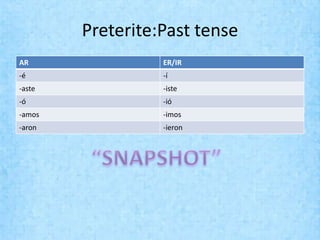
Preterite:Past tense
AR                ER/IR
-é                -í
-aste             -iste
-ó                -ió
-amos             -imos
-aron             -ieron
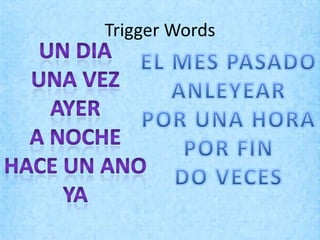
Trigger Words
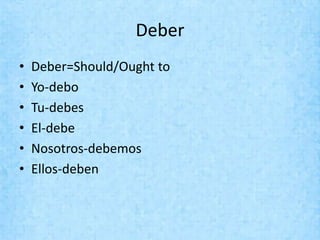
Deber
•   Deber=Should/Ought to
•   Yo-debo
•   Tu-debes
•   El-debe
•   Nosotros-debemos
•   Ellos-deben
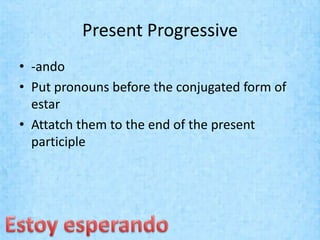
Present Progressive
• -ando
• Put pronouns before the conjugated form of
  estar
• Attatch them to the end of the present
  participle
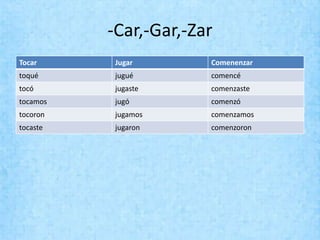
-Car,-Gar,-Zar
Tocar      Jugar       Comenenzar
toqué      jugué       comencé
tocó       jugaste     comenzaste
tocamos    jugó        comenzó
tocoron    jugamos     comenzamos
tocaste    jugaron     comenzoron
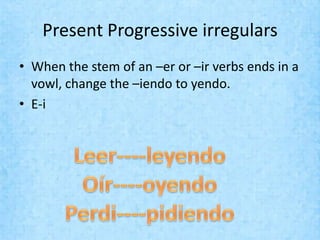
Present Progressive irregulars
• When the stem of an –er or –ir verbs ends in a
  vowl, change the –iendo to yendo.
• E-i
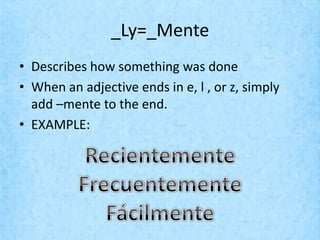
_Ly=_Mente
• Describes how something was done
• When an adjective ends in e, l , or z, simply
  add –mente to the end.
• EXAMPLE:
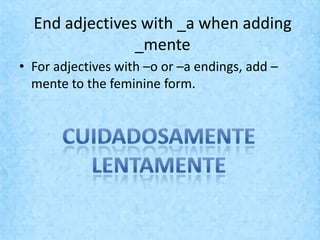
End adjectives with _a when adding
                _mente
• For adjectives with –o or –a endings, add –
  mente to the feminine form.

Grammarbook

  • 1.
  • 2.
    1) Nationalities Table of Contents 2) Stem Changers 3) para 4) IOP 5) Pronoun Placement 6) Gustar 7)Affirmative and Negative Words 8) Superlatives 9) Reflexives 10) Affirmative tu commands +irregulars +pronoun placements 11) Negative tu commands +irregulars + pronoun placement 12) Sequencing events 13)Trigger Words 14)Deber 15)Modal Words 16)Present Progressive 17)-Car,-Gar,-Zar 18)Present Progressive Irregulars 19)_ly=_mente 20)End adjectives with _a when adding _mente
  • 4.
    Pedir e I Dormir o ue Yo- duermo Yo-pido Tu- duermes El,ella,usted- duerme Tu-pides Nosotros-doremos El,ella,usted-pide Ellos,ellas,ustedes- duermen Nosotros-pedemos Ellos,ellas,ustedes- piden E/I endings -o -es -e -emos -en
  • 7.
    Object pronoun placement 1.Attach the pronoun to the infinitive 2.Attach the pronoun to the progressive tense 3.Attach the pronoun to the affirmative command 4.Place the pronoun before the conjugated verb EXAMPLE: Juan me compra un regalo.
  • 8.
    Gustar A mi Me gusta • Te gusta A ti usted Le gusta A nosotros Nos gusta A ustedes Les gusta
  • 9.
    Affirmative and NegativeWords Algo Something Alguien Someone Algun/alguno Some Siempre Always Tambien also Nada nothing Nadie Nothing ninguin/ninguno None, not any Nunca Never Tampoco Neither, either
  • 10.
    Superlatives • Express extremesfor most adjectives • Ends in –isimo • EX: interesantisimo
  • 11.
    Reflexives • Are usedto indicate that the subject receives the action of the verb. • Used when people do stuff to themselves. • EXAMPLES:
  • 14.
    Sequencing events Primero Entonces Luego/desp Porfin Antes de/ Por la Los lunes, ues Despues de manana/ matrtes, Tarde/ etc noche Fisrt Then Before, Finally Before/ In the/ On the day After after During the of
  • 15.
    Preterite:Past tense AR ER/IR -é -í -aste -iste -ó -ió -amos -imos -aron -ieron
  • 16.
  • 17.
    Deber • Deber=Should/Ought to • Yo-debo • Tu-debes • El-debe • Nosotros-debemos • Ellos-deben
  • 19.
    Present Progressive • -ando •Put pronouns before the conjugated form of estar • Attatch them to the end of the present participle
  • 20.
    -Car,-Gar,-Zar Tocar Jugar Comenenzar toqué jugué comencé tocó jugaste comenzaste tocamos jugó comenzó tocoron jugamos comenzamos tocaste jugaron comenzoron
  • 21.
    Present Progressive irregulars •When the stem of an –er or –ir verbs ends in a vowl, change the –iendo to yendo. • E-i
  • 22.
    _Ly=_Mente • Describes howsomething was done • When an adjective ends in e, l , or z, simply add –mente to the end. • EXAMPLE:
  • 23.
    End adjectives with_a when adding _mente • For adjectives with –o or –a endings, add – mente to the feminine form.