Presented By:- Mehreen Hameed
BS Botany 5th semester
Roll no Bot-15-21
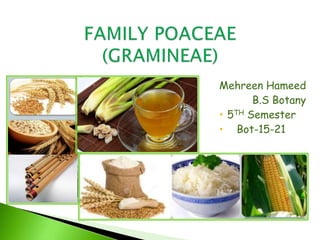
Mehreen Hameed
B.S Botany
 5TH Semester
 Bot-15-21
 The Poaceae name was given by John
Hendley Barnhart in 1895, based on the
tribe Poeae (described in 1814 by Robert
Brown), and the type genus Poa (described
in 1753 by Linnaeus).
 The term is derived from the Ancient Greek
πόα (póa, “Grass”).
 Formerly known as Gramineae
 Usually called grass family
 Has 12 subfamilies, about 525 genera, and
10,000 or more species
 In Pakistan family is represented by 158
genera and 492 species
 Includes the cereal grasses, bamboos and the
grasses of natural grassland and cultivated
lawns (turf) and pasture.
 All the cereal crops and about 75% of the
species used as forages are grasses
 Division: Phanerogams
 SUB-Division: Angiosperms
 Class: Monocotyledons
 Sub-Class: Commelinidae
 Series: Glumaceae
 Order: Poales
 Family: Poaceae (Gramineae)
 Cosmopolitan
 5th largest plant family, following the
Asteraceae, Orchidaceae, Fabaceae and
Rubiaceae
 2nd largest among monocotyledons
 Cereals and Grasses (25% of vegetation)
 Grasslands such as savannah and prairie
where grasses are dominant are estimated
to constitute 40.5% of the land area of the
Earth
 Habit.
Mainly herbs [annuals (Oryza) or perennials
(Sacharum)] or shrubs, rarely trees like
(Bambusa, Dendrocalamus).
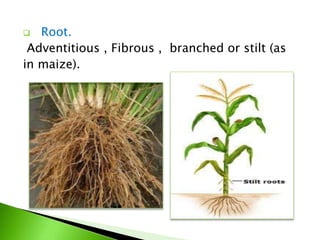
 Root.
Adventitious , Fibrous , branched or stilt (as
in maize).
 Stem
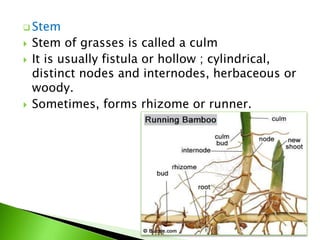
 Stem of grasses is called a culm
 It is usually fistula or hollow ; cylindrical,
distinct nodes and internodes, herbaceous or
woody.
 Sometimes, forms rhizome or runner.
 Leaf
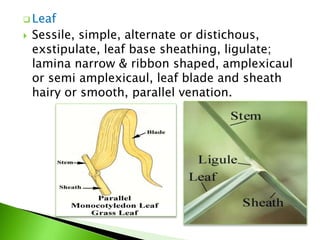
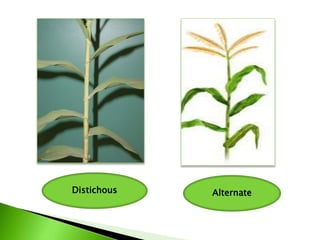
 Sessile, simple, alternate or distichous,
exstipulate, leaf base sheathing, ligulate;
lamina narrow & ribbon shaped, amplexicaul
or semi amplexicaul, leaf blade and sheath
hairy or smooth, parallel venation.
Distichous Alternate
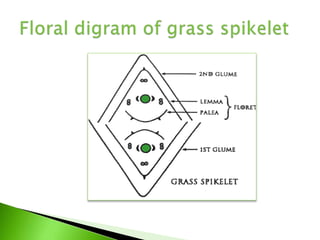
 Inflorescence
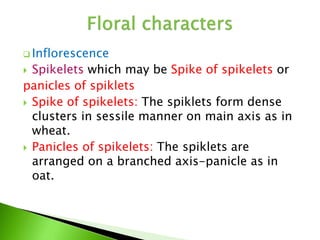
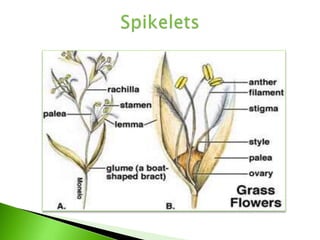
 Spikelets which may be Spike of spikelets or
panicles of spiklets
 Spike of spikelets: The spiklets form dense
clusters in sessile manner on main axis as in
wheat.
 Panicles of spikelets: The spiklets are
arranged on a branched axis-panicle as in
oat.
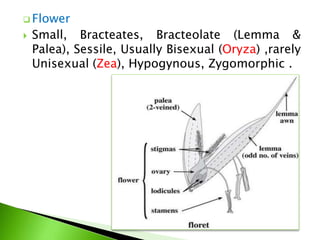
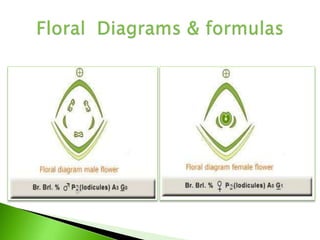
 Flower
 Small, Bracteates, Bracteolate (Lemma &
Palea), Sessile, Usually Bisexual (Oryza) ,rarely
Unisexual (Zea), Hypogynous, Zygomorphic .
 Perianth:
 Absent or sometime 2 or 3 scale like lodicules
are present; free, valvate
 Androecium
 stamens are usually 3, but in Bambusa and
Oryza stamens are 6 , arranged in 2 whorls of
3, numerous in Pariana; polyandrous
 Anthers are dithecous , versatile, introse;
dehiscence longitudinally
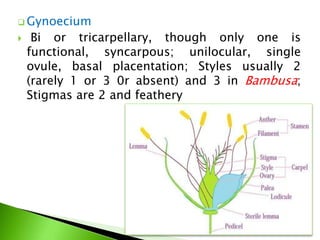
 Gynoecium
 Bi or tricarpellary, though only one is
functional, syncarpous; unilocular, single
ovule, basal placentation; Styles usually 2
(rarely 1 or 3 0r absent) and 3 in Bambusa;
Stigmas are 2 and feathery
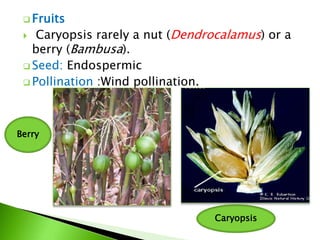
 Fruits
 Caryopsis rarely a nut (Dendrocalamus) or a
berry (Bambusa).
 Seed: Endospermic
 Pollination :Wind pollination.
Berry
Caryopsis
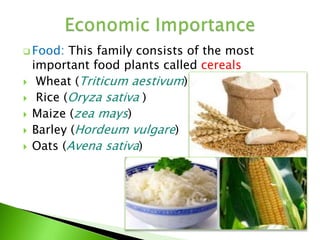
 Food: This family consists of the most
important food plants called cereals
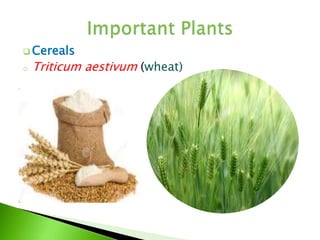
 Wheat (Triticum aestivum)
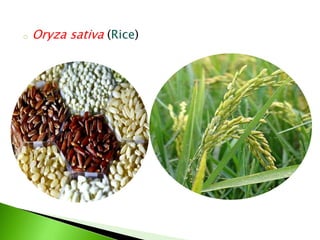
 Rice (Oryza sativa )
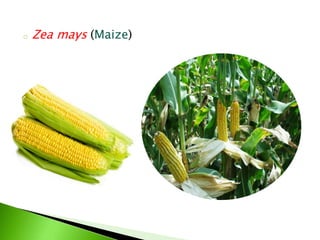
 Maize (zea mays)
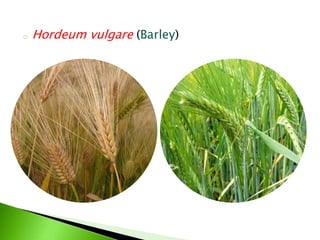
 Barley (Hordeum vulgare)
 Oats (Avena sativa)
 Use as food of animals, e.g fodder for cattle
and sheeps etc
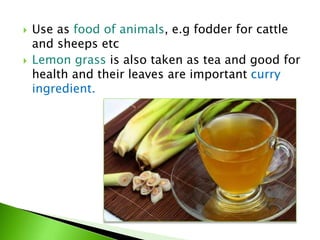
 Lemon grass is also taken as tea and good for
health and their leaves are important curry
ingredient.
 Industrial uses:
 Manufacturing of paper (Bambusa and
dendrocalamus)
 Sugar is obtanied
 Biofuel production
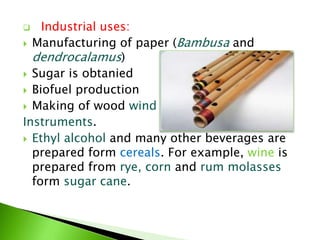
 Making of wood wind
Instruments.
 Ethyl alcohol and many other beverages are
prepared form cereals. For example, wine is
prepared from rye, corn and rum molasses
form sugar cane.
 Medicinal
 Roots of Vetiveria zizanioides are medicinal
and give a pleasant scent.
 Bambusa leaves are given to horses for
curing cough and cold.
 Setaria italica is diuretic.
 Valuable perfumery oils are obtained from
Cymbopogon citratus (lemon grass) and
Andropogon odonatus (ginger grass)
 Ornamental : Cynodon (Bermuda grass) ,
Agrostis (florin grass) , Poa (meadow grass)
and Festuca (festuca grass) are grown in
lawns.
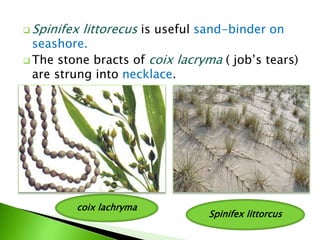
 Spinifex littorecus is useful sand-binder on
seashore.
 The stone bracts of coix lacryma ( job’s tears)
are strung into necklace.
Spinifex littorcus
coix lachryma
 Cereals
o Triticum aestivum (wheat)
o Hordeum vulgare (Barley)
o Zea mays (Maize)
o Oryza sativa (Rice)
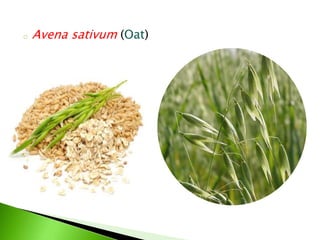
o Avena sativum (Oat)
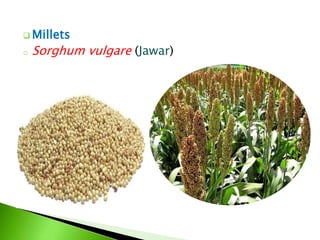
 Millets
o Sorghum vulgare (Jawar)
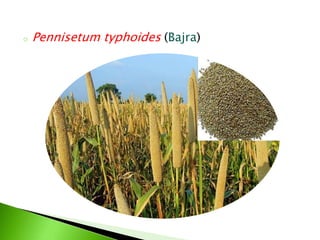
o Pennisetum typhoides (Bajra)
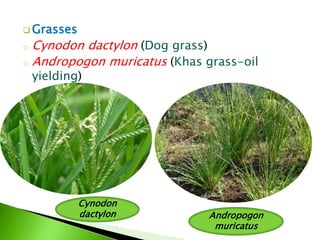
 Grasses
o Cynodon dactylon (Dog grass)
o Andropogon muricatus (Khas grass-oil
yielding)
Andropogon
muricatus
Cynodon
dactylon
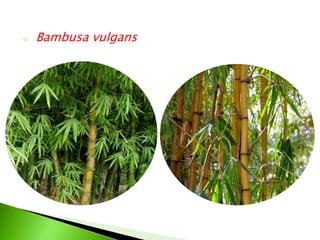
o Bambusa vulgans
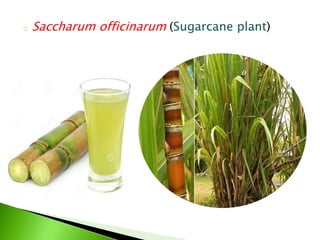
o Saccharum officinarum (Sugarcane plant)
 Mostly annual herbs with fistular stem
 Leaves distichous with sheathing bases and
ligule
 Inflorescence unit is a spikelet
 Perianth is reduced to lodicules or even
absent
 Anthers are versatile
 Stigma are feathery
 Fruit is caryopsis
 Herbaceous , annual or perennial habit
 Exstipulate leaves with sheathing bases and
ligules
 Flowers arranged in distinct inflorescence
called spikelet
 Highly reduced , inconspicuous and
zygomorphic flowers
 Perianth is represented by lodicules
 Reduction in the number of stamens to three
 Monocarpellary and unilocular ovary with a
single ovule on basal placenta
 Fruit is a caryopsis

Mehru

  • 3.
    Presented By:- MehreenHameed BS Botany 5th semester Roll no Bot-15-21
  • 4.
    Mehreen Hameed B.S Botany 5TH Semester  Bot-15-21
  • 5.
     The Poaceaename was given by John Hendley Barnhart in 1895, based on the tribe Poeae (described in 1814 by Robert Brown), and the type genus Poa (described in 1753 by Linnaeus).  The term is derived from the Ancient Greek πόα (póa, “Grass”).
  • 6.
     Formerly knownas Gramineae  Usually called grass family  Has 12 subfamilies, about 525 genera, and 10,000 or more species  In Pakistan family is represented by 158 genera and 492 species  Includes the cereal grasses, bamboos and the grasses of natural grassland and cultivated lawns (turf) and pasture.  All the cereal crops and about 75% of the species used as forages are grasses
  • 7.
     Division: Phanerogams SUB-Division: Angiosperms  Class: Monocotyledons  Sub-Class: Commelinidae  Series: Glumaceae  Order: Poales  Family: Poaceae (Gramineae)
  • 8.
     Cosmopolitan  5thlargest plant family, following the Asteraceae, Orchidaceae, Fabaceae and Rubiaceae  2nd largest among monocotyledons  Cereals and Grasses (25% of vegetation)  Grasslands such as savannah and prairie where grasses are dominant are estimated to constitute 40.5% of the land area of the Earth
  • 9.
     Habit. Mainly herbs[annuals (Oryza) or perennials (Sacharum)] or shrubs, rarely trees like (Bambusa, Dendrocalamus).
  • 10.
     Root. Adventitious ,Fibrous , branched or stilt (as in maize).
  • 11.
     Stem  Stemof grasses is called a culm  It is usually fistula or hollow ; cylindrical, distinct nodes and internodes, herbaceous or woody.  Sometimes, forms rhizome or runner.
  • 12.
     Leaf  Sessile,simple, alternate or distichous, exstipulate, leaf base sheathing, ligulate; lamina narrow & ribbon shaped, amplexicaul or semi amplexicaul, leaf blade and sheath hairy or smooth, parallel venation.
  • 13.
  • 14.
     Inflorescence  Spikeletswhich may be Spike of spikelets or panicles of spiklets  Spike of spikelets: The spiklets form dense clusters in sessile manner on main axis as in wheat.  Panicles of spikelets: The spiklets are arranged on a branched axis-panicle as in oat.
  • 16.
     Flower  Small,Bracteates, Bracteolate (Lemma & Palea), Sessile, Usually Bisexual (Oryza) ,rarely Unisexual (Zea), Hypogynous, Zygomorphic .
  • 17.
     Perianth:  Absentor sometime 2 or 3 scale like lodicules are present; free, valvate  Androecium  stamens are usually 3, but in Bambusa and Oryza stamens are 6 , arranged in 2 whorls of 3, numerous in Pariana; polyandrous  Anthers are dithecous , versatile, introse; dehiscence longitudinally
  • 18.
     Gynoecium  Bior tricarpellary, though only one is functional, syncarpous; unilocular, single ovule, basal placentation; Styles usually 2 (rarely 1 or 3 0r absent) and 3 in Bambusa; Stigmas are 2 and feathery
  • 19.
     Fruits  Caryopsisrarely a nut (Dendrocalamus) or a berry (Bambusa).  Seed: Endospermic  Pollination :Wind pollination. Berry Caryopsis
  • 22.
     Food: Thisfamily consists of the most important food plants called cereals  Wheat (Triticum aestivum)  Rice (Oryza sativa )  Maize (zea mays)  Barley (Hordeum vulgare)  Oats (Avena sativa)
  • 23.
     Use asfood of animals, e.g fodder for cattle and sheeps etc  Lemon grass is also taken as tea and good for health and their leaves are important curry ingredient.
  • 24.
     Industrial uses: Manufacturing of paper (Bambusa and dendrocalamus)  Sugar is obtanied  Biofuel production  Making of wood wind Instruments.  Ethyl alcohol and many other beverages are prepared form cereals. For example, wine is prepared from rye, corn and rum molasses form sugar cane.
  • 25.
     Medicinal  Rootsof Vetiveria zizanioides are medicinal and give a pleasant scent.  Bambusa leaves are given to horses for curing cough and cold.  Setaria italica is diuretic.  Valuable perfumery oils are obtained from Cymbopogon citratus (lemon grass) and Andropogon odonatus (ginger grass)  Ornamental : Cynodon (Bermuda grass) , Agrostis (florin grass) , Poa (meadow grass) and Festuca (festuca grass) are grown in lawns.
  • 26.
     Spinifex littorecusis useful sand-binder on seashore.  The stone bracts of coix lacryma ( job’s tears) are strung into necklace. Spinifex littorcus coix lachryma
  • 27.
     Cereals o Triticumaestivum (wheat)
  • 28.
  • 29.
    o Zea mays(Maize)
  • 30.
  • 31.
  • 32.
     Millets o Sorghumvulgare (Jawar)
  • 33.
  • 34.
     Grasses o Cynodondactylon (Dog grass) o Andropogon muricatus (Khas grass-oil yielding) Andropogon muricatus Cynodon dactylon
  • 35.
  • 36.
    o Saccharum officinarum(Sugarcane plant)
  • 37.
     Mostly annualherbs with fistular stem  Leaves distichous with sheathing bases and ligule  Inflorescence unit is a spikelet  Perianth is reduced to lodicules or even absent  Anthers are versatile  Stigma are feathery  Fruit is caryopsis
  • 38.
     Herbaceous ,annual or perennial habit  Exstipulate leaves with sheathing bases and ligules  Flowers arranged in distinct inflorescence called spikelet  Highly reduced , inconspicuous and zygomorphic flowers  Perianth is represented by lodicules  Reduction in the number of stamens to three  Monocarpellary and unilocular ovary with a single ovule on basal placenta  Fruit is a caryopsis