Download to read offline
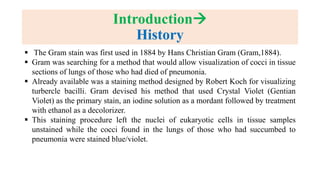


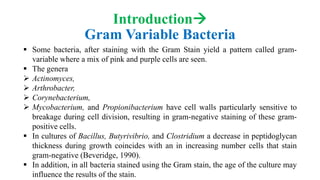


The Gram staining method was developed in 1884 by Hans Christian Gram to differentiate between bacteria in tissue samples. It uses crystal violet dye followed by iodine and decolorizing agents to stain bacteria either purple (Gram-positive) or red (Gram-negative) based on their cell wall structure. Gram-positive bacteria have a thick peptidoglycan layer that retains the crystal violet dye, while Gram-negative bacteria have a thin peptidoglycan layer and stain red. The Gram stain remains a fundamental method for phenotypic characterization of bacteria.


