1. Gram staining is a differential staining technique used to classify bacteria into two groups, Gram-positive and Gram-negative, based on differences in their cell wall structure that determine whether the stain is retained or washed away.
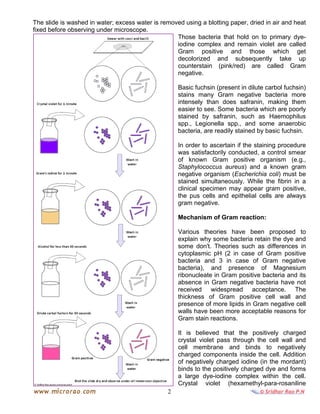
2. The Gram staining procedure involves applying a primary stain, a mordant, a decolorizer, and a counterstain. Gram-positive bacteria retain the primary stain due to their thick peptidoglycan layer, while Gram-negative bacteria's thinner cell wall allows the stain to be washed away.
3. Gram staining is useful for initial identification and classification of bacteria, as well as determining appropriate culture methods and empirical antibiotic treatment. However, some bacteria can display variable or