- Hans Christian Gram developed the Gram staining technique in 1884 while examining lung tissue from pneumonia patients under the microscope. He discovered that certain bacterial cells retained dye differently than others.
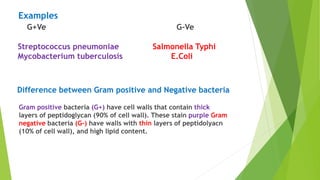
- Gram staining is a common differential staining technique that classifies bacteria as either Gram positive or Gram negative based on differences in their cell wall structure. Gram positive bacteria have a thick peptidoglycan layer that retains the primary stain, while Gram negative bacteria have a thin layer and outer membrane that washes away the primary stain.
- The Gram staining procedure involves staining a smear with crystal violet, adding a mordant, decolorizing with alcohol, and counterstaining with safranin. Gram positive bacteria appear purple/blue