Gram Stain Viva Questions-
Set-1
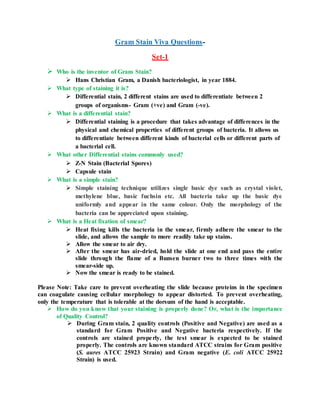
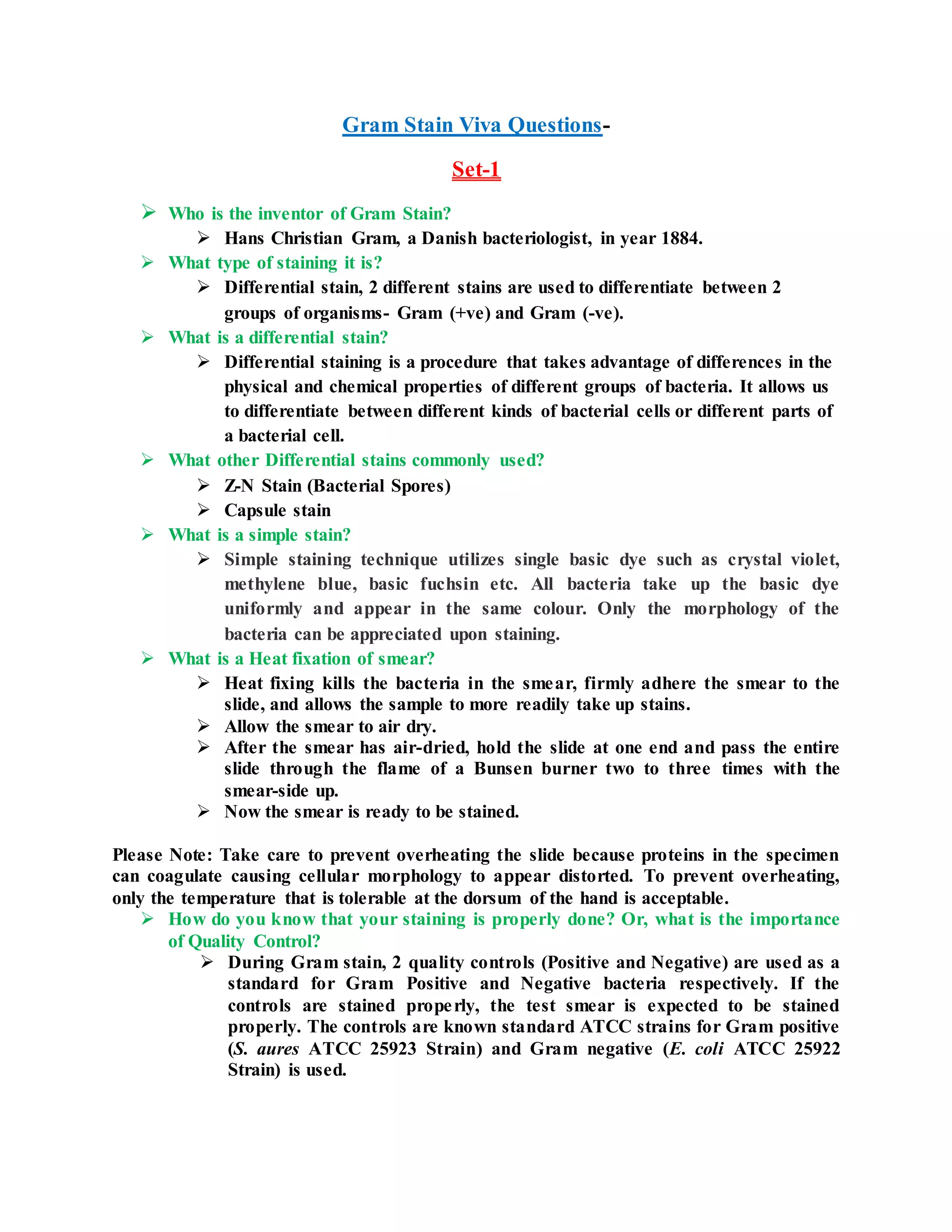
 Who is the inventor of Gram Stain?
 Hans Christian Gram, a Danish bacteriologist, in year 1884.
 What type of staining it is?
 Differential stain, 2 different stains are used to differentiate between 2
groups of organisms- Gram (+ve) and Gram (-ve).
 What is a differential stain?
 Differential staining is a procedure that takes advantage of differences in the
physical and chemical properties of different groups of bacteria. It allows us
to differentiate between different kinds of bacterial cells or different parts of
a bacterial cell.
 What other Differential stains commonly used?
 Z-N Stain (Bacterial Spores)
 Capsule stain
 What is a simple stain?
 Simple staining technique utilizes single basic dye such as crystal violet,
methylene blue, basic fuchsin etc. All bacteria take up the basic dye
uniformly and appear in the same colour. Only the morphology of the
bacteria can be appreciated upon staining.
 What is a Heat fixation of smear?
 Heat fixing kills the bacteria in the smear, firmly adhere the smear to the
slide, and allows the sample to more readily take up stains.
 Allow the smear to air dry.
 After the smear has air-dried, hold the slide at one end and pass the entire
slide through the flame of a Bunsen burner two to three times with the
smear-side up.
 Now the smear is ready to be stained.
Please Note: Take care to prevent overheating the slide because proteins in the specimen
can coagulate causing cellular morphology to appear distorted. To prevent overheating,
only the temperature that is tolerable at the dorsum of the hand is acceptable.
 How do you know that your staining is properly done? Or, what is the importance
of Quality Control?
 During Gram stain, 2 quality controls (Positive and Negative) are used as a
standard for Gram Positive and Negative bacteria respectively. If the
controls are stained properly, the test smear is expected to be stained
properly. The controls are known standard ATCC strains for Gram positive
(S. aures ATCC 25923 Strain) and Gram negative (E. coli ATCC 25922
Strain) is used.
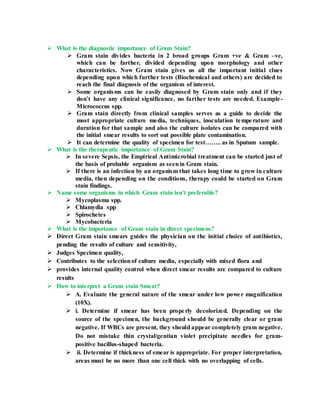
 What is the diagnostic importance of Gram Stain?
 Gram stain divides bacteria in 2 broad groups Gram +ve & Gram –ve,
which can be farther, divided depending upon morphology and other
characteristics. Now Gram stain gives us all the important initial clues
depending upon which further tests (Biochemical and others) are decided to
reach the final diagnosis of the organism of interest.
 Some organisms can be easily diagnosed by Gram stain only and if they
don’t have any clinical significance, no farther tests are needed. Example-
Micrococcus spp.
 Gram stain directly from clinical samples serves as a guide to decide the
most appropriate culture media, techniques, inoculation temperature and
duration for that sample and also the culture isolates can be compared with
the initial smear results to sort out possible plate contamination.
 It can determine the quality of specimen for test…….. as in Sputum sample.
 What is the therapeutic importance of Gram Stain?
 In severe Sepsis, the Empirical Antimicrobial treatment can be started just of
the basis of probable organism as seenin Gram stain.
 If there is an infection by an organism that takes long time to grow in culture
media, then depending on the conditions, therapy could be started on Gram
stain findings.
 Name some organisms in which Gram stain isn’t preferable?
 Mycoplasma spp.
 Chlamydia spp
 Spirochetes
 Mycobacteria
 What is the importance of Gram stain in direct specimens?
 Direct Gram stain smears guides the physician on the initial choice of antibiotics,
pending the results of culture and sensitivity,
 Judges Specimen quality,
 Contributes to the selectionof culture media, especially with mixed flora and
 provides internal quality control when direct smear results are compared to culture
results
 How to interpret a Gram stain Smear?
 A. Evaluate the general nature of the smear under low power magnification
(10X).
 i. Determine if smear has been properly decolorized. Depending on the
source of the specimen, the background should be generally clear or gram
negative. If WBCs are present, they should appear completely gram negative.
Do not mistake thin crystal/gentian violet precipitate needles for gram-
positive bacillus-shaped bacteria.
 ii. Determine if thickness of smear is appropriate. For proper interpretation,
areas must be no more than one cell thick with no overlapping of cells.
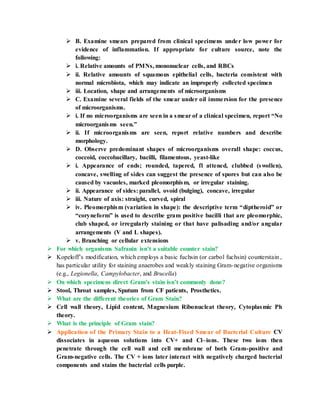
 B. Examine smears prepared from clinical specimens under low power for
evidence of inflammation. If appropriate for culture source, note the
following:
 i. Relative amounts of PMNs, mononuclear cells, and RBCs
 ii. Relative amounts of squamous epithelial cells, bacteria consistent with
normal microbiota, which may indicate an improperly collected specimen
 iii. Location, shape and arrangements of microorganisms
 C. Examine several fields of the smear under oil immersion for the presence
of microorganisms.
 i. If no microorganisms are seen in a smear of a clinical specimen, report “No
microorganisms seen.”
 ii. If microorganisms are seen, report relative numbers and describe
morphology.
 D. Observe predominant shapes of microorganisms overall shape: coccus,
coccoid, coccobacillary, bacilli, filamentous, yeast-like
 i. Appearance of ends; rounded, tapered, fl attened, clubbed (swollen),
concave, swelling of sides can suggest the presence of spores but can also be
caused by vacuoles, marked pleomorphism, or irregular staining.
 ii. Appearance of sides: parallel, ovoid (bulging), concave, irregular
 iii. Nature of axis: straight, curved, spiral
 iv. Pleomorphism (variation in shape): the descriptive term “diptheroid” or
“coryneform” is used to describe gram positive bacilli that are pleomorphic,
club shaped, or irregularly staining or that have palisading and/or angular
arrangements (V and L shapes).
 v. Branching or cellular extensions
 For which organisms Safranin isn’t a suitable counter stain?
 Kopeloff’s modification, which employs a basic fuchsin (or carbol fuchsin) counterstain ,
has particular utility for staining anaerobes and weakly staining Gram-negative organisms
(e.g., Legionella, Campylobacter, and Brucella)
 On which specimens direct Gram’s stain isn’t commonly done?
 Stool, Throat samples, Sputum from CF patients, Prosthetics.
 What are the different theories of Gram Stain?
 Cell wall theory, Lipid content, Magnesium Ribonucleat theory, Cytoplasmic Ph
theory.
 What is the principle of Gram stain?
 Application of the Primary Stain to a Heat-Fixed Smear of Bacterial Culture CV
dissociates in aqueous solutions into CV+ and Cl–ions. These two ions then
penetrate through the cell wall and cell membrane of both Gram-positive and
Gram-negative cells. The CV + ions later interact with negatively charged bacterial
components and stains the bacterial cells purple.
 Addition of Gram’s Iodine Iodine (I− or I3−) acts as a mordant and as a trapping
agent. A mordant is a substance that increases the affinity of the cell wall for a stain
by binding to the primary stain, thus forming an insoluble complex, which gets
trapped in the cell wall. In the Gram stain reaction, the CV and iodine form an
insoluble complex (CV-I), which serves to turn the smear a dark purple color. At
this stage, all cells will turn purple.
 Decolorization with 95% Ethyl Alcohol Alcohol or acetone dissolves the lipid outer
membrane of Gram-negative bacteria, thus leaving the peptidoglycan layer exposed
and increases the porosity of the cell wall. The CV-I complex is then washed away
from the thin peptidoglycan layer, leaving Gram-negative bacteria colorless. On the
other hand, alcohol has a dehydrating effect on the cell walls of Gram-positive
bacteria that causes the pores of the cell wall to shrink. The CV-I complex gets
tightly bound into the multi-layered, highly cross-linked Gram-positive cell wall
thus staining the cells purple. The decolorization step must be performed carefully.
Otherwise over-decolorization may occur. This step is critical and must be timed
correctly otherwise the CV stain will be removed from the Gram-positive cells. If
the decolorizing agent is applied on the cell for too long time, the Gram-positive
organisms to appear Gram-negative. Under-decolorization occurs when the alcohol
is not left on long enough to wash out the CV-I complex from the Gram-negative
cells, resulting in Gram-negative bacteria to appear Gram-positive.
 Counterstain with Safranin The decolorized Gram-negative cells can be rendered
visible with a suitable counter-stain, which is usually positively charged safranin,
which stains them pink. Pink color that adheres to the Gram-positive bacteria is
masked by the purple of the CV (basic fuschin is sometimes used instead of safranin
in rare situations).
 Gram Positive aerobic/ Facultative anaerobic cocci-
 Staphylococcus spp. Streptococcus spp.
 Gram positive aerobic bacilli-
 Bacillus anthacis, Bacillus cereus
 Gram- positive anaerobic cocci-
 Peptostreptococcus, Gamella.
 Gram positive anaerobic bacilli (Spore forming)-
 Clostridium spp.
 Gram Negative bacilli (facultative anaerobes)-
 Enterobacteriacae family (E. coli, Klebseilla spp.)
 Gram Negative bacilli (strictly aerobes)-
 Pseudomonas spp.
 Gram Negative bacilli (strictly anaerobes)-
 Bacteriods spp, Prevotella
 Gram Negative cocci (Aerobic)
 N. meningitides
 Gram negative cocci (Anaerobic)
 Veillonella spp
 Gram variable bacteria-
 Actinomyces bovis, Actinomyces viscosus, Arthrobacter globiformis, Bacillus brevis,
Butyrivibrio fibrisolvens, Clostridium tetani, Clostridium thermosaccharolyticum,
Corynebacterium parvum, Mycobacterium phlei, and Propionibacterium acnes.

Gram stain viva 1

  • 1.
    Gram Stain VivaQuestions- Set-1  Who is the inventor of Gram Stain?  Hans Christian Gram, a Danish bacteriologist, in year 1884.  What type of staining it is?  Differential stain, 2 different stains are used to differentiate between 2 groups of organisms- Gram (+ve) and Gram (-ve).  What is a differential stain?  Differential staining is a procedure that takes advantage of differences in the physical and chemical properties of different groups of bacteria. It allows us to differentiate between different kinds of bacterial cells or different parts of a bacterial cell.  What other Differential stains commonly used?  Z-N Stain (Bacterial Spores)  Capsule stain  What is a simple stain?  Simple staining technique utilizes single basic dye such as crystal violet, methylene blue, basic fuchsin etc. All bacteria take up the basic dye uniformly and appear in the same colour. Only the morphology of the bacteria can be appreciated upon staining.  What is a Heat fixation of smear?  Heat fixing kills the bacteria in the smear, firmly adhere the smear to the slide, and allows the sample to more readily take up stains.  Allow the smear to air dry.  After the smear has air-dried, hold the slide at one end and pass the entire slide through the flame of a Bunsen burner two to three times with the smear-side up.  Now the smear is ready to be stained. Please Note: Take care to prevent overheating the slide because proteins in the specimen can coagulate causing cellular morphology to appear distorted. To prevent overheating, only the temperature that is tolerable at the dorsum of the hand is acceptable.  How do you know that your staining is properly done? Or, what is the importance of Quality Control?  During Gram stain, 2 quality controls (Positive and Negative) are used as a standard for Gram Positive and Negative bacteria respectively. If the controls are stained properly, the test smear is expected to be stained properly. The controls are known standard ATCC strains for Gram positive (S. aures ATCC 25923 Strain) and Gram negative (E. coli ATCC 25922 Strain) is used.
  • 2.
     What isthe diagnostic importance of Gram Stain?  Gram stain divides bacteria in 2 broad groups Gram +ve & Gram –ve, which can be farther, divided depending upon morphology and other characteristics. Now Gram stain gives us all the important initial clues depending upon which further tests (Biochemical and others) are decided to reach the final diagnosis of the organism of interest.  Some organisms can be easily diagnosed by Gram stain only and if they don’t have any clinical significance, no farther tests are needed. Example- Micrococcus spp.  Gram stain directly from clinical samples serves as a guide to decide the most appropriate culture media, techniques, inoculation temperature and duration for that sample and also the culture isolates can be compared with the initial smear results to sort out possible plate contamination.  It can determine the quality of specimen for test…….. as in Sputum sample.  What is the therapeutic importance of Gram Stain?  In severe Sepsis, the Empirical Antimicrobial treatment can be started just of the basis of probable organism as seenin Gram stain.  If there is an infection by an organism that takes long time to grow in culture media, then depending on the conditions, therapy could be started on Gram stain findings.  Name some organisms in which Gram stain isn’t preferable?  Mycoplasma spp.  Chlamydia spp  Spirochetes  Mycobacteria  What is the importance of Gram stain in direct specimens?  Direct Gram stain smears guides the physician on the initial choice of antibiotics, pending the results of culture and sensitivity,  Judges Specimen quality,  Contributes to the selectionof culture media, especially with mixed flora and  provides internal quality control when direct smear results are compared to culture results  How to interpret a Gram stain Smear?  A. Evaluate the general nature of the smear under low power magnification (10X).  i. Determine if smear has been properly decolorized. Depending on the source of the specimen, the background should be generally clear or gram negative. If WBCs are present, they should appear completely gram negative. Do not mistake thin crystal/gentian violet precipitate needles for gram- positive bacillus-shaped bacteria.  ii. Determine if thickness of smear is appropriate. For proper interpretation, areas must be no more than one cell thick with no overlapping of cells.
  • 3.
     B. Examinesmears prepared from clinical specimens under low power for evidence of inflammation. If appropriate for culture source, note the following:  i. Relative amounts of PMNs, mononuclear cells, and RBCs  ii. Relative amounts of squamous epithelial cells, bacteria consistent with normal microbiota, which may indicate an improperly collected specimen  iii. Location, shape and arrangements of microorganisms  C. Examine several fields of the smear under oil immersion for the presence of microorganisms.  i. If no microorganisms are seen in a smear of a clinical specimen, report “No microorganisms seen.”  ii. If microorganisms are seen, report relative numbers and describe morphology.  D. Observe predominant shapes of microorganisms overall shape: coccus, coccoid, coccobacillary, bacilli, filamentous, yeast-like  i. Appearance of ends; rounded, tapered, fl attened, clubbed (swollen), concave, swelling of sides can suggest the presence of spores but can also be caused by vacuoles, marked pleomorphism, or irregular staining.  ii. Appearance of sides: parallel, ovoid (bulging), concave, irregular  iii. Nature of axis: straight, curved, spiral  iv. Pleomorphism (variation in shape): the descriptive term “diptheroid” or “coryneform” is used to describe gram positive bacilli that are pleomorphic, club shaped, or irregularly staining or that have palisading and/or angular arrangements (V and L shapes).  v. Branching or cellular extensions  For which organisms Safranin isn’t a suitable counter stain?  Kopeloff’s modification, which employs a basic fuchsin (or carbol fuchsin) counterstain , has particular utility for staining anaerobes and weakly staining Gram-negative organisms (e.g., Legionella, Campylobacter, and Brucella)  On which specimens direct Gram’s stain isn’t commonly done?  Stool, Throat samples, Sputum from CF patients, Prosthetics.  What are the different theories of Gram Stain?  Cell wall theory, Lipid content, Magnesium Ribonucleat theory, Cytoplasmic Ph theory.  What is the principle of Gram stain?  Application of the Primary Stain to a Heat-Fixed Smear of Bacterial Culture CV dissociates in aqueous solutions into CV+ and Cl–ions. These two ions then penetrate through the cell wall and cell membrane of both Gram-positive and Gram-negative cells. The CV + ions later interact with negatively charged bacterial components and stains the bacterial cells purple.
  • 4.
     Addition ofGram’s Iodine Iodine (I− or I3−) acts as a mordant and as a trapping agent. A mordant is a substance that increases the affinity of the cell wall for a stain by binding to the primary stain, thus forming an insoluble complex, which gets trapped in the cell wall. In the Gram stain reaction, the CV and iodine form an insoluble complex (CV-I), which serves to turn the smear a dark purple color. At this stage, all cells will turn purple.  Decolorization with 95% Ethyl Alcohol Alcohol or acetone dissolves the lipid outer membrane of Gram-negative bacteria, thus leaving the peptidoglycan layer exposed and increases the porosity of the cell wall. The CV-I complex is then washed away from the thin peptidoglycan layer, leaving Gram-negative bacteria colorless. On the other hand, alcohol has a dehydrating effect on the cell walls of Gram-positive bacteria that causes the pores of the cell wall to shrink. The CV-I complex gets tightly bound into the multi-layered, highly cross-linked Gram-positive cell wall thus staining the cells purple. The decolorization step must be performed carefully. Otherwise over-decolorization may occur. This step is critical and must be timed correctly otherwise the CV stain will be removed from the Gram-positive cells. If the decolorizing agent is applied on the cell for too long time, the Gram-positive organisms to appear Gram-negative. Under-decolorization occurs when the alcohol is not left on long enough to wash out the CV-I complex from the Gram-negative cells, resulting in Gram-negative bacteria to appear Gram-positive.  Counterstain with Safranin The decolorized Gram-negative cells can be rendered visible with a suitable counter-stain, which is usually positively charged safranin, which stains them pink. Pink color that adheres to the Gram-positive bacteria is masked by the purple of the CV (basic fuschin is sometimes used instead of safranin in rare situations).  Gram Positive aerobic/ Facultative anaerobic cocci-  Staphylococcus spp. Streptococcus spp.  Gram positive aerobic bacilli-  Bacillus anthacis, Bacillus cereus  Gram- positive anaerobic cocci-  Peptostreptococcus, Gamella.  Gram positive anaerobic bacilli (Spore forming)-  Clostridium spp.  Gram Negative bacilli (facultative anaerobes)-  Enterobacteriacae family (E. coli, Klebseilla spp.)  Gram Negative bacilli (strictly aerobes)-  Pseudomonas spp.  Gram Negative bacilli (strictly anaerobes)-  Bacteriods spp, Prevotella  Gram Negative cocci (Aerobic)
  • 5.
     N. meningitides Gram negative cocci (Anaerobic)  Veillonella spp  Gram variable bacteria-  Actinomyces bovis, Actinomyces viscosus, Arthrobacter globiformis, Bacillus brevis, Butyrivibrio fibrisolvens, Clostridium tetani, Clostridium thermosaccharolyticum, Corynebacterium parvum, Mycobacterium phlei, and Propionibacterium acnes.