The Role of Microbiology in the Diagnosis and Treatment of
Urinary Tract Infections (UTIs) Caused by the Bacteria
Escherichia coli
Katie McDowall, Kim Campbell, Bri McKenna| Tiffany Gill | MLT-1080 Clinical Microbiology
Abstract
Acceptable Culture Specimen
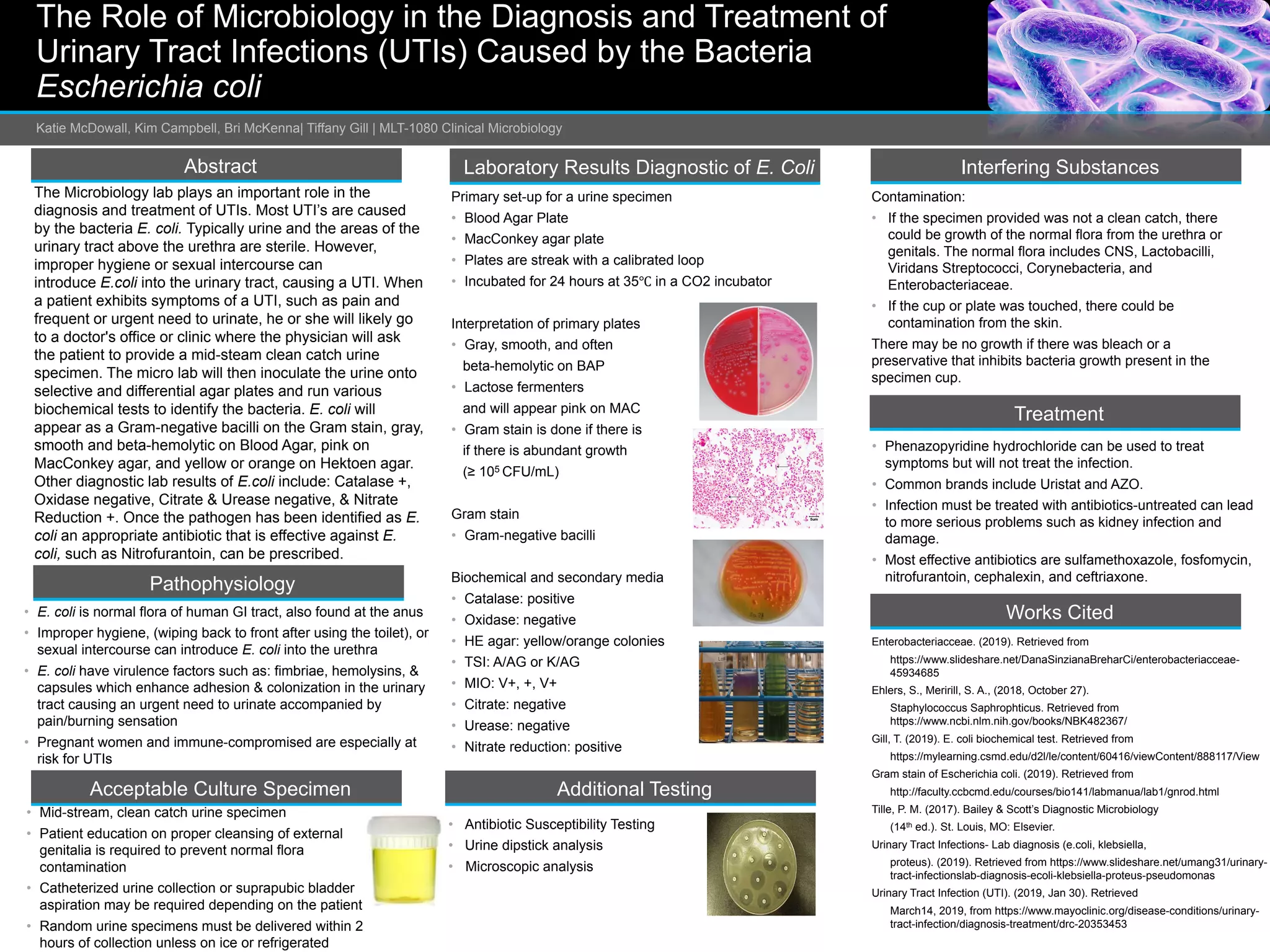
Laboratory Results Diagnostic of E. Coli
Additional Testing
Interfering Substances
• Mid-stream, clean catch urine specimen
• Patient education on proper cleansing of external
genitalia is required to prevent normal flora
contamination
• Catheterized urine collection or suprapubic bladder
aspiration may be required depending on the patient
• Random urine specimens must be delivered within 2
hours of collection unless on ice or refrigerated
Treatment
• E. coli is normal flora of human GI tract, also found at the anus
• Improper hygiene, (wiping back to front after using the toilet), or
sexual intercourse can introduce E. coli into the urethra
• E. coli have virulence factors such as: fimbriae, hemolysins, &
capsules which enhance adhesion & colonization in the urinary
tract causing an urgent need to urinate accompanied by
pain/burning sensation
• Pregnant women and immune-compromised are especially at
risk for UTIs
Works Cited
Enterobacteriacceae. (2019). Retrieved from
https://www.slideshare.net/DanaSinzianaBreharCi/enterobacteriacceae-
45934685
Ehlers, S., Meririll, S. A., (2018, October 27).
Staphylococcus Saphrophticus. Retrieved from
https://www.ncbi.nlm.nih.gov/books/NBK482367/
Gill, T. (2019). E. coli biochemical test. Retrieved from
https://mylearning.csmd.edu/d2l/le/content/60416/viewContent/888117/View
Gram stain of Escherichia coli. (2019). Retrieved from
http://faculty.ccbcmd.edu/courses/bio141/labmanua/lab1/gnrod.html
Tille, P. M. (2017). Bailey & Scott’s Diagnostic Microbiology
(14th ed.). St. Louis, MO: Elsevier.
Urinary Tract Infections- Lab diagnosis (e.coli, klebsiella,
proteus). (2019). Retrieved from https://www.slideshare.net/umang31/urinary-
tract-infectionslab-diagnosis-ecoli-klebsiella-proteus-pseudomonas
Urinary Tract Infection (UTI). (2019, Jan 30). Retrieved
March14, 2019, from https://www.mayoclinic.org/disease-conditions/urinary-
tract-infection/diagnosis-treatment/drc-20353453
Pathophysiology
The Microbiology lab plays an important role in the
diagnosis and treatment of UTIs. Most UTI’s are caused
by the bacteria E. coli. Typically urine and the areas of the
urinary tract above the urethra are sterile. However,
improper hygiene or sexual intercourse can
introduce E.coli into the urinary tract, causing a UTI. When
a patient exhibits symptoms of a UTI, such as pain and
frequent or urgent need to urinate, he or she will likely go
to a doctor's office or clinic where the physician will ask
the patient to provide a mid-steam clean catch urine
specimen. The micro lab will then inoculate the urine onto
selective and differential agar plates and run various
biochemical tests to identify the bacteria. E. coli will
appear as a Gram-negative bacilli on the Gram stain, gray,
smooth and beta-hemolytic on Blood Agar, pink on
MacConkey agar, and yellow or orange on Hektoen agar.
Other diagnostic lab results of E.coli include: Catalase +,
Oxidase negative, Citrate & Urease negative, & Nitrate
Reduction +. Once the pathogen has been identified as E.
coli an appropriate antibiotic that is effective against E.
coli, such as Nitrofurantoin, can be prescribed.
Primary set-up for a urine specimen
• Blood Agar Plate
• MacConkey agar plate
• Plates are streak with a calibrated loop
• Incubated for 24 hours at 35℃ in a CO2 incubator
Interpretation of primary plates
• Gray, smooth, and often
beta-hemolytic on BAP
• Lactose fermenters
and will appear pink on MAC
• Gram stain is done if there is
if there is abundant growth
(≥ 105 CFU/mL)
Gram stain
• Gram-negative bacilli
Biochemical and secondary media
• Catalase: positive
• Oxidase: negative
• HE agar: yellow/orange colonies
• TSI: A/AG or K/AG
• MIO: V+, +, V+
• Citrate: negative
• Urease: negative
• Nitrate reduction: positive
Contamination:
• If the specimen provided was not a clean catch, there
could be growth of the normal flora from the urethra or
genitals. The normal flora includes CNS, Lactobacilli,
Viridans Streptococci, Corynebacteria, and
Enterobacteriaceae.
• If the cup or plate was touched, there could be
contamination from the skin.
There may be no growth if there was bleach or a
preservative that inhibits bacteria growth present in the
specimen cup.
• Phenazopyridine hydrochloride can be used to treat
symptoms but will not treat the infection.
• Common brands include Uristat and AZO.
• Infection must be treated with antibiotics-untreated can lead
to more serious problems such as kidney infection and
damage.
• Most effective antibiotics are sulfamethoxazole, fosfomycin,
nitrofurantoin, cephalexin, and ceftriaxone.
• Antibiotic Susceptibility Testing
• Urine dipstick analysis
• Microscopic analysis

Clinical Microbiology Scientific Poster

  • 1.
    The Role ofMicrobiology in the Diagnosis and Treatment of Urinary Tract Infections (UTIs) Caused by the Bacteria Escherichia coli Katie McDowall, Kim Campbell, Bri McKenna| Tiffany Gill | MLT-1080 Clinical Microbiology Abstract Acceptable Culture Specimen Laboratory Results Diagnostic of E. Coli Additional Testing Interfering Substances • Mid-stream, clean catch urine specimen • Patient education on proper cleansing of external genitalia is required to prevent normal flora contamination • Catheterized urine collection or suprapubic bladder aspiration may be required depending on the patient • Random urine specimens must be delivered within 2 hours of collection unless on ice or refrigerated Treatment • E. coli is normal flora of human GI tract, also found at the anus • Improper hygiene, (wiping back to front after using the toilet), or sexual intercourse can introduce E. coli into the urethra • E. coli have virulence factors such as: fimbriae, hemolysins, & capsules which enhance adhesion & colonization in the urinary tract causing an urgent need to urinate accompanied by pain/burning sensation • Pregnant women and immune-compromised are especially at risk for UTIs Works Cited Enterobacteriacceae. (2019). Retrieved from https://www.slideshare.net/DanaSinzianaBreharCi/enterobacteriacceae- 45934685 Ehlers, S., Meririll, S. A., (2018, October 27). Staphylococcus Saphrophticus. Retrieved from https://www.ncbi.nlm.nih.gov/books/NBK482367/ Gill, T. (2019). E. coli biochemical test. Retrieved from https://mylearning.csmd.edu/d2l/le/content/60416/viewContent/888117/View Gram stain of Escherichia coli. (2019). Retrieved from http://faculty.ccbcmd.edu/courses/bio141/labmanua/lab1/gnrod.html Tille, P. M. (2017). Bailey & Scott’s Diagnostic Microbiology (14th ed.). St. Louis, MO: Elsevier. Urinary Tract Infections- Lab diagnosis (e.coli, klebsiella, proteus). (2019). Retrieved from https://www.slideshare.net/umang31/urinary- tract-infectionslab-diagnosis-ecoli-klebsiella-proteus-pseudomonas Urinary Tract Infection (UTI). (2019, Jan 30). Retrieved March14, 2019, from https://www.mayoclinic.org/disease-conditions/urinary- tract-infection/diagnosis-treatment/drc-20353453 Pathophysiology The Microbiology lab plays an important role in the diagnosis and treatment of UTIs. Most UTI’s are caused by the bacteria E. coli. Typically urine and the areas of the urinary tract above the urethra are sterile. However, improper hygiene or sexual intercourse can introduce E.coli into the urinary tract, causing a UTI. When a patient exhibits symptoms of a UTI, such as pain and frequent or urgent need to urinate, he or she will likely go to a doctor's office or clinic where the physician will ask the patient to provide a mid-steam clean catch urine specimen. The micro lab will then inoculate the urine onto selective and differential agar plates and run various biochemical tests to identify the bacteria. E. coli will appear as a Gram-negative bacilli on the Gram stain, gray, smooth and beta-hemolytic on Blood Agar, pink on MacConkey agar, and yellow or orange on Hektoen agar. Other diagnostic lab results of E.coli include: Catalase +, Oxidase negative, Citrate & Urease negative, & Nitrate Reduction +. Once the pathogen has been identified as E. coli an appropriate antibiotic that is effective against E. coli, such as Nitrofurantoin, can be prescribed. Primary set-up for a urine specimen • Blood Agar Plate • MacConkey agar plate • Plates are streak with a calibrated loop • Incubated for 24 hours at 35℃ in a CO2 incubator Interpretation of primary plates • Gray, smooth, and often beta-hemolytic on BAP • Lactose fermenters and will appear pink on MAC • Gram stain is done if there is if there is abundant growth (≥ 105 CFU/mL) Gram stain • Gram-negative bacilli Biochemical and secondary media • Catalase: positive • Oxidase: negative • HE agar: yellow/orange colonies • TSI: A/AG or K/AG • MIO: V+, +, V+ • Citrate: negative • Urease: negative • Nitrate reduction: positive Contamination: • If the specimen provided was not a clean catch, there could be growth of the normal flora from the urethra or genitals. The normal flora includes CNS, Lactobacilli, Viridans Streptococci, Corynebacteria, and Enterobacteriaceae. • If the cup or plate was touched, there could be contamination from the skin. There may be no growth if there was bleach or a preservative that inhibits bacteria growth present in the specimen cup. • Phenazopyridine hydrochloride can be used to treat symptoms but will not treat the infection. • Common brands include Uristat and AZO. • Infection must be treated with antibiotics-untreated can lead to more serious problems such as kidney infection and damage. • Most effective antibiotics are sulfamethoxazole, fosfomycin, nitrofurantoin, cephalexin, and ceftriaxone. • Antibiotic Susceptibility Testing • Urine dipstick analysis • Microscopic analysis

Editor's Notes

  • #2 To change this poster, replace our sample content with your own. Or, if you'd rather start from a clean slate, press the New Slide button on the Home tab to insert a new page. Now enter your text and pictures in the empty placeholders. If you need more placeholders for titles, subtitles or body text, copy any of the existing placeholders, then drag the new one into place.