COLLEGE OF NURSING,
MADRAS MEDICAL COLLEGE, CHENNAI-03.
M . SC (NURSING),
BRANCH - I MEDICAL - SURGICAL NURSING.
RESEARCH PROPOSAL
“THE EXPERIENCES OF
CACHEXIAAMONG CANCER
SURVIVORS”
Deepika. R
M . Sc (nursing) I year,
Medical surgical nursing,
College of nursing,
Madras medical college,
Chennai-03.
INTRODUCTION
“Cancer cannot cripple love, it cannot shatter hope, it
cannot conquer the spirit.”
The term cachexia originates from the Greek root
Kakos hexes, which translates into "bad condition," Were recognized for
centuries as a progressive deterioration of body habitus.
Cachexia is also called wasting syndrome or anorexia cachexia
syndrome.
Loss of body weight and muscle mass, and weakness that may occur in
patients with cancer, AIDS, or other chronic diseases.
Cont …..
The prominent clinical feature of cachexia is weight loss in adults
(fluid retention correction) or growth failure in children (excluding
endocrine disorders).
Cancer cachexia is characterized by a major decrease in skeletal muscle
mass in humans and animals that depends on the severity of the
disease/model and the localization of the tumor.
Cancer cachexia occurs in about 33% of newly diagnosed patients with
cancer and may lead to delayed, missed, or decreased treatments.
Cachexia isn’t just associated with cancer. It is common in the
advanced stages of other illnesses such as heart disease, HIV, and
kidney disease.
BACKGROUND OF THE STUDY
WORLD WIDE LEVEL:
Globally, the overall prevalence of cachexia (due to any disease and not
necessarily leading to hospital admission) is around 1 % of the patient
population,
i.e. around 9 million people are affected.
The global cancer cachexia market size reached US$ 2.0 Billion in 2022.
Looking forward, IMARC Group expects the market to reach US$ 2.6 Billion
by 2028, exhibiting a growth rate (CAGR) of 4.5% during 2023-2028.
Cachexia seems more common in people with lung cancer or cancers
anywhere in the digestive system.
Mortality: Mortality rates of patients with cachexia range from 20–80% in
cancer cachexia.
NATIONAL LEVEL
India has around 2.25 million cases with over 1 lakh new cases being registered every
year, according to Cancerindia.org.
The Indian Council of Medical Research (ICMR estimates that the country is likely to
register over 17 lakh new cases and report over 8 lakh deaths by 2020.
The estimated number of incident cases of cancer in India for the year 2022 was
found to be 14,61,427 (crude rate:100.4 per 100,000).
 In India, one in nine people is likely to develop cancer in his/her lifetime.
STATE LEVEL
We had 81,814 cancer cases in 2021.
When compared to 2012, when we had 53,022 cases, the incidence of cancer has been
increasing gradually in the State,”
The annual cancer burden predicted for 2012–16 is 6100 for Chennai, translating to 55
000 new cases per year statewide (in Tamil Nadu)
A total of 65,590 cancer cases were diagnosed in 2016 in TN and the estimated cancer
burden in 2020 was 78,641. Of this, the highest CIR of cancers was observed in Chennai
(140.8) and the least in Krishnagiri (48.5).
The incidence of breast cancer in women observed in Chennai (46.4 per 1,00,000
women) was the highest in the country.
NEED OF THE STUDY
"The experiences of cancer cachexia survivors offer invaluable insights
that can guide us in developing patient-centered strategies and
interventions, ensuring that no aspect of their journey is overlooked."
Holistic Understanding
Improved Patient Care
Quality of Life
Treatment and Management
Psychological and Social Impact
Policy and Advocacy
STATEMENT OF THE PROBLEM
“A STUDY TO EXPLORE THE EXPERIENCES OF
CACHEXIAAMONG CANCER SURVIVORS AT TERTIARY
CARE CENTRE, CHENNAI”
-A QUALITATIVE STUDY.
OBJECTIVES
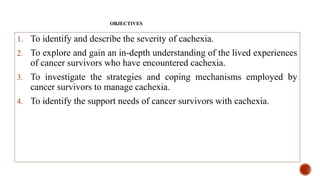
1. To identify and describe the severity of cachexia.
2. To explore and gain an in-depth understanding of the lived experiences
of cancer survivors who have encountered cachexia.
3. To investigate the strategies and coping mechanisms employed by
cancer survivors to manage cachexia.
4. To identify the support needs of cancer survivors with cachexia.
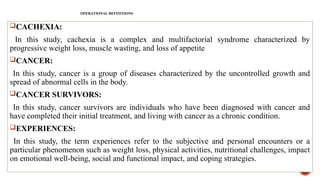
CACHEXIA:
In this study, cachexia is a complex and multifactorial syndrome characterized by
progressive weight loss, muscle wasting, and loss of appetite
CANCER:
In this study, cancer is a group of diseases characterized by the uncontrolled growth and
spread of abnormal cells in the body.
CANCER SURVIVORS:
In this study, cancer survivors are individuals who have been diagnosed with cancer and
have completed their initial treatment, and living with cancer as a chronic condition.
EXPERIENCES:
In this study, the term experiences refer to the subjective and personal encounters or a
particular phenomenon such as weight loss, physical activities, nutritional challenges, impact
on emotional well-being, social and functional impact, and coping strategies.
OPERATIONAL DEFINITIONS
ASSUMPTION
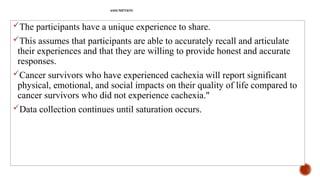
The participants have a unique experience to share.
This assumes that participants are able to accurately recall and articulate
their experiences and that they are willing to provide honest and accurate
responses.
Cancer survivors who have experienced cachexia will report significant
physical, emotional, and social impacts on their quality of life compared to
cancer survivors who did not experience cachexia."
Data collection continues until saturation occurs.
REVIEW OF LITERATURE
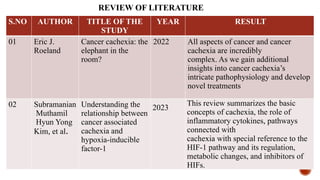
S.NO AUTHOR TITLE OF THE
STUDY
YEAR RESULT
01 Eric J.
Roeland
Cancer cachexia: the
elephant in the
room?
2022 All aspects of cancer and cancer
cachexia are incredibly
complex. As we gain additional
insights into cancer cachexia’s
intricate pathophysiology and develop
novel treatments
02 Subramanian
Muthamil
Hyun Yong
Kim, et al.
Understanding the
relationship between
cancer associated
cachexia and
hypoxia-inducible
factor-1
2023
This review summarizes the basic
concepts of cachexia, the role of
inflammatory cytokines, pathways
connected with
cachexia with special reference to the
HIF-1 pathway and its regulation,
metabolic changes, and inhibitors of
HIFs.
S.N
O
AUTHOR TITLE YEAR RESULT
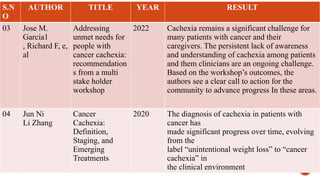
03 Jose M.
Garcia1
, Richard F, e,
al
Addressing
unmet needs for
people with
cancer cachexia:
recommendation
s from a multi
stake holder
workshop
2022 Cachexia remains a significant challenge for
many patients with cancer and their
caregivers. The persistent lack of awareness
and understanding of cachexia among patients
and them clinicians are an ongoing challenge.
Based on the workshop’s outcomes, the
authors see a clear call to action for the
community to advance progress In these areas.
04 Jun Ni
Li Zhang
Cancer
Cachexia:
Definition,
Staging, and
Emerging
Treatments
2020 The diagnosis of cachexia in patients with
cancer has
made significant progress over time, evolving
from the
label “unintentional weight loss” to “cancer
cachexia” in
the clinical environment
S.NO AUTHORS TITLE OF THE
STUDY
YEAR RESULT
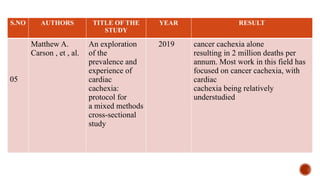
05
Matthew A.
Carson , et , al.
An exploration
of the
prevalence and
experience of
cardiac
cachexia:
protocol for
a mixed methods
cross-sectional
study
2019 cancer cachexia alone
resulting in 2 million deaths per
annum. Most work in this field has
focused on cancer cachexia, with
cardiac
cachexia being relatively
understudied
METHODOLOGY
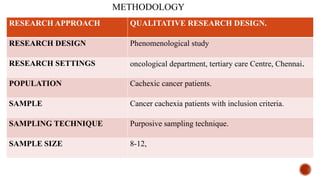
RESEARCH APPROACH QUALITATIVE RESEARCH DESIGN.
RESEARCH DESIGN Phenomenological study
RESEARCH SETTINGS oncological department, tertiary care Centre, Chennai.
POPULATION Cachexic cancer patients.
SAMPLE Cancer cachexia patients with inclusion criteria.
SAMPLING TECHNIQUE Purposive sampling technique.
SAMPLE SIZE 8-12,
INCLUSION AND EXCLUSION CRITERIA
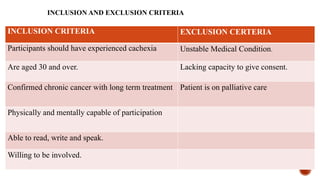
INCLUSION CRITERIA EXCLUSION CERTERIA
Participants should have experienced cachexia Unstable Medical Condition.
Are aged 30 and over. Lacking capacity to give consent.
Confirmed chronic cancer with long term treatment Patient is on palliative care
Physically and mentally capable of participation
Able to read, write and speak.
Willing to be involved.
TOOLS FOR ASSESSMENT
Mid-upper arm circumference.
Skinfold thickness.
Muscle strength: Manual Muscle Testing (MMT)
Weight and BMI.
Blood measures.
FACIT (Functional Assessment of Chronic Illness Therapy) Fatigue Scale
(ordinal data)
FAACT (Functional Assessment Anorexia/Cachexia Therapy scale)
(ordinal data)
Euro QOL five dimensions (EQ-5D) questionnaire (quality of life).
 DISCRIPTION OF TOOL
Skinfold thickness.
The skinfold measurements are typically taken on the right side of the
body, and each site is usually measured two or three times to improve
accuracy.
The calipers are applied perpendicular to the skinfold, approximately 1 cm
above the fingers, and the skinfold is gently grasped and measured.
The measurement is recorded in millimeters (mm).
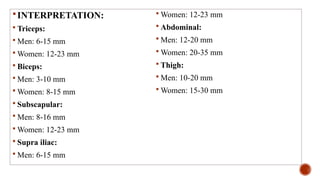
INTERPRETATION:
 Triceps:
 Men: 6-15 mm
 Women: 12-23 mm
 Biceps:
 Men: 3-10 mm
 Women: 8-15 mm
 Subscapular:
 Men: 8-16 mm
 Women: 12-23 mm
 Supra iliac:
 Men: 6-15 mm
 Women: 12-23 mm
 Abdominal:
 Men: 12-20 mm
 Women: 20-35 mm
 Thigh:
 Men: 10-20 mm
 Women: 15-30 mm
MID-UPPER ARM CIRCUMFERENCE.
 Measurement:
 Use a flexible measuring tape (such as a non-stretchable tape) to wrap it around the arm
at the identified midpoint.
 The tape should be snug but not compress the soft tissues of the arm. Make sure the tape
is parallel to the floor and not twisted.
INTERPRETATION:
 Severely malnourished: less than 16 cm (severe cachexia)
 Moderately malnourished: 16-18.4 cm (mild and moderate cachexia)
 Normal or well-nourished: above 18.5 cm ( no cachexia)
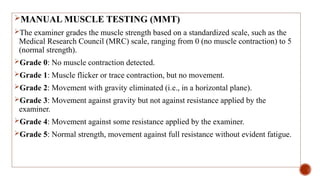
MANUAL MUSCLE TESTING (MMT)
The examiner grades the muscle strength based on a standardized scale, such as the
Medical Research Council (MRC) scale, ranging from 0 (no muscle contraction) to 5
(normal strength).
Grade 0: No muscle contraction detected.
Grade 1: Muscle flicker or trace contraction, but no movement.
Grade 2: Movement with gravity eliminated (i.e., in a horizontal plane).
Grade 3: Movement against gravity but not against resistance applied by the
examiner.
Grade 4: Movement against some resistance applied by the examiner.
Grade 5: Normal strength, movement against full resistance without evident fatigue.
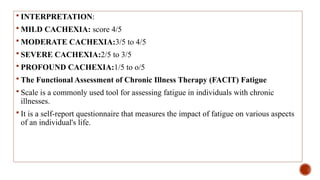
 INTERPRETATION:
 MILD CACHEXIA: score 4/5
 MODERATE CACHEXIA:3/5 to 4/5
 SEVERE CACHEXIA:2/5 to 3/5
 PROFOUND CACHEXIA:1/5 to o/5
 The Functional Assessment of Chronic Illness Therapy (FACIT) Fatigue
 Scale is a commonly used tool for assessing fatigue in individuals with chronic
illnesses.
 It is a self-report questionnaire that measures the impact of fatigue on various aspects
of an individual's life.
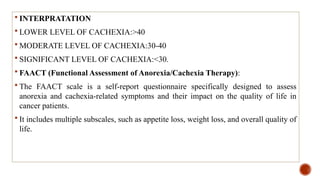
 INTERPRATATION
 LOWER LEVEL OF CACHEXIA:>40
 MODERATE LEVEL OF CACHEXIA:30-40
 SIGNIFICANT LEVEL OF CACHEXIA:<30.
 FAACT (Functional Assessment of Anorexia/Cachexia Therapy):
 The FAACT scale is a self-report questionnaire specifically designed to assess
anorexia and cachexia-related symptoms and their impact on the quality of life in
cancer patients.
 It includes multiple subscales, such as appetite loss, weight loss, and overall quality of
life.
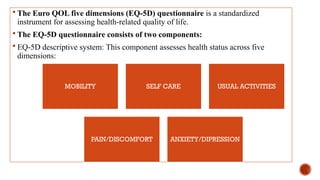
 The Euro QOL five dimensions (EQ-5D) questionnaire is a standardized
instrument for assessing health-related quality of life.
 The EQ-5D questionnaire consists of two components:
 EQ-5D descriptive system: This component assesses health status across five
dimensions:
MOBILITY SELF CARE USUAL ACTIVITIES
PAIN/DISCOMFORT ANXIETY/DIPRESSION
 VALIDITY AND RELIABILITY:
 In this study, tools are valid and reliable to assess the severity of cachexia.
 PILOT STUDY
 In this study pilot study will be conducted after ethical consideration
 DATA COLLECTION PROCEDURE:
 1. DEPARTMENT APPROVAL
 2. ETHICAL CONSIDERATION
 3. INFORMED CONSENT
 PLAN: Conduct semi-structured interviews.
 PLACE: oncology department.
 INTERVENTIONAL TOOL:
 Questionnaires, semi-structured interviews, observation protocols, and measurement
scales.
 DURATION: the time required for each data collection method and allocate
sufficient time accordingly.
 FREQUENCY: collecting data from the same participants at multiple time points
over an extended period.
 TIME: depending on the research objectives, study design, and available resources.
 ADMINISTERD BY: Investigator.
 CONCLUSION:
 The experiences of cancer cachexia among survivors are diverse and unique to each
individual. Qualitative studies have provided valuable insights into the lived
experiences of cancer survivors dealing with cachexia. These studies have highlighted
the physical, emotional, and social challenges faced by patients, including the impact
on body image, self-esteem, and daily activities. The findings emphasize the need for
comprehensive supportive care interventions that address the holistic needs of cancer
survivors with cachexia.
CACHEXIA.pptx..REASEARCH PPT DEEPIKA RAMALIMGAM

CACHEXIA.pptx..REASEARCH PPT DEEPIKA RAMALIMGAM

  • 1.
    COLLEGE OF NURSING, MADRASMEDICAL COLLEGE, CHENNAI-03. M . SC (NURSING), BRANCH - I MEDICAL - SURGICAL NURSING. RESEARCH PROPOSAL
  • 2.
    “THE EXPERIENCES OF CACHEXIAAMONGCANCER SURVIVORS” Deepika. R M . Sc (nursing) I year, Medical surgical nursing, College of nursing, Madras medical college, Chennai-03.
  • 3.
    INTRODUCTION “Cancer cannot cripplelove, it cannot shatter hope, it cannot conquer the spirit.” The term cachexia originates from the Greek root Kakos hexes, which translates into "bad condition," Were recognized for centuries as a progressive deterioration of body habitus. Cachexia is also called wasting syndrome or anorexia cachexia syndrome. Loss of body weight and muscle mass, and weakness that may occur in patients with cancer, AIDS, or other chronic diseases.
  • 4.
    Cont ….. The prominentclinical feature of cachexia is weight loss in adults (fluid retention correction) or growth failure in children (excluding endocrine disorders). Cancer cachexia is characterized by a major decrease in skeletal muscle mass in humans and animals that depends on the severity of the disease/model and the localization of the tumor. Cancer cachexia occurs in about 33% of newly diagnosed patients with cancer and may lead to delayed, missed, or decreased treatments. Cachexia isn’t just associated with cancer. It is common in the advanced stages of other illnesses such as heart disease, HIV, and kidney disease.
  • 5.
    BACKGROUND OF THESTUDY WORLD WIDE LEVEL: Globally, the overall prevalence of cachexia (due to any disease and not necessarily leading to hospital admission) is around 1 % of the patient population, i.e. around 9 million people are affected. The global cancer cachexia market size reached US$ 2.0 Billion in 2022. Looking forward, IMARC Group expects the market to reach US$ 2.6 Billion by 2028, exhibiting a growth rate (CAGR) of 4.5% during 2023-2028. Cachexia seems more common in people with lung cancer or cancers anywhere in the digestive system. Mortality: Mortality rates of patients with cachexia range from 20–80% in cancer cachexia.
  • 6.
    NATIONAL LEVEL India hasaround 2.25 million cases with over 1 lakh new cases being registered every year, according to Cancerindia.org. The Indian Council of Medical Research (ICMR estimates that the country is likely to register over 17 lakh new cases and report over 8 lakh deaths by 2020. The estimated number of incident cases of cancer in India for the year 2022 was found to be 14,61,427 (crude rate:100.4 per 100,000).  In India, one in nine people is likely to develop cancer in his/her lifetime.
  • 7.
    STATE LEVEL We had81,814 cancer cases in 2021. When compared to 2012, when we had 53,022 cases, the incidence of cancer has been increasing gradually in the State,” The annual cancer burden predicted for 2012–16 is 6100 for Chennai, translating to 55 000 new cases per year statewide (in Tamil Nadu) A total of 65,590 cancer cases were diagnosed in 2016 in TN and the estimated cancer burden in 2020 was 78,641. Of this, the highest CIR of cancers was observed in Chennai (140.8) and the least in Krishnagiri (48.5). The incidence of breast cancer in women observed in Chennai (46.4 per 1,00,000 women) was the highest in the country.
  • 8.
    NEED OF THESTUDY "The experiences of cancer cachexia survivors offer invaluable insights that can guide us in developing patient-centered strategies and interventions, ensuring that no aspect of their journey is overlooked." Holistic Understanding Improved Patient Care Quality of Life Treatment and Management Psychological and Social Impact Policy and Advocacy
  • 9.
    STATEMENT OF THEPROBLEM “A STUDY TO EXPLORE THE EXPERIENCES OF CACHEXIAAMONG CANCER SURVIVORS AT TERTIARY CARE CENTRE, CHENNAI” -A QUALITATIVE STUDY.
  • 10.
    OBJECTIVES 1. To identifyand describe the severity of cachexia. 2. To explore and gain an in-depth understanding of the lived experiences of cancer survivors who have encountered cachexia. 3. To investigate the strategies and coping mechanisms employed by cancer survivors to manage cachexia. 4. To identify the support needs of cancer survivors with cachexia.
  • 11.
    CACHEXIA: In this study,cachexia is a complex and multifactorial syndrome characterized by progressive weight loss, muscle wasting, and loss of appetite CANCER: In this study, cancer is a group of diseases characterized by the uncontrolled growth and spread of abnormal cells in the body. CANCER SURVIVORS: In this study, cancer survivors are individuals who have been diagnosed with cancer and have completed their initial treatment, and living with cancer as a chronic condition. EXPERIENCES: In this study, the term experiences refer to the subjective and personal encounters or a particular phenomenon such as weight loss, physical activities, nutritional challenges, impact on emotional well-being, social and functional impact, and coping strategies. OPERATIONAL DEFINITIONS
  • 12.
    ASSUMPTION The participants havea unique experience to share. This assumes that participants are able to accurately recall and articulate their experiences and that they are willing to provide honest and accurate responses. Cancer survivors who have experienced cachexia will report significant physical, emotional, and social impacts on their quality of life compared to cancer survivors who did not experience cachexia." Data collection continues until saturation occurs.
  • 13.
    REVIEW OF LITERATURE S.NOAUTHOR TITLE OF THE STUDY YEAR RESULT 01 Eric J. Roeland Cancer cachexia: the elephant in the room? 2022 All aspects of cancer and cancer cachexia are incredibly complex. As we gain additional insights into cancer cachexia’s intricate pathophysiology and develop novel treatments 02 Subramanian Muthamil Hyun Yong Kim, et al. Understanding the relationship between cancer associated cachexia and hypoxia-inducible factor-1 2023 This review summarizes the basic concepts of cachexia, the role of inflammatory cytokines, pathways connected with cachexia with special reference to the HIF-1 pathway and its regulation, metabolic changes, and inhibitors of HIFs.
  • 14.
    S.N O AUTHOR TITLE YEARRESULT 03 Jose M. Garcia1 , Richard F, e, al Addressing unmet needs for people with cancer cachexia: recommendation s from a multi stake holder workshop 2022 Cachexia remains a significant challenge for many patients with cancer and their caregivers. The persistent lack of awareness and understanding of cachexia among patients and them clinicians are an ongoing challenge. Based on the workshop’s outcomes, the authors see a clear call to action for the community to advance progress In these areas. 04 Jun Ni Li Zhang Cancer Cachexia: Definition, Staging, and Emerging Treatments 2020 The diagnosis of cachexia in patients with cancer has made significant progress over time, evolving from the label “unintentional weight loss” to “cancer cachexia” in the clinical environment
  • 15.
    S.NO AUTHORS TITLEOF THE STUDY YEAR RESULT 05 Matthew A. Carson , et , al. An exploration of the prevalence and experience of cardiac cachexia: protocol for a mixed methods cross-sectional study 2019 cancer cachexia alone resulting in 2 million deaths per annum. Most work in this field has focused on cancer cachexia, with cardiac cachexia being relatively understudied
  • 16.
    METHODOLOGY RESEARCH APPROACH QUALITATIVERESEARCH DESIGN. RESEARCH DESIGN Phenomenological study RESEARCH SETTINGS oncological department, tertiary care Centre, Chennai. POPULATION Cachexic cancer patients. SAMPLE Cancer cachexia patients with inclusion criteria. SAMPLING TECHNIQUE Purposive sampling technique. SAMPLE SIZE 8-12,
  • 17.
    INCLUSION AND EXCLUSIONCRITERIA INCLUSION CRITERIA EXCLUSION CERTERIA Participants should have experienced cachexia Unstable Medical Condition. Are aged 30 and over. Lacking capacity to give consent. Confirmed chronic cancer with long term treatment Patient is on palliative care Physically and mentally capable of participation Able to read, write and speak. Willing to be involved.
  • 18.
    TOOLS FOR ASSESSMENT Mid-upperarm circumference. Skinfold thickness. Muscle strength: Manual Muscle Testing (MMT) Weight and BMI. Blood measures. FACIT (Functional Assessment of Chronic Illness Therapy) Fatigue Scale (ordinal data) FAACT (Functional Assessment Anorexia/Cachexia Therapy scale) (ordinal data) Euro QOL five dimensions (EQ-5D) questionnaire (quality of life).
  • 19.
     DISCRIPTION OFTOOL Skinfold thickness. The skinfold measurements are typically taken on the right side of the body, and each site is usually measured two or three times to improve accuracy. The calipers are applied perpendicular to the skinfold, approximately 1 cm above the fingers, and the skinfold is gently grasped and measured. The measurement is recorded in millimeters (mm).
  • 20.
    INTERPRETATION:  Triceps:  Men:6-15 mm  Women: 12-23 mm  Biceps:  Men: 3-10 mm  Women: 8-15 mm  Subscapular:  Men: 8-16 mm  Women: 12-23 mm  Supra iliac:  Men: 6-15 mm  Women: 12-23 mm  Abdominal:  Men: 12-20 mm  Women: 20-35 mm  Thigh:  Men: 10-20 mm  Women: 15-30 mm
  • 21.
    MID-UPPER ARM CIRCUMFERENCE. Measurement:  Use a flexible measuring tape (such as a non-stretchable tape) to wrap it around the arm at the identified midpoint.  The tape should be snug but not compress the soft tissues of the arm. Make sure the tape is parallel to the floor and not twisted. INTERPRETATION:  Severely malnourished: less than 16 cm (severe cachexia)  Moderately malnourished: 16-18.4 cm (mild and moderate cachexia)  Normal or well-nourished: above 18.5 cm ( no cachexia)
  • 22.
    MANUAL MUSCLE TESTING(MMT) The examiner grades the muscle strength based on a standardized scale, such as the Medical Research Council (MRC) scale, ranging from 0 (no muscle contraction) to 5 (normal strength). Grade 0: No muscle contraction detected. Grade 1: Muscle flicker or trace contraction, but no movement. Grade 2: Movement with gravity eliminated (i.e., in a horizontal plane). Grade 3: Movement against gravity but not against resistance applied by the examiner. Grade 4: Movement against some resistance applied by the examiner. Grade 5: Normal strength, movement against full resistance without evident fatigue.
  • 23.
     INTERPRETATION:  MILDCACHEXIA: score 4/5  MODERATE CACHEXIA:3/5 to 4/5  SEVERE CACHEXIA:2/5 to 3/5  PROFOUND CACHEXIA:1/5 to o/5  The Functional Assessment of Chronic Illness Therapy (FACIT) Fatigue  Scale is a commonly used tool for assessing fatigue in individuals with chronic illnesses.  It is a self-report questionnaire that measures the impact of fatigue on various aspects of an individual's life.
  • 24.
     INTERPRATATION  LOWERLEVEL OF CACHEXIA:>40  MODERATE LEVEL OF CACHEXIA:30-40  SIGNIFICANT LEVEL OF CACHEXIA:<30.  FAACT (Functional Assessment of Anorexia/Cachexia Therapy):  The FAACT scale is a self-report questionnaire specifically designed to assess anorexia and cachexia-related symptoms and their impact on the quality of life in cancer patients.  It includes multiple subscales, such as appetite loss, weight loss, and overall quality of life.
  • 25.
     The EuroQOL five dimensions (EQ-5D) questionnaire is a standardized instrument for assessing health-related quality of life.  The EQ-5D questionnaire consists of two components:  EQ-5D descriptive system: This component assesses health status across five dimensions: MOBILITY SELF CARE USUAL ACTIVITIES PAIN/DISCOMFORT ANXIETY/DIPRESSION
  • 26.
     VALIDITY ANDRELIABILITY:  In this study, tools are valid and reliable to assess the severity of cachexia.  PILOT STUDY  In this study pilot study will be conducted after ethical consideration  DATA COLLECTION PROCEDURE:  1. DEPARTMENT APPROVAL  2. ETHICAL CONSIDERATION  3. INFORMED CONSENT  PLAN: Conduct semi-structured interviews.  PLACE: oncology department.
  • 27.
     INTERVENTIONAL TOOL: Questionnaires, semi-structured interviews, observation protocols, and measurement scales.  DURATION: the time required for each data collection method and allocate sufficient time accordingly.  FREQUENCY: collecting data from the same participants at multiple time points over an extended period.  TIME: depending on the research objectives, study design, and available resources.  ADMINISTERD BY: Investigator.
  • 28.
     CONCLUSION:  Theexperiences of cancer cachexia among survivors are diverse and unique to each individual. Qualitative studies have provided valuable insights into the lived experiences of cancer survivors dealing with cachexia. These studies have highlighted the physical, emotional, and social challenges faced by patients, including the impact on body image, self-esteem, and daily activities. The findings emphasize the need for comprehensive supportive care interventions that address the holistic needs of cancer survivors with cachexia.