JOURNAL CRITIQUE
PRESENTED BY
Deepika R
M Sc nursing I year
College of nursing
Madras medical college.
chennai
ABOUT THE ARTICLE
Dissertation Name _ Dissertation from medical surgical nursing
Source _ From library
Author name _Ms . Durairaj jothisubbulakshmi,II year M.Sc
Nursing.
Month and year _ 2014-2016.
INTRODUCTION
Stroke is a major cause of long term physical ,cognitive , emotional social
and vocational disability . mirror therapy is a physical rehabilitation
measure which uses a mirror of size 20cm width and 30 cm length .clients
are instructed do range of motion exercise with distal joints of affected
hand in front of mirror for 30 minutes daily for 4 weeks so the researcher
proposed to study the effectiveness of mirror therapy on upper limb motor
functions among stroke clients.
TITLE
A STUDY TO ASSESS THE EFFECTIVENESS OF MIRROR
THERAPY ON UPPER LIMB MOTOR FUNCTIONS AMONG
PATIENTS WITH STROKE ADMITTED IN RAJIV GANDHI
GOVERNMENT GENERAL HOSPITAL ,CHENNAI.
OBJECTIVE OF THE STUDY
To compare the effectiveness of mirror therapy on upper limb motor
functions among patients in experimental group with control group.
To identify the association between upper limb motor functions and
selected demographic and clinical variables among the experimental and
control group.
To assess the demographic variables among clients admitted with stroke.
To assess the upper limb muscle tone among clients with stoke by using
Modified Ashworth Scale among experimental and control group.
METHODOLOGY
•STUDY SETTING- Rajiv Gandhi governmental general
medical college and hospital
•STUDY PERIOD- two years Two years.
•STUDY APPROACH-Quantitative approach.
•STUDY DESIGN- Quasi experimental design , pre test-post
test only design.
•Cont…
•STUDY POPULATION -patient with stroke.
•SAMPLE SIZE– 60 clients with acute stroke (30-
Experimental, 30 Control).
•SAMPLING TECHNIQUE-simple random sampling (lottery
method).
•SAMPLE TOOL-modified Ashworth scale , Brunn storm’s
stages of motor recovery.
• Inclusion criteria
• Clients who are,
• Having CT evidence of acute stroke.
• Willing to participate in the study Available during the time of study.
• Clients who are able to understand read and speak .
• Exclusion criteria:
• Stroke clients who are,
• Unconscious.
• Quadriplegic.
ETHICs CONSIDERATION
 This study was conducted after the approval from the Ethical
committee of, Madras medical College, Chennai . Permission was
obtained from Professor and HOD of the Neurology Department and
Director of the Internal Medicine.
 Confidentiality of the study results was ensured. The freedom was
given to the subjects to leave the study at his/her will without assigning
any reason. No routine care was altered or withheld. Thus the
investigator followed the ethical guidelines which were issued by the
research committee. Written permission was obtained from all subjects.
DATA COLLECTION
• Data collection done after approval from ethical
committee, consent from participants.
•Muscle tone and spasticity were score were analyzed by
Modified Ashworth Scale and
•Brunnstorm's stages of motor recovery tool before and
after mirror therapy on upper limb motor functions among
stroke clients.
RESULT
The obtained data were analyzed using paired "t" test. The result
shows that there is significant improvement in hand functioning like
wrist flexion, wrist extension, finger abduction, finger adduction. The
association of level of gain score with selected demographic variable.
Younger, (x2-9.19p-0.02), more educated (x2-9.50 p=0.05) and no
other systematic disease clients (72-7.50 p=0.01**) are benefitted
more than others. Statistical significance was calculated using chi
square test. Hence, it is concluded that Mirror therapy is found to be
effective in Cerebrovascular accident patient.
DISCUSSION
Mirror therapy is a visual feedback imaginery technique Mirror
therapy is a relatively new therapeutic intervention that focuses on
moving the unimpaired limb Mirror therapy involves performing
movements of the unimpaired limbs that creating the visual illusion
of enhanced movement capability of the impaired limb.
CONCLUSION
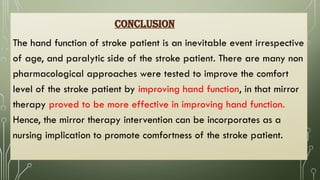
The hand function of stroke patient is an inevitable event irrespective
of age, and paralytic side of the stroke patient. There are many non
pharmacological approaches were tested to improve the comfort
level of the stroke patient by improving hand function, in that mirror
therapy proved to be more effective in improving hand function.
Hence, the mirror therapy intervention can be incorporates as a
nursing implication to promote comfortness of the stroke patient.
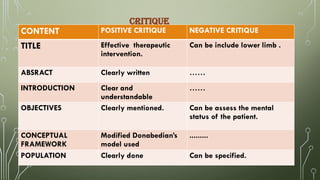
CRITIQUE
CONTENT POSITIVE CRITIQUE NEGATIVE CRITIQUE
TITLE Effective therapeutic
intervention.
Can be include lower limb .
ABSRACT Clearly written ……
INTRODUCTION Clear and
understandable
……
OBJECTIVES Clearly mentioned. Can be assess the mental
status of the patient.
CONCEPTUAL
FRAMEWORK
Modified Donabedian’s
model used
.........
POPULATION Clearly done Can be specified.
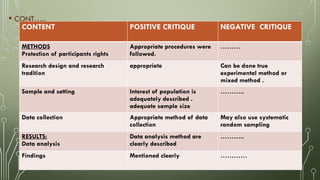
• CONT…..
CONTENT POSITIVE CRITIQUE NEGATIVE CRITIQUE
METHODS
Protection of participants rights
Appropriate procedures were
followed.
………
Research design and research
tradition
appropriate Can be done true
experimental method or
mixed method .
Sample and setting Interest of population is
adequately described .
adequate sample size
………..
Data collection Appropriate method of data
collection
May also use systematic
random sampling
RESULTS:
Data analysis
Data analysis method are
clearly described
………..
Findings Mentioned clearly …………
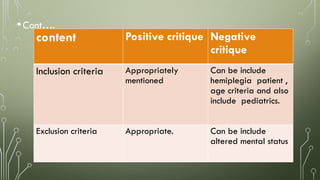
•Cont….
content Positive critique Negative
critique
Inclusion criteria Appropriately
mentioned
Can be include
hemiplegia patient ,
age criteria and also
include pediatrics.
Exclusion criteria Appropriate. Can be include
altered mental status
•Cont….
CONTENT POSITIVE CRITIQUE NEGATIVE
CRITIQUE
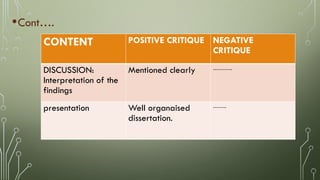
DISCUSSION:
Interpretation of the
findings
Mentioned clearly ……….
presentation Well organaised
dissertation.
…….
THANK YOU

CRITQUE.pptx.DEEPIKA RAMALINGAM,........

  • 1.
    JOURNAL CRITIQUE PRESENTED BY DeepikaR M Sc nursing I year College of nursing Madras medical college. chennai
  • 2.
    ABOUT THE ARTICLE DissertationName _ Dissertation from medical surgical nursing Source _ From library Author name _Ms . Durairaj jothisubbulakshmi,II year M.Sc Nursing. Month and year _ 2014-2016.
  • 3.
    INTRODUCTION Stroke is amajor cause of long term physical ,cognitive , emotional social and vocational disability . mirror therapy is a physical rehabilitation measure which uses a mirror of size 20cm width and 30 cm length .clients are instructed do range of motion exercise with distal joints of affected hand in front of mirror for 30 minutes daily for 4 weeks so the researcher proposed to study the effectiveness of mirror therapy on upper limb motor functions among stroke clients.
  • 4.
    TITLE A STUDY TOASSESS THE EFFECTIVENESS OF MIRROR THERAPY ON UPPER LIMB MOTOR FUNCTIONS AMONG PATIENTS WITH STROKE ADMITTED IN RAJIV GANDHI GOVERNMENT GENERAL HOSPITAL ,CHENNAI.
  • 5.
    OBJECTIVE OF THESTUDY To compare the effectiveness of mirror therapy on upper limb motor functions among patients in experimental group with control group. To identify the association between upper limb motor functions and selected demographic and clinical variables among the experimental and control group. To assess the demographic variables among clients admitted with stroke. To assess the upper limb muscle tone among clients with stoke by using Modified Ashworth Scale among experimental and control group.
  • 6.
    METHODOLOGY •STUDY SETTING- RajivGandhi governmental general medical college and hospital •STUDY PERIOD- two years Two years. •STUDY APPROACH-Quantitative approach. •STUDY DESIGN- Quasi experimental design , pre test-post test only design.
  • 7.
    •Cont… •STUDY POPULATION -patientwith stroke. •SAMPLE SIZE– 60 clients with acute stroke (30- Experimental, 30 Control). •SAMPLING TECHNIQUE-simple random sampling (lottery method). •SAMPLE TOOL-modified Ashworth scale , Brunn storm’s stages of motor recovery.
  • 8.
    • Inclusion criteria •Clients who are, • Having CT evidence of acute stroke. • Willing to participate in the study Available during the time of study. • Clients who are able to understand read and speak . • Exclusion criteria: • Stroke clients who are, • Unconscious. • Quadriplegic.
  • 9.
    ETHICs CONSIDERATION  Thisstudy was conducted after the approval from the Ethical committee of, Madras medical College, Chennai . Permission was obtained from Professor and HOD of the Neurology Department and Director of the Internal Medicine.  Confidentiality of the study results was ensured. The freedom was given to the subjects to leave the study at his/her will without assigning any reason. No routine care was altered or withheld. Thus the investigator followed the ethical guidelines which were issued by the research committee. Written permission was obtained from all subjects.
  • 10.
    DATA COLLECTION • Datacollection done after approval from ethical committee, consent from participants. •Muscle tone and spasticity were score were analyzed by Modified Ashworth Scale and •Brunnstorm's stages of motor recovery tool before and after mirror therapy on upper limb motor functions among stroke clients.
  • 11.
    RESULT The obtained datawere analyzed using paired "t" test. The result shows that there is significant improvement in hand functioning like wrist flexion, wrist extension, finger abduction, finger adduction. The association of level of gain score with selected demographic variable. Younger, (x2-9.19p-0.02), more educated (x2-9.50 p=0.05) and no other systematic disease clients (72-7.50 p=0.01**) are benefitted more than others. Statistical significance was calculated using chi square test. Hence, it is concluded that Mirror therapy is found to be effective in Cerebrovascular accident patient.
  • 12.
    DISCUSSION Mirror therapy isa visual feedback imaginery technique Mirror therapy is a relatively new therapeutic intervention that focuses on moving the unimpaired limb Mirror therapy involves performing movements of the unimpaired limbs that creating the visual illusion of enhanced movement capability of the impaired limb.
  • 13.
    CONCLUSION The hand functionof stroke patient is an inevitable event irrespective of age, and paralytic side of the stroke patient. There are many non pharmacological approaches were tested to improve the comfort level of the stroke patient by improving hand function, in that mirror therapy proved to be more effective in improving hand function. Hence, the mirror therapy intervention can be incorporates as a nursing implication to promote comfortness of the stroke patient.
  • 14.
    CRITIQUE CONTENT POSITIVE CRITIQUENEGATIVE CRITIQUE TITLE Effective therapeutic intervention. Can be include lower limb . ABSRACT Clearly written …… INTRODUCTION Clear and understandable …… OBJECTIVES Clearly mentioned. Can be assess the mental status of the patient. CONCEPTUAL FRAMEWORK Modified Donabedian’s model used ......... POPULATION Clearly done Can be specified.
  • 15.
    • CONT….. CONTENT POSITIVECRITIQUE NEGATIVE CRITIQUE METHODS Protection of participants rights Appropriate procedures were followed. ……… Research design and research tradition appropriate Can be done true experimental method or mixed method . Sample and setting Interest of population is adequately described . adequate sample size ……….. Data collection Appropriate method of data collection May also use systematic random sampling RESULTS: Data analysis Data analysis method are clearly described ……….. Findings Mentioned clearly …………
  • 16.
    •Cont…. content Positive critiqueNegative critique Inclusion criteria Appropriately mentioned Can be include hemiplegia patient , age criteria and also include pediatrics. Exclusion criteria Appropriate. Can be include altered mental status
  • 17.
    •Cont…. CONTENT POSITIVE CRITIQUENEGATIVE CRITIQUE DISCUSSION: Interpretation of the findings Mentioned clearly ………. presentation Well organaised dissertation. …….
  • 18.