


MICROSOFT EXCEL
GRADE 6
Microsoft Excel
is a productivity tool that organize data for easier computation
and presentation. The worksheet area can be used as a
document area of a word processor. Making a table using MS
Excel is much easier than Using MS Word because the gridlines
are already there. Use the command tools to utilize the
program to its full potential. Study the different commands
under each menu category of MS Excel.
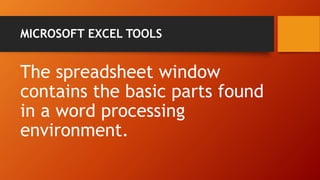
MICROSOFT EXCEL TOOLS
The spreadsheet window
contains the basic parts found
in a word processing
environment.
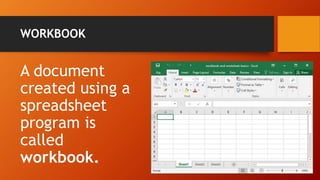
WORKBOOK
A document
created using a
spreadsheet
program is
called
workbook.
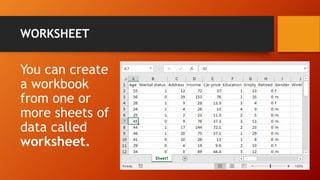
WORKSHEET
You can create
a workbook
from one or
more sheets of
data called
worksheet.
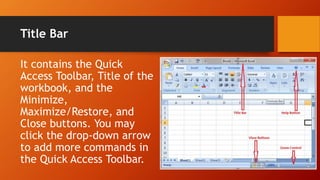
Title Bar
It contains the Quick
Access Toolbar, Title of the
workbook, and the
Minimize,
Maximize/Restore, and
Close buttons. You may
click the drop-down arrow
to add more commands in
the Quick Access Toolbar.
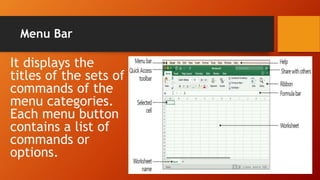
Menu Bar
It displays the
titles of the sets of
commands of the
menu categories.
Each menu button
contains a list of
commands or
options.
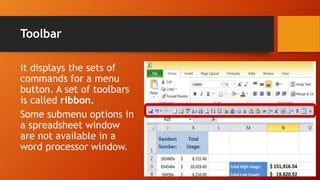
Toolbar
it displays the sets of
commands for a menu
button. A set of toolbars
is called ribbon.
Some submenu options in
a spreadsheet window
are not available in a
word processor window.
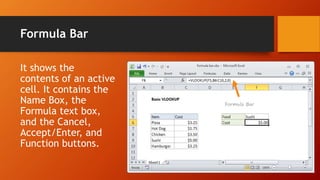
Formula Bar
It shows the
contents of an active
cell. It contains the
Name Box, the
Formula text box,
and the Cancel,
Accept/Enter, and
Function buttons.
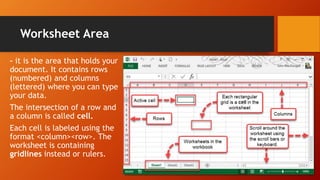
Worksheet Area
– it is the area that holds your
document. It contains rows
(numbered) and columns
(lettered) where you can type
your data.
The intersection of a row and
a column is called cell.
Each cell is labeled using the
format <column><row>. The
worksheet is containing
gridlines instead or rulers.
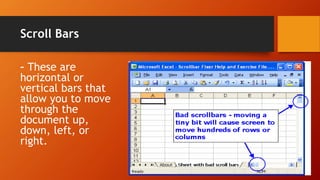
Scroll Bars
– These are
horizontal or
vertical bars that
allow you to move
through the
document up,
down, left, or
right.
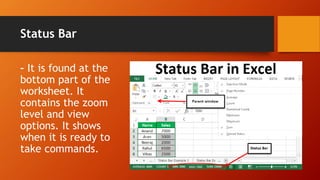
Status Bar
– It is found at the
bottom part of the
worksheet. It
contains the zoom
level and view
options. It shows
when it is ready to
take commands.
Microsoft Excel
is a productivity tool that organize data for easier computation
and presentation. The worksheet area can be used as a
document area of a word processor. Making a table using MS
Excel is much easier than Using MS Word because the gridlines
are already there. Use the command tools to utilize the
program to its full potential. Study the different commands
under each menu category of MS Excel.
THE FILE MENU
The File menu contains commands to manage files. It is the first menu
that you will use to start creating a workbook. It contains the following
basic commands:
• New – Opens a blank workbook or a saved template.
• Open – Opens saved workbooks.
• Save – Saves the current workbook in the desire file location.
• Save As – Saves the current workbook under a new file name and/or
location.
• Print – Prints the current workbook or specific pages in the active
worksheet.
THE HOME MENU
The Home menu allows you to format values in
MS Excel. Formatting can be applied to a cell and
to the data inside it. You can start your workbook
by assigning attributes such as font styles, font
size, font color, and background color to your
data entries. You can also set the title in bold
face or adjust its position inside the cell.
The Home menu contains the following
toolbars:
•Clipboard – Includes the commands
Cut, Copy, Paste, and Format
Painter. The Cut command removes
a selection and places it on the
clipboard so that you can paste it to
a new location.
The Home menu contains the following
toolbars:
•Font – Customizes text, cell border,
and background color of the cell. It
can help you highlight important
headings and/or labels for sorting
related data entries.
The Home menu contains the following
toolbars:
•Alignment – Allows the user
to format text alignment
inside a cell and combine
selected cells into one cell.
The Home menu contains the following
toolbars:
•Number - Customizes how numbers
should appear inside a cell.
Numbers inside a cell can be
formatted to make data more
organized. You may choose to
format numbers to include commas
or decimals for easier computation.
The Home menu contains the following
toolbars:
•Styles – Changes cell styles to
easily spot important data. A
range of cell can be formatted
with its own style using this
toolbar.
The Home menu contains the following
toolbars:
•Cells – Inserts/deletes cell,
row or column. You can also
format row height and
column width to contain data
entries.
The Home menu contains the following
toolbars:
•Editing – Contains the commands
AutoSum, Sort and Filter, Fill,
Find, and Clear. These
commands are useful in editing a
table you have just completed.
THE INSERT MENU
The Insert menu allows you to insert different objects
in the worksheet. You can add or insert objects such as
tables, text, illustrations, charts, symbols, and links.
When conducting a survey using the traditional
methods, that is, giving questionnaires or conducting
an interview, you will need to manually input the
gathered data. You can present the numerical data
using tables and charts to easily analyze the results of
related data.
THE PAGE LAYOUT MENU
You can customize a worksheet’s
layout and add effects to the
worksheet using the Page Layout
menu.
The Page Layout menu contains the following
toolbars and their corresponding functions:
•Themes – Assigns a unique set of
colors, fonts, and effects to each
style. You can change all the colors
used in your document by choosing
a different color palette.
The Page Layout menu contains the following
toolbars and their corresponding functions:
•Page Setup – Allows the user to choose
from several commonly-used margin
format and printing options (like page
size, print area, and page orientation).
You can also choose a background for
your worksheet to customize your
workbook.
The Page Layout menu contains the following
toolbars and their corresponding functions:
•Scale to Fit – Adjust row
height, column width, and
scaling.
The Page Layout menu contains the following
toolbars and their corresponding functions:
•Sheet Options – Contains
checkboxes to allow you to view
and/or print gridlines and headings.
You can deselect the gridlines to
make the worksheet area look like a
document area in word processor.
The Page Layout menu contains the following
toolbars and their corresponding functions:
•Arrange – Arranges the position of
objects in the worksheet. You can
use this toolbar to change the
visibility of a selected object or its
placement on the page.
THE FORMULA MENU
The Formulas menu is one of the
main menus in MS Excel that
helps you perform mathematical
calculations based on formulas
and numbers in other cells.
It contains the following toolbars and their
corresponding functions.
• Function Library – Allows the user to create
formulas from different categories like
statistics, trigonometry, logical, and financial. It
contains a wide range of functions from simple
formatting options like changing ordinary time
to military time to finding the hyperbolic cosine
of a number.
It contains the following toolbars and their
corresponding functions.
•Defined Names – Create, edit,
delete, and find names in your
workbook. You can use names to
define cell references and use them
as substitutes in formulas.
It contains the following toolbars and their
corresponding functions.
•Formula Auditing- Shows tools
that help in checking if the
formula used is correct. It tells
you which cells affect the
selected cell.
It contains the following toolbars and their
corresponding functions.
•Calculation – Allows you to
choose whether to calculate
formula automatically or
manually.
THE DATA MENU
This menu is not found in the MS
Word but it is an important
function in MS Excel.
The following toolbars and their corresponding
functions are found in the Data menu:
•Get External Data - Allows you
to get data from external source
such as Microsoft database, a
webpage, a text file, and other
common sources.
The following toolbars and their corresponding
functions are found in the Data menu:
•Connections- Displays all data
connections for the workbook.
You can also get the latest data
by refreshing all sources in the
workbook.
The following toolbars and their corresponding
functions are found in the Data menu:
•Sort & Filter – Arranges data
in desired order. You can find
values in a column or in a
row using the Filter
command.
The following toolbars and their corresponding
functions are found in the Data menu:
•Data Tools – Consist of commands to
split a column of text into two or
more columns, automatically fill in
values, delete duplicate rows in a
worksheet, and summarize data.
The following toolbars and their corresponding
functions are found in the Data menu:
•Outline – Group or
ungroup a range of
cells.
The following toolbars and their corresponding
functions are found in the Data menu:
•Sort & Filter – Arranges data in
desired order. You can find values
in a column or in a row using the
Filter command.
The following toolbars and their corresponding
functions are found in the Data menu:
•Data Tools – Consist of commands to
split a column of text into two or more
columns, automatically fill in values,
delete duplicate rows in a worksheet,
and summarize data.
The following toolbars and their corresponding
functions are found in the Data menu:
•Outline – Group or
ungroup a range of
cells.
THE REVIEW MENU
The Review menu contains
many useful applications
that are also found in the
Tools menu of MS Word.
Look at the Review menu toolbars and their corresponding functions.
• Proofing – Check you spelling, use a thesaurus, and use tools to define
selected word.
• Language – Translates the selected text into a different language.
• Comments – Allows a user to attach information to a cell, post a
question about a formula, or answer a query in a comment box. This is a
great tool especially for collaborators of a workbook.
• Changes – Protects your worksheet and workbook. You can limit the
ability of other users to edit your worksheets. Also, you may opt to track
any changes made to your workbook.
THE VIEW MENU
The View menu in MS Excel
contains commands not
present in MS Word. scroll
through the rest of sheet.
Below are the toolbars in the View menu and
their corresponding functions.
•Workbook Views – The user can
view how the document will look
when it is printed. You can check
out where pages begin and end. It
also allows you to see any header or
footer on the page.
Below are the toolbars in the View menu and
their corresponding functions.
•Show – The checkboxes
are used to let the choose
which elements are
displayed on the screen.
Below are the toolbars in the View menu and
their corresponding functions.
•Zoom – Magnifies or reduces
zoom level of the street. It
zooms the sheet to help focus on
a specific cell or range of cells.
Below are the toolbars in the View menu and
their corresponding functions.
• Window – Opens a new window for the active
workbook and arrange open windows. You can
choose to divide a window into different panes
that can scroll separately or you can
hide/unhide the current window. The Freeze
Panes command freezes top row, first column,
or a portion of the sheet while you
The number of command tools that you
can use to organize your data may be
overwhelming. With the use to Tooltip,
you can view hints of what a button can
do even before you click it.
THE TOOLTIP
A Tooltip is user interface that displays the functions of
specific command button. There are three ways to
activate the Tooltip:
• by pausing a mouse pointer over a command button
• by focusing on an element using the tab key
• by holding the button
• With this tool, you do not need to memorize the function
of each button on your spreadsheet windows.

Grade 6 COMPUTER

  • 1.
  • 2.
    Microsoft Excel is aproductivity tool that organize data for easier computation and presentation. The worksheet area can be used as a document area of a word processor. Making a table using MS Excel is much easier than Using MS Word because the gridlines are already there. Use the command tools to utilize the program to its full potential. Study the different commands under each menu category of MS Excel.
  • 3.
    MICROSOFT EXCEL TOOLS Thespreadsheet window contains the basic parts found in a word processing environment.
  • 4.
    WORKBOOK A document created usinga spreadsheet program is called workbook.
  • 5.
    WORKSHEET You can create aworkbook from one or more sheets of data called worksheet.
  • 6.
    Title Bar It containsthe Quick Access Toolbar, Title of the workbook, and the Minimize, Maximize/Restore, and Close buttons. You may click the drop-down arrow to add more commands in the Quick Access Toolbar.
  • 7.
    Menu Bar It displaysthe titles of the sets of commands of the menu categories. Each menu button contains a list of commands or options.
  • 8.
    Toolbar it displays thesets of commands for a menu button. A set of toolbars is called ribbon. Some submenu options in a spreadsheet window are not available in a word processor window.
  • 9.
    Formula Bar It showsthe contents of an active cell. It contains the Name Box, the Formula text box, and the Cancel, Accept/Enter, and Function buttons.
  • 10.
    Worksheet Area – itis the area that holds your document. It contains rows (numbered) and columns (lettered) where you can type your data. The intersection of a row and a column is called cell. Each cell is labeled using the format <column><row>. The worksheet is containing gridlines instead or rulers.
  • 11.
    Scroll Bars – Theseare horizontal or vertical bars that allow you to move through the document up, down, left, or right.
  • 12.
    Status Bar – Itis found at the bottom part of the worksheet. It contains the zoom level and view options. It shows when it is ready to take commands.
  • 13.
    Microsoft Excel is aproductivity tool that organize data for easier computation and presentation. The worksheet area can be used as a document area of a word processor. Making a table using MS Excel is much easier than Using MS Word because the gridlines are already there. Use the command tools to utilize the program to its full potential. Study the different commands under each menu category of MS Excel.
  • 14.
    THE FILE MENU TheFile menu contains commands to manage files. It is the first menu that you will use to start creating a workbook. It contains the following basic commands: • New – Opens a blank workbook or a saved template. • Open – Opens saved workbooks. • Save – Saves the current workbook in the desire file location. • Save As – Saves the current workbook under a new file name and/or location. • Print – Prints the current workbook or specific pages in the active worksheet.
  • 15.
    THE HOME MENU TheHome menu allows you to format values in MS Excel. Formatting can be applied to a cell and to the data inside it. You can start your workbook by assigning attributes such as font styles, font size, font color, and background color to your data entries. You can also set the title in bold face or adjust its position inside the cell.
  • 16.
    The Home menucontains the following toolbars: •Clipboard – Includes the commands Cut, Copy, Paste, and Format Painter. The Cut command removes a selection and places it on the clipboard so that you can paste it to a new location.
  • 17.
    The Home menucontains the following toolbars: •Font – Customizes text, cell border, and background color of the cell. It can help you highlight important headings and/or labels for sorting related data entries.
  • 18.
    The Home menucontains the following toolbars: •Alignment – Allows the user to format text alignment inside a cell and combine selected cells into one cell.
  • 19.
    The Home menucontains the following toolbars: •Number - Customizes how numbers should appear inside a cell. Numbers inside a cell can be formatted to make data more organized. You may choose to format numbers to include commas or decimals for easier computation.
  • 20.
    The Home menucontains the following toolbars: •Styles – Changes cell styles to easily spot important data. A range of cell can be formatted with its own style using this toolbar.
  • 21.
    The Home menucontains the following toolbars: •Cells – Inserts/deletes cell, row or column. You can also format row height and column width to contain data entries.
  • 22.
    The Home menucontains the following toolbars: •Editing – Contains the commands AutoSum, Sort and Filter, Fill, Find, and Clear. These commands are useful in editing a table you have just completed.
  • 23.
    THE INSERT MENU TheInsert menu allows you to insert different objects in the worksheet. You can add or insert objects such as tables, text, illustrations, charts, symbols, and links. When conducting a survey using the traditional methods, that is, giving questionnaires or conducting an interview, you will need to manually input the gathered data. You can present the numerical data using tables and charts to easily analyze the results of related data.
  • 24.
    THE PAGE LAYOUTMENU You can customize a worksheet’s layout and add effects to the worksheet using the Page Layout menu.
  • 25.
    The Page Layoutmenu contains the following toolbars and their corresponding functions: •Themes – Assigns a unique set of colors, fonts, and effects to each style. You can change all the colors used in your document by choosing a different color palette.
  • 26.
    The Page Layoutmenu contains the following toolbars and their corresponding functions: •Page Setup – Allows the user to choose from several commonly-used margin format and printing options (like page size, print area, and page orientation). You can also choose a background for your worksheet to customize your workbook.
  • 27.
    The Page Layoutmenu contains the following toolbars and their corresponding functions: •Scale to Fit – Adjust row height, column width, and scaling.
  • 28.
    The Page Layoutmenu contains the following toolbars and their corresponding functions: •Sheet Options – Contains checkboxes to allow you to view and/or print gridlines and headings. You can deselect the gridlines to make the worksheet area look like a document area in word processor.
  • 29.
    The Page Layoutmenu contains the following toolbars and their corresponding functions: •Arrange – Arranges the position of objects in the worksheet. You can use this toolbar to change the visibility of a selected object or its placement on the page.
  • 30.
    THE FORMULA MENU TheFormulas menu is one of the main menus in MS Excel that helps you perform mathematical calculations based on formulas and numbers in other cells.
  • 31.
    It contains thefollowing toolbars and their corresponding functions. • Function Library – Allows the user to create formulas from different categories like statistics, trigonometry, logical, and financial. It contains a wide range of functions from simple formatting options like changing ordinary time to military time to finding the hyperbolic cosine of a number.
  • 32.
    It contains thefollowing toolbars and their corresponding functions. •Defined Names – Create, edit, delete, and find names in your workbook. You can use names to define cell references and use them as substitutes in formulas.
  • 33.
    It contains thefollowing toolbars and their corresponding functions. •Formula Auditing- Shows tools that help in checking if the formula used is correct. It tells you which cells affect the selected cell.
  • 34.
    It contains thefollowing toolbars and their corresponding functions. •Calculation – Allows you to choose whether to calculate formula automatically or manually.
  • 35.
    THE DATA MENU Thismenu is not found in the MS Word but it is an important function in MS Excel.
  • 36.
    The following toolbarsand their corresponding functions are found in the Data menu: •Get External Data - Allows you to get data from external source such as Microsoft database, a webpage, a text file, and other common sources.
  • 37.
    The following toolbarsand their corresponding functions are found in the Data menu: •Connections- Displays all data connections for the workbook. You can also get the latest data by refreshing all sources in the workbook.
  • 38.
    The following toolbarsand their corresponding functions are found in the Data menu: •Sort & Filter – Arranges data in desired order. You can find values in a column or in a row using the Filter command.
  • 39.
    The following toolbarsand their corresponding functions are found in the Data menu: •Data Tools – Consist of commands to split a column of text into two or more columns, automatically fill in values, delete duplicate rows in a worksheet, and summarize data.
  • 40.
    The following toolbarsand their corresponding functions are found in the Data menu: •Outline – Group or ungroup a range of cells.
  • 41.
    The following toolbarsand their corresponding functions are found in the Data menu: •Sort & Filter – Arranges data in desired order. You can find values in a column or in a row using the Filter command.
  • 42.
    The following toolbarsand their corresponding functions are found in the Data menu: •Data Tools – Consist of commands to split a column of text into two or more columns, automatically fill in values, delete duplicate rows in a worksheet, and summarize data.
  • 43.
    The following toolbarsand their corresponding functions are found in the Data menu: •Outline – Group or ungroup a range of cells.
  • 44.
    THE REVIEW MENU TheReview menu contains many useful applications that are also found in the Tools menu of MS Word.
  • 45.
    Look at theReview menu toolbars and their corresponding functions. • Proofing – Check you spelling, use a thesaurus, and use tools to define selected word. • Language – Translates the selected text into a different language. • Comments – Allows a user to attach information to a cell, post a question about a formula, or answer a query in a comment box. This is a great tool especially for collaborators of a workbook. • Changes – Protects your worksheet and workbook. You can limit the ability of other users to edit your worksheets. Also, you may opt to track any changes made to your workbook.
  • 46.
    THE VIEW MENU TheView menu in MS Excel contains commands not present in MS Word. scroll through the rest of sheet.
  • 47.
    Below are thetoolbars in the View menu and their corresponding functions. •Workbook Views – The user can view how the document will look when it is printed. You can check out where pages begin and end. It also allows you to see any header or footer on the page.
  • 48.
    Below are thetoolbars in the View menu and their corresponding functions. •Show – The checkboxes are used to let the choose which elements are displayed on the screen.
  • 49.
    Below are thetoolbars in the View menu and their corresponding functions. •Zoom – Magnifies or reduces zoom level of the street. It zooms the sheet to help focus on a specific cell or range of cells.
  • 50.
    Below are thetoolbars in the View menu and their corresponding functions. • Window – Opens a new window for the active workbook and arrange open windows. You can choose to divide a window into different panes that can scroll separately or you can hide/unhide the current window. The Freeze Panes command freezes top row, first column, or a portion of the sheet while you
  • 51.
    The number ofcommand tools that you can use to organize your data may be overwhelming. With the use to Tooltip, you can view hints of what a button can do even before you click it.
  • 52.
    THE TOOLTIP A Tooltipis user interface that displays the functions of specific command button. There are three ways to activate the Tooltip: • by pausing a mouse pointer over a command button • by focusing on an element using the tab key • by holding the button • With this tool, you do not need to memorize the function of each button on your spreadsheet windows.