WHAT IS GENETICS?
GRADE 8 SCIENCE
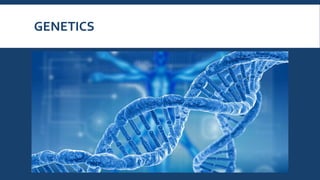
GENETICS
GENETICS
Genetics is a branch
of biology concerned with the
study of genes, genetic variation,
and heredity in organisms.
Definition of biology
1: a branch of knowledge that deals with
living organisms and vital processes
Definition of gene
: a specific sequence of nucleotides in DNA or RNA that is

located usually on a chromosome and that is the functional unit
of inheritance controlling the transmission and expression of one
or more traits by specifying the structure of a
particular polypeptide and especially a protein or controlling the
function of other genetic material
What is meant by genetic variation?
Genetic variation is a term used
to describe the variation in the DNA sequence in
each of our genomes. ... Genetic variation results
in different forms, or alleles?, of genes.
Definition of heredity
1 a: INHERITANCE
b: TRADITION
2 a: the sum of the characteristics and potentialities genetically
derived from one's ancestors
b: the transmission of such qualities from ancestor to
descendant through the genes
Definition of organism
1: a complex structure of interdependent and subordinate
elements whose relations and properties are largely
determined by their function in the whole the nation is not
merely the sum of individual citizens at any given time, but
it is a living organism, a mystical body … of which the
individual is an ephemeral part— Joseph Rossi
GREGOR MENDEL
GENETICS
Though heredity had been observed for millennia,Gregor
Mendel, a scientist and Augustinian friar working in the
19th century, was the first to study genetics scientifically.
Mendel studied "trait inheritance", patterns in the way
traits are handed down from parents to offspring.
He observed that organisms (pea plants) inherit traits by
way of discrete "units of inheritance".
This term, still used today, is a somewhat ambiguous
definition of what is referred to as a gene.
GENETICS
Trait inheritance and molecular inheritance
mechanisms of genes are still primary
principles of genetics in the 21st century, but
modern genetics has expanded beyond
inheritance to studying the function and
behavior of genes.
GENETICS
Gene structure and function,
variation, and distribution are studied
within the context of the cell, the
organism (e.g. dominance), and
within the context of a population.
GENETICS
Genetics has given rise to a number of
subfields, including molecular
genetics, epigenetics and population
genetics.
GENETICS
Organisms studied within the
broad field span the domains
of life (archaea, bacteria,
and eukarya).
Definition of organism
1: a complex structure of interdependent and subordinate
elements whose relations and properties are largely
determined by their function in the whole the nation is not
merely the sum of individual citizens at any given time, but it is
a living organism, a mystical body … of which the individual is
an ephemeral part— Joseph Rossi
Definition of bacteria
Overprescribing antibiotics can contribute to the development of antibiotic-
resistant bacteria.— Maanvi Singh
NOTE: Microscopic single-celled organisms lacking a distinct nucleus are known
as bacteria. They may be shaped like spheres, rods, or spirals. They inhabit virtually
all environments, including soil, water, organic matter, and the bodies of animals.
Many bacteria swim by means of long whiplike structures called flagella. The DNA
of most bacteria is found in a single, circular chromosome, and is distributed
throughout the cytoplasm rather than contained within a membrane-enclosed
nucleus. Though some bacteria can cause food poisoning and infectious diseases
in humans, most are harmless and many are beneficial. They are used in various
industrial processes, especially in the food industry (for example, in the production
of yogurt, cheeses, and pickles).
Definition of bacterium
biology : any of a domain (Bacteria) (see DOMAIN SENSE 8) of chiefly round, spiral, or rod-shaped
single-celled prokaryotic microorganisms that typically live in soil, water, organic matter, or the
bodies of plants and animals, that make their own food especially from sunlight or are saprophytic or
parasitic, are often motile by means of flagella, reproduce especially by binary fission, and include
many important
pathogensbroadly :
PROKARYOTE
NOTE: Bacteria lack a nuclear membrane or membrane-bound organelles and are categorized
as gram-positive or gram-negative when a cell wall is present. While many bacteria are aerobic
requiring the presence of oxygen to survive, others are anaerobic and are able to survive only in the
absence of oxygen.
— compare ARCHAEA, EUKARYOTE
Definition of eukaryote
: any of a domain (Eukarya) or a higher taxonomic group
(Eukaryota) above the kingdom that includes organisms
composed of one or more cells containing visibly evident
nuclei and organelles
GENETICS
Genetic processes work in
combination with an organism's
environment and experiences to
influence development and behavior,
often referred to as nature versus
nurture.
GENETICS
The intracellular or extracellular environment
of a living cell or organism may switch gene
transcription on or off. A classic example is
two seeds of genetically identical corn, one
placed in a temperate climate and one in an
arid climate (lacking sufficient waterfall or
rain).
GENETICS
While the average height of the two corn
stalks may be genetically determined to
be equal, the one in the arid climate only
grows to half the height of the one in the
temperate climate due to lack of water
and nutrients in its environment.
GENETICS ISTHE STUDY OF HEREDITY.
Heredity is a biological process whereby a parent
passes certain genes onto their children or offspring.
Every child inherits genes from both of their biological
parents and these genes, in turn, express specific
traits. Some of these traits may be physical for
example hair and eye color etc.
On the other hand, some genes may also carry the risk
of certain diseases and disorders that may be passed
on from parents to their offspring.
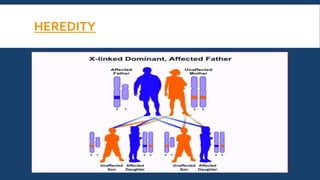
HEREDITY
GENES INTHE CELL
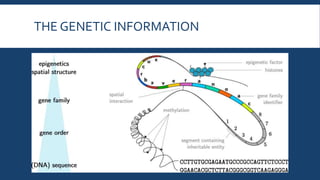
The genetic information lies within the cell
nucleus of each living cell in the body.The
information can be considered to be retained
in a book for example. Part of this book with
the genetic information comes from the
father while the other part comes from the
mother.
THE GENETIC INFORMATION
CHROMOSOMES
The genes lie within the chromosomes.
Humans have 23 pairs of these small
thread-like structures in the nucleus of
their cells. 23 or half of the total 46
comes from the mother while the other
23 comes from the father.
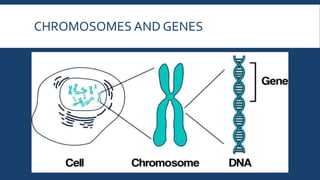
CHROMOSOMES AND GENES
The chromosomes contain genes just like pages
of a book. Some chromosomes may carry
thousands of important genes while some may
carry only a few.
The chromosomes, and therefore the genes, are
made up of the chemical substance called DNA
(DeoxyriboNucleic Acid).The chromosomes are
very long thin strands of DNA, coiled up tightly.
CHROMOSOMES AND GENES
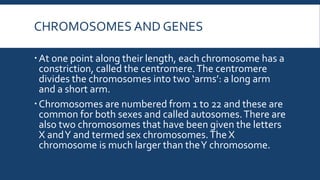
At one point along their length, each chromosome has a
constriction, called the centromere.The centromere
divides the chromosomes into two ‘arms’: a long arm
and a short arm.
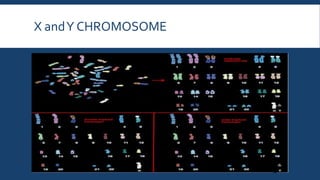
Chromosomes are numbered from 1 to 22 and these are
common for both sexes and called autosomes.There are
also two chromosomes that have been given the letters
X andY and termed sex chromosomes.The X
chromosome is much larger than theY chromosome.
X andY CHROMOSOME
CHEMICAL BASES
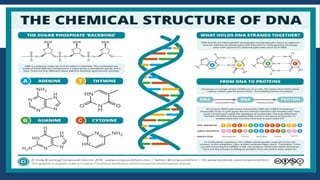
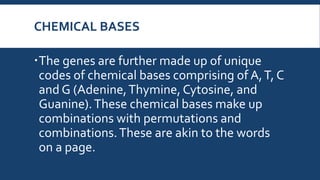
The genes are further made up of unique
codes of chemical bases comprising of A,T, C
and G (Adenine,Thymine, Cytosine, and
Guanine).These chemical bases make up
combinations with permutations and
combinations.These are akin to the words
on a page.
CHEMICAL BASES
These chemical bases are part of the DNA.
The words when strung together act as the
blueprints that tell the cells of the body when
and how to grow, mature and perform
various functions. With age, the genes may
be affected and may develop faults and
damages due to environmental and
endogenous toxins.
MALES AND FEMALES
Women have 46 chromosomes (44
autosomes plus two copies of the X
chromosome) in their body cells.
They have half of this or 22
autosomes plus an X chromosome in
their egg cells.
MALES AND FEMALES
Men have 46 chromosomes (44 autosomes plus
an X and aY chromosome) in their body cells and
have half of these 22 autosomes plus an X orY
chromosome in their sperm cells.
When the egg joins with the sperm, the resultant
baby has 46 chromosomes (with either an XX in a
female baby or XY in a male baby).
GENES AND GENETICS
Each gene is a piece of genetic information. All the
DNA in the cell makes up for the human genome.
There are about 20,000 genes located on one of the 23
chromosome pairs found in the nucleus.
To date, about 12,800 genes have been mapped to
specific locations (loci) on each of the chromosomes.
This database was begun as part of the Human
Genome Project.The project was officially completed
in April 2003 but the exact number of genes in the
human genome is still unknown.
SOURCES
 http://www.nlm.nih.gov/exhibition/harrypottersworld/pdf/prelesson.pdf
 www.genetics.edu.au/.../Genes-and-Chromosomes-FS1
 www.ornl.gov/sci/techresources/Human_Genome/publicat/primer/primer.pdf
 http://www.genome.gov/Pages/Education/Modules/BasicsPresentation.pdf
 http://www.angrau.net/StudyMaterial/GPBR/GPBR111.pdf
FURTHER READING
 All Genetics and Genomics Content
 What are DNA ‘fingerprints’?
 What is a Gene Mutation?
 Advancements in Genome Editing
 What is Achondroplasia?
 DNA Higher-Order Structure Formation
 A new study finds a potential immunotherapeutic pan-
target on cancer cells
 Role ofTrauma on Depression- LinkedGenes
 Understanding bipolar disorder and its potential future
developments
 Considering evolution of the cancer genome in metastatic
disease
 Examining the genetics of cortical myelination in young
adults using MRI
 Role of NPSR1Gene in Sleep
 Importance of Making Single-Stranded DNA
 Mitochondrial and Nuclear Genome Interactions
 How CanWe BuildArtificial Chromosomes?
 Distinct loss-of-function variants cause shared clinical
features in neuronal development disorders
 Nucleosomal DNA Dynamics Mediate Oct4 Pioneer Factor
Binding
 Mutant Splicing Factors asOncogenes
 Epigenetics in Neurobiology
 What is Forensic Epigenetics?
 The Genome of the Microbiome
END

What is genetics

  • 1.
  • 2.
  • 3.
    GENETICS Genetics is abranch of biology concerned with the study of genes, genetic variation, and heredity in organisms.
  • 4.
    Definition of biology 1:a branch of knowledge that deals with living organisms and vital processes
  • 5.
    Definition of gene :a specific sequence of nucleotides in DNA or RNA that is located usually on a chromosome and that is the functional unit of inheritance controlling the transmission and expression of one or more traits by specifying the structure of a particular polypeptide and especially a protein or controlling the function of other genetic material
  • 6.
    What is meantby genetic variation? Genetic variation is a term used to describe the variation in the DNA sequence in each of our genomes. ... Genetic variation results in different forms, or alleles?, of genes.
  • 7.
    Definition of heredity 1a: INHERITANCE b: TRADITION 2 a: the sum of the characteristics and potentialities genetically derived from one's ancestors b: the transmission of such qualities from ancestor to descendant through the genes
  • 8.
    Definition of organism 1:a complex structure of interdependent and subordinate elements whose relations and properties are largely determined by their function in the whole the nation is not merely the sum of individual citizens at any given time, but it is a living organism, a mystical body … of which the individual is an ephemeral part— Joseph Rossi
  • 9.
  • 10.
    GENETICS Though heredity hadbeen observed for millennia,Gregor Mendel, a scientist and Augustinian friar working in the 19th century, was the first to study genetics scientifically. Mendel studied "trait inheritance", patterns in the way traits are handed down from parents to offspring. He observed that organisms (pea plants) inherit traits by way of discrete "units of inheritance". This term, still used today, is a somewhat ambiguous definition of what is referred to as a gene.
  • 11.
    GENETICS Trait inheritance andmolecular inheritance mechanisms of genes are still primary principles of genetics in the 21st century, but modern genetics has expanded beyond inheritance to studying the function and behavior of genes.
  • 12.
    GENETICS Gene structure andfunction, variation, and distribution are studied within the context of the cell, the organism (e.g. dominance), and within the context of a population.
  • 13.
    GENETICS Genetics has givenrise to a number of subfields, including molecular genetics, epigenetics and population genetics.
  • 14.
    GENETICS Organisms studied withinthe broad field span the domains of life (archaea, bacteria, and eukarya).
  • 15.
    Definition of organism 1:a complex structure of interdependent and subordinate elements whose relations and properties are largely determined by their function in the whole the nation is not merely the sum of individual citizens at any given time, but it is a living organism, a mystical body … of which the individual is an ephemeral part— Joseph Rossi
  • 16.
    Definition of bacteria Overprescribingantibiotics can contribute to the development of antibiotic- resistant bacteria.— Maanvi Singh NOTE: Microscopic single-celled organisms lacking a distinct nucleus are known as bacteria. They may be shaped like spheres, rods, or spirals. They inhabit virtually all environments, including soil, water, organic matter, and the bodies of animals. Many bacteria swim by means of long whiplike structures called flagella. The DNA of most bacteria is found in a single, circular chromosome, and is distributed throughout the cytoplasm rather than contained within a membrane-enclosed nucleus. Though some bacteria can cause food poisoning and infectious diseases in humans, most are harmless and many are beneficial. They are used in various industrial processes, especially in the food industry (for example, in the production of yogurt, cheeses, and pickles).
  • 17.
    Definition of bacterium biology: any of a domain (Bacteria) (see DOMAIN SENSE 8) of chiefly round, spiral, or rod-shaped single-celled prokaryotic microorganisms that typically live in soil, water, organic matter, or the bodies of plants and animals, that make their own food especially from sunlight or are saprophytic or parasitic, are often motile by means of flagella, reproduce especially by binary fission, and include many important pathogensbroadly : PROKARYOTE NOTE: Bacteria lack a nuclear membrane or membrane-bound organelles and are categorized as gram-positive or gram-negative when a cell wall is present. While many bacteria are aerobic requiring the presence of oxygen to survive, others are anaerobic and are able to survive only in the absence of oxygen. — compare ARCHAEA, EUKARYOTE
  • 18.
    Definition of eukaryote :any of a domain (Eukarya) or a higher taxonomic group (Eukaryota) above the kingdom that includes organisms composed of one or more cells containing visibly evident nuclei and organelles
  • 19.
    GENETICS Genetic processes workin combination with an organism's environment and experiences to influence development and behavior, often referred to as nature versus nurture.
  • 20.
    GENETICS The intracellular orextracellular environment of a living cell or organism may switch gene transcription on or off. A classic example is two seeds of genetically identical corn, one placed in a temperate climate and one in an arid climate (lacking sufficient waterfall or rain).
  • 21.
    GENETICS While the averageheight of the two corn stalks may be genetically determined to be equal, the one in the arid climate only grows to half the height of the one in the temperate climate due to lack of water and nutrients in its environment.
  • 22.
    GENETICS ISTHE STUDYOF HEREDITY. Heredity is a biological process whereby a parent passes certain genes onto their children or offspring. Every child inherits genes from both of their biological parents and these genes, in turn, express specific traits. Some of these traits may be physical for example hair and eye color etc. On the other hand, some genes may also carry the risk of certain diseases and disorders that may be passed on from parents to their offspring.
  • 23.
  • 24.
    GENES INTHE CELL Thegenetic information lies within the cell nucleus of each living cell in the body.The information can be considered to be retained in a book for example. Part of this book with the genetic information comes from the father while the other part comes from the mother.
  • 25.
  • 26.
    CHROMOSOMES The genes liewithin the chromosomes. Humans have 23 pairs of these small thread-like structures in the nucleus of their cells. 23 or half of the total 46 comes from the mother while the other 23 comes from the father.
  • 27.
  • 28.
    CHROMOSOMES AND GENES Thechromosomes contain genes just like pages of a book. Some chromosomes may carry thousands of important genes while some may carry only a few. The chromosomes, and therefore the genes, are made up of the chemical substance called DNA (DeoxyriboNucleic Acid).The chromosomes are very long thin strands of DNA, coiled up tightly.
  • 29.
    CHROMOSOMES AND GENES Atone point along their length, each chromosome has a constriction, called the centromere.The centromere divides the chromosomes into two ‘arms’: a long arm and a short arm. Chromosomes are numbered from 1 to 22 and these are common for both sexes and called autosomes.There are also two chromosomes that have been given the letters X andY and termed sex chromosomes.The X chromosome is much larger than theY chromosome.
  • 31.
  • 32.
    CHEMICAL BASES The genesare further made up of unique codes of chemical bases comprising of A,T, C and G (Adenine,Thymine, Cytosine, and Guanine).These chemical bases make up combinations with permutations and combinations.These are akin to the words on a page.
  • 33.
    CHEMICAL BASES These chemicalbases are part of the DNA. The words when strung together act as the blueprints that tell the cells of the body when and how to grow, mature and perform various functions. With age, the genes may be affected and may develop faults and damages due to environmental and endogenous toxins.
  • 34.
    MALES AND FEMALES Womenhave 46 chromosomes (44 autosomes plus two copies of the X chromosome) in their body cells. They have half of this or 22 autosomes plus an X chromosome in their egg cells.
  • 35.
    MALES AND FEMALES Menhave 46 chromosomes (44 autosomes plus an X and aY chromosome) in their body cells and have half of these 22 autosomes plus an X orY chromosome in their sperm cells. When the egg joins with the sperm, the resultant baby has 46 chromosomes (with either an XX in a female baby or XY in a male baby).
  • 36.
    GENES AND GENETICS Eachgene is a piece of genetic information. All the DNA in the cell makes up for the human genome. There are about 20,000 genes located on one of the 23 chromosome pairs found in the nucleus. To date, about 12,800 genes have been mapped to specific locations (loci) on each of the chromosomes. This database was begun as part of the Human Genome Project.The project was officially completed in April 2003 but the exact number of genes in the human genome is still unknown.
  • 37.
    SOURCES  http://www.nlm.nih.gov/exhibition/harrypottersworld/pdf/prelesson.pdf  www.genetics.edu.au/.../Genes-and-Chromosomes-FS1 www.ornl.gov/sci/techresources/Human_Genome/publicat/primer/primer.pdf  http://www.genome.gov/Pages/Education/Modules/BasicsPresentation.pdf  http://www.angrau.net/StudyMaterial/GPBR/GPBR111.pdf
  • 38.
    FURTHER READING  AllGenetics and Genomics Content  What are DNA ‘fingerprints’?  What is a Gene Mutation?  Advancements in Genome Editing  What is Achondroplasia?  DNA Higher-Order Structure Formation  A new study finds a potential immunotherapeutic pan- target on cancer cells  Role ofTrauma on Depression- LinkedGenes  Understanding bipolar disorder and its potential future developments  Considering evolution of the cancer genome in metastatic disease  Examining the genetics of cortical myelination in young adults using MRI  Role of NPSR1Gene in Sleep  Importance of Making Single-Stranded DNA  Mitochondrial and Nuclear Genome Interactions  How CanWe BuildArtificial Chromosomes?  Distinct loss-of-function variants cause shared clinical features in neuronal development disorders  Nucleosomal DNA Dynamics Mediate Oct4 Pioneer Factor Binding  Mutant Splicing Factors asOncogenes  Epigenetics in Neurobiology  What is Forensic Epigenetics?  The Genome of the Microbiome
  • 39.