Teacher: KRESGE D. ELUMBARING-
PACATANG
COMPUTER BASICS
THE PARTS OF A DESKTOP
1
REVIEW OF THE
PREVIOUS LESSONS
2
LOOKING BACK3
• What is a computer?
• What are the types of
computerS?
• Why do we need all these
computers?
• How do you differentiate a
hardware and a software?
• How does a computer
works?
4
OBJECTIVES
 Identify the different parts of the
desktop.
 Locate the parts of the desktop using
the mouse.
 Appreciate the importance of
remembering the parts of the
desktop.
5
What are the
parts of the
Desktop?
6
7
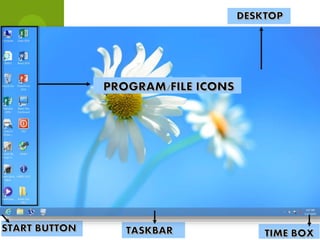
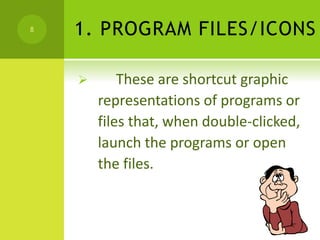
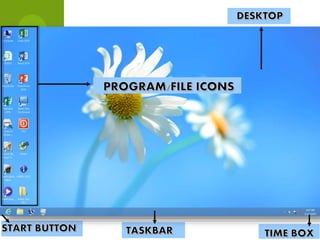
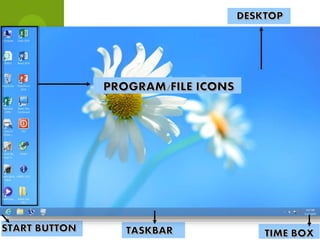
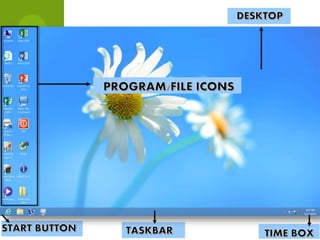
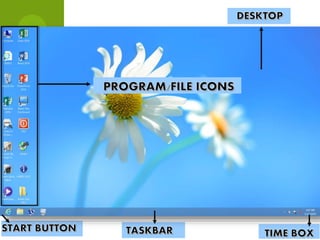
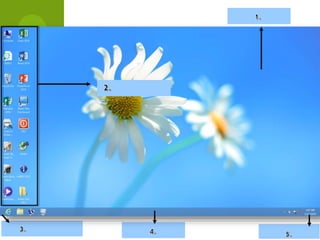
1. PROGRAM FILES/ICONS
 These are shortcut graphic
representations of programs or
files that, when double-clicked,
launch the programs or open
the files.
8
9
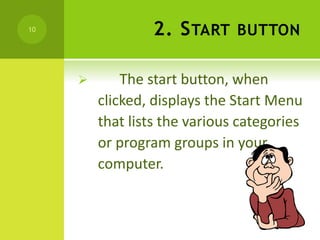
2. START BUTTON
 The start button, when
clicked, displays the Start Menu
that lists the various categories
or program groups in your
computer.
10
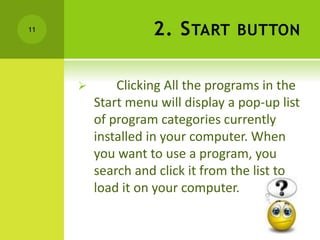
2. START BUTTON
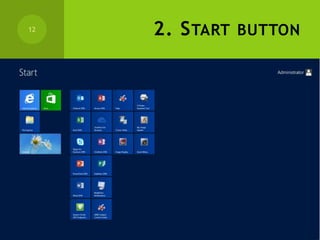
 Clicking All the programs in the
Start menu will display a pop-up list
of program categories currently
installed in your computer. When
you want to use a program, you
search and click it from the list to
load it on your computer.
11
2. START BUTTON12
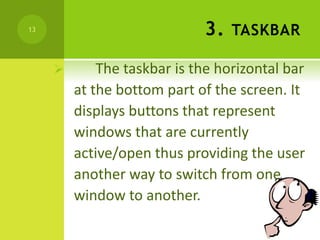
3. TASKBAR
 The taskbar is the horizontal bar
at the bottom part of the screen. It
displays buttons that represent
windows that are currently
active/open thus providing the user
another way to switch from one
window to another.
13
3. TASKBAR
 This can also be done by
pressing the Alt and Tab key
simultaneously (Alt + Tab). The
right hand side of the taskbar
displays program icons for easy
access including the time box.
14
15
4. TIME BOX
 This part shows the current time
and date when the mouse is put
over the time box.
16
17
5. DESKTOP
 It shows the working environment
for the Windows operating
system. It makes of the Graphical
User Interface (GUI) that makes
use of graphic symbols or icons to
represent programs, files, and
folders that can be directly
accessed with the use of the
mouse.
18
19
ACTIVITY
Directions:
 Try handling the mouse to locate the parts of
a desktop.
 The mouse is represented on a desktop by a
white arrow. This is called a pointer. The
pointer is used to access, load/close, and
manipulate programs, commands, files, or
folders.
20
ACTIVITY
 Move the pointer over the different parts of
a desktop.
 Then move the pointer over the Start button
at the bottom left portion of the screen.
Click the left mouse button. This will pop up
the Start Menu that lists commonly accessed
programs.
 Moving the pointer to All Programs will
show most of the application softwares in
your computer.
21
SHORT QUIZ
 Prepare ¼ size of paper
22
23
ASSIGNMENT
 Give the 10 different parts of a
typical screen of a Windows
application and its function.
24
Thank you!
25

Basic Parts of a Desktop

  • 1.
    Teacher: KRESGE D.ELUMBARING- PACATANG COMPUTER BASICS THE PARTS OF A DESKTOP 1
  • 2.
  • 3.
  • 4.
    • What isa computer? • What are the types of computerS? • Why do we need all these computers? • How do you differentiate a hardware and a software? • How does a computer works? 4
  • 5.
    OBJECTIVES  Identify thedifferent parts of the desktop.  Locate the parts of the desktop using the mouse.  Appreciate the importance of remembering the parts of the desktop. 5
  • 6.
    What are the partsof the Desktop? 6
  • 7.
  • 8.
    1. PROGRAM FILES/ICONS These are shortcut graphic representations of programs or files that, when double-clicked, launch the programs or open the files. 8
  • 9.
  • 10.
    2. START BUTTON The start button, when clicked, displays the Start Menu that lists the various categories or program groups in your computer. 10
  • 11.
    2. START BUTTON Clicking All the programs in the Start menu will display a pop-up list of program categories currently installed in your computer. When you want to use a program, you search and click it from the list to load it on your computer. 11
  • 12.
  • 13.
    3. TASKBAR  Thetaskbar is the horizontal bar at the bottom part of the screen. It displays buttons that represent windows that are currently active/open thus providing the user another way to switch from one window to another. 13
  • 14.
    3. TASKBAR  Thiscan also be done by pressing the Alt and Tab key simultaneously (Alt + Tab). The right hand side of the taskbar displays program icons for easy access including the time box. 14
  • 15.
  • 16.
    4. TIME BOX This part shows the current time and date when the mouse is put over the time box. 16
  • 17.
  • 18.
    5. DESKTOP  Itshows the working environment for the Windows operating system. It makes of the Graphical User Interface (GUI) that makes use of graphic symbols or icons to represent programs, files, and folders that can be directly accessed with the use of the mouse. 18
  • 19.
  • 20.
    ACTIVITY Directions:  Try handlingthe mouse to locate the parts of a desktop.  The mouse is represented on a desktop by a white arrow. This is called a pointer. The pointer is used to access, load/close, and manipulate programs, commands, files, or folders. 20
  • 21.
    ACTIVITY  Move thepointer over the different parts of a desktop.  Then move the pointer over the Start button at the bottom left portion of the screen. Click the left mouse button. This will pop up the Start Menu that lists commonly accessed programs.  Moving the pointer to All Programs will show most of the application softwares in your computer. 21
  • 22.
    SHORT QUIZ  Prepare¼ size of paper 22
  • 23.
  • 24.
    ASSIGNMENT  Give the10 different parts of a typical screen of a Windows application and its function. 24
  • 25.