Microsoft
Microsoft
Excel
Excel
Global Information Internship Program
Created By: Jamie McPike 2003
Return to Table of Contents
How to Use Tutorial
How to Use Tutorial
Step 1> The next page will show you the table of contents
Step 4> Once you become familiar with this application you can use
this tutorial as a reference tool.
Step 2> Use the mouse and click on the topic links to begin learning
Step 3> You can learn at your own pace, click on the Action buttons
to review the material as much as you need to.
To begin learning click on this button>>
Return to Table of Contents
Table of Contents
Table of Contents
1_ Introduction to Excel
2_ Overview of the Excel Screen
3_ The Excel Menus:
File Menu
Edit Menu
Insert Menu
Format Menu
View Menu
Help Menu and Office Assistant
4_ Excel Worksheets
5_ Entering Formulas and Data
6_ Formatting Workbooks
7_ Charts
8_ Freezing Panes
9_ Printing
10_ Keyboard Shortcuts
Return to Table of Contents
Excel is a computer program used to create electronic
spreadsheets. Within Excel, users can organize data,
create charts, and perform calculations. Excel is a
convenient program because it allows the user to create
large spreadsheets, reference information from other
spreadsheets, and it allows for better storage and
modification of information. Excel operates like other
Microsoft (MS) Office programs and has many of the
same functions and shortcuts of other MS programs.
Introduction to Excel
Return to Table of Contents
Overview of the Excel
Screen
Screen
Before working with Excel, it is essential to first become familiar with the
Excel screen. The following will help you to recognize the various parts of an
Excel screen and their functions.
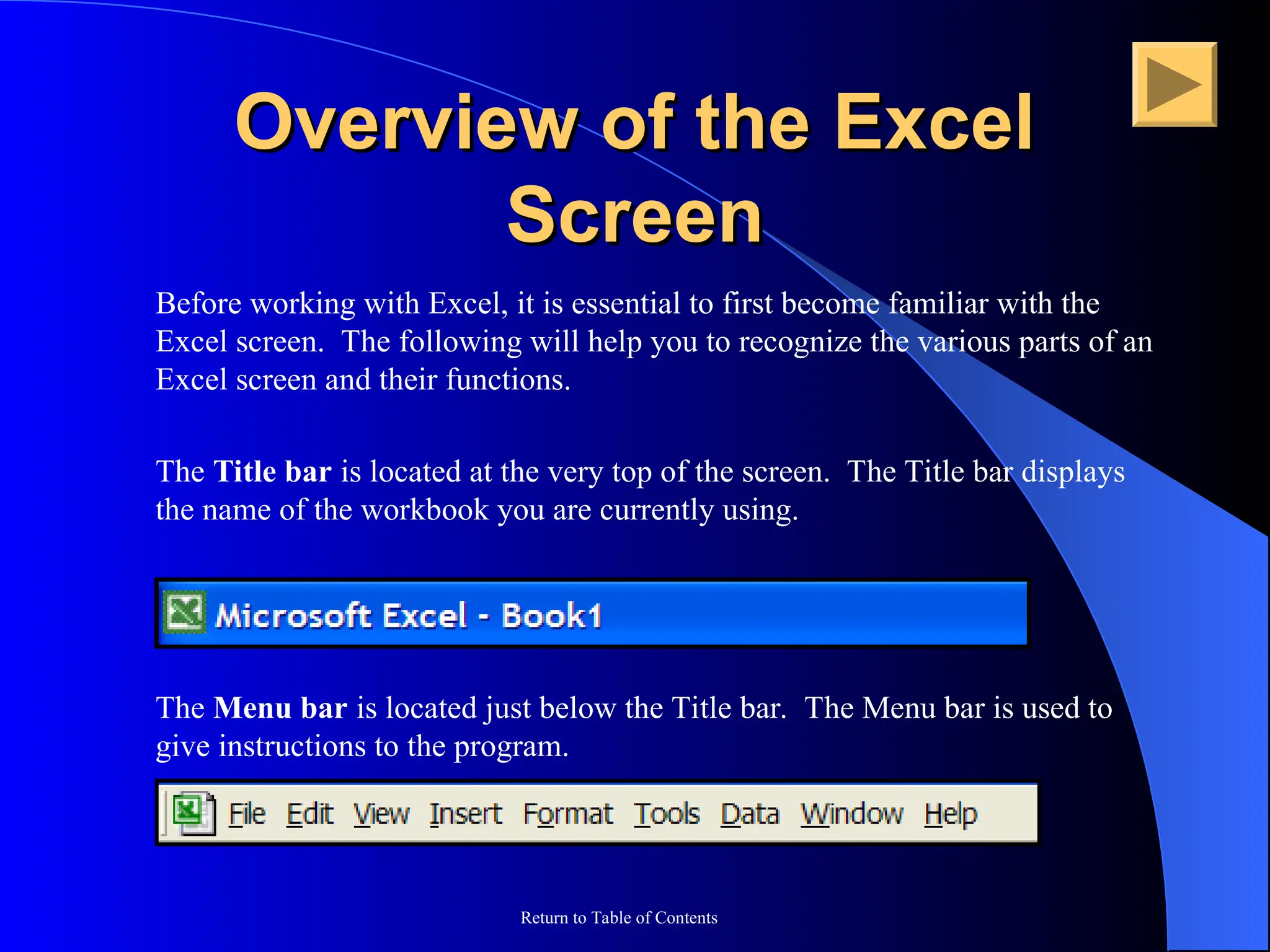
The Title bar is located at the very top of the screen. The Title bar displays
the name of the workbook you are currently using.
The Menu bar is located just below the Title bar. The Menu bar is used to
give instructions to the program.
Return to Table of Contents
Overview of the Excel
Screen
Screen
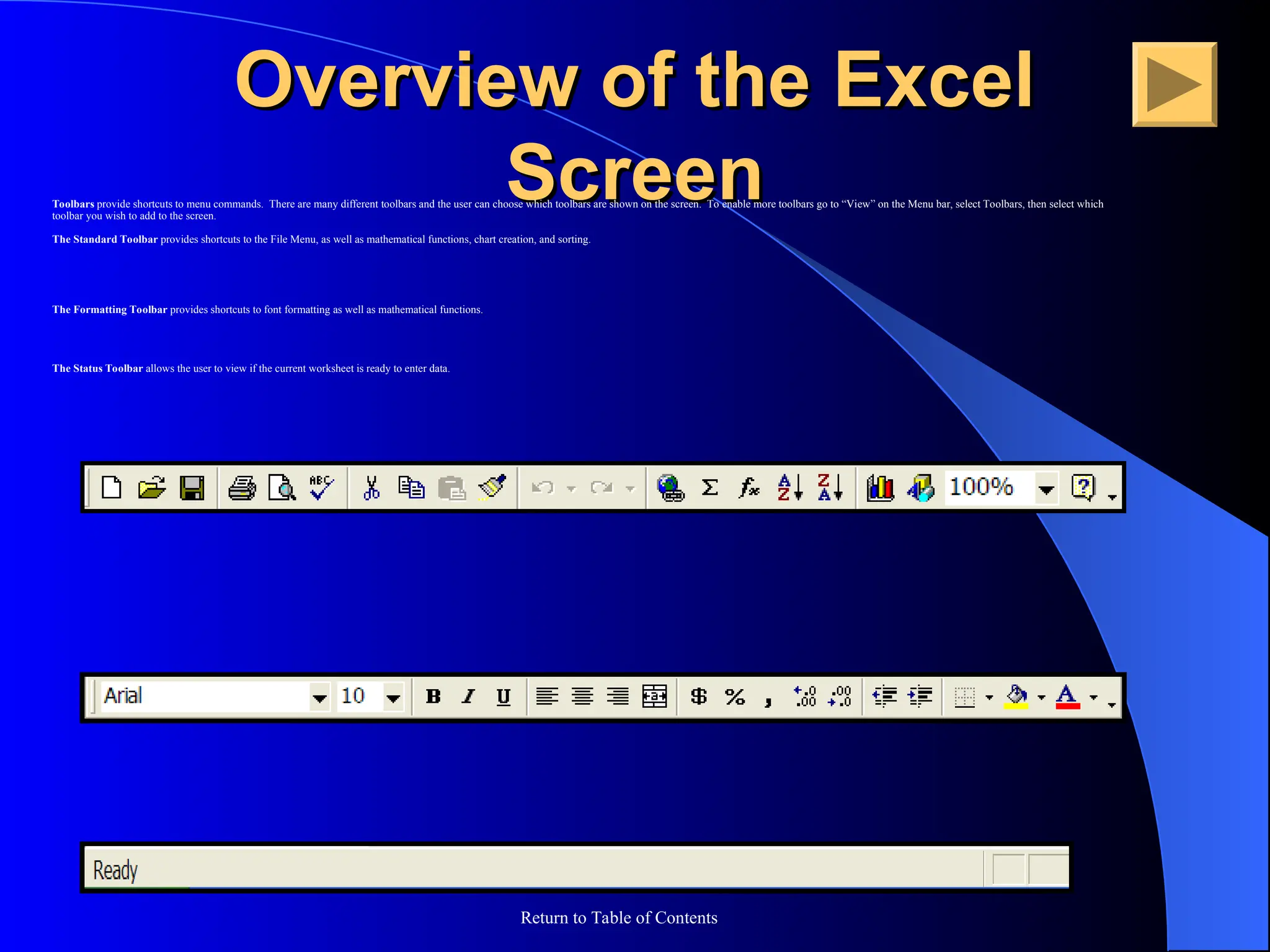
Toolbars provide shortcuts to menu commands. There are many different toolbars and the user can choose which toolbars are shown on the screen. To enable more toolbars go to “View” on the Menu bar, select Toolbars, then select which
toolbar you wish to add to the screen.
The Standard Toolbar provides shortcuts to the File Menu, as well as mathematical functions, chart creation, and sorting.
The Formatting Toolbar provides shortcuts to font formatting as well as mathematical functions.
The Status Toolbar allows the user to view if the current worksheet is ready to enter data.
Return to Table of Contents
Overview of the Excel
Screen
Screen
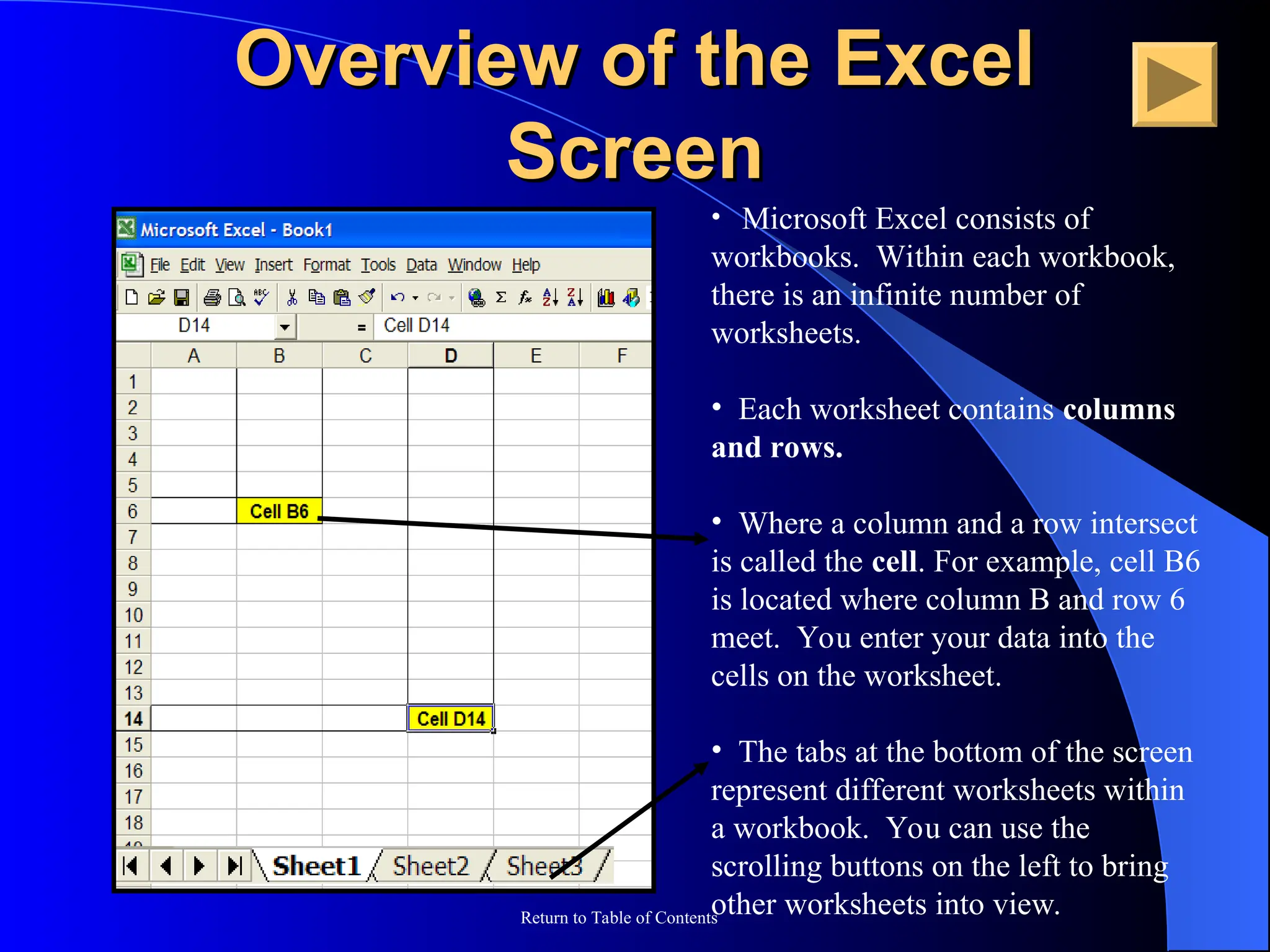
• Microsoft Excel consists of
workbooks. Within each workbook,
there is an infinite number of
worksheets.
• Each worksheet contains columns
and rows.
• Where a column and a row intersect
is called the cell. For example, cell B6
is located where column B and row 6
meet. You enter your data into the
cells on the worksheet.
• The tabs at the bottom of the screen
represent different worksheets within
a workbook. You can use the
scrolling buttons on the left to bring
other worksheets into view.
Return to Table of Contents
Overview of the Excel
Screen
Screen
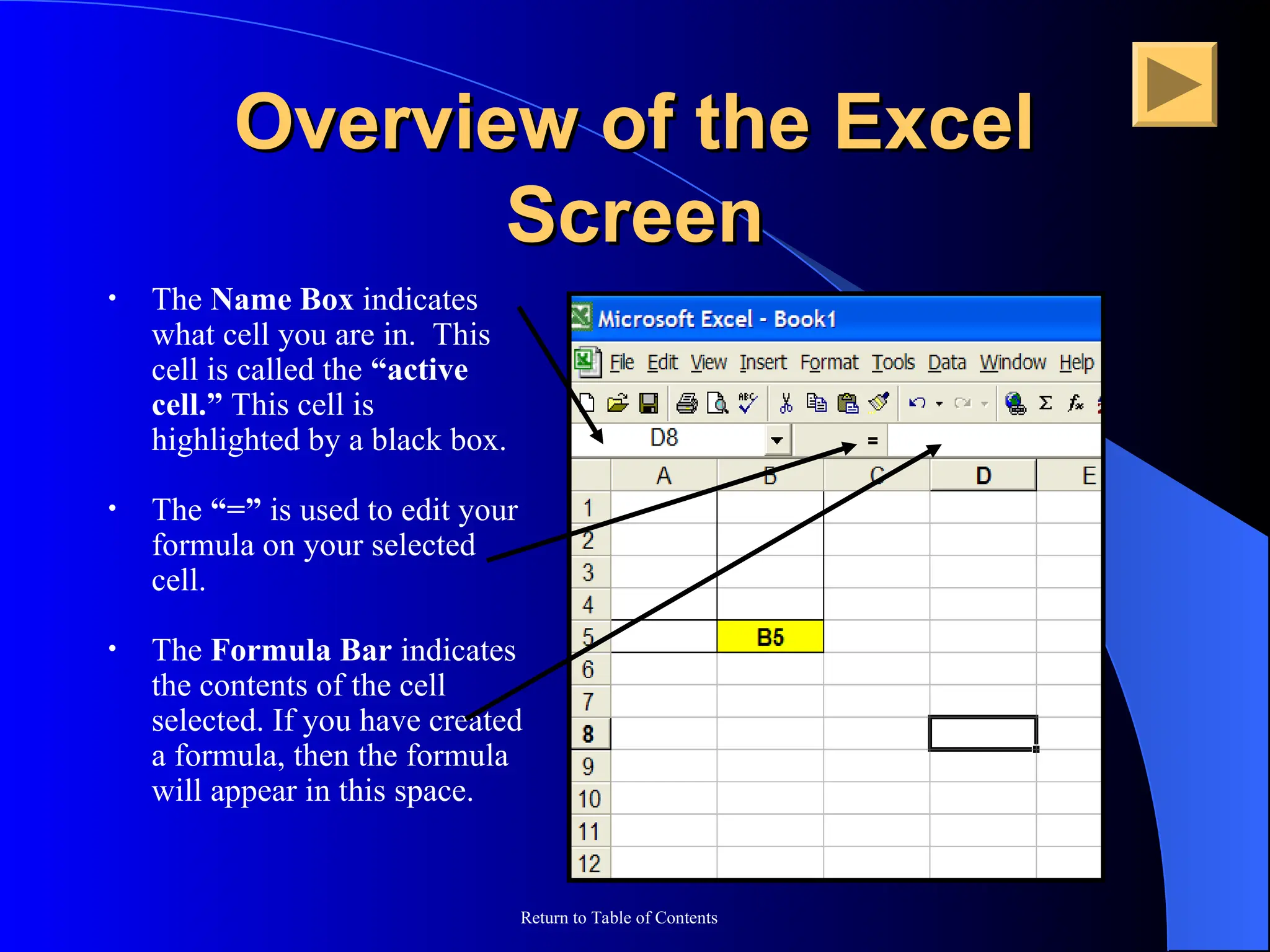
• The Name Box indicates
what cell you are in. This
cell is called the “active
cell.” This cell is
highlighted by a black box.
• The “=” is used to edit your
formula on your selected
cell.
• The Formula Bar indicates
the contents of the cell
selected. If you have created
a formula, then the formula
will appear in this space.
Return to Table of Contents
File Menu
File Menu
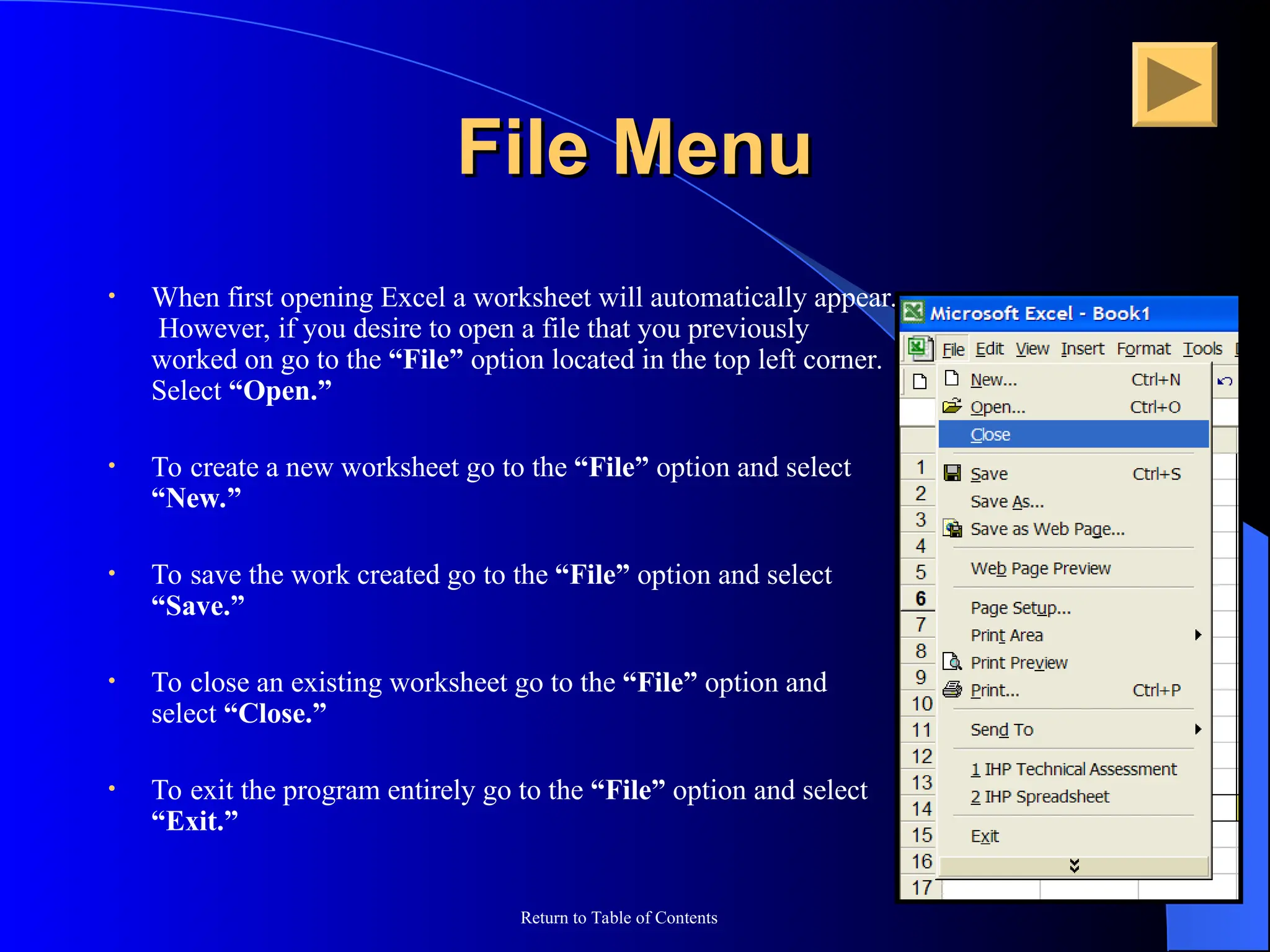
• When first opening Excel a worksheet will automatically appear.
However, if you desire to open a file that you previously
worked on go to the “File” option located in the top left corner.
Select “Open.”
• To create a new worksheet go to the “File” option and select
“New.”
• To save the work created go to the “File” option and select
“Save.”
• To close an existing worksheet go to the “File” option and
select “Close.”
• To exit the program entirely go to the “File” option and select
“Exit.”
Return to Table of Contents
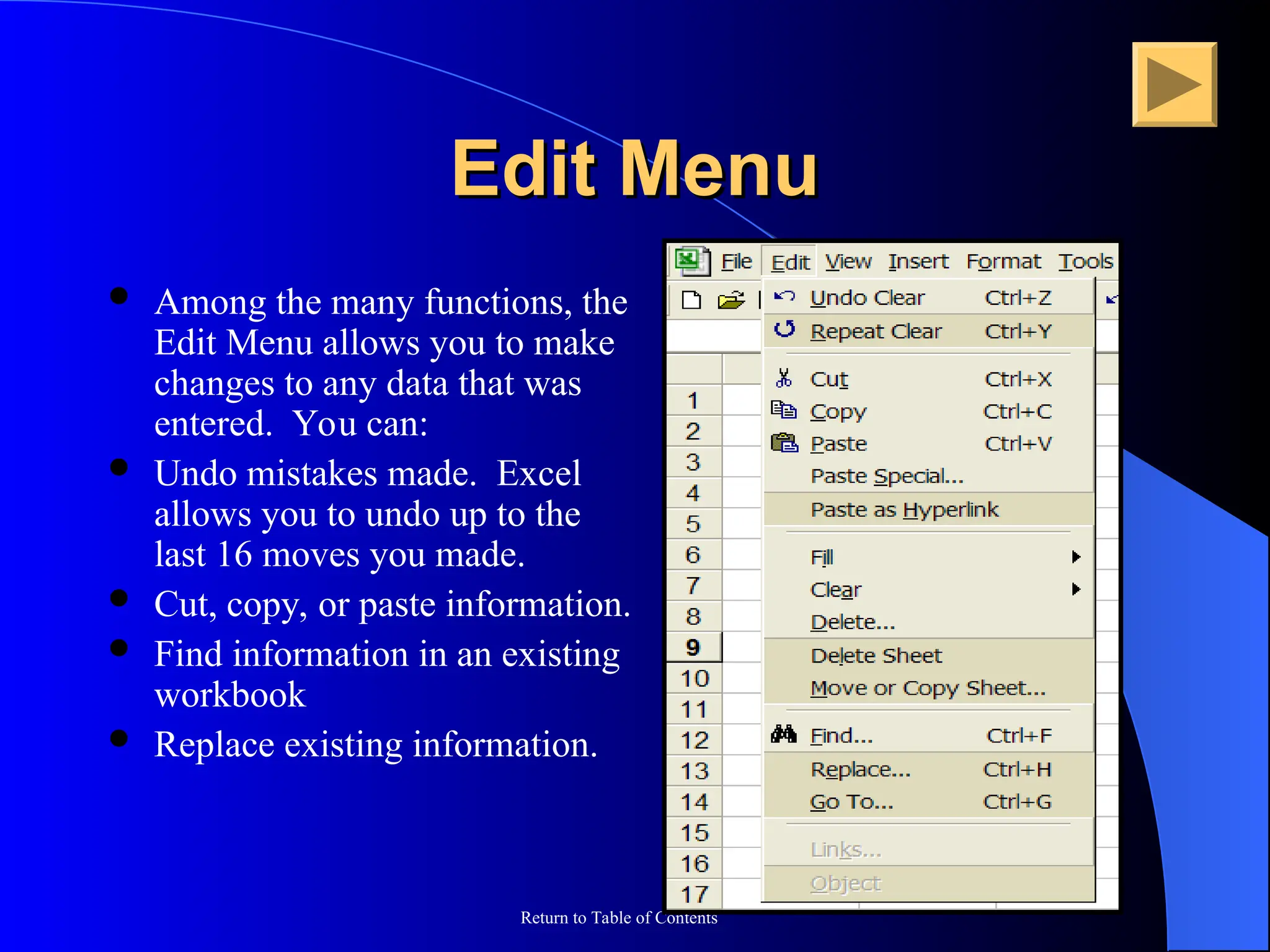
Edit Menu
Edit Menu
 Among the many functions, the
Edit Menu allows you to make
changes to any data that was
entered. You can:
 Undo mistakes made. Excel
allows you to undo up to the
last 16 moves you made.
 Cut, copy, or paste information.
 Find information in an existing
workbook
 Replace existing information.
Return to Table of Contents
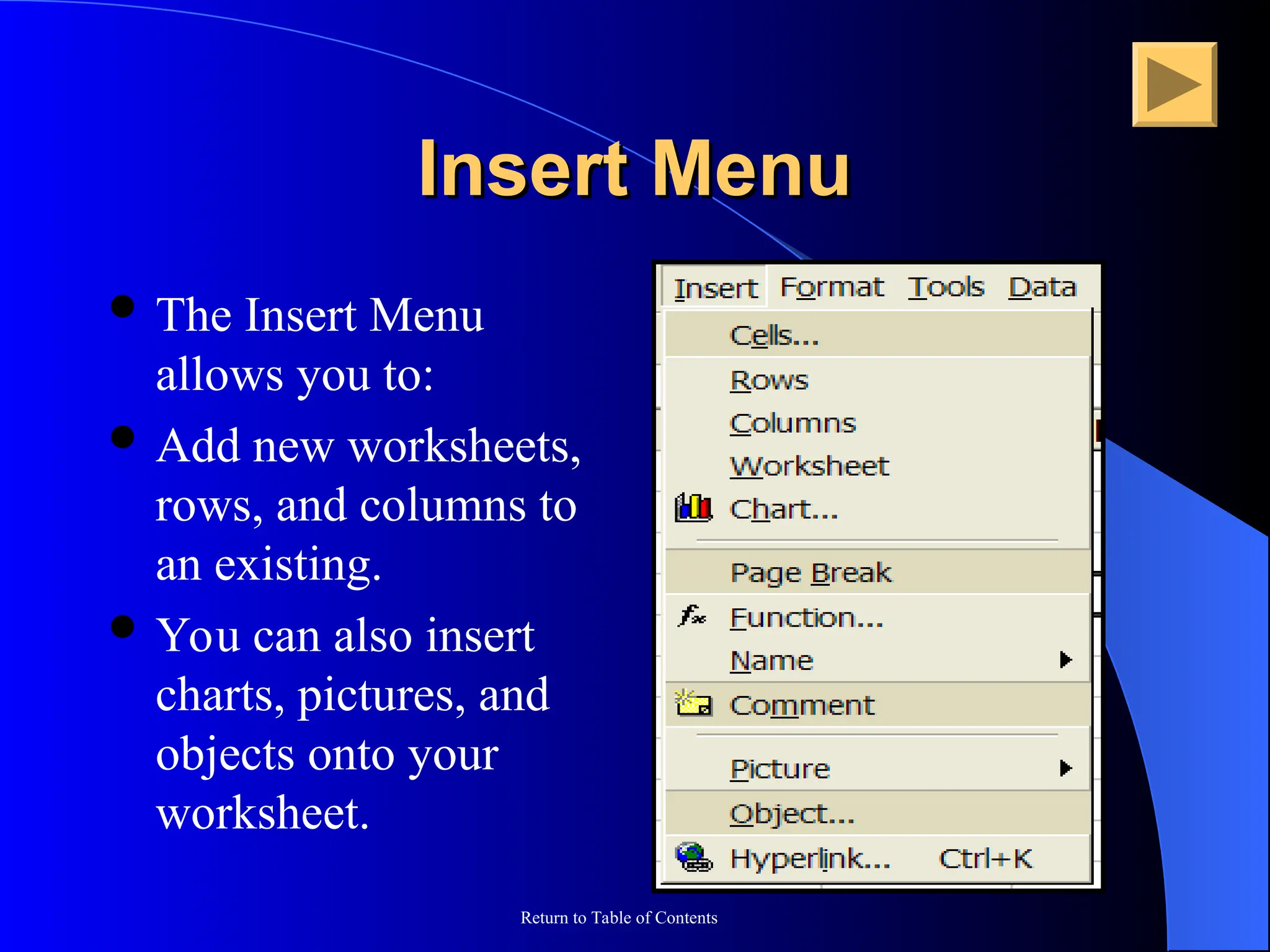
Insert Menu
Insert Menu
 The Insert Menu
allows you to:
 Add new worksheets,
rows, and columns to
an existing.
 You can also insert
charts, pictures, and
objects onto your
worksheet.
Return to Table of Contents
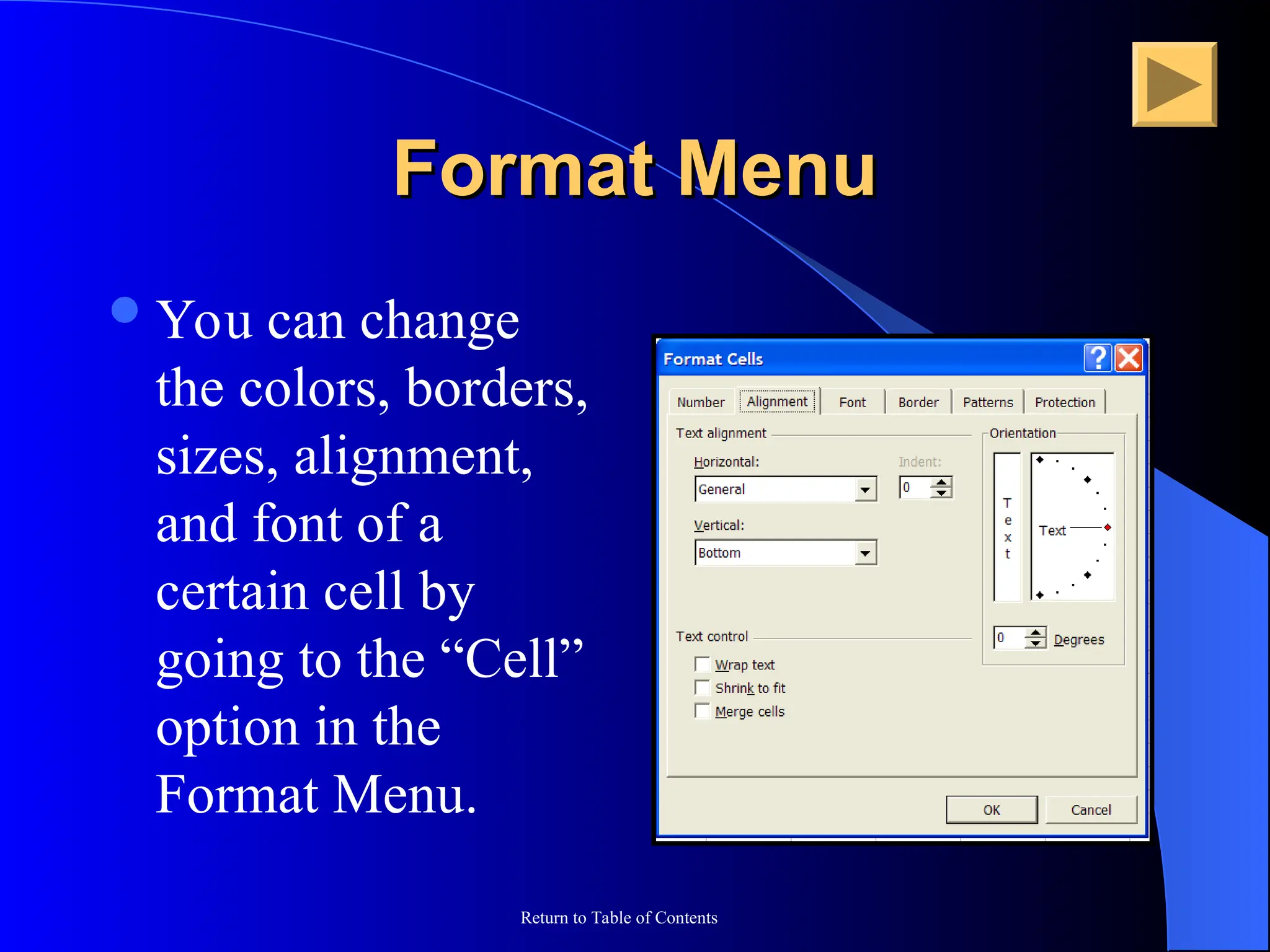
Format Menu
Format Menu
You can change
the colors, borders,
sizes, alignment,
and font of a
certain cell by
going to the “Cell”
option in the
Format Menu.
Return to Table of Contents
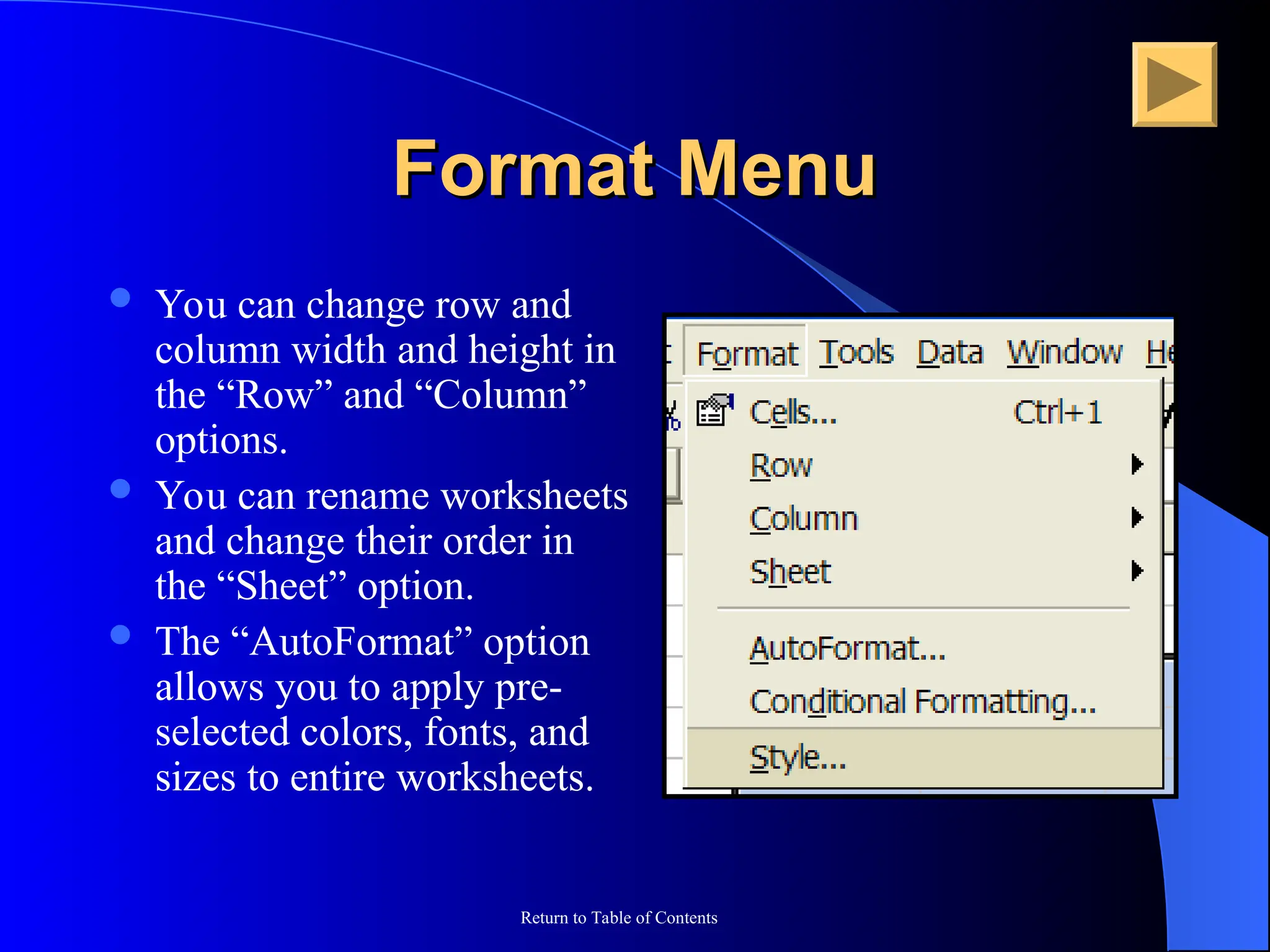
Format Menu
Format Menu
 You can change row and
column width and height in
the “Row” and “Column”
options.
 You can rename worksheets
and change their order in
the “Sheet” option.
 The “AutoFormat” option
allows you to apply pre-
selected colors, fonts, and
sizes to entire worksheets.
Return to Table of Contents
View Menu
View Menu
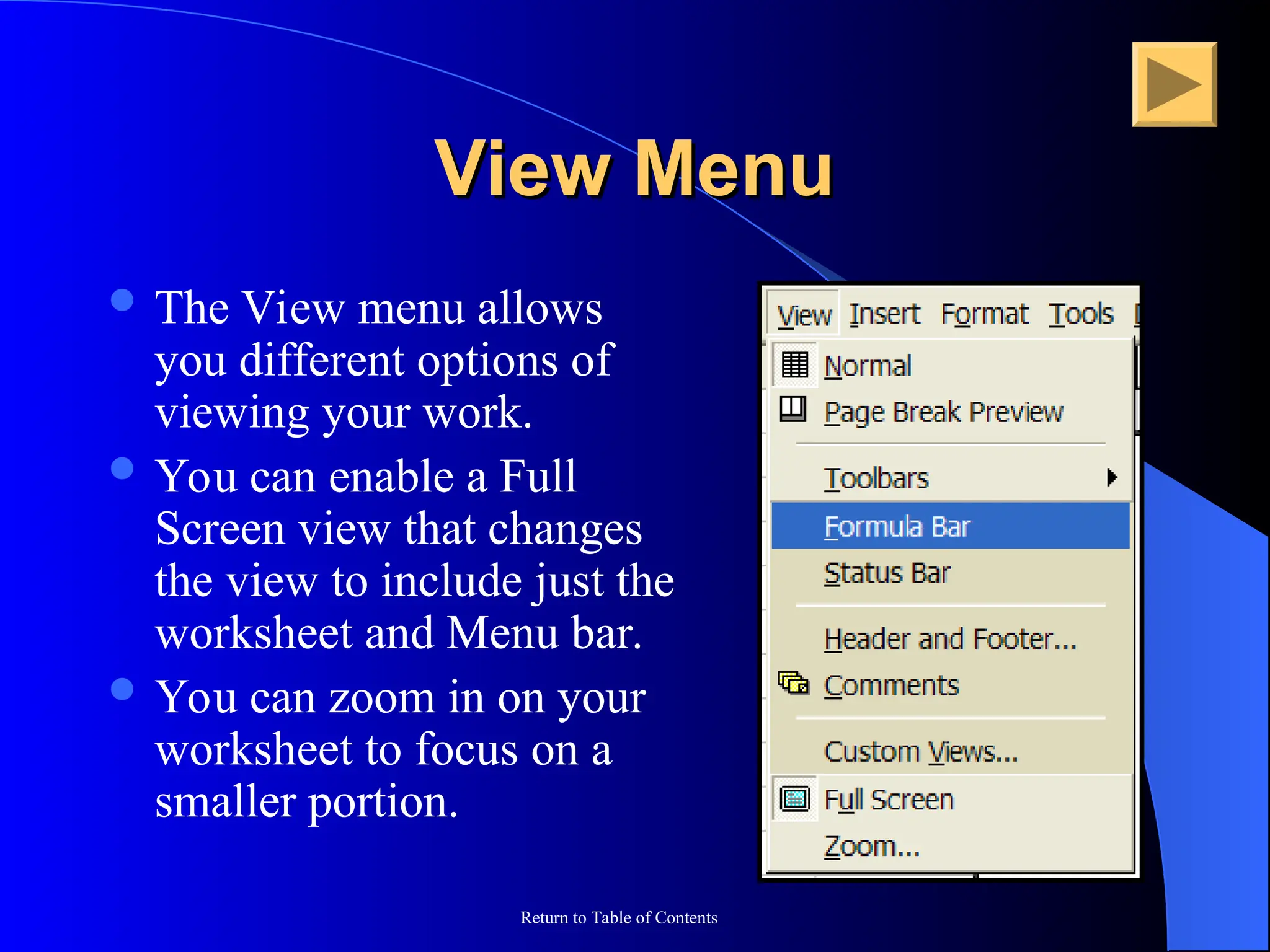
 The View menu allows
you different options of
viewing your work.
 You can enable a Full
Screen view that changes
the view to include just the
worksheet and Menu bar.
 You can zoom in on your
worksheet to focus on a
smaller portion.
Return to Table of Contents
View Menu
View Menu
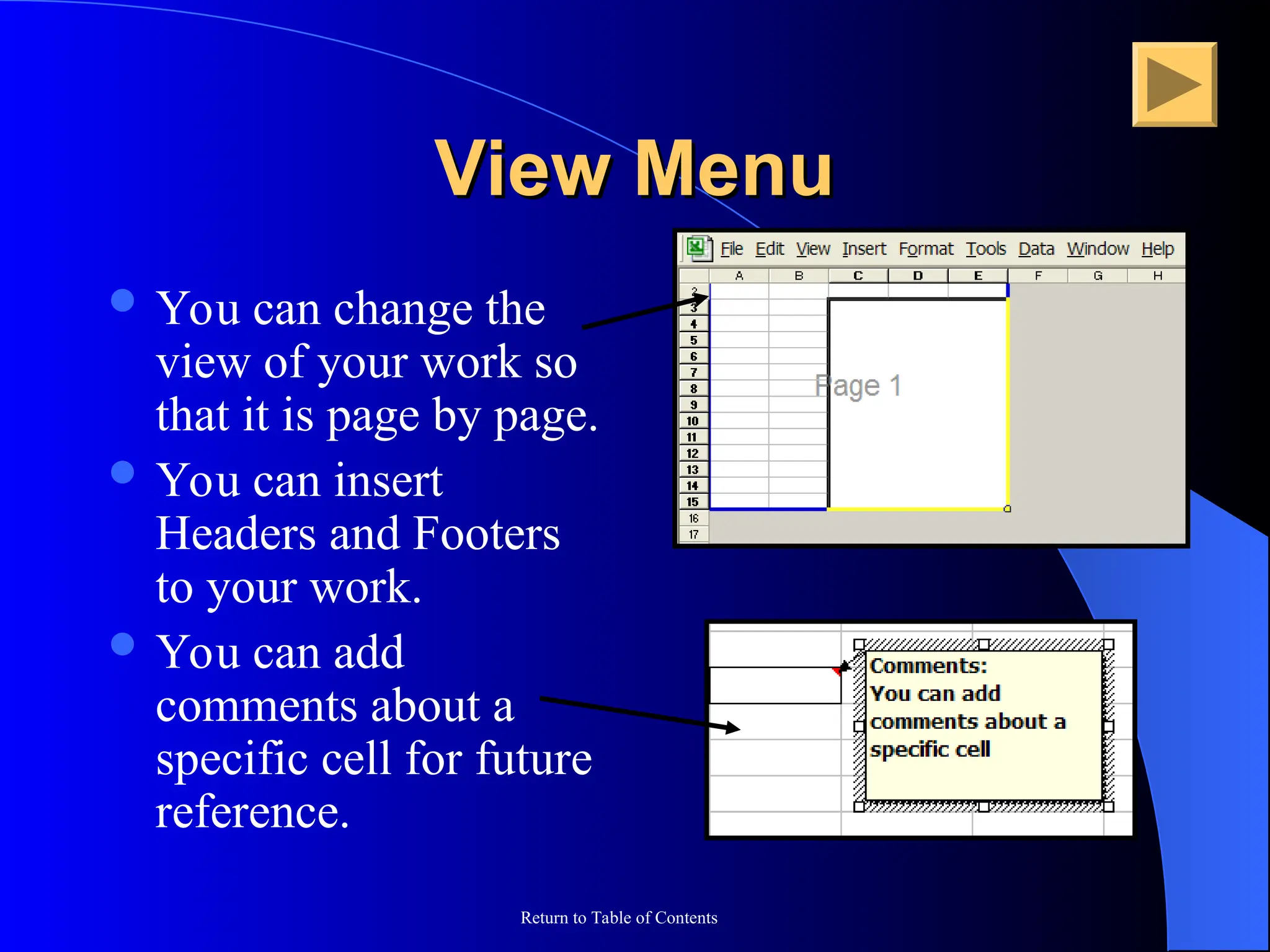
 You can change the
view of your work so
that it is page by page.
 You can insert
Headers and Footers
to your work.
 You can add
comments about a
specific cell for future
reference.
Return to Table of Contents
Help Menu and Office
Assistant
Assistant
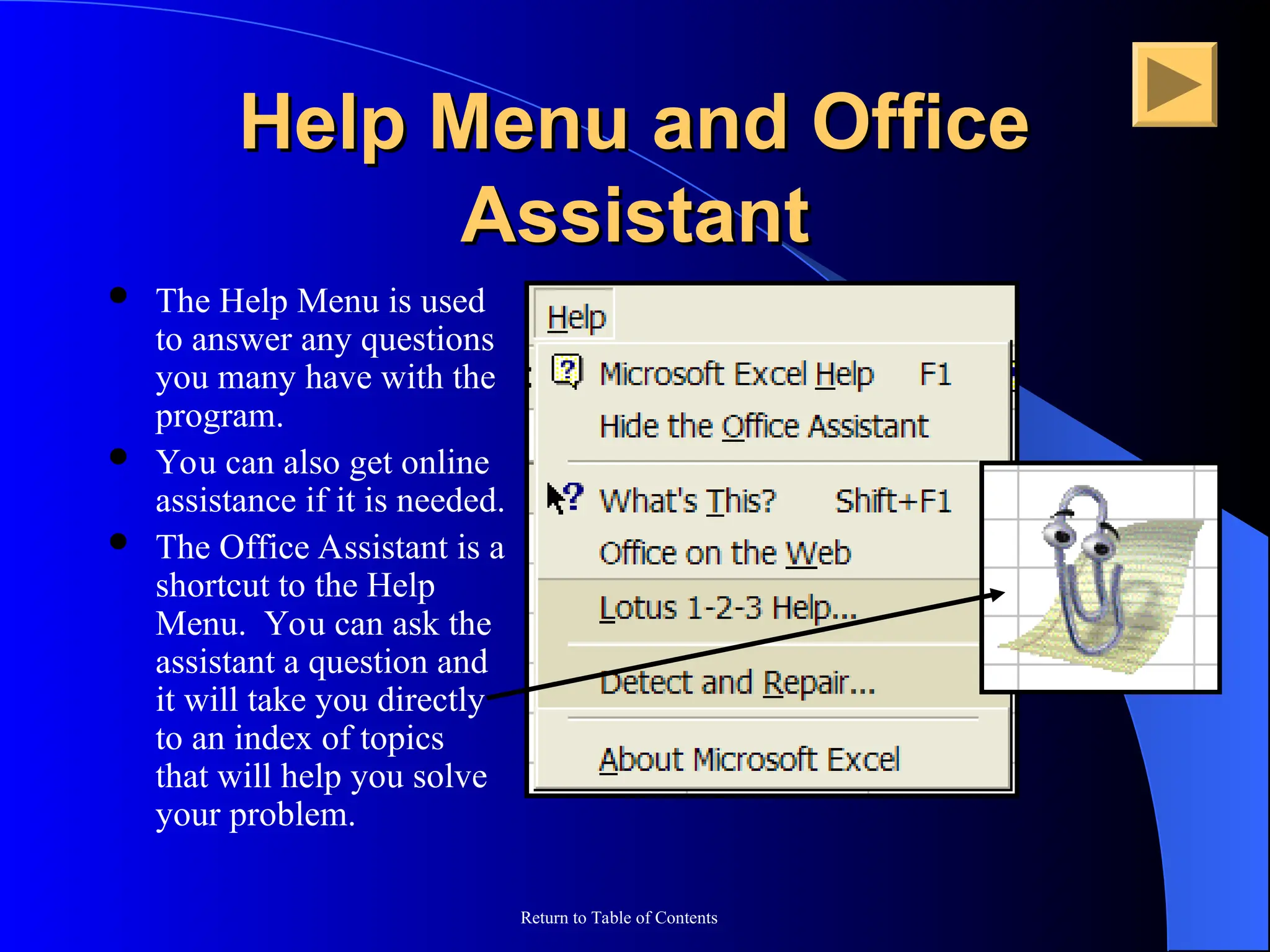
 The Help Menu is used
to answer any questions
you many have with the
program.
 You can also get online
assistance if it is needed.
 The Office Assistant is a
shortcut to the Help
Menu. You can ask the
assistant a question and
it will take you directly
to an index of topics
that will help you solve
your problem.
Return to Table of Contents
Excel Worksheets
Excel Worksheets
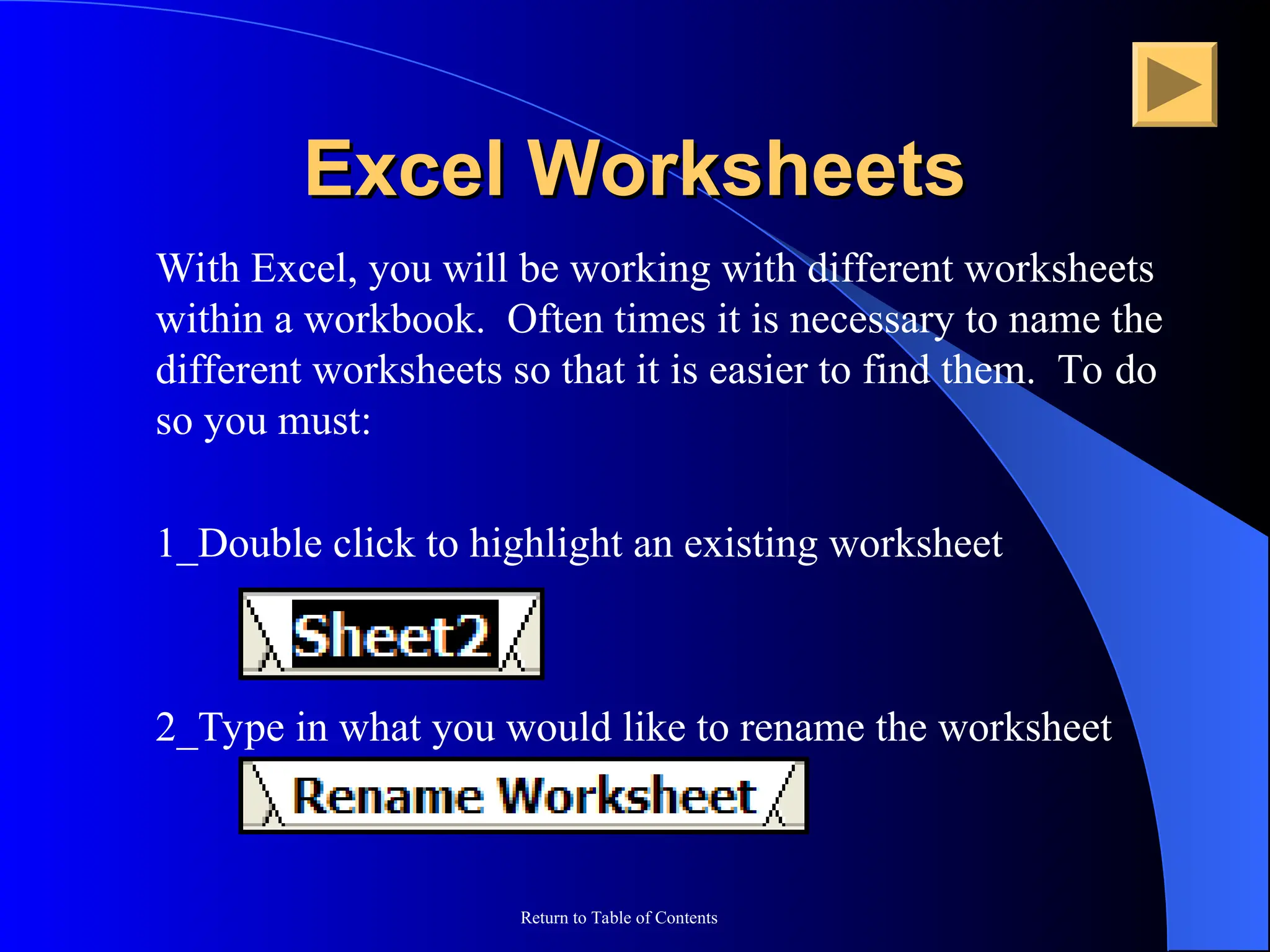
With Excel, you will be working with different worksheets
within a workbook. Often times it is necessary to name the
different worksheets so that it is easier to find them. To do
so you must:
1_Double click to highlight an existing worksheet
2_Type in what you would like to rename the worksheet
Return to Table of Contents
Entering Formulas
Entering Formulas
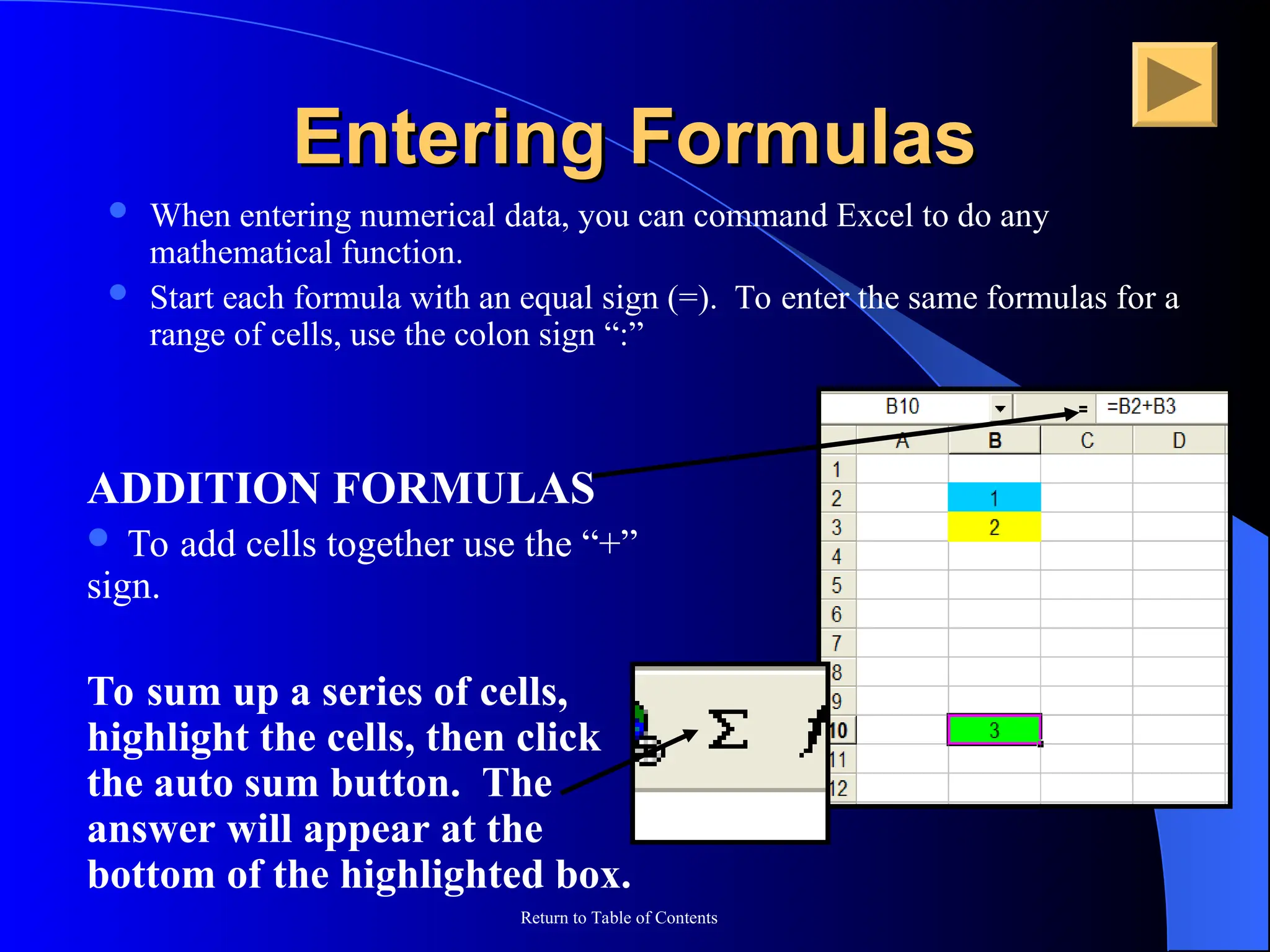
 When entering numerical data, you can command Excel to do any
mathematical function.
 Start each formula with an equal sign (=). To enter the same formulas for a
range of cells, use the colon sign “:”
ADDITION FORMULAS
 To add cells together use the “+”
sign.
To sum up a series of cells,
highlight the cells, then click
the auto sum button. The
answer will appear at the
bottom of the highlighted box.
Return to Table of Contents
Entering Formulas
Entering Formulas
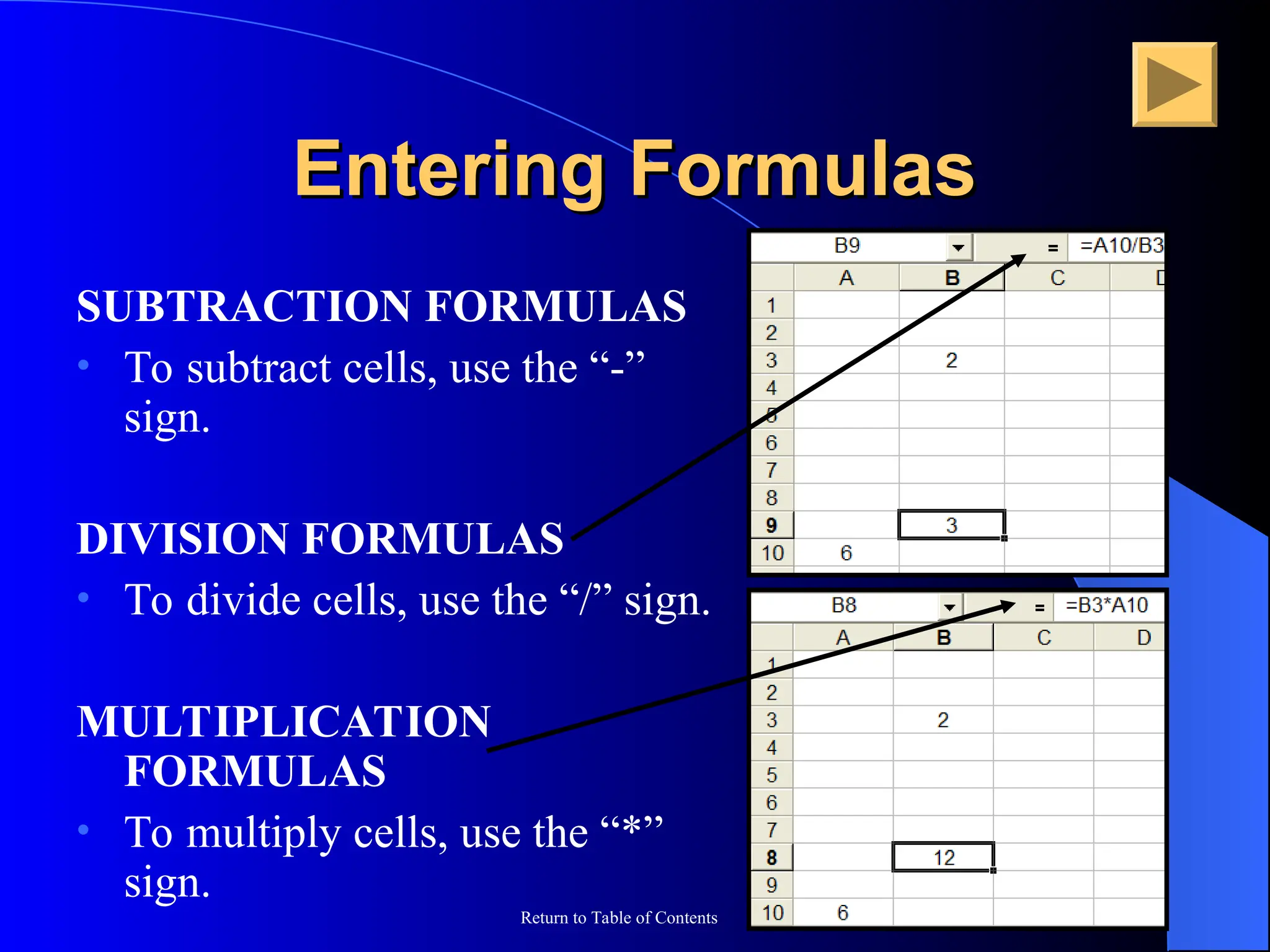
SUBTRACTION FORMULAS
• To subtract cells, use the “-”
sign.
DIVISION FORMULAS
• To divide cells, use the “/” sign.
MULTIPLICATION
FORMULAS
• To multiply cells, use the “*”
sign.
Return to Table of Contents
Tips for Entering Data
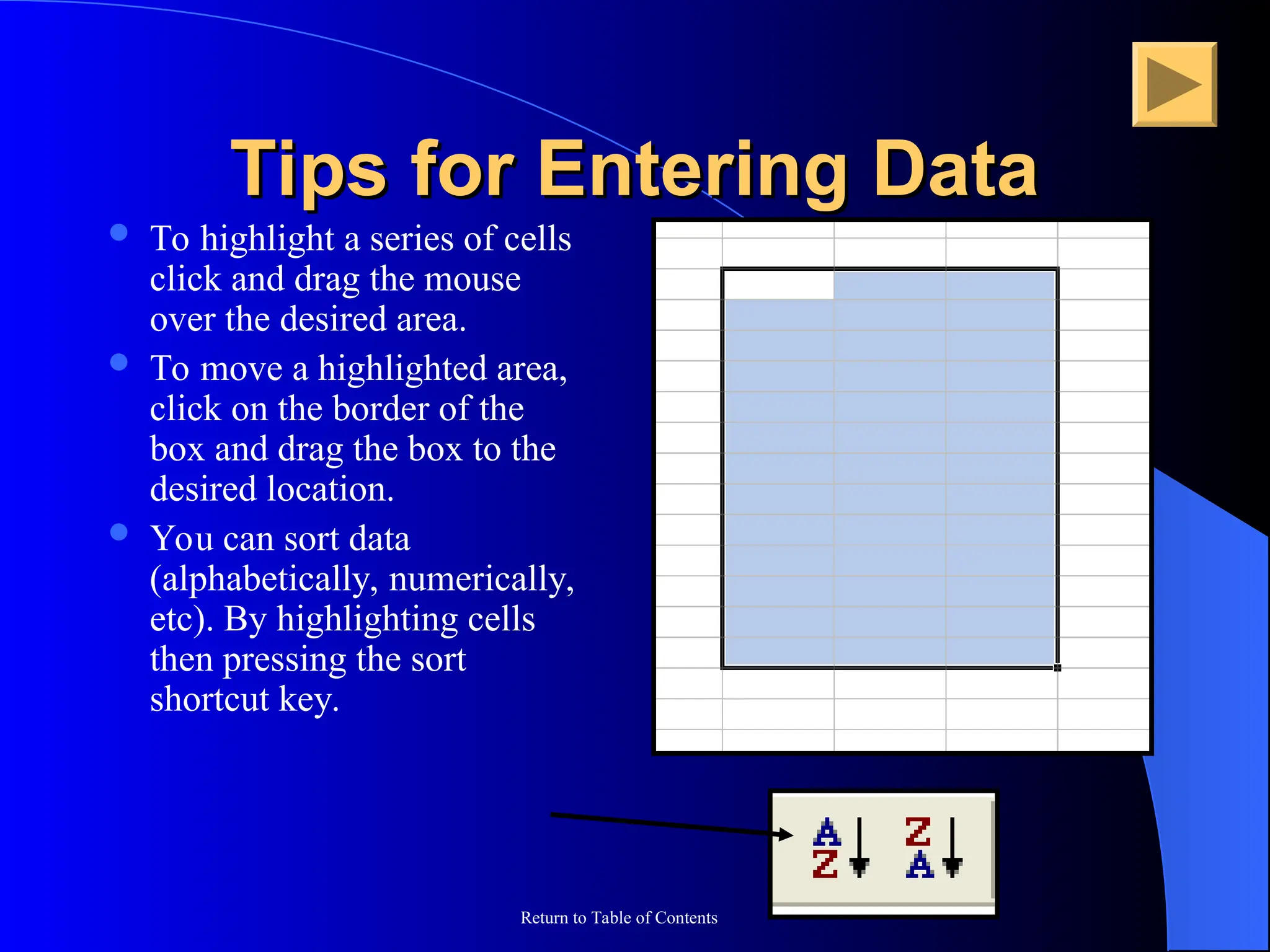
 To highlight a series of cells
click and drag the mouse
over the desired area.
 To move a highlighted area,
click on the border of the
box and drag the box to the
desired location.
 You can sort data
(alphabetically, numerically,
etc). By highlighting cells
then pressing the sort
shortcut key.
Return to Table of Contents
Tips for Entering Data
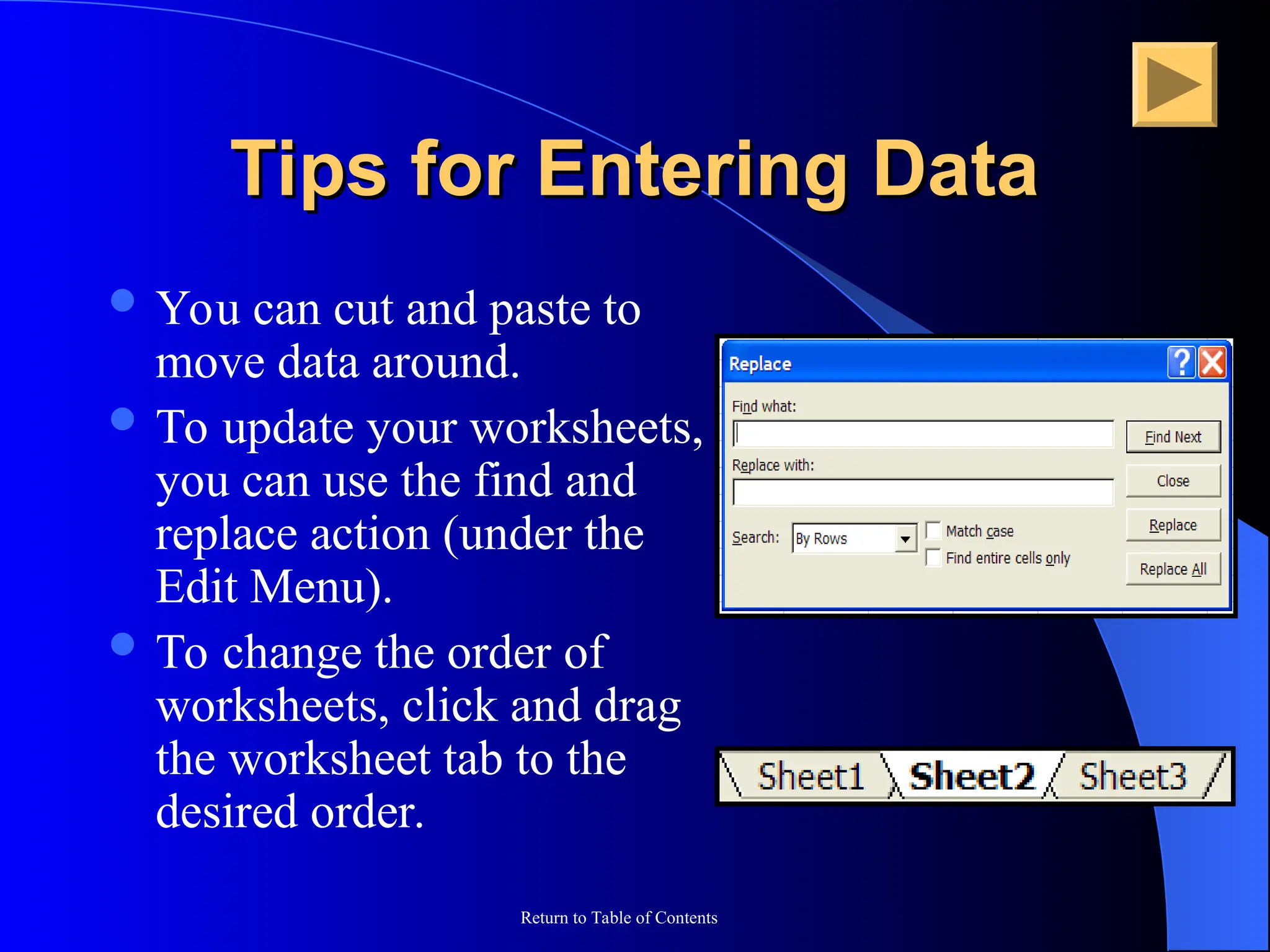
 You can cut and paste to
move data around.
 To update your worksheets,
you can use the find and
replace action (under the
Edit Menu).
 To change the order of
worksheets, click and drag
the worksheet tab to the
desired order.
Return to Table of Contents
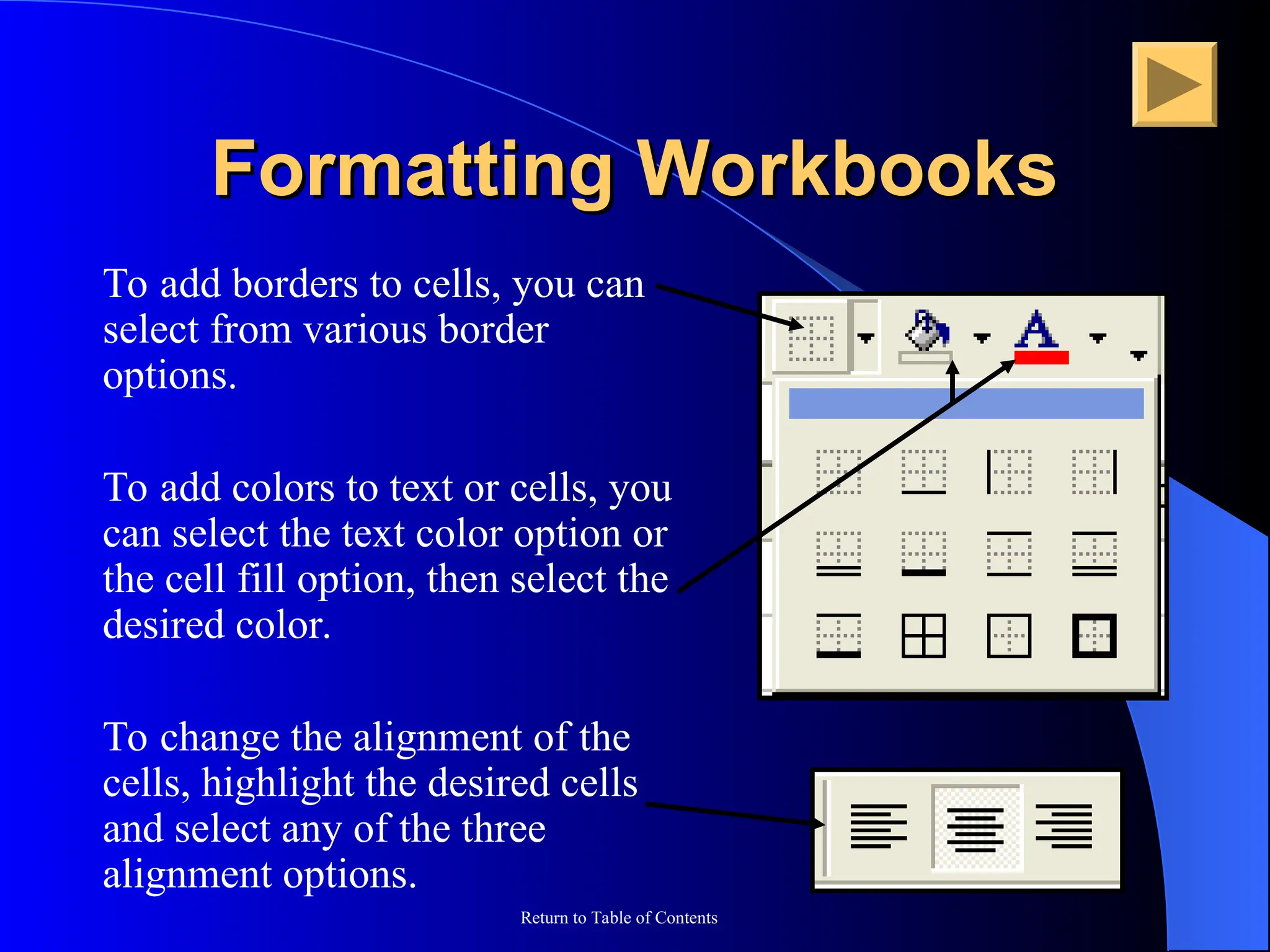
Formatting Workbooks
To add borders to cells, you can
select from various border
options.
To add colors to text or cells, you
can select the text color option or
the cell fill option, then select the
desired color.
To change the alignment of the
cells, highlight the desired cells
and select any of the three
alignment options.
Return to Table of Contents
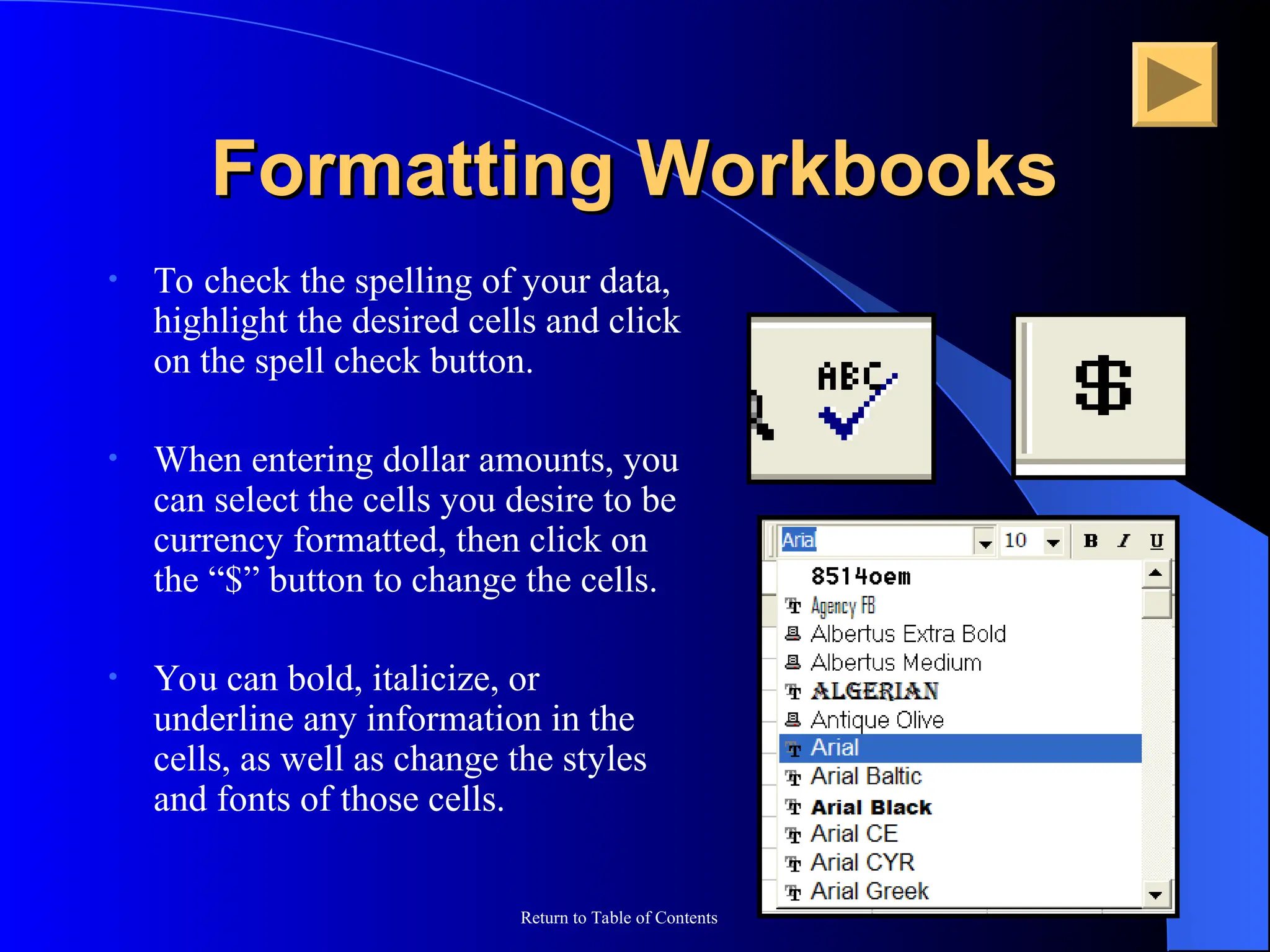
Formatting Workbooks
• To check the spelling of your data,
highlight the desired cells and click
on the spell check button.
• When entering dollar amounts, you
can select the cells you desire to be
currency formatted, then click on
the “$” button to change the cells.
• You can bold, italicize, or
underline any information in the
cells, as well as change the styles
and fonts of those cells.
Return to Table of Contents
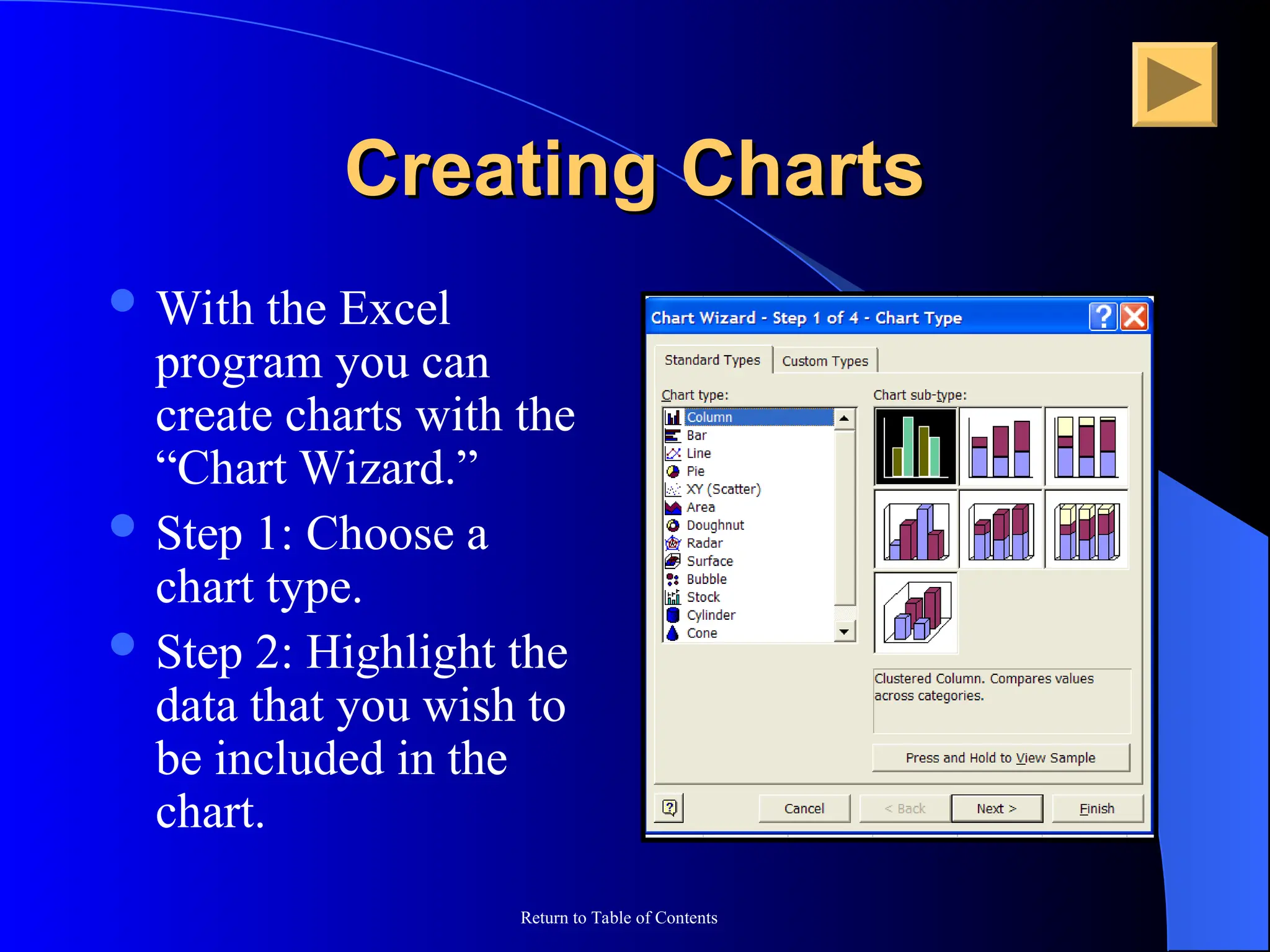
Creating Charts
Creating Charts
 With the Excel
program you can
create charts with the
“Chart Wizard.”
 Step 1: Choose a
chart type.
 Step 2: Highlight the
data that you wish to
be included in the
chart.
Return to Table of Contents
Creating Charts
Creating Charts
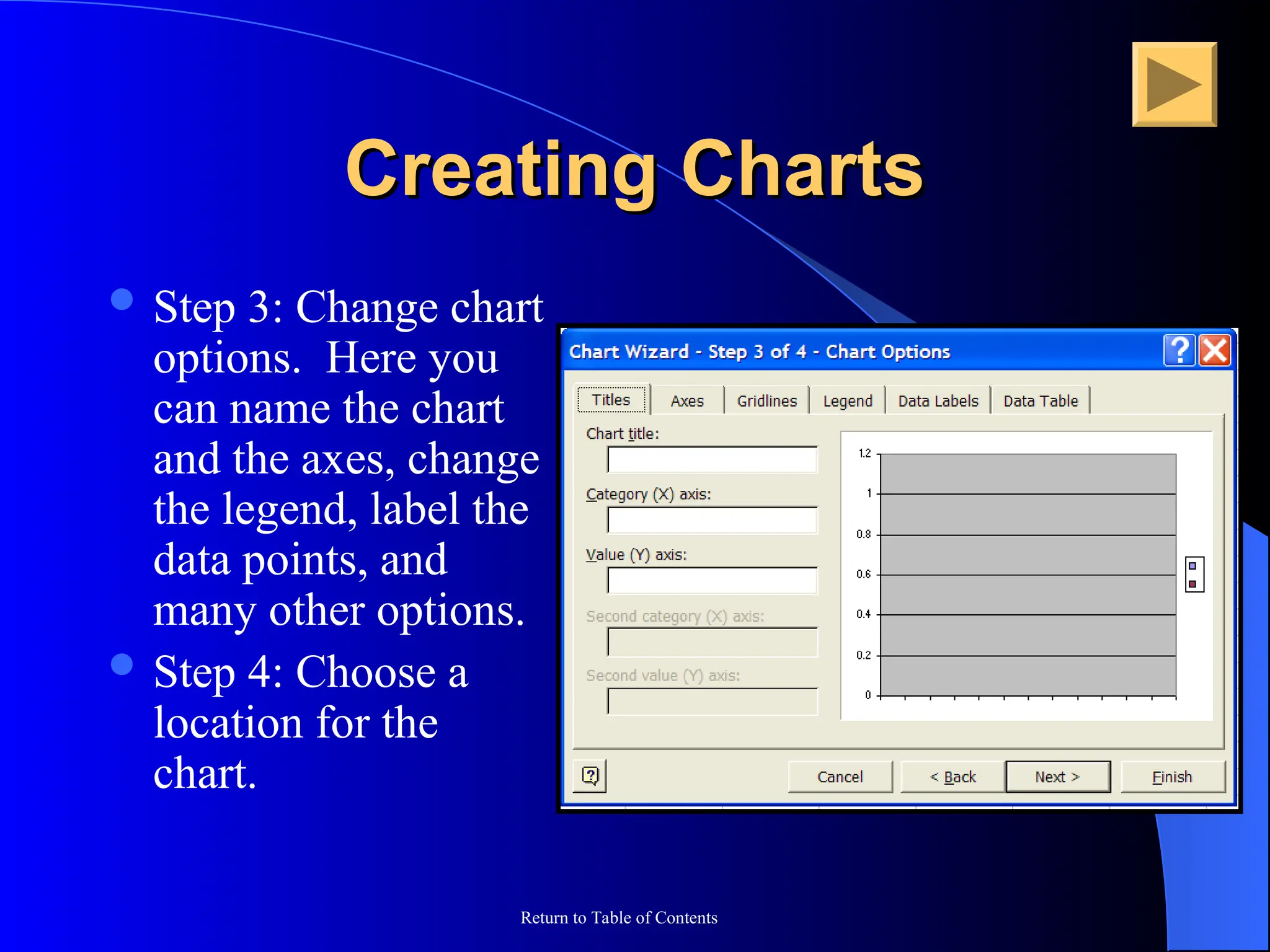
 Step 3: Change chart
options. Here you
can name the chart
and the axes, change
the legend, label the
data points, and
many other options.
 Step 4: Choose a
location for the
chart.
Return to Table of Contents
Freezing Panes
Freezing Panes
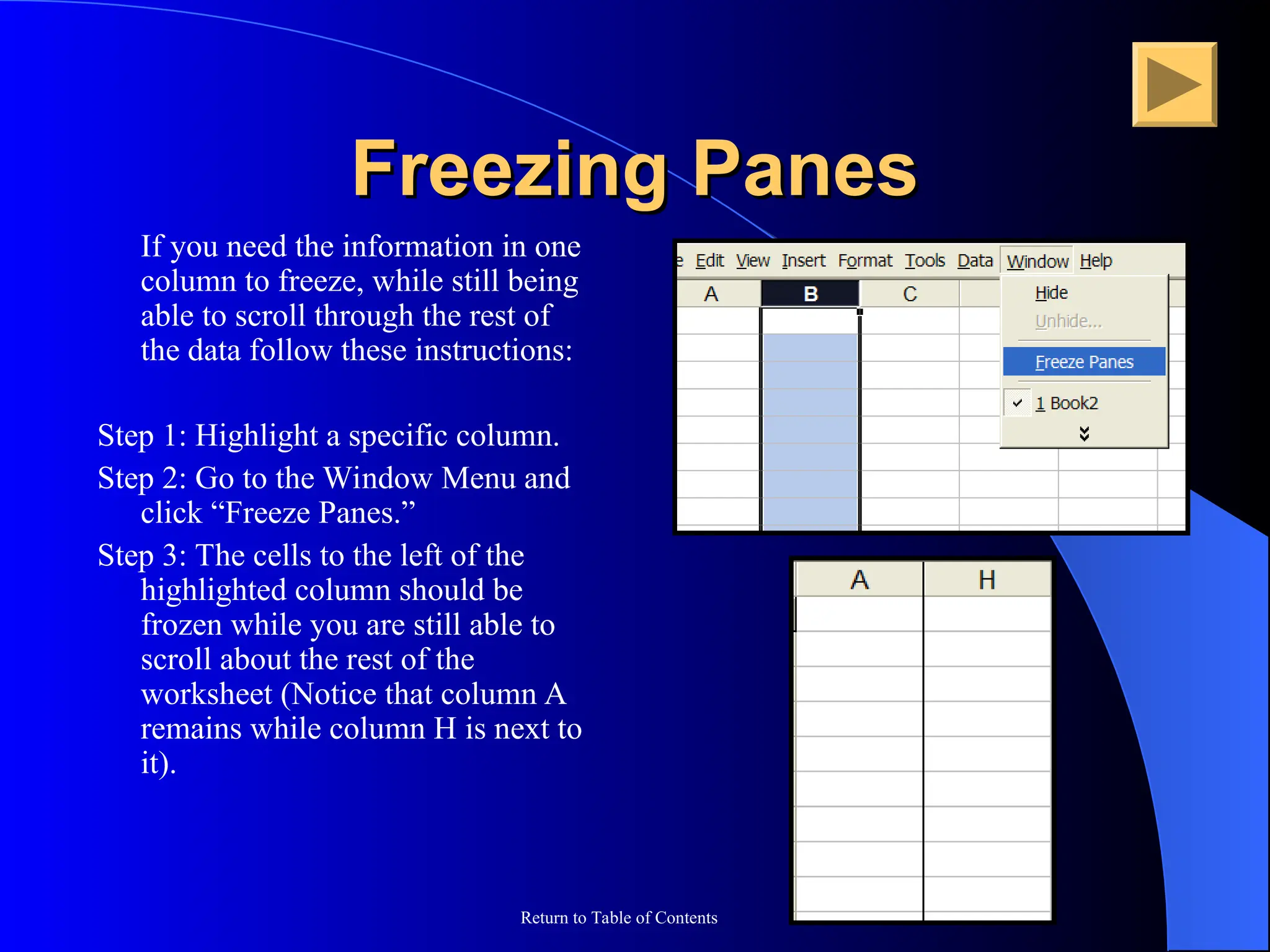
If you need the information in one
column to freeze, while still being
able to scroll through the rest of
the data follow these instructions:
Step 1: Highlight a specific column.
Step 2: Go to the Window Menu and
click “Freeze Panes.”
Step 3: The cells to the left of the
highlighted column should be
frozen while you are still able to
scroll about the rest of the
worksheet (Notice that column A
remains while column H is next to
it).
Return to Table of Contents
Printing
Printing
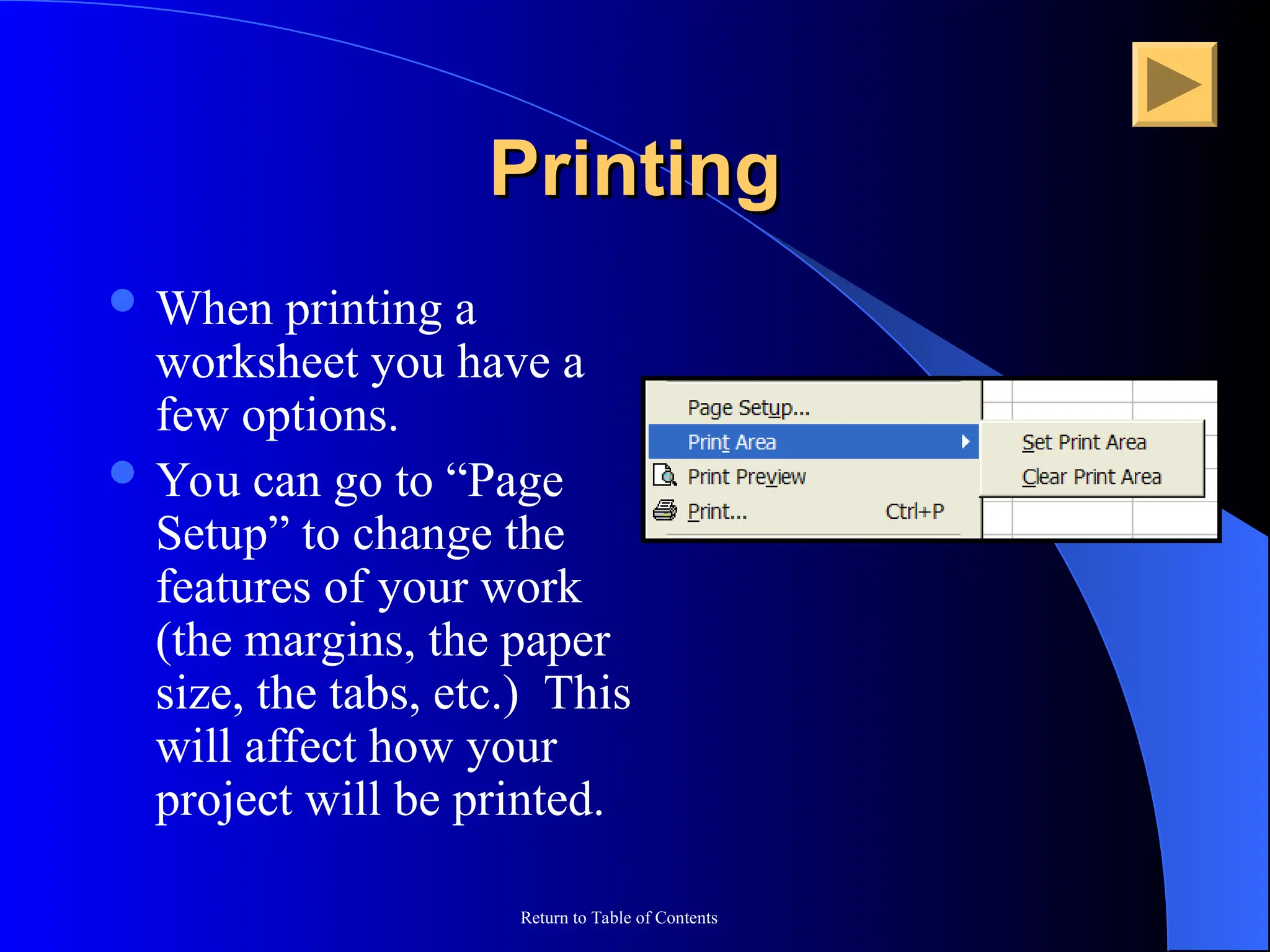
 When printing a
worksheet you have a
few options.
 You can go to “Page
Setup” to change the
features of your work
(the margins, the paper
size, the tabs, etc.) This
will affect how your
project will be printed.
Return to Table of Contents
Printing
Printing
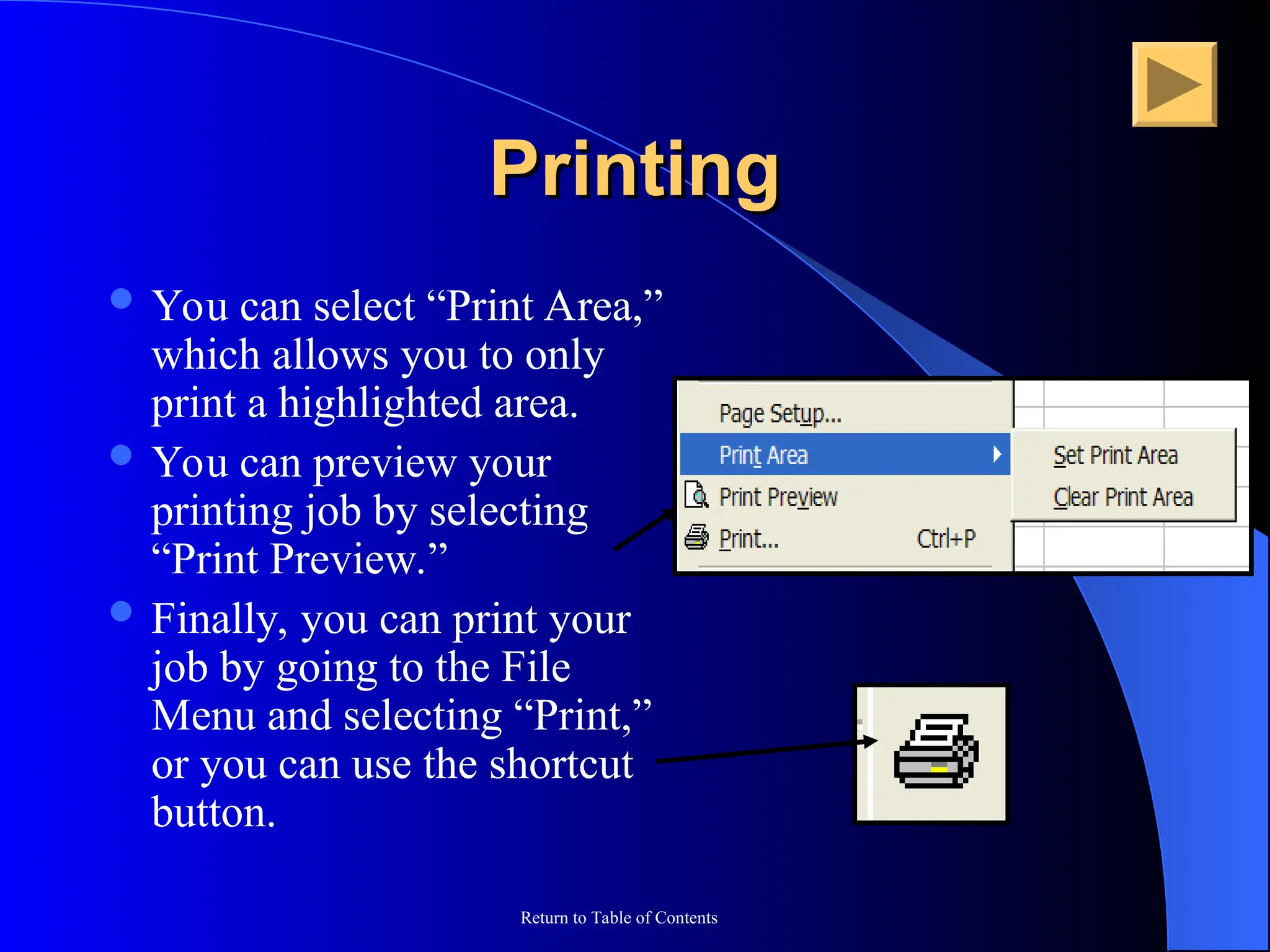
 You can select “Print Area,”
which allows you to only
print a highlighted area.
 You can preview your
printing job by selecting
“Print Preview.”
 Finally, you can print your
job by going to the File
Menu and selecting “Print,”
or you can use the shortcut
button.
Return to Table of Contents
Keyboard Shortcuts
Keyboard Shortcuts
 Here are some basic keyboard shortcuts:
– Shift + arrow key = highlight information
– CTLR + A = Select All
– CTRL + C = Copy Information
– CTRL + X = Cut Information
– CTRL + V = Paste Information
– CTRL + Z = Undo Information
– HOME = Move to the beginning of the worksheet
Return to Table of Contents
Notes to the teacher:
 This curriculum was designed so that it could be easily modified by the
teacher.
 The teacher can add slides at any point in the curriculum depending on
the level of computer literacy of the students.
 The Basic Outline of the curriculum is to be used as a guidance tool and
will help the teacher create a syllabus for the class being taught.
 Slides that are blank are topics we deemed important but not necessary
to have included in the curriculum. These slides were considered
advanced topics. (please ignore if there are no blank slides)
 You can choose to add content to these slides or to delete them.

teaching-excel-1627.ppthgcydtydtydyddtydy

  • 1.
  • 2.
    Return to Tableof Contents How to Use Tutorial How to Use Tutorial Step 1> The next page will show you the table of contents Step 4> Once you become familiar with this application you can use this tutorial as a reference tool. Step 2> Use the mouse and click on the topic links to begin learning Step 3> You can learn at your own pace, click on the Action buttons to review the material as much as you need to. To begin learning click on this button>>
  • 3.
    Return to Tableof Contents Table of Contents Table of Contents 1_ Introduction to Excel 2_ Overview of the Excel Screen 3_ The Excel Menus: File Menu Edit Menu Insert Menu Format Menu View Menu Help Menu and Office Assistant 4_ Excel Worksheets 5_ Entering Formulas and Data 6_ Formatting Workbooks 7_ Charts 8_ Freezing Panes 9_ Printing 10_ Keyboard Shortcuts
  • 4.
    Return to Tableof Contents Excel is a computer program used to create electronic spreadsheets. Within Excel, users can organize data, create charts, and perform calculations. Excel is a convenient program because it allows the user to create large spreadsheets, reference information from other spreadsheets, and it allows for better storage and modification of information. Excel operates like other Microsoft (MS) Office programs and has many of the same functions and shortcuts of other MS programs. Introduction to Excel Introduction to Excel
  • 5.
    Return to Tableof Contents Overview of the Excel Overview of the Excel Screen Screen Before working with Excel, it is essential to first become familiar with the Excel screen. The following will help you to recognize the various parts of an Excel screen and their functions. The Title bar is located at the very top of the screen. The Title bar displays the name of the workbook you are currently using. The Menu bar is located just below the Title bar. The Menu bar is used to give instructions to the program.
  • 6.
    Return to Tableof Contents Overview of the Excel Overview of the Excel Screen Screen Toolbars provide shortcuts to menu commands. There are many different toolbars and the user can choose which toolbars are shown on the screen. To enable more toolbars go to “View” on the Menu bar, select Toolbars, then select which toolbar you wish to add to the screen. The Standard Toolbar provides shortcuts to the File Menu, as well as mathematical functions, chart creation, and sorting. The Formatting Toolbar provides shortcuts to font formatting as well as mathematical functions. The Status Toolbar allows the user to view if the current worksheet is ready to enter data.
  • 7.
    Return to Tableof Contents Overview of the Excel Overview of the Excel Screen Screen • Microsoft Excel consists of workbooks. Within each workbook, there is an infinite number of worksheets. • Each worksheet contains columns and rows. • Where a column and a row intersect is called the cell. For example, cell B6 is located where column B and row 6 meet. You enter your data into the cells on the worksheet. • The tabs at the bottom of the screen represent different worksheets within a workbook. You can use the scrolling buttons on the left to bring other worksheets into view.
  • 8.
    Return to Tableof Contents Overview of the Excel Overview of the Excel Screen Screen • The Name Box indicates what cell you are in. This cell is called the “active cell.” This cell is highlighted by a black box. • The “=” is used to edit your formula on your selected cell. • The Formula Bar indicates the contents of the cell selected. If you have created a formula, then the formula will appear in this space.
  • 9.
    Return to Tableof Contents File Menu File Menu • When first opening Excel a worksheet will automatically appear. However, if you desire to open a file that you previously worked on go to the “File” option located in the top left corner. Select “Open.” • To create a new worksheet go to the “File” option and select “New.” • To save the work created go to the “File” option and select “Save.” • To close an existing worksheet go to the “File” option and select “Close.” • To exit the program entirely go to the “File” option and select “Exit.”
  • 10.
    Return to Tableof Contents Edit Menu Edit Menu  Among the many functions, the Edit Menu allows you to make changes to any data that was entered. You can:  Undo mistakes made. Excel allows you to undo up to the last 16 moves you made.  Cut, copy, or paste information.  Find information in an existing workbook  Replace existing information.
  • 11.
    Return to Tableof Contents Insert Menu Insert Menu  The Insert Menu allows you to:  Add new worksheets, rows, and columns to an existing.  You can also insert charts, pictures, and objects onto your worksheet.
  • 12.
    Return to Tableof Contents Format Menu Format Menu You can change the colors, borders, sizes, alignment, and font of a certain cell by going to the “Cell” option in the Format Menu.
  • 13.
    Return to Tableof Contents Format Menu Format Menu  You can change row and column width and height in the “Row” and “Column” options.  You can rename worksheets and change their order in the “Sheet” option.  The “AutoFormat” option allows you to apply pre- selected colors, fonts, and sizes to entire worksheets.
  • 14.
    Return to Tableof Contents View Menu View Menu  The View menu allows you different options of viewing your work.  You can enable a Full Screen view that changes the view to include just the worksheet and Menu bar.  You can zoom in on your worksheet to focus on a smaller portion.
  • 15.
    Return to Tableof Contents View Menu View Menu  You can change the view of your work so that it is page by page.  You can insert Headers and Footers to your work.  You can add comments about a specific cell for future reference.
  • 16.
    Return to Tableof Contents Help Menu and Office Help Menu and Office Assistant Assistant  The Help Menu is used to answer any questions you many have with the program.  You can also get online assistance if it is needed.  The Office Assistant is a shortcut to the Help Menu. You can ask the assistant a question and it will take you directly to an index of topics that will help you solve your problem.
  • 17.
    Return to Tableof Contents Excel Worksheets Excel Worksheets With Excel, you will be working with different worksheets within a workbook. Often times it is necessary to name the different worksheets so that it is easier to find them. To do so you must: 1_Double click to highlight an existing worksheet 2_Type in what you would like to rename the worksheet
  • 18.
    Return to Tableof Contents Entering Formulas Entering Formulas  When entering numerical data, you can command Excel to do any mathematical function.  Start each formula with an equal sign (=). To enter the same formulas for a range of cells, use the colon sign “:” ADDITION FORMULAS  To add cells together use the “+” sign. To sum up a series of cells, highlight the cells, then click the auto sum button. The answer will appear at the bottom of the highlighted box.
  • 19.
    Return to Tableof Contents Entering Formulas Entering Formulas SUBTRACTION FORMULAS • To subtract cells, use the “-” sign. DIVISION FORMULAS • To divide cells, use the “/” sign. MULTIPLICATION FORMULAS • To multiply cells, use the “*” sign.
  • 20.
    Return to Tableof Contents Tips for Entering Data Tips for Entering Data  To highlight a series of cells click and drag the mouse over the desired area.  To move a highlighted area, click on the border of the box and drag the box to the desired location.  You can sort data (alphabetically, numerically, etc). By highlighting cells then pressing the sort shortcut key.
  • 21.
    Return to Tableof Contents Tips for Entering Data Tips for Entering Data  You can cut and paste to move data around.  To update your worksheets, you can use the find and replace action (under the Edit Menu).  To change the order of worksheets, click and drag the worksheet tab to the desired order.
  • 22.
    Return to Tableof Contents Formatting Workbooks Formatting Workbooks To add borders to cells, you can select from various border options. To add colors to text or cells, you can select the text color option or the cell fill option, then select the desired color. To change the alignment of the cells, highlight the desired cells and select any of the three alignment options.
  • 23.
    Return to Tableof Contents Formatting Workbooks Formatting Workbooks • To check the spelling of your data, highlight the desired cells and click on the spell check button. • When entering dollar amounts, you can select the cells you desire to be currency formatted, then click on the “$” button to change the cells. • You can bold, italicize, or underline any information in the cells, as well as change the styles and fonts of those cells.
  • 24.
    Return to Tableof Contents Creating Charts Creating Charts  With the Excel program you can create charts with the “Chart Wizard.”  Step 1: Choose a chart type.  Step 2: Highlight the data that you wish to be included in the chart.
  • 25.
    Return to Tableof Contents Creating Charts Creating Charts  Step 3: Change chart options. Here you can name the chart and the axes, change the legend, label the data points, and many other options.  Step 4: Choose a location for the chart.
  • 26.
    Return to Tableof Contents Freezing Panes Freezing Panes If you need the information in one column to freeze, while still being able to scroll through the rest of the data follow these instructions: Step 1: Highlight a specific column. Step 2: Go to the Window Menu and click “Freeze Panes.” Step 3: The cells to the left of the highlighted column should be frozen while you are still able to scroll about the rest of the worksheet (Notice that column A remains while column H is next to it).
  • 27.
    Return to Tableof Contents Printing Printing  When printing a worksheet you have a few options.  You can go to “Page Setup” to change the features of your work (the margins, the paper size, the tabs, etc.) This will affect how your project will be printed.
  • 28.
    Return to Tableof Contents Printing Printing  You can select “Print Area,” which allows you to only print a highlighted area.  You can preview your printing job by selecting “Print Preview.”  Finally, you can print your job by going to the File Menu and selecting “Print,” or you can use the shortcut button.
  • 29.
    Return to Tableof Contents Keyboard Shortcuts Keyboard Shortcuts  Here are some basic keyboard shortcuts: – Shift + arrow key = highlight information – CTLR + A = Select All – CTRL + C = Copy Information – CTRL + X = Cut Information – CTRL + V = Paste Information – CTRL + Z = Undo Information – HOME = Move to the beginning of the worksheet
  • 30.
    Return to Tableof Contents Notes to the teacher: Notes to the teacher:  This curriculum was designed so that it could be easily modified by the teacher.  The teacher can add slides at any point in the curriculum depending on the level of computer literacy of the students.  The Basic Outline of the curriculum is to be used as a guidance tool and will help the teacher create a syllabus for the class being taught.  Slides that are blank are topics we deemed important but not necessary to have included in the curriculum. These slides were considered advanced topics. (please ignore if there are no blank slides)  You can choose to add content to these slides or to delete them.