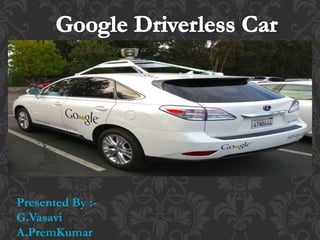
Presented By :-
G.Vasavi
A.PremKumar
Contents
Introduction
History
Components
Current Status Of Project
Advantage
Conclusion
References

Introduction
The Google Driverless Car is like any car, but:
It can steer itself while looking out for obstacles.
It can accelerate itself to the correct speed limit.
It can stop and go itself based on any traffic condition.
The project is currently being
led by: Sebastian Thrun.
Director of the Stanford
Artificial Intelligence
Laboratory.
Co-inventor of Google
Street View.
Google Maps
Hardware Sensors with MICRO SOFT Controllers
LIDAR
VIDEO CAMERA
POSITION ESTIMATOR
DISTANCE SENSOR
Automotive Night Vision
Artificial Intelligence
Provides the car with road
information.
Google Maps interacts with
GPS and acts like a database.
Speed Limits.
Upcoming intersections.
Traffic Report.
Nearby collisions.
Directions.
Its further Components:
LIDAR
VIDEO CAMERA
POSITION ESTIMATOR
DISTANCE SENSOR
“Heart of the system“
LIDAR stands for Light Detection And
Ranging.
It can measure the distance to, or other
properties of a target by illuminating the
target with light.
Scanning distance of 60 meters (~197 feet).
Google Maps and the hardware sensors
Data& MICROSOFT controller are sent to the
AI.
AI then determines:
how fast to accelerate
when to slow down/stop
when to steer the wheel
Goal of AI
The agent's goal is to take the passenger to
its desired destination safely and legally.
LET'S SEE IT IN ACTION!
A look from the inside... A look from the outside...
As of 2012:
Nevada
1st state to allow
driverless vehicles can be
legally operated on public
roads.
6 Google Driverless Cars
5 Toyota Prius
1 Audi TT.
Total miles
140,000 miles with
occasional human
intervention.
Relief of vehicle
occupants from driving
and navigation chores.
Reduction in car theft, due
to the vehicle's self-
awareness.
The driverless car improves vehicle’s
stability helps to minimize the loss
of control.
Main aim is to minimize the road
accidents.
CONCLUSION
References
1. en.m.wikipedia.org/wiki/Google_driverless_car
2. ^ "The Test Driven Google Car" .
The Official GoogleBlog.
Googledriverlesscar

Googledriverlesscar

  • 1.
  • 2.
    Contents Introduction History Components Current Status OfProject Advantage Conclusion References 
  • 3.
    Introduction The Google DriverlessCar is like any car, but: It can steer itself while looking out for obstacles. It can accelerate itself to the correct speed limit. It can stop and go itself based on any traffic condition.
  • 4.
    The project iscurrently being led by: Sebastian Thrun. Director of the Stanford Artificial Intelligence Laboratory. Co-inventor of Google Street View.
  • 5.
    Google Maps Hardware Sensorswith MICRO SOFT Controllers LIDAR VIDEO CAMERA POSITION ESTIMATOR DISTANCE SENSOR Automotive Night Vision Artificial Intelligence
  • 6.
    Provides the carwith road information. Google Maps interacts with GPS and acts like a database. Speed Limits. Upcoming intersections. Traffic Report. Nearby collisions. Directions.
  • 7.
    Its further Components: LIDAR VIDEOCAMERA POSITION ESTIMATOR DISTANCE SENSOR
  • 8.
    “Heart of thesystem“ LIDAR stands for Light Detection And Ranging. It can measure the distance to, or other properties of a target by illuminating the target with light. Scanning distance of 60 meters (~197 feet).
  • 10.
    Google Maps andthe hardware sensors Data& MICROSOFT controller are sent to the AI. AI then determines: how fast to accelerate when to slow down/stop when to steer the wheel Goal of AI The agent's goal is to take the passenger to its desired destination safely and legally.
  • 11.
    LET'S SEE ITIN ACTION! A look from the inside... A look from the outside...
  • 12.
    As of 2012: Nevada 1ststate to allow driverless vehicles can be legally operated on public roads. 6 Google Driverless Cars 5 Toyota Prius 1 Audi TT. Total miles 140,000 miles with occasional human intervention.
  • 13.
    Relief of vehicle occupantsfrom driving and navigation chores. Reduction in car theft, due to the vehicle's self- awareness.
  • 14.
    The driverless carimproves vehicle’s stability helps to minimize the loss of control. Main aim is to minimize the road accidents. CONCLUSION
  • 15.
    References 1. en.m.wikipedia.org/wiki/Google_driverless_car 2. ^"The Test Driven Google Car" . The Official GoogleBlog.