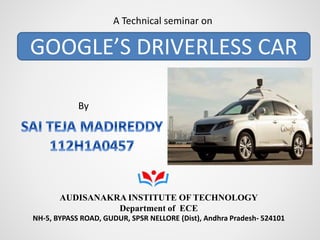
GOOGLE’S DRIVERLESS CAR
A Technical seminar on
AUDISANAKRA INSTITUTE OF TECHNOLOGY
Department of ECE
NH-5, BYPASS ROAD, GUDUR, SPSR NELLORE (Dist), Andhra Pradesh- 524101
By
Sai teja madireddy
Sai teja madireddy
Imagine…
Sai teja madireddy
The Best of Both Worlds…….
Sai teja madireddy
Imagine no more…
Sai teja madireddy
Driverless cars proven in a race
Sai teja madireddy
Seeing is believing
Sai teja madireddy
 Introduction.
 History.
 Components.
 Current scenario.
Conclusion.
Google’s Driverless car
Sai teja madireddy
INTRODUCTION:
The Google Driverless Car is like any car, but:
 It can steer itself while looking out for obstacles.
 It can accelerate itself to the correct speed limit.
 It can stop and go itself based on any traffic condition.
It can take its passengers anywhere it wants to
go safely, legally, and comfortably.
INTRODUCTION
Sai teja madireddy
HISTORY:
The project is currently being led by:
Sebastian Thrun
 Director of the Stanford Artificial
Intelligence Laboratory
 2005 DARPA Grand Challenge
Winner
 Co-inventor of Google Street
View
HISTORY
Sai teja madireddy
COMPONENTS:
Integrates Google Maps with various hardware sensors and artificial
intelligence software
Google Maps
Provides the car with road information
Hardware Sensors
Provides the car with real time environment conditions
Artificial Intelligence
Provides the car with real time decisions
COMPONENTS
Sai teja madireddy
GOOGLE MAP:
 Speed Limits.
 Upcoming
intersections.
 Traffic Report.
 Nearby collisions.
 Directions.
Google Maps interacts with GPS and acts like a database.
GOOGLE MAP
Sai teja madireddy
HARDWARE SENSORS:
 The hardware sensors gives real time
environmental properties.
 Environment is dynamic so need real time results.
 Sensors attempt to create fully observable
environment.
HARDWARE SENSORS
Sai teja madireddy
HARDWARE SENSORS:
 LIDAR
 VIDEO CAMERA
 POSITION ESTIMATOR
 DISTANCE SENSOR
HARDWARE SENSORS
Sai teja madireddy
Sai teja madireddy
 “Heart of our system“
 LIDAR (Light Detection And Ranging, also LADAR) is an
optical remote sensing technology that can measure the
distance to, or other properties of a target by illuminating the
target with light, often using pulses from a laser.
 Scanning distance of 60 meters (~197 feet)
LIDAR
Sai teja madireddy
MAP OF THE SURROUNDINGS
No blind spot
e.g. pedestrian emerged from
between two parked cars
Sai teja madireddy
 VIDEO CAMERA
Detects upcoming traffic light.
 DISTANCE SENSOR
Allow the car to "see" far enough to detect nearby or
upcoming cars or obstacles
 POSITION ESTIMATOR(Wheel Encoder)
Determines vehicle's location and keeps track of its
movements.
VIDEO CAMERA
DISTANCE SENSORS
POSITION ESTIMATOR (WHEEL ENCODER)
Sai teja madireddy
Google Maps and the hardware sensors data are sent to the AI.
AI then determines:
 how fast to accelerate
 when to slow down/stop
 when to steer the wheel
 Goal of AI
The agent's goal is to take the passenger to its desired destination
safely and legally
ARTIFICIAL INTELLIGENCE
Sai teja madireddy
CURRENTLY.
As of 2014:
• Nevada
o 1st state to allow driverless
vehicles can be legally
operated on public roads
• 6 Google Driverless Cars
o 5 Toyota Prius
o 1 Audi TT
• Total miles
o 140,000 miles with
occasional human
intervention
CURRENTLY
Sai teja madireddy
CONCLUSION:CONCLUSION
•The driver less car’s technologies improves vehicle's
stability helps to minimize loss of control.
•Driver less cars are designed to minimize accidents by
addressing the main causes of collisions: driving error,
distraction and drowsiness.
Sai teja madireddy
ANY QUIRIES?
GOOGLE’S DRIVERLESS CAR
Sai teja madireddy
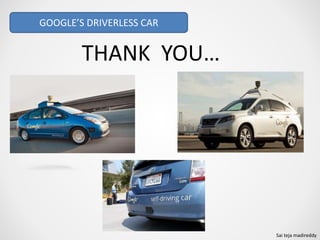
THANK YOU…
GOOGLE’S DRIVERLESS CAR
Sai teja madireddy

Google's Driverless car

  • 1.
    GOOGLE’S DRIVERLESS CAR ATechnical seminar on AUDISANAKRA INSTITUTE OF TECHNOLOGY Department of ECE NH-5, BYPASS ROAD, GUDUR, SPSR NELLORE (Dist), Andhra Pradesh- 524101 By
  • 2.
  • 3.
  • 4.
  • 5.
    The Best ofBoth Worlds……. Sai teja madireddy
  • 6.
    Imagine no more… Saiteja madireddy
  • 7.
    Driverless cars provenin a race Sai teja madireddy
  • 8.
  • 9.
     Introduction.  History. Components.  Current scenario. Conclusion. Google’s Driverless car Sai teja madireddy
  • 10.
    INTRODUCTION: The Google DriverlessCar is like any car, but:  It can steer itself while looking out for obstacles.  It can accelerate itself to the correct speed limit.  It can stop and go itself based on any traffic condition. It can take its passengers anywhere it wants to go safely, legally, and comfortably. INTRODUCTION Sai teja madireddy
  • 11.
    HISTORY: The project iscurrently being led by: Sebastian Thrun  Director of the Stanford Artificial Intelligence Laboratory  2005 DARPA Grand Challenge Winner  Co-inventor of Google Street View HISTORY Sai teja madireddy
  • 12.
    COMPONENTS: Integrates Google Mapswith various hardware sensors and artificial intelligence software Google Maps Provides the car with road information Hardware Sensors Provides the car with real time environment conditions Artificial Intelligence Provides the car with real time decisions COMPONENTS Sai teja madireddy
  • 13.
    GOOGLE MAP:  SpeedLimits.  Upcoming intersections.  Traffic Report.  Nearby collisions.  Directions. Google Maps interacts with GPS and acts like a database. GOOGLE MAP Sai teja madireddy
  • 14.
    HARDWARE SENSORS:  Thehardware sensors gives real time environmental properties.  Environment is dynamic so need real time results.  Sensors attempt to create fully observable environment. HARDWARE SENSORS Sai teja madireddy
  • 15.
    HARDWARE SENSORS:  LIDAR VIDEO CAMERA  POSITION ESTIMATOR  DISTANCE SENSOR HARDWARE SENSORS Sai teja madireddy
  • 16.
  • 17.
     “Heart ofour system“  LIDAR (Light Detection And Ranging, also LADAR) is an optical remote sensing technology that can measure the distance to, or other properties of a target by illuminating the target with light, often using pulses from a laser.  Scanning distance of 60 meters (~197 feet) LIDAR Sai teja madireddy
  • 18.
    MAP OF THESURROUNDINGS No blind spot e.g. pedestrian emerged from between two parked cars Sai teja madireddy
  • 19.
     VIDEO CAMERA Detectsupcoming traffic light.  DISTANCE SENSOR Allow the car to "see" far enough to detect nearby or upcoming cars or obstacles  POSITION ESTIMATOR(Wheel Encoder) Determines vehicle's location and keeps track of its movements. VIDEO CAMERA DISTANCE SENSORS POSITION ESTIMATOR (WHEEL ENCODER) Sai teja madireddy
  • 20.
    Google Maps andthe hardware sensors data are sent to the AI. AI then determines:  how fast to accelerate  when to slow down/stop  when to steer the wheel  Goal of AI The agent's goal is to take the passenger to its desired destination safely and legally ARTIFICIAL INTELLIGENCE Sai teja madireddy
  • 21.
    CURRENTLY. As of 2014: •Nevada o 1st state to allow driverless vehicles can be legally operated on public roads • 6 Google Driverless Cars o 5 Toyota Prius o 1 Audi TT • Total miles o 140,000 miles with occasional human intervention CURRENTLY Sai teja madireddy
  • 22.
    CONCLUSION:CONCLUSION •The driver lesscar’s technologies improves vehicle's stability helps to minimize loss of control. •Driver less cars are designed to minimize accidents by addressing the main causes of collisions: driving error, distraction and drowsiness. Sai teja madireddy
  • 23.
    ANY QUIRIES? GOOGLE’S DRIVERLESSCAR Sai teja madireddy
  • 24.
    THANK YOU… GOOGLE’S DRIVERLESSCAR Sai teja madireddy