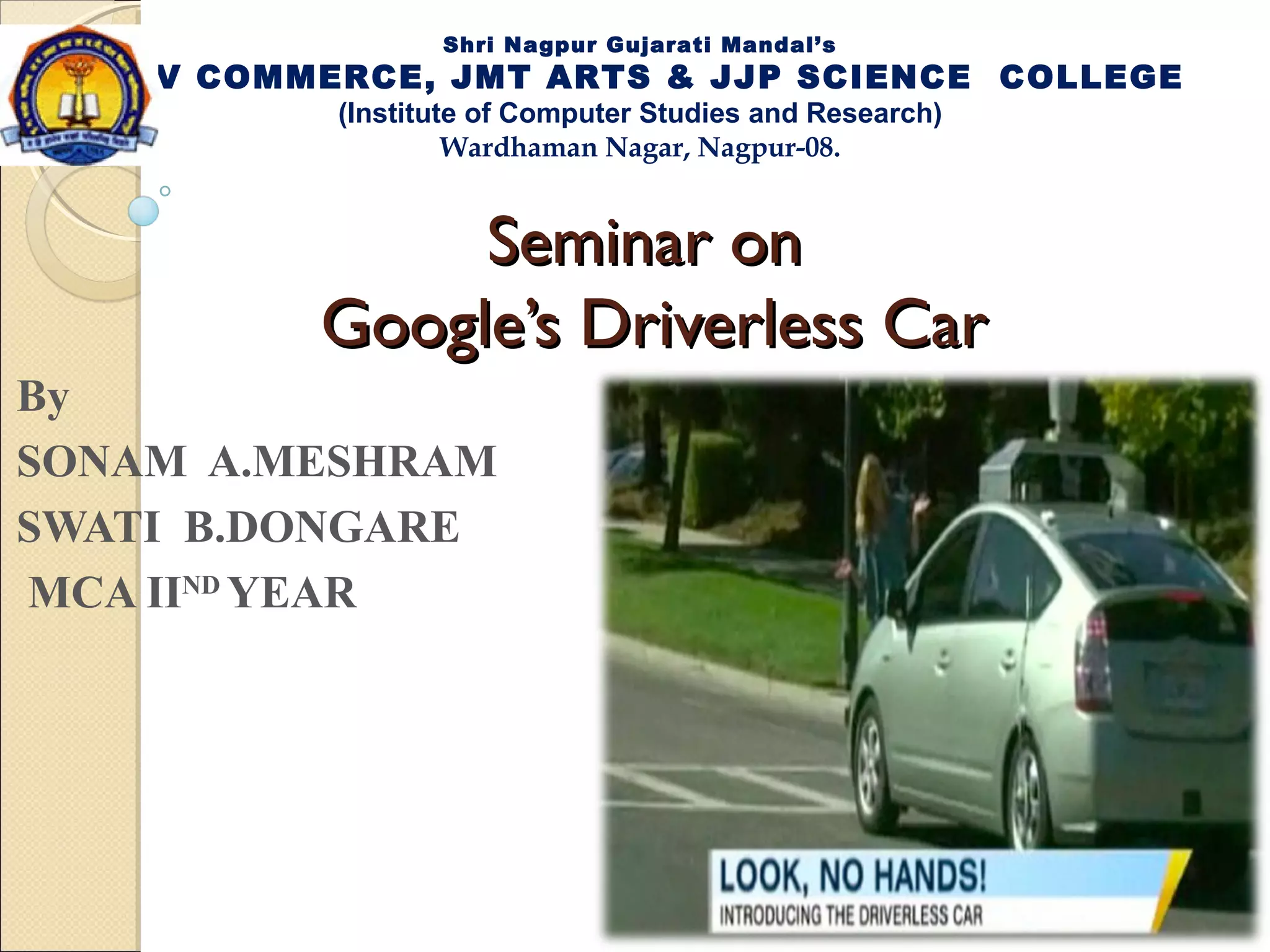
Seminar onSeminar on
Google’s Driverless CarGoogle’s Driverless Car
By
SONAM A.MESHRAM
SWATI B.DONGARE
MCA IIND
YEAR
Shri Nagpur Gujarati Mandal’s
VMV COMMERCE, JMT ARTS & JJP SCIENCE COLLEGE
(Institute of Computer Studies and Research)
Wardhaman Nagar, Nagpur-08.
CONTENTS:CONTENTS:
Introduction
Technologies Behind
Benefits
◦ Self
◦ Others
◦ General Society
Adoption Challenges
Future Implication
Conclusion
When life becomes so hectic that…When life becomes so hectic that…
When such hectic turns out as tragediesWhen such hectic turns out as tragedies
Imagine…
The Best of BothThe Best of Both
Google
Introducing the
Google Driverless
Car
HistoryHistory
 The project is currently
being led by Google engineer
Sebastian Thrun.
 Director of the Stanford
Artificial Intelligence
Laboratory.
 Won the 2005 DARPA Grand Challenge.
 Co-inventor of Google Street View.
What is Google Driverless Car ?What is Google Driverless Car ?
 What?
◦ The Google Self-Driving Car is a project by Google that involves
developing technology for autonomous cars, mainly electric cars. The
software powering Google's cars is called Google Chauffeur.
 When?
◦ Informally since 2005
◦ From 2010, by a formal team of 15 engineers from Google
 Progress so far?
◦ Google currently lobbying for driverless car laws in more states in the
US
◦ Nevada as the 1st
state having passed such law in mid-2011 (operation
of driverless cars)
◦ Florida and California as the 2nd
and 3rd
state in early and late 2012.
Which type of Technology is usedWhich type of Technology is used
1.Lidar is a remote sensing
technology
2. Velodyne range finder mounted
on the top .
3.Scanner/Rotating Sensor
4.Video Camera
Google's robotic cars have equipment including :
Devices involvedDevices involved
Laser sensor on the roof
(1.5 million
measurements per
second)
Radar sensor in front
and rear bumpers
GPS
Settings of driving personalities
Self-learning Program HD camera looking out and inward
from the windshield
Constant mappingConstant mapping
Effective and efficient parkingEffective and efficient parking
Use of sensor
◦ Measuring parking space available
◦ Determining if there is sufficient space
◦ Steering itself into the space
◦ In essence, automatic search for suitable parking space within designated
area, and then execution
Beyond “vision”Beyond “vision”
ADVANTAGESADVANTAGES
• Safer
•More efficient
•Fewer accidents
•Follow traffic laws
DISADVANTAGES:DISADVANTAGES:
• Liability
• Loss of jobs
• Reliance on up to date
technology
• Costly
• Timeframe
ChallengesChallenges
Cost Issue
Total cost: US$ 300,000
includes:
•Laser system - $ 70,000
•Hi-tech Equipment - $ 150,000
•Impacts on public
transport industry
•Technology & Privacy Issues
FUTURE IMPLICATIONFUTURE IMPLICATION
Short Term
- Difficult to make this innovation profitable as the
technology requires expensive sensors, computing
power and software.
Long Term
- Demand is higher. Automated driving means more
people can use cars, and more cars can be fitted
safely on roads.
Conclusion
Conclusion, upon addressing the mechanics of the
driverless car as well as its benefits and potential issues, it
is quite interesting to see how the world will actually
become by the year 2040.
Very Useful
Driverless cars are designed to minimized the road
accidents.
Google driver less car

Google driver less car

  • 1.
    Seminar onSeminar on Google’sDriverless CarGoogle’s Driverless Car By SONAM A.MESHRAM SWATI B.DONGARE MCA IIND YEAR Shri Nagpur Gujarati Mandal’s VMV COMMERCE, JMT ARTS & JJP SCIENCE COLLEGE (Institute of Computer Studies and Research) Wardhaman Nagar, Nagpur-08.
  • 2.
    CONTENTS:CONTENTS: Introduction Technologies Behind Benefits ◦ Self ◦Others ◦ General Society Adoption Challenges Future Implication Conclusion
  • 3.
    When life becomesso hectic that…When life becomes so hectic that…
  • 4.
    When such hecticturns out as tragediesWhen such hectic turns out as tragedies
  • 5.
  • 6.
    The Best ofBothThe Best of Both Google Introducing the Google Driverless Car
  • 7.
    HistoryHistory  The projectis currently being led by Google engineer Sebastian Thrun.  Director of the Stanford Artificial Intelligence Laboratory.  Won the 2005 DARPA Grand Challenge.  Co-inventor of Google Street View.
  • 8.
    What is GoogleDriverless Car ?What is Google Driverless Car ?  What? ◦ The Google Self-Driving Car is a project by Google that involves developing technology for autonomous cars, mainly electric cars. The software powering Google's cars is called Google Chauffeur.  When? ◦ Informally since 2005 ◦ From 2010, by a formal team of 15 engineers from Google  Progress so far? ◦ Google currently lobbying for driverless car laws in more states in the US ◦ Nevada as the 1st state having passed such law in mid-2011 (operation of driverless cars) ◦ Florida and California as the 2nd and 3rd state in early and late 2012.
  • 9.
    Which type ofTechnology is usedWhich type of Technology is used 1.Lidar is a remote sensing technology 2. Velodyne range finder mounted on the top . 3.Scanner/Rotating Sensor 4.Video Camera Google's robotic cars have equipment including :
  • 10.
    Devices involvedDevices involved Lasersensor on the roof (1.5 million measurements per second) Radar sensor in front and rear bumpers GPS Settings of driving personalities Self-learning Program HD camera looking out and inward from the windshield
  • 11.
  • 12.
    Effective and efficientparkingEffective and efficient parking Use of sensor ◦ Measuring parking space available ◦ Determining if there is sufficient space ◦ Steering itself into the space ◦ In essence, automatic search for suitable parking space within designated area, and then execution
  • 13.
  • 14.
  • 15.
    DISADVANTAGES:DISADVANTAGES: • Liability • Lossof jobs • Reliance on up to date technology • Costly • Timeframe
  • 16.
    ChallengesChallenges Cost Issue Total cost:US$ 300,000 includes: •Laser system - $ 70,000 •Hi-tech Equipment - $ 150,000 •Impacts on public transport industry •Technology & Privacy Issues
  • 17.
    FUTURE IMPLICATIONFUTURE IMPLICATION ShortTerm - Difficult to make this innovation profitable as the technology requires expensive sensors, computing power and software. Long Term - Demand is higher. Automated driving means more people can use cars, and more cars can be fitted safely on roads.
  • 18.
    Conclusion Conclusion, upon addressingthe mechanics of the driverless car as well as its benefits and potential issues, it is quite interesting to see how the world will actually become by the year 2040. Very Useful Driverless cars are designed to minimized the road accidents.

Editor's Notes

  • #11 different driving personalities — from cautious, in which it is more likely to yield to another car, to aggressive, where it is more likely to go first