• Introduction
• What is A Google car?
• Technologies behind self-driving
car
• Working
• Advantages of Google car
• Disadvantages of Google car
• Conclusion
• Driver error is the most common cause of traffic
accidents
• India contributes 6 % of the world's road accident
deaths
• Cell phones in-car ,entertainment systems, more
traffic and more complicated road systems making
it more frequent
• By this improving technology our car will do the
concentrating for us.
‣ An Google car is also known as Driverless car ,
Self-Driving Car
‣ It is vehicle that can drive itself from one point to
another without any assistance from driver
‣ In other words it is operated by an autopilot
system
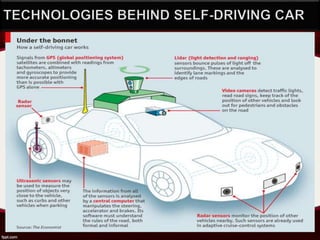
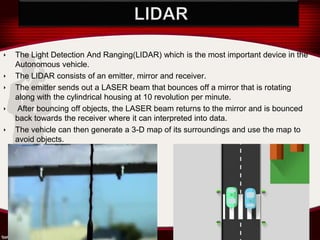
‣ The Light Detection And Ranging(LIDAR) which is the most important device in the
Autonomous vehicle.
‣ The LIDAR consists of an emitter, mirror and receiver.
‣ The emitter sends out a LASER beam that bounces off a mirror that is rotating
along with the cylindrical housing at 10 revolution per minute.
‣ After bouncing off objects, the LASER beam returns to the mirror and is bounced
back towards the receiver where it can interpreted into data.
‣ The vehicle can then generate a 3-D map of its surroundings and use the map to
avoid objects.
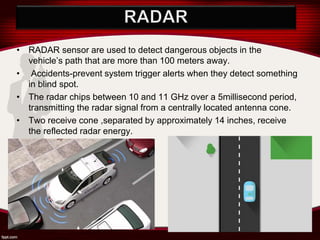
• RADAR sensor are used to detect dangerous objects in the
vehicle’s path that are more than 100 meters away.
• Accidents-prevent system trigger alerts when they detect something
in blind spot.
• The radar chips between 10 and 11 GHz over a 5millisecond period,
transmitting the radar signal from a centrally located antenna cone.
• Two receive cone ,separated by approximately 14 inches, receive
the reflected radar energy.
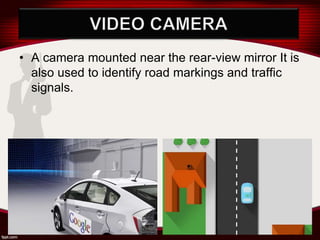
• A camera mounted near the rear-view mirror It is
also used to identify road markings and traffic
signals.
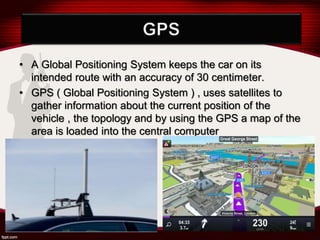
• A Global Positioning System keeps the car on its
intended route with an accuracy of 30 centimeter.
• GPS ( Global Positioning System ) , uses satellites to
gather information about the current position of the
vehicle , the topology and by using the GPS a map of the
area is loaded into the central computer
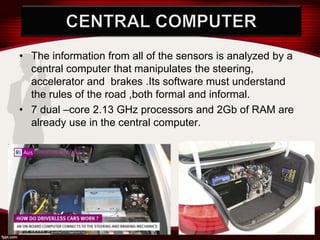
• The information from all of the sensors is analyzed by a
central computer that manipulates the steering,
accelerator and brakes .Its software must understand
the rules of the road ,both formal and informal.
• 7 dual –core 2.13 GHz processors and 2Gb of RAM are
already use in the central computer.
• The “driver” sets a destination. The car’s software calculates a route and
starts the car on its way.
• A rotating, roof-mounted LIDAR (Light Detection and Ranging - a
technology similar to radar) sensor monitors a 60-meter range around the
car and creates a dynamic 3D map of the car’s current environment.
• A sensor on the left rear wheel monitors sideways movement to detect the
car’s position relative to the 3-D map.
• Radar systems in the front and rear bumpers calculate distances to
obstacles.
• Artificial intelligence (AI) software in the car is connected to all the sensors
and has input from Google Street View and video cameras inside the car.
• The AI simulates human perceptual and decision-making processes and
controls actions in driver-control systems such as steering and brakes.
• The car’s software consults Google Maps for advance notice of things like
landmarks and traffic signals and lights.
• Managing traffic flow to increase road capacity.
• Relieving vehicle occupants from driving allowing them to concentrate
on other tasks or to rest during their journeys.
• To avoid accidents .
• Increasing roadway capacity by reducing the distances between cars.
• The current location of vehicle can be determine using global
positioning system (G.P.S) .
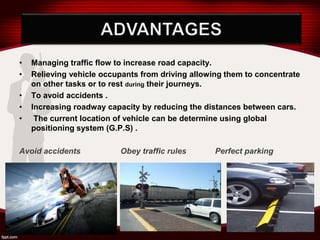
Avoid accidents Obey traffic rules Perfect parking
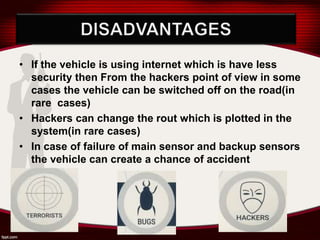
• If the vehicle is using internet which is have less
security then From the hackers point of view in some
cases the vehicle can be switched off on the road(in
rare cases)
• Hackers can change the rout which is plotted in the
system(in rare cases)
• In case of failure of main sensor and backup sensors
the vehicle can create a chance of accident
CONCLUSION
• The driver less car’s technologies improves
vehicle's stability helps to minimize loss of control.
• Driver less cars are designed to minimize accidents
by addressing the main causes of collisions: driving
error, distraction .
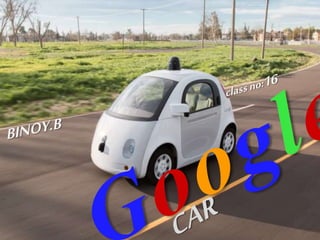
Google CAR
Google CAR

Google CAR

  • 2.
    • Introduction • Whatis A Google car? • Technologies behind self-driving car • Working • Advantages of Google car • Disadvantages of Google car • Conclusion
  • 3.
    • Driver erroris the most common cause of traffic accidents • India contributes 6 % of the world's road accident deaths • Cell phones in-car ,entertainment systems, more traffic and more complicated road systems making it more frequent • By this improving technology our car will do the concentrating for us.
  • 4.
    ‣ An Googlecar is also known as Driverless car , Self-Driving Car ‣ It is vehicle that can drive itself from one point to another without any assistance from driver ‣ In other words it is operated by an autopilot system
  • 6.
    ‣ The LightDetection And Ranging(LIDAR) which is the most important device in the Autonomous vehicle. ‣ The LIDAR consists of an emitter, mirror and receiver. ‣ The emitter sends out a LASER beam that bounces off a mirror that is rotating along with the cylindrical housing at 10 revolution per minute. ‣ After bouncing off objects, the LASER beam returns to the mirror and is bounced back towards the receiver where it can interpreted into data. ‣ The vehicle can then generate a 3-D map of its surroundings and use the map to avoid objects.
  • 7.
    • RADAR sensorare used to detect dangerous objects in the vehicle’s path that are more than 100 meters away. • Accidents-prevent system trigger alerts when they detect something in blind spot. • The radar chips between 10 and 11 GHz over a 5millisecond period, transmitting the radar signal from a centrally located antenna cone. • Two receive cone ,separated by approximately 14 inches, receive the reflected radar energy.
  • 8.
    • A cameramounted near the rear-view mirror It is also used to identify road markings and traffic signals.
  • 9.
    • A GlobalPositioning System keeps the car on its intended route with an accuracy of 30 centimeter. • GPS ( Global Positioning System ) , uses satellites to gather information about the current position of the vehicle , the topology and by using the GPS a map of the area is loaded into the central computer
  • 10.
    • The informationfrom all of the sensors is analyzed by a central computer that manipulates the steering, accelerator and brakes .Its software must understand the rules of the road ,both formal and informal. • 7 dual –core 2.13 GHz processors and 2Gb of RAM are already use in the central computer.
  • 11.
    • The “driver”sets a destination. The car’s software calculates a route and starts the car on its way. • A rotating, roof-mounted LIDAR (Light Detection and Ranging - a technology similar to radar) sensor monitors a 60-meter range around the car and creates a dynamic 3D map of the car’s current environment. • A sensor on the left rear wheel monitors sideways movement to detect the car’s position relative to the 3-D map. • Radar systems in the front and rear bumpers calculate distances to obstacles. • Artificial intelligence (AI) software in the car is connected to all the sensors and has input from Google Street View and video cameras inside the car. • The AI simulates human perceptual and decision-making processes and controls actions in driver-control systems such as steering and brakes. • The car’s software consults Google Maps for advance notice of things like landmarks and traffic signals and lights.
  • 13.
    • Managing trafficflow to increase road capacity. • Relieving vehicle occupants from driving allowing them to concentrate on other tasks or to rest during their journeys. • To avoid accidents . • Increasing roadway capacity by reducing the distances between cars. • The current location of vehicle can be determine using global positioning system (G.P.S) . Avoid accidents Obey traffic rules Perfect parking
  • 14.
    • If thevehicle is using internet which is have less security then From the hackers point of view in some cases the vehicle can be switched off on the road(in rare cases) • Hackers can change the rout which is plotted in the system(in rare cases) • In case of failure of main sensor and backup sensors the vehicle can create a chance of accident
  • 15.
    CONCLUSION • The driverless car’s technologies improves vehicle's stability helps to minimize loss of control. • Driver less cars are designed to minimize accidents by addressing the main causes of collisions: driving error, distraction .