Submitted by:
PIYUSH TYAGI
4th year (ME)
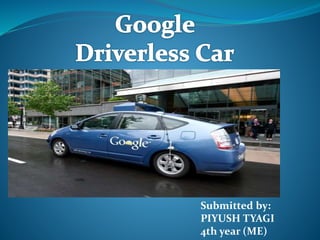
The Google Driverless Car is like any car, but:
 It can steer itself while looking out for obstacles.
 It can accelerate itself to the correct speed limit.
 It can stop and go itself based on any traffic
condition.
The project is currently being
led by: Sebastian Thrun
 Director of the Stanford
Artificial Intelligence
Laboratory
 Co-inventor of Google Street
View
AUTONOMOUS
 Google self-driving car is a range of autonomous
cars, developed by Google X as part of its project to
develop technology for mainly electric cars.
 The software installed in Google's cars is called
Google Chauffeur.
Google Maps
Provides the car with road information
Hardware Sensors
Provides the car with real time environment
conditions
Artificial Intelligence
Provides the car with real time decisions
 Google Maps interacts
with GPS and acts like a
database.
 Speed Limits.
 Upcoming intersections.
 Traffic Report.
 Nearby collisions.
 Directions.
 Sensors attempt to create fully observable
environment
 The hardware sensors gives real time
environmental properties.
 Its further Components:
1. LIDAR
2. VIDEO CAMERA
3. POSITION ESTIMATOR
4. DISTANCE SENSOR
 “Heart of the system“
 LIDAR stands for Light Detection And
Ranging
 It is an optical remote sensing technology
 It can measure the distance to, or other
properties of a target by illuminating the
target with light.
 Scanning distance of 60 meters (~197 feet)
VIDEO CAMERA
Detects upcoming traffic light.
 DISTANCE SENSOR
Allow the car to "see" far enough to detect
nearby or upcoming cars or obstacles
 POSITION ESTIMATOR(Wheel Encoder)
Determines vehicle's location and keeps track
of its movements.
Google Maps and the hardware sensors data are
sent to the AI.
AI then determines:
 how fast to accelerate
 when to slow down/stop
 when to steer the wheel
 Goal of AI
The agent's goal is to take the passenger to its
desired destination safely and legally
HOW IT WORKS..??
 Car uses the sensor and software to sense objects like
Pedestrians, cyclist, vehicles and more, and are
designed to safely drive around them.
 The car Processes both map and sensor information to
determine where he is in the world. The car knows
what street it’s on and which lane it’s in.
 Sensor help detect objects all
around it. The software
classifies objects based on
their size, shape and
movement pattern.
 The software predicts what all
the object around might do the
next.
 The software then chooses a
safe speed and trajectory for
the car.
CAR IN ACTION!
A look from the inside...
A look from the outside...
 Legislation has been passed in four U.S.
states and Washington, D.C. allowing
driverless cars
 The state of Nevada passed a law on June
29, 2011, permitting the operation of
autonomous cars in Nevada
The Nevada Department of Motor Vehicles issued the first
license for an autonomous car in May 2012, to a Toyota
Prius.
In April 2012, Florida became the second state to allow the
testing of autonomous cars on public roads.
California became the third.
 In December 2013, Michigan became the fourth state to
allow testing of driverless cars on public roads.
___ON TRACK.___
Google's vehicles have traversed San Francisco's
Lombard Street, famed for its steep hairpin turns,
and through city traffic.
The vehicles have driven over the Golden Gate
Bridge and around Lake Tahoe. The system drives at
the speed limit it has stored on its maps and
maintains its distance from other vehicles using its
system of sensors.
In August 2012, the team announced that they have
completed over 300,000 autonomous-driving miles
(500,000 km) accident-free
In April 2014, the team announced that their vehicles have
now logged nearly 700,000 autonomous miles (1.1 million
km).
 In late May, Google revealed a new prototype of its
driverless car, which had no steering wheel, gas pedal, or
brake pedal, being 100% autonomous.
 In June 2015, the team announced that their vehicles
have now driven over 1,000,000 mi (1,600,000 km),
in the process they had encountered 200,000 stop
signs, 600,000 traffic lights, and 180 million other
 During testing, the prototypes' speed cannot exceed 25
mph (40 km/h) and will have safety drivers aboard the
entire time.
Accident..!!
 As of July 2015, Google's 23 self-
driving cars have been involved in
14 minor traffic accidents on public
roads
 In July 2015, three Google
employees suffered minor injuries
when the self-driving car they were
riding in was rear-ended by a car
whose driver failed to brake at a
traffic light. This was the first time
that a self-driving car collision
resulted in injuries.
• Avoid accidents.
•Current location can be
easily identified by GPS.
•Manage traffic Flow.
•Increasing Roadway
capacity.
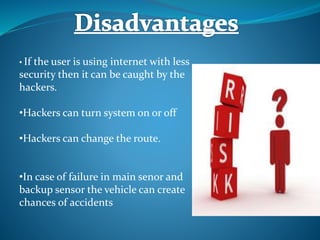
• If the user is using internet with less
security then it can be caught by the
hackers.
•Hackers can turn system on or off
•Hackers can change the route.
•In case of failure in main senor and
backup sensor the vehicle can create
chances of accidents
•The driverless car improves vehicle’s stability helps to minimize
the loss of control.
•Main aim is to minimize the road accidents.
Google driverless car with working

Google driverless car with working

  • 1.
  • 2.
    The Google DriverlessCar is like any car, but:  It can steer itself while looking out for obstacles.  It can accelerate itself to the correct speed limit.  It can stop and go itself based on any traffic condition.
  • 3.
    The project iscurrently being led by: Sebastian Thrun  Director of the Stanford Artificial Intelligence Laboratory  Co-inventor of Google Street View
  • 4.
    AUTONOMOUS  Google self-drivingcar is a range of autonomous cars, developed by Google X as part of its project to develop technology for mainly electric cars.  The software installed in Google's cars is called Google Chauffeur.
  • 5.
    Google Maps Provides thecar with road information Hardware Sensors Provides the car with real time environment conditions Artificial Intelligence Provides the car with real time decisions
  • 6.
     Google Mapsinteracts with GPS and acts like a database.  Speed Limits.  Upcoming intersections.  Traffic Report.  Nearby collisions.  Directions.
  • 7.
     Sensors attemptto create fully observable environment  The hardware sensors gives real time environmental properties.  Its further Components: 1. LIDAR 2. VIDEO CAMERA 3. POSITION ESTIMATOR 4. DISTANCE SENSOR
  • 9.
     “Heart ofthe system“  LIDAR stands for Light Detection And Ranging  It is an optical remote sensing technology  It can measure the distance to, or other properties of a target by illuminating the target with light.  Scanning distance of 60 meters (~197 feet)
  • 10.
    VIDEO CAMERA Detects upcomingtraffic light.  DISTANCE SENSOR Allow the car to "see" far enough to detect nearby or upcoming cars or obstacles  POSITION ESTIMATOR(Wheel Encoder) Determines vehicle's location and keeps track of its movements.
  • 11.
    Google Maps andthe hardware sensors data are sent to the AI. AI then determines:  how fast to accelerate  when to slow down/stop  when to steer the wheel  Goal of AI The agent's goal is to take the passenger to its desired destination safely and legally
  • 12.
    HOW IT WORKS..?? Car uses the sensor and software to sense objects like Pedestrians, cyclist, vehicles and more, and are designed to safely drive around them.  The car Processes both map and sensor information to determine where he is in the world. The car knows what street it’s on and which lane it’s in.
  • 13.
     Sensor helpdetect objects all around it. The software classifies objects based on their size, shape and movement pattern.  The software predicts what all the object around might do the next.  The software then chooses a safe speed and trajectory for the car.
  • 14.
    CAR IN ACTION! Alook from the inside... A look from the outside...
  • 15.
     Legislation hasbeen passed in four U.S. states and Washington, D.C. allowing driverless cars  The state of Nevada passed a law on June 29, 2011, permitting the operation of autonomous cars in Nevada
  • 16.
    The Nevada Departmentof Motor Vehicles issued the first license for an autonomous car in May 2012, to a Toyota Prius. In April 2012, Florida became the second state to allow the testing of autonomous cars on public roads. California became the third.  In December 2013, Michigan became the fourth state to allow testing of driverless cars on public roads.
  • 17.
    ___ON TRACK.___ Google's vehicleshave traversed San Francisco's Lombard Street, famed for its steep hairpin turns, and through city traffic. The vehicles have driven over the Golden Gate Bridge and around Lake Tahoe. The system drives at the speed limit it has stored on its maps and maintains its distance from other vehicles using its system of sensors.
  • 18.
    In August 2012,the team announced that they have completed over 300,000 autonomous-driving miles (500,000 km) accident-free In April 2014, the team announced that their vehicles have now logged nearly 700,000 autonomous miles (1.1 million km).  In late May, Google revealed a new prototype of its driverless car, which had no steering wheel, gas pedal, or brake pedal, being 100% autonomous.
  • 19.
     In June2015, the team announced that their vehicles have now driven over 1,000,000 mi (1,600,000 km), in the process they had encountered 200,000 stop signs, 600,000 traffic lights, and 180 million other  During testing, the prototypes' speed cannot exceed 25 mph (40 km/h) and will have safety drivers aboard the entire time.
  • 20.
    Accident..!!  As ofJuly 2015, Google's 23 self- driving cars have been involved in 14 minor traffic accidents on public roads  In July 2015, three Google employees suffered minor injuries when the self-driving car they were riding in was rear-ended by a car whose driver failed to brake at a traffic light. This was the first time that a self-driving car collision resulted in injuries.
  • 21.
    • Avoid accidents. •Currentlocation can be easily identified by GPS. •Manage traffic Flow. •Increasing Roadway capacity.
  • 22.
    • If theuser is using internet with less security then it can be caught by the hackers. •Hackers can turn system on or off •Hackers can change the route. •In case of failure in main senor and backup sensor the vehicle can create chances of accidents
  • 23.
    •The driverless carimproves vehicle’s stability helps to minimize the loss of control. •Main aim is to minimize the road accidents.