Subscribe the channel for more vedio lectures
“Biology with saqib zeb”
Saqib Zeb
Molecular Genetics
FSC Biology
Chapter First
Lecture 4
Golgi body
Golgi Body (Subscribethechannel formore vedio lectures “Biologywithsaqib zeb)
Definition:
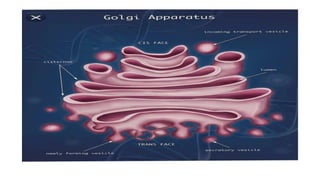
Membrane bounded organelle of eukaryotic cell that is made up of series of
flattened stackedpouches Called cisternae and associated vesicles.
Synonym :
• Golgi apparatus
• Golgi complex
• Dicytosome (plants)
Golgi body
Discoverey:
• Camilo Golgi-1898 (Nervous system cell)
• Named it “internal reticular apparatus”-1898
• Golgi apparatus name was given later in 1910.
Analogy:
• Post Office of cell
• Traffic Police of cell
Shape:
• Cisternae – Rod/saucer/flat shaped
• Vesicle-sphericle/granular
• Tubules -Rod
Number:
• 40-100 (Mammalian cell)-depend on activity of cell
Golgi body
Composition:
• Lipids
• Proteins
• Enzymes
Structure :
A. Morphology:
Morphologically it is distinguished into three parts.
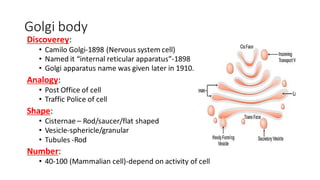
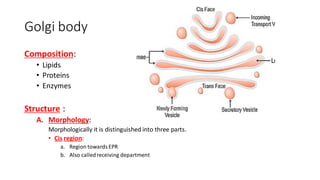
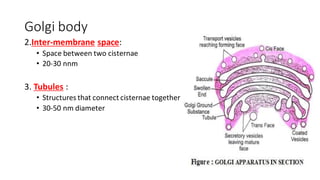
• Cis region:
a. Region towards EPR
b. Also calledreceiving department
Golgi body
• Shape of cisternae present here is convex (bulged outward)
• Receive secretion through transport vesicles
Golgi body
• Medial region:
• Region between cis and trans face
• Modify secretion
• Usually flat cisternae
Golgi body
• Trans region
• Region towards cytoplasm
• Cisternae-concave (bulged inward)
• Also called shipping department
• Release processed secretion
Anatomy :
Four parts
• Cisternae
• Cisternal Space
• Tubules
• Vesicles
Golgi body (Subscribethe channel formore vediolectures“Biologywithsaqib
zeb
1. Cisternae:
Origin: Latin word, Cista-Sac/box
Synonym: Saccules/dictytosome
Definition : Semicircular/bent/saucer shaped Structuressurrounded by
membrane.
Golgi body
Number :
• 4-8 per Golgi body
Diameter:
• 1 um
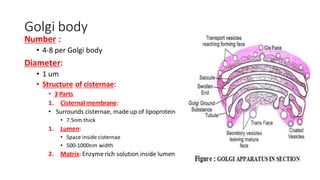
• Structure of cisternae:
• 3 Parts
1. Cisternal membrane:
• Surrounds cisternae, made up of lipoprotein
• 7.5nm thick
1. Lumen:
• Space inside cisternae
• 500-1000nm width
2. Matrix: Enzyme rich solution inside lumen
Golgi body
2.Inter-membrane space:
• Space between two cisternae
• 20-30 nnm
3. Tubules :
• Structures that connect cisternae together
• 30-50 nm diameter
Golgi body Subscribe the channel for more vedio lectures “Biology with saqib zeb
4. Vesicles
Definition:
Spherical or granular membrane bounded structure containing secretion from
EPR and Golgi body
Types:
• Two main types
1. Transport vesicles :
• Carry secretion from one site to another inside cell e. g From EPR to Golgi body
• Protein from ribosome synthesized at Rough EPR.
2. Secretory vesicles:
• Carry secretion to outside cell through exocytosis
• Secretion like hormones, enzymes etc
Golgi body Subscribe the channel for more vedio lectures “Biology with saqib zeb
Function :
1. Packing,Modification and delivery of secretion :
• Golgi body receive (Cis face) Secretion
• Modify (Medial portion)-add or remove molecules like sugar, amino acids
• Pack and deliver(Trans region) secretion to its destination-
• Correct delivery is because they are tagged with molecules like sugar, amino
acids etc
• Same function like that performed by traffic police or performed at post
Office
Golgi body
2. Formation of organelles
• Plasma membrane –exocytotic vesicles
• Lysosomes
• Acrosome (derivative of golgi body, contain digestive enxymes)
• Cortical granules (granules in oocyte to prevent polyspermy)
Golgi body
3.Involved in transport of lipids around the cell
4.Formation of proteoglycan (protein backbone and carbohydrates side
branches)-present in extracellular matrix.
5.Plants-formation of cell wall material
Subscribe the channel for more vedio lectures “Biology with saqib zeb
Golgi body Etea repeated MCQS
Subscribe the channel for more vediolectures “Biology withsaqibzeb
1. Golgi complex was first recognised in
• Neuron
• RBC
• Epitheilial cells
• Hepatocytes
2. Besides giving out secretary vesicles, the Golgi apparatus is also
concerned with the formation of
• Lysosomes
• Acrosome
• Cortical granules
• All
Golgi body mcqs
3. Which one the following does not contain golgi body.
• Yeast
• Bacteria
• Plants
• Algae
4. The simplest unit, the saucer-like closed compartments of Golgi
apparatus is called as
• Tubules
• Vesicles
• Cisternae
• Lumen
Golgi body mcqs
Subscribe the channel for more vediolectures “Biology withsaqibzeb
5. Which organelles is called traffuc police of cell.
• Ribosome
• Lysosomes
• Golgi body
• Plastid
6. Organelle involved in cell plate formation is,
• Cell wall
• Lysosome
• Golgi body
• Plastid
Golgi body mcqs
7. Which one of the following organelle take part in the secretion
• Mitochondria
• Golgi body
• Endo plasmic reticulum
• Peroxisome
8. Which one of the following cell will have more Golgi bodies
• Liver cellS
• Rod cellS
• Taste bud
• Cells of lungs
Golgi body Mcqs
9. Which one of the following structure help to prevent polyspermy
• Acrosome
• Mesosome
• Cortical granules
• Inclusion bodies
10. Which organelle is responsible for directing the secretion to its
target site
• Golgi apparatus
• Endo plasmic reticulum
• Sarcoplasmic reticulum
Thanks for watching the vedio
Please subscribe the channel “Biology with saqib zeb”

Golgi Body.pdf

  • 3.
    Subscribe the channelfor more vedio lectures “Biology with saqib zeb” Saqib Zeb Molecular Genetics FSC Biology Chapter First Lecture 4 Golgi body
  • 4.
    Golgi Body (Subscribethechannelformore vedio lectures “Biologywithsaqib zeb) Definition: Membrane bounded organelle of eukaryotic cell that is made up of series of flattened stackedpouches Called cisternae and associated vesicles. Synonym : • Golgi apparatus • Golgi complex • Dicytosome (plants)
  • 5.
    Golgi body Discoverey: • CamiloGolgi-1898 (Nervous system cell) • Named it “internal reticular apparatus”-1898 • Golgi apparatus name was given later in 1910. Analogy: • Post Office of cell • Traffic Police of cell Shape: • Cisternae – Rod/saucer/flat shaped • Vesicle-sphericle/granular • Tubules -Rod Number: • 40-100 (Mammalian cell)-depend on activity of cell
  • 6.
    Golgi body Composition: • Lipids •Proteins • Enzymes Structure : A. Morphology: Morphologically it is distinguished into three parts. • Cis region: a. Region towards EPR b. Also calledreceiving department
  • 7.
    Golgi body • Shapeof cisternae present here is convex (bulged outward) • Receive secretion through transport vesicles
  • 8.
    Golgi body • Medialregion: • Region between cis and trans face • Modify secretion • Usually flat cisternae
  • 9.
    Golgi body • Transregion • Region towards cytoplasm • Cisternae-concave (bulged inward) • Also called shipping department • Release processed secretion Anatomy : Four parts • Cisternae • Cisternal Space • Tubules • Vesicles
  • 10.
    Golgi body (Subscribethechannel formore vediolectures“Biologywithsaqib zeb 1. Cisternae: Origin: Latin word, Cista-Sac/box Synonym: Saccules/dictytosome Definition : Semicircular/bent/saucer shaped Structuressurrounded by membrane.
  • 11.
    Golgi body Number : •4-8 per Golgi body Diameter: • 1 um • Structure of cisternae: • 3 Parts 1. Cisternal membrane: • Surrounds cisternae, made up of lipoprotein • 7.5nm thick 1. Lumen: • Space inside cisternae • 500-1000nm width 2. Matrix: Enzyme rich solution inside lumen
  • 12.
    Golgi body 2.Inter-membrane space: •Space between two cisternae • 20-30 nnm 3. Tubules : • Structures that connect cisternae together • 30-50 nm diameter
  • 13.
    Golgi body Subscribethe channel for more vedio lectures “Biology with saqib zeb 4. Vesicles Definition: Spherical or granular membrane bounded structure containing secretion from EPR and Golgi body Types: • Two main types 1. Transport vesicles : • Carry secretion from one site to another inside cell e. g From EPR to Golgi body • Protein from ribosome synthesized at Rough EPR. 2. Secretory vesicles: • Carry secretion to outside cell through exocytosis • Secretion like hormones, enzymes etc
  • 15.
    Golgi body Subscribethe channel for more vedio lectures “Biology with saqib zeb Function : 1. Packing,Modification and delivery of secretion : • Golgi body receive (Cis face) Secretion • Modify (Medial portion)-add or remove molecules like sugar, amino acids • Pack and deliver(Trans region) secretion to its destination- • Correct delivery is because they are tagged with molecules like sugar, amino acids etc • Same function like that performed by traffic police or performed at post Office
  • 16.
    Golgi body 2. Formationof organelles • Plasma membrane –exocytotic vesicles • Lysosomes • Acrosome (derivative of golgi body, contain digestive enxymes) • Cortical granules (granules in oocyte to prevent polyspermy)
  • 18.
    Golgi body 3.Involved intransport of lipids around the cell 4.Formation of proteoglycan (protein backbone and carbohydrates side branches)-present in extracellular matrix. 5.Plants-formation of cell wall material Subscribe the channel for more vedio lectures “Biology with saqib zeb
  • 19.
    Golgi body Etearepeated MCQS Subscribe the channel for more vediolectures “Biology withsaqibzeb 1. Golgi complex was first recognised in • Neuron • RBC • Epitheilial cells • Hepatocytes 2. Besides giving out secretary vesicles, the Golgi apparatus is also concerned with the formation of • Lysosomes • Acrosome • Cortical granules • All
  • 20.
    Golgi body mcqs 3.Which one the following does not contain golgi body. • Yeast • Bacteria • Plants • Algae 4. The simplest unit, the saucer-like closed compartments of Golgi apparatus is called as • Tubules • Vesicles • Cisternae • Lumen
  • 21.
    Golgi body mcqs Subscribethe channel for more vediolectures “Biology withsaqibzeb 5. Which organelles is called traffuc police of cell. • Ribosome • Lysosomes • Golgi body • Plastid 6. Organelle involved in cell plate formation is, • Cell wall • Lysosome • Golgi body • Plastid
  • 22.
    Golgi body mcqs 7.Which one of the following organelle take part in the secretion • Mitochondria • Golgi body • Endo plasmic reticulum • Peroxisome 8. Which one of the following cell will have more Golgi bodies • Liver cellS • Rod cellS • Taste bud • Cells of lungs
  • 23.
    Golgi body Mcqs 9.Which one of the following structure help to prevent polyspermy • Acrosome • Mesosome • Cortical granules • Inclusion bodies 10. Which organelle is responsible for directing the secretion to its target site • Golgi apparatus • Endo plasmic reticulum • Sarcoplasmic reticulum
  • 24.
    Thanks for watchingthe vedio Please subscribe the channel “Biology with saqib zeb”