OUTLINE
Introduction
Discovery
Morphology
      Cisternae
      Cis-Face
      Trans-Face
Functions
Working Of Golgi Complex
Transportation
GOLGI COMPLEX
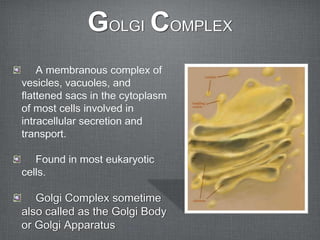
    A membranous complex of
vesicles, vacuoles, and
flattened sacs in the cytoplasm
of most cells involved in
intracellular secretion and
transport.

   Found in most eukaryotic
cells.

   Golgi Complex sometime
also called as the Golgi Body
or Golgi Apparatus
DISCOVERY
Golgi apparatus is named after the
scientist who discovered it.

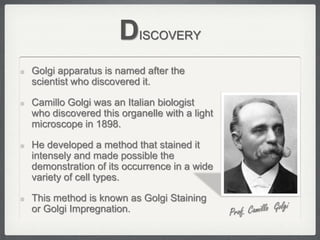
Camillo Golgi was an Italian biologist
who discovered this organelle with a light
microscope in 1898.

He developed a method that stained it
intensely and made possible the
demonstration of its occurrence in a wide
variety of cell types.

This method is known as Golgi Staining
or Golgi Impregnation.
MORPHOLOGY
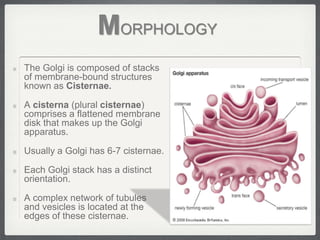
The Golgi is composed of stacks
of membrane-bound structures
known as Cisternae.

A cisterna (plural cisternae)
comprises a flattened membrane
disk that makes up the Golgi
apparatus.

Usually a Golgi has 6-7 cisternae.

Each Golgi stack has a distinct
orientation.

A complex network of tubules
and vesicles is located at the
edges of these cisternae.
MORPHOLOGY
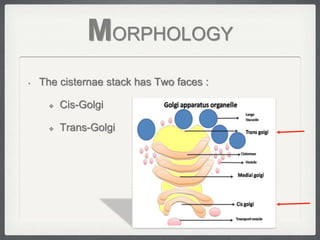
•   The cisternae stack has Two faces :

        Cis-Golgi

        Trans-Golgi
CIS-GOLGI
 The side faces the Endoplasmic reticulum is Cis Face and is the entry face
    that receives small membrane vesicles from the ER.

 Vesicles from the endoplasmic reticulum fuse with the cis-Golgi network and
    subsequently progress through the stack to the trans-Golgi network.

 The cis is the site at which transport vesicles bringing newly synthesized
    products from the endoplasmic reticulum with and add their contents to the
    Golgi cisternae.

 A complex network of anatomizing (connecting) membrane tubules attach to
    and cover cisternae on the cis face and serve as a docking site for transport
    vesicles.

   Each region contains different enzymes which selectively modify the contents
    depending on where they are destined to reside.
TRANS-GOLGI
 The side faces the cell membrane is Trans Face and is the exit face where vesicles
    leave the Golgi and move to their targets, including the exterior of the cell.

   As the last station of the Golgi complex, the trans-Golgi network (TGN) plays a
    pivotal role in directing proteins in the secretary pathway to the appropriate cellular
    destination.

 Proteins synthesized on membrane-bound ribosomes are transported through the
    Golgi apparatus and, on reaching the trans-Golgi network, are sorted for delivery to
    various cellular destinations.

 Sorting involves the assembly of cytosol-oriented coat structures which preferentially
    package cargo into vesicular transport intermediates.

 Protein sorting into different transport vesicles requires specific interactions between
    sorting motifs on the cargo molecules and vesicle coat components that recognize
    these motifs.
FUNCTIONS
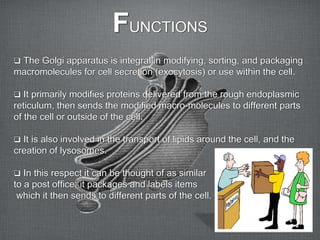
 The Golgi apparatus is integral in modifying, sorting, and packaging
macromolecules for cell secretion (exocytosis) or use within the cell.

 It primarily modifies proteins delivered from the rough endoplasmic
reticulum, then sends the modified macro-molecules to different parts
of the cell or outside of the cell.

 It is also involved in the transport of lipids around the cell, and the
creation of lysosomes.

 In this respect it can be thought of as similar
to a post office; it packages and labels items
 which it then sends to different parts of the cell.
FUNCTIONS
 The Golgi plays an important role in the synthesis of proteoglycans,
  which are molecules present in the extracellular matrix of animals.

 It is also a major site of carbohydrate synthesis.

 A newly characterized protein, GAAP (Golgi anti-apoptotic protein),
  almost exclusively resides in the Golgi and protects against cell
  destruction known as apoptosis by an as-yet undefined mechanism.

 Sometimes vital proteins needed in the rough endoplasmic reticulum
  are transported along with the other proteins in the Golgi complex.
  The Golgi complex has a mechanism for trapping them and sending
  them back to the rough endoplasmic reticulum.
WORKING OF GOLGI COMPLEX

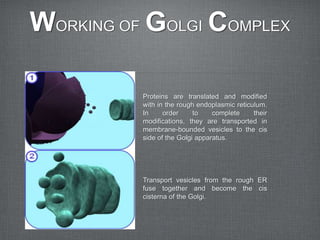
          Proteins are translated and modified
          with in the rough endoplasmic reticulum.
          In     order     to    complete     their
          modifications, they are transported in
          membrane-bounded vesicles to the cis
          side of the Golgi apparatus.


          Transport vesicles from the rough ER
          fuse together and become the cis
          cisterna of the Golgi.
WORKING OF GOLGI COMPLEX

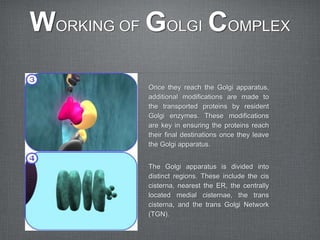
          Once they reach the Golgi apparatus,
          additional modifications are made to
          the transported proteins by resident
          Golgi enzymes. These modifications
          are key in ensuring the proteins reach
          their final destinations once they leave
          the Golgi apparatus.


          The Golgi apparatus is divided into
          distinct regions. These include the cis
          cisterna, nearest the ER, the centrally
          located medial cisternae, the trans
          cisterna, and the trans Golgi Network
          (TGN).
WORKING OF GOLGI COMPLEX
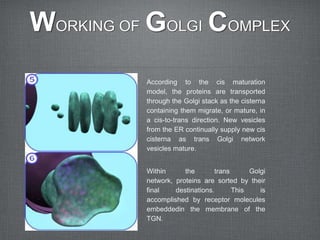
          According to the cis maturation
          model, the proteins are transported
          through the Golgi stack as the cisterna
          containing them migrate, or mature, in
          a cis-to-trans direction. New vesicles
          from the ER continually supply new cis
          cisterna as trans Golgi network
          vesicles mature.


          Within      the       trans      Golgi
          network, proteins are sorted by their
          final    destinations.      This    is
          accomplished by receptor molecules
          embeddedin the membrane of the
          TGN.
WORKING OF GOLGI COMPLEX

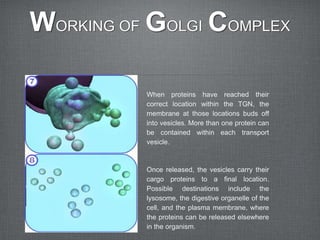
          When proteins have reached their
          correct location within the TGN, the
          membrane at those locations buds off
          into vesicles. More than one protein can
          be contained within each transport
          vesicle.


          Once released, the vesicles carry their
          cargo proteins to a final location.
          Possible destinations include the
          lysosome, the digestive organelle of the
          cell, and the plasma membrane, where
          the proteins can be released elsewhere
          in the organism.
TRANSPORTATION
   The flow of cargo proteins through Golgi apparatus is from cis to
    trans.

   Despite this flow there are many resident proteins that are localized
    in particular parts of the Golgi.

   How newly produced proteins travel from the ER to the Golgi
    complex and travel among Golgi stacks while the resident proteins
    stay in place ?

         Vesicle Transport Model

         Cisternal Maturation Method
TRANSPORTATION
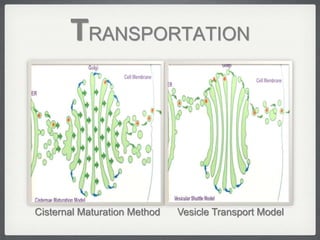
       •   Cisternal Maturation Method


•   Created by Jennifer Lippincott Schwartz from the National Institute of Child health and human
    development.

•   The cis-most cisterna is the youngest, having been recently formed from incoming vesicles

•   The trans-most cisterna is the oldest and breaks up into vesicles as material is moved to the trans
    Golgi network

•   Cargo proteins are carried with the cisterna; resident proteins are returned to their proper location
    by retrograde movement of vesicles.
TRANSPORTATION
Vesicle Transport Model
•   This Model was created by Gram Warren of Yale School of medicine

•   One model suggests that proteins are transported enclosed in vesicles. Another model
    proposes that one stack of the Golgi "matures" into the next stack.

•   Cargo proteins (but not resident proteins) are moved from stack to stack by vesicle
    transport.

•   This sorting also involves both forward, anterograde (cis to trans), and backward, or
    retrograde (trans to cis), flow of vesicles with proteins, moving back up the stack.

•   Resident proteins that are carried to locations trans to their normal location are transported
    back by retrograde movement of vesicles
TRANSPORTATION


Cisternal Maturation Method   Vesicle Transport Model
Golgi appratus

Golgi appratus

  • 2.
    OUTLINE Introduction Discovery Morphology Cisternae Cis-Face Trans-Face Functions Working Of Golgi Complex Transportation
  • 3.
    GOLGI COMPLEX A membranous complex of vesicles, vacuoles, and flattened sacs in the cytoplasm of most cells involved in intracellular secretion and transport. Found in most eukaryotic cells. Golgi Complex sometime also called as the Golgi Body or Golgi Apparatus
  • 4.
    DISCOVERY Golgi apparatus isnamed after the scientist who discovered it. Camillo Golgi was an Italian biologist who discovered this organelle with a light microscope in 1898. He developed a method that stained it intensely and made possible the demonstration of its occurrence in a wide variety of cell types. This method is known as Golgi Staining or Golgi Impregnation.
  • 5.
    MORPHOLOGY The Golgi iscomposed of stacks of membrane-bound structures known as Cisternae. A cisterna (plural cisternae) comprises a flattened membrane disk that makes up the Golgi apparatus. Usually a Golgi has 6-7 cisternae. Each Golgi stack has a distinct orientation. A complex network of tubules and vesicles is located at the edges of these cisternae.
  • 6.
    MORPHOLOGY • The cisternae stack has Two faces :  Cis-Golgi  Trans-Golgi
  • 7.
    CIS-GOLGI  The sidefaces the Endoplasmic reticulum is Cis Face and is the entry face that receives small membrane vesicles from the ER.  Vesicles from the endoplasmic reticulum fuse with the cis-Golgi network and subsequently progress through the stack to the trans-Golgi network.  The cis is the site at which transport vesicles bringing newly synthesized products from the endoplasmic reticulum with and add their contents to the Golgi cisternae.  A complex network of anatomizing (connecting) membrane tubules attach to and cover cisternae on the cis face and serve as a docking site for transport vesicles.  Each region contains different enzymes which selectively modify the contents depending on where they are destined to reside.
  • 8.
    TRANS-GOLGI  The sidefaces the cell membrane is Trans Face and is the exit face where vesicles leave the Golgi and move to their targets, including the exterior of the cell.  As the last station of the Golgi complex, the trans-Golgi network (TGN) plays a pivotal role in directing proteins in the secretary pathway to the appropriate cellular destination.  Proteins synthesized on membrane-bound ribosomes are transported through the Golgi apparatus and, on reaching the trans-Golgi network, are sorted for delivery to various cellular destinations.  Sorting involves the assembly of cytosol-oriented coat structures which preferentially package cargo into vesicular transport intermediates.  Protein sorting into different transport vesicles requires specific interactions between sorting motifs on the cargo molecules and vesicle coat components that recognize these motifs.
  • 9.
    FUNCTIONS  The Golgiapparatus is integral in modifying, sorting, and packaging macromolecules for cell secretion (exocytosis) or use within the cell.  It primarily modifies proteins delivered from the rough endoplasmic reticulum, then sends the modified macro-molecules to different parts of the cell or outside of the cell.  It is also involved in the transport of lipids around the cell, and the creation of lysosomes.  In this respect it can be thought of as similar to a post office; it packages and labels items which it then sends to different parts of the cell.
  • 10.
    FUNCTIONS  The Golgiplays an important role in the synthesis of proteoglycans, which are molecules present in the extracellular matrix of animals.  It is also a major site of carbohydrate synthesis.  A newly characterized protein, GAAP (Golgi anti-apoptotic protein), almost exclusively resides in the Golgi and protects against cell destruction known as apoptosis by an as-yet undefined mechanism.  Sometimes vital proteins needed in the rough endoplasmic reticulum are transported along with the other proteins in the Golgi complex. The Golgi complex has a mechanism for trapping them and sending them back to the rough endoplasmic reticulum.
  • 11.
    WORKING OF GOLGICOMPLEX Proteins are translated and modified with in the rough endoplasmic reticulum. In order to complete their modifications, they are transported in membrane-bounded vesicles to the cis side of the Golgi apparatus. Transport vesicles from the rough ER fuse together and become the cis cisterna of the Golgi.
  • 12.
    WORKING OF GOLGICOMPLEX Once they reach the Golgi apparatus, additional modifications are made to the transported proteins by resident Golgi enzymes. These modifications are key in ensuring the proteins reach their final destinations once they leave the Golgi apparatus. The Golgi apparatus is divided into distinct regions. These include the cis cisterna, nearest the ER, the centrally located medial cisternae, the trans cisterna, and the trans Golgi Network (TGN).
  • 13.
    WORKING OF GOLGICOMPLEX According to the cis maturation model, the proteins are transported through the Golgi stack as the cisterna containing them migrate, or mature, in a cis-to-trans direction. New vesicles from the ER continually supply new cis cisterna as trans Golgi network vesicles mature. Within the trans Golgi network, proteins are sorted by their final destinations. This is accomplished by receptor molecules embeddedin the membrane of the TGN.
  • 14.
    WORKING OF GOLGICOMPLEX When proteins have reached their correct location within the TGN, the membrane at those locations buds off into vesicles. More than one protein can be contained within each transport vesicle. Once released, the vesicles carry their cargo proteins to a final location. Possible destinations include the lysosome, the digestive organelle of the cell, and the plasma membrane, where the proteins can be released elsewhere in the organism.
  • 15.
    TRANSPORTATION  The flow of cargo proteins through Golgi apparatus is from cis to trans.  Despite this flow there are many resident proteins that are localized in particular parts of the Golgi.  How newly produced proteins travel from the ER to the Golgi complex and travel among Golgi stacks while the resident proteins stay in place ?  Vesicle Transport Model  Cisternal Maturation Method
  • 16.
    TRANSPORTATION • Cisternal Maturation Method • Created by Jennifer Lippincott Schwartz from the National Institute of Child health and human development. • The cis-most cisterna is the youngest, having been recently formed from incoming vesicles • The trans-most cisterna is the oldest and breaks up into vesicles as material is moved to the trans Golgi network • Cargo proteins are carried with the cisterna; resident proteins are returned to their proper location by retrograde movement of vesicles.
  • 17.
    TRANSPORTATION Vesicle Transport Model • This Model was created by Gram Warren of Yale School of medicine • One model suggests that proteins are transported enclosed in vesicles. Another model proposes that one stack of the Golgi "matures" into the next stack. • Cargo proteins (but not resident proteins) are moved from stack to stack by vesicle transport. • This sorting also involves both forward, anterograde (cis to trans), and backward, or retrograde (trans to cis), flow of vesicles with proteins, moving back up the stack. • Resident proteins that are carried to locations trans to their normal location are transported back by retrograde movement of vesicles
  • 18.