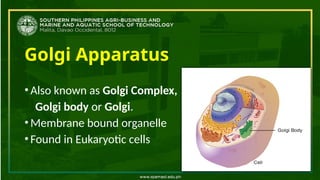
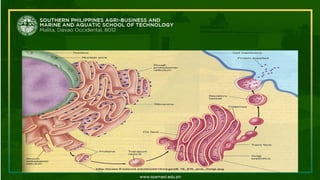
Golgi Apparatus
•Also knownas Golgi Complex,
Golgi body or Golgi.
•Membrane bound organelle
•Found in Eukaryotic cells
3.
Variations Across CellTypes:
• Animal Cells: Typically has a centralized, single Golgi complex near
the nucleus.
• Plant Cells: Consists of multiple smaller Golgi stacks called
dictyosomes, distributed throughout the cell.
• Fungal Cells: Contains several simpler Golgi stacks, which play a
role in cell wall production, including chitin synthesis.
4.
Key Differences:
• Presenceof Cell Wall: Plant and fungal cells have a rigid cell wall that affects the Golgi’s
role in wall component synthesis, unlike animal cells, which lack a cell wall.
•Vesicular Trafficking: Plant cells have more specialized vesicular pathways for secreting
components involved in cell wall formation, while animal cells are more focused on vesicles
for secretion and endocytosis.
• Size and Structure: The Golgi apparatus in plant cells can be fragmented into smaller
stacks and distributed throughout the cytoplasm, while in animal and fungal cells, it is often
more centralized.
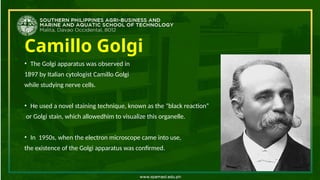
Camillo Golgi
• TheGolgi apparatus was observed in
1897 by Italian cytologist Camillo Golgi
while studying nerve cells.
• He used a novel staining technique, known as the "black reaction“
or Golgi stain, which allowedhim to visualize this organelle.
• In 1950s, when the electron microscope came into use,
the existence of the Golgi apparatus was confirmed.
7.
Golgi Apparatus
• Itis made up of a series of flattened, stacked pouches
called cisternae. The Golgi apparatus is responsible for transporting,
modifying, and packaging proteins and lipids into vesicles for
delivery to targeted destinations.
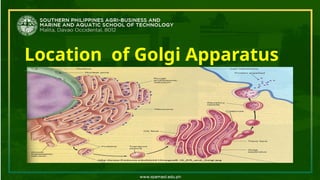
• It is located in the cytoplasm next to the endocrine retecullum and
near the cell nucleus.
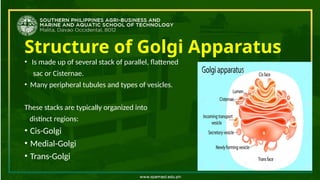
Structure of GolgiApparatus
• Is made up of several stack of parallel, flattened
sac or Cisternae.
• Many peripheral tubules and types of vesicles.
These stacks are typically organized into
distinct regions:
• Cis-Golgi
• Medial-Golgi
• Trans-Golgi
10.
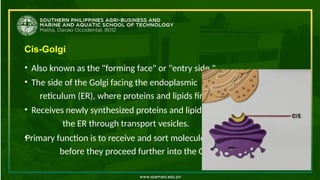
Cis-Golgi
• Also knownas the "forming face" or "entry side."
• The side of the Golgi facing the endoplasmic
reticulum (ER), where proteins and lipids first enter.
• Receives newly synthesized proteins and lipids from
the ER through transport vesicles.
•
Primary function is to receive and sort molecules
before they proceed further into the Golgi.
•
11.
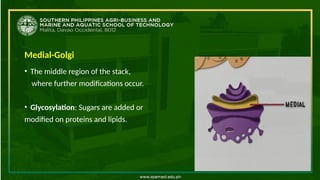
Medial-Golgi
• The middleregion of the stack,
where further modifications occur.
• Glycosylation: Sugars are added or
modified on proteins and lipids.
12.
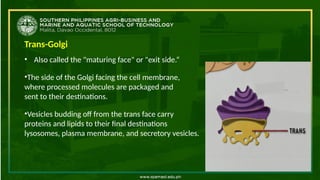
Trans-Golgi
• Also calledthe "maturing face" or "exit side.“
•The side of the Golgi facing the cell membrane,
where processed molecules are packaged and
sent to their destinations.
•Vesicles budding off from the trans face carry modified
proteins and lipids to their final destinations (e. in
lysosomes, plasma membrane, and secretory vesicles.
13.
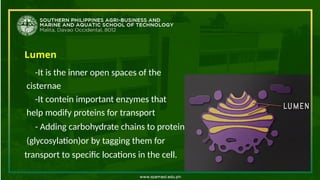
Lumen
-It is theinner open spaces of the
cisternae
-It contein important enzymes that
help modify proteins for transport
- Adding carbohydrate chains to proteins
(glycosylation)or by tagging them for
transport to specific locations in the cell.
14.
Vesicles Associated withGolgi Apparatus
• The Golgi apparatus is surrounded by small vesicles involved in the transport of
molecules.
Types of Vesicles:
• Transport vesicles
• COPI-coated vesicles
• COPII-coated vesicles
• Secretory vesicles
• Lysosomal vesicles
15.
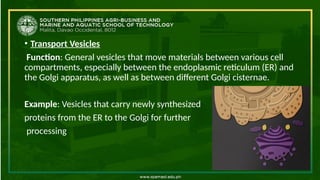
• Transport Vesicles
Function:General vesicles that move materials between various cell
compartments, especially between the endoplasmic reticulum (ER) and
the Golgi apparatus, as well as between different Golgi cisternae.
Example: Vesicles that carry newly synthesized
proteins from the ER to the Golgi for further
processing
16.
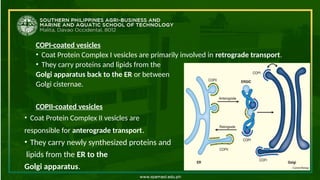
COPI-coated vesicles
• CoatProtein Complex I vesicles are primarily involved in retrograde transport.
• They carry proteins and lipids from the
Golgi apparatus back to the ER or between
Golgi cisternae.
COPII-coated vesicles
• Coat Protein Complex II vesicles are
responsible for anterograde transport.
• They carry newly synthesized proteins and
lipids from the ER to the
Golgi apparatus.
17.
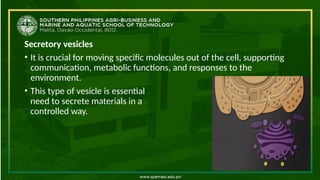
Secretory vesicles
• Itis crucial for moving specific molecules out of the cell, supporting
communication, metabolic functions, and responses to the
environment.
• This type of vesicle is essential for cells that
need to secrete materials in a
controlled way.
18.
Function of GolgiApparatus
Protein Modification and Processing
•The Golgi apparatus modifies proteins that are synthesized in the endoplasmic
reticulum (ER).
•It adds carbohydrates, phosphates, or sulfates to proteins, enhancing their
functionality and targeting them for specific cellular locations.
19.
Sorting and PackagingProteins and Lipids
•The Golgi sorts and packages proteins and lipids into vesicles for transport to their
destination.
• It ensures proteins and lipids are correctly directed to locations within the cell,
such as the plasma membrane, lysosomes, or secretory vesicles.
20.
Creation of Lysosomesand Other Cellular Components
•The Golgi is responsible for producing lysosomes, organelles that contain enzymes for
digestion within the cell.
•It also helps form other cellular components, playing a key role in overall cellular
organization and function.
21.
Importance of Protein
•Protein processing, particularly through post-translational modification (PTM), is
essential for the structure, function, and regulation of proteins.
• PTMs are chemical modifications that occur after a protein is synthesized (post-
translation) and are crucial for cellular processes
22.
Functional Diversity
PTMs, suchas phosphorylation, acetylation, methylation, and
glycosylation, can alter protein function and activity, adding
diversity without requiring new genes.
This allows cells to respond flexibly to different stimuli and
environmental changes.
23.
Regulation of ProteinActivity
Modifications like phosphorylation can activate or deactivate enzymes and
receptors, acting as a switch to control pathways like metabolism, cell signaling,
and gene expression.
Structural Stability and Folding
PTMs such as glycosylation and disulfide bond formation are critical for
proper protein folding and stability. Misfolded proteins can lead to cellular
stress and diseases like Alzheimer’s or cystic fibrosis.
24.
Localization and Transport
•Modifications like lipidation and glycosylation guide proteins to their correct cellular
destinations (e.g., membrane targeting or nuclear import), affecting their localization and
function within the cell.
Cell Signaling and Communication
•PTMs allow proteins to participate in signaling cascades, communicating signals from
the cell surface to the nucleus and other cellular compartments. Ubiquitination, for
instance, marks proteins for degradation, which is a regulatory mechanism in signaling.
25.
Immune Response andRecognition
• Glycosylation is particularly important for immune recognition and response, as many
immune proteins rely on glycan structures to interact with pathogens and host cells.
Disease Implications
• Abnormal PTMs are linked to various diseases, including cancer, neurodegenerative
diseases, and autoimmune disorders. Understanding PTMs can help in developing
therapeutic strategies, like drugs that inhibit or mimic specific modifications.
Editor's Notes
#2 The Golgi apparatus works closely with the endoplasmic reticulum (ER). After proteins are synthesized in the rough ER, they are transported to the Golgi for further processing.This organelle is essential for the secretion of substances and for sending proteins to their correct destinations inside and outside the cell.
#3 The Golgi apparatus, present in all eukaryotic cells, adapts in structure and function to meet specific cellular needs, centralizing secretion in animal cells, aiding cell wall production in plants, and producing chitin and enzymes in fungi.
#6 Initial Skepticism: Some scientists thought the structure was an artifact of staining.
Golgi’s black reaction involved silver nitrate and potassium dichromate,
which selectively stained certain cell structures.Despite skepticism,
his discovery was eventually accepted, and the structure was named the Golgi apparatus in his honor.
#8 The Golgi is located right near the nucleus. It’s called a perinuclear body, and it’s actually right near the endoplasmic reticulum as well. And when proteins come out of the endoplasmic reticulum, they go into the Golgi for further processing
#9 It has a many peripheral tubules and types of vesicles
Sac(supot)
#10 It Faces the endoplasmic reticulum (ER) and is close to it.
This is the cis on a cisternae
#11 are part of the maturation process that prepares proteins and lipids for their final roles in the cell.
#12 Located opposite the cis face, facing away from the ER and toward the plasma membrane.
Plays a role in packaging and directing proteins and lipids to specific cellular locations.
#13 This lumen plays a key role in processing, modifying, and sorting proteins and lipids as they pass through the Golgi apparatus.
Enzymes within the lumen modify molecules, such as by adding carbohydrate chains to proteins (glycosylation)
#16 COPII vesicles transport materials from the ER to the Golgi (forward or anterograde transport), while COPI vesicles transport materials back to the ER from the Golgi (reverse or retrograde transport). This bidirectional movement is essential for cellular organization, protein quality control, and function.
#21 Here are some reasons why post-translational modification (PTMs) are important in protein processing:
#22 - "PTMs—such as phosphorylation, acetylation, methylation, and glycosylation—are chemical changes to proteins that increase diversity and functionality without the need for new genes."
- "These modifications allow cells to quickly adapt to different stimuli and environmental changes, providing flexibility essential for survival and function."
#23 Here are two bullet points for speaker notes on *Regulation of Protein Activity*:
- "Phosphorylation and other modifications act like switches, turning enzymes and receptors on or off to regulate cellular processes."
"These 'on-off' switches help control critical pathways in the cell, such as metabolism, cell signaling, and gene expression.“
Here are two bullet points for speaker notes on *Structural Stability and Folding*:
- "Glycosylation and disulfide bonds are types of PTMs that help proteins fold correctly and maintain stability, which is crucial for proper cellular function."
- "When proteins misfold, it can cause cellular stress and lead to diseases like Alzheimer’s and cystic fibrosis, highlighting the importance of proper protein folding."
#24 Here are two bullet points for speaker notes on *Localization and Transport*:
- "Modifications such as lipidation and glycosylation help direct proteins to their specific locations within the cell, like membranes or the nucleus."
"By guiding proteins to their proper destinations, these modifications ensure that proteins function effectively in the right cellular context.“
Here are two bullet points for speaker notes on *Cell Signaling and Communication*:
- "Post-translational modifications (PTMs) enable proteins to relay signals within the cell, allowing communication from the cell surface to internal compartments like the nucleus."
"An example is ubiquitination, which tags proteins for degradation, serving as a regulatory mechanism to control signaling pathways.“
#25 Here are two bullet points for speaker notes on *Immune Response and Recognition*:
- "Glycosylation is essential in the immune system, as it helps proteins involved in immune responses recognize and bind to pathogens and host cells."
- "Many immune proteins rely on specific glycan structures to identify and interact effectively with foreign invaders, supporting a targeted immune response."
Here are two bullet points for speaker notes on *Disease Implications*:
- "Abnormal post-translational modifications (PTMs) are associated with diseases like cancer, neurodegenerative disorders, and autoimmune conditions."
- "Studying PTMs can lead to new therapies, as drugs can be designed to inhibit or mimic specific modifications to treat these diseases effectively."
#26 First, newly synthesized proteins or lipids enter the exit sites of the ER and are sorted into budding vesicles that are dependent on the COPII. Second, vesicles move to the ER‑Golgi intermediate compartment (ERGIC) and forward to the cis‑Golgi networks (CGN). Third, proteins or lipids enter cis‑Golgi cisternae and move towards the trans‑Golgi cisternae. Vesicular transport and cisternal maturation are the two classical models of intra‑Golgi transport (20). The vesic‑ ular transport model proposes that Golgi cisternae are static, and the cargos are transported through them by COPI vesicles. The cisternal maturation model suggests that cisternae are dynamic structures, while Golgi enzymes are recycled via retrograde transport of COPI vesicles. Fourth, vesicles reach the trans‑Golgi networks (TGN), which are involved in the sorting of products to their final destinations such as lyso‑ somes, endosomes, or the plasma membrane.