Structure
Function
Lecture6
Cytoplasmic membrane systems
Asma Saleh Alilesh/ biotechnology department
/ Misurata University
Endomembrane system
 The Endomembrane System is very important
in our cells. Eukaryotic cells are the only cells
that have the endomembrane system
 The system is defined as the set of membranes
that form a single functional unit, either being
connected directly, or exchanging material
through vesicle transport.
 This system includes: :endoplasmic reticulum,
Golgi apparatus, lysosome, different types of
vesicles and vacuoles,and the plasma
membrane.
 The function of the Endomembrane System
deals mostly with proteins. It includes the
Vesicular transport pathways
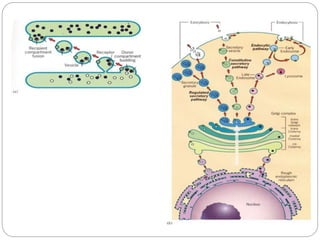
1. Biosynthetic or secretory pathway:
Move proteins from their site of synthesis in
the endoplasmic reticulum through the Golgi
complex to the final destination.
2. Endocytic pathway:
Move materials in the opposite direction from
the plasma membrane or extracellular space
to the cell interior.
Biosynthetic (or secretory)
pathway
- Secretory activities of cells can be divided into two
types:
A. Constitutive secretion:
materials are transported in secretory vesicles
from their sites of synthesis and discharged into
the extracellular space in a continual way.
Most cells engage in constitutive secretion, like a
process that contributes formation of the plasma
membrane .
B- regulated secretion:
materials are stored as membrane-bound
packages and discharged only in response to an
Endoplasmic reticulum
 ER is a type of organelle in the cells of eukaryotic
organisms that forms an interconnected network of
flattened, membrane-enclosed sacs or tube-like
structures known as cisternae.
 The membranes of the ER are continuous with the
outer nuclear membrane.
 Space inside cisternae called luminal space whose
composition is different from that of surrounding
cytosolic space.
There are two types of endoplasmic reticulum :
1. the rough endoplasmic reticulum (RER)
2. the smooth endoplasmic reticulum (SER)
Rough endoplasmic reticulum (RER)
 The surface of the RER
reticulum ribosomes giving it a "rough"
appearance
 The RER is typically composed of a network of
flattened sacs (cisternae)
 The membrane of the rough endoplasmic
reticulum forms large double membrane sheets
that are located near, and continuous with, the
outer layer of the nuclear envelope.
 Although there is no continuous membrane
between the endoplasmic reticulum and the Golgi
apparatus.
Function of RER
 Synthesis of secreted proteins, lysosomal
proteins and integral membrane proteins.
 The rough ER is the starting point of the
biosynthetic pathway: it is the site of
synthesis of the proteins, carbohydrate
chains, and phospholipids that journey
through the membranous compartments
of the cell
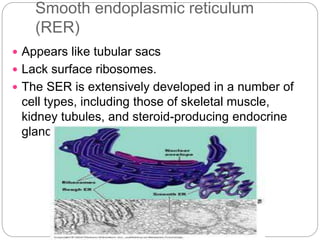
 Appears like tubular sacs
 Lack surface ribosomes.
 The SER is extensively developed in a number of
cell types, including those of skeletal muscle,
kidney tubules, and steroid-producing endocrine
glands.
Smooth endoplasmic reticulum
(RER)
Function of SER
 Synthesis of steroid hormones in the endocrine
cells of the
gonad and adrenal cortex.
 Detoxification in the liver of a wide variety of
organic compounds, including ethanol, whose
chronic use can lead to proliferation of the SER
in liver cells.
 Sequestering calcium ions within the cytoplasm
of cells.
Golgi apparatous
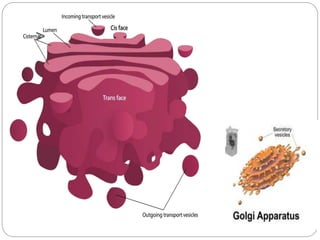
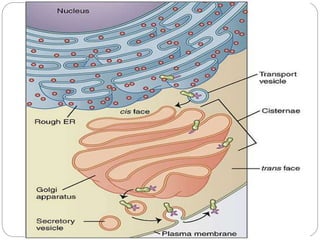
 The Golgi apparatus also known as the Golgi
complex, Golgi body, or simply the Golgi, is an
organelle found in most eukaryotic cells.
 The Golgi apparatus is made up of a series of
compartments consisting of two main networks: the
cis Golgi network (CGN) and the trans Golgi network
(TGN).
 The CGN is a collection of fused, flattened
membrane-enclosed disks known as cisternae
 Typically, a Golgi stack contains fewer than eight
cisternae. An individual cell may contain from a few to
several thousand distinct stacks, depending on the
cell type.
 The section of the Golgi apparatus that receives the
vesicles from the ER is known as the cis face, and is
usually near the ER. The opposite end of the Golgi
apparatus is called the trans face, this is where the
>
Golgi function
1. The Golgi apparatus is a major collection
and dispatch station of protein products
received from the endoplasmic reticulum
(ER).
 Proteins synthesized in the ER are packaged
into vesicles, which then fuse with the Golgi
apparatus.
 These cargo proteins are modified and
destined for secretion via exocytosis or for use
in the cell.
 The Golgi apparatus is also involved
in lipid transport and lysosome formation.
Vesicular transport
1. The vesicles that leave the RER are
transported to the cis face of the Golgi
apparatus.
2. Then they fuse with the Golgi membrane
and empty their contents into the lumen.
Once inside the lumen, the molecules are
modified,
3. then sorted for transport to their next
destinations .
 That materials move through the Golgi
complex vesicular transport model, cargo
>

Endoplasmic system (structure and function))

  • 1.
    Structure Function Lecture6 Cytoplasmic membrane systems AsmaSaleh Alilesh/ biotechnology department / Misurata University
  • 3.
    Endomembrane system  TheEndomembrane System is very important in our cells. Eukaryotic cells are the only cells that have the endomembrane system  The system is defined as the set of membranes that form a single functional unit, either being connected directly, or exchanging material through vesicle transport.  This system includes: :endoplasmic reticulum, Golgi apparatus, lysosome, different types of vesicles and vacuoles,and the plasma membrane.  The function of the Endomembrane System deals mostly with proteins. It includes the
  • 4.
    Vesicular transport pathways 1.Biosynthetic or secretory pathway: Move proteins from their site of synthesis in the endoplasmic reticulum through the Golgi complex to the final destination. 2. Endocytic pathway: Move materials in the opposite direction from the plasma membrane or extracellular space to the cell interior.
  • 5.
    Biosynthetic (or secretory) pathway -Secretory activities of cells can be divided into two types: A. Constitutive secretion: materials are transported in secretory vesicles from their sites of synthesis and discharged into the extracellular space in a continual way. Most cells engage in constitutive secretion, like a process that contributes formation of the plasma membrane . B- regulated secretion: materials are stored as membrane-bound packages and discharged only in response to an
  • 7.
    Endoplasmic reticulum  ERis a type of organelle in the cells of eukaryotic organisms that forms an interconnected network of flattened, membrane-enclosed sacs or tube-like structures known as cisternae.  The membranes of the ER are continuous with the outer nuclear membrane.  Space inside cisternae called luminal space whose composition is different from that of surrounding cytosolic space. There are two types of endoplasmic reticulum : 1. the rough endoplasmic reticulum (RER) 2. the smooth endoplasmic reticulum (SER)
  • 9.
    Rough endoplasmic reticulum(RER)  The surface of the RER reticulum ribosomes giving it a "rough" appearance  The RER is typically composed of a network of flattened sacs (cisternae)  The membrane of the rough endoplasmic reticulum forms large double membrane sheets that are located near, and continuous with, the outer layer of the nuclear envelope.  Although there is no continuous membrane between the endoplasmic reticulum and the Golgi apparatus.
  • 11.
    Function of RER Synthesis of secreted proteins, lysosomal proteins and integral membrane proteins.  The rough ER is the starting point of the biosynthetic pathway: it is the site of synthesis of the proteins, carbohydrate chains, and phospholipids that journey through the membranous compartments of the cell
  • 12.
     Appears liketubular sacs  Lack surface ribosomes.  The SER is extensively developed in a number of cell types, including those of skeletal muscle, kidney tubules, and steroid-producing endocrine glands. Smooth endoplasmic reticulum (RER)
  • 13.
    Function of SER Synthesis of steroid hormones in the endocrine cells of the gonad and adrenal cortex.  Detoxification in the liver of a wide variety of organic compounds, including ethanol, whose chronic use can lead to proliferation of the SER in liver cells.  Sequestering calcium ions within the cytoplasm of cells.
  • 14.
    Golgi apparatous  TheGolgi apparatus also known as the Golgi complex, Golgi body, or simply the Golgi, is an organelle found in most eukaryotic cells.  The Golgi apparatus is made up of a series of compartments consisting of two main networks: the cis Golgi network (CGN) and the trans Golgi network (TGN).  The CGN is a collection of fused, flattened membrane-enclosed disks known as cisternae  Typically, a Golgi stack contains fewer than eight cisternae. An individual cell may contain from a few to several thousand distinct stacks, depending on the cell type.  The section of the Golgi apparatus that receives the vesicles from the ER is known as the cis face, and is usually near the ER. The opposite end of the Golgi apparatus is called the trans face, this is where the
  • 15.
  • 16.
    Golgi function 1. TheGolgi apparatus is a major collection and dispatch station of protein products received from the endoplasmic reticulum (ER).  Proteins synthesized in the ER are packaged into vesicles, which then fuse with the Golgi apparatus.  These cargo proteins are modified and destined for secretion via exocytosis or for use in the cell.  The Golgi apparatus is also involved in lipid transport and lysosome formation.
  • 17.
    Vesicular transport 1. Thevesicles that leave the RER are transported to the cis face of the Golgi apparatus. 2. Then they fuse with the Golgi membrane and empty their contents into the lumen. Once inside the lumen, the molecules are modified, 3. then sorted for transport to their next destinations .  That materials move through the Golgi complex vesicular transport model, cargo
  • 18.