











King Saud University
College of Education
Department of Curriculum and Instruction
Major TESOL
1
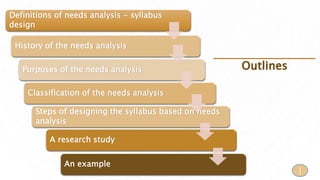
Definitions of needs analysis - syllabus
design
History of the needs analysis
Purposes of the needs analysis
Classification of the needs analysis
Steps of designing the syllabus based on needs
analysis
A research study
An example
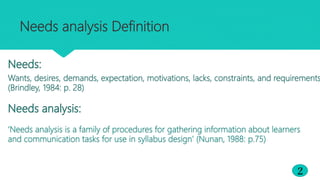
Needs analysis Definition
2
Syllabus design
Definition
3
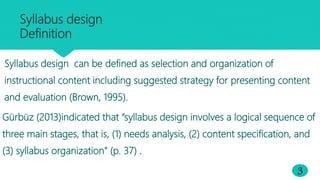
Syllabus design can be defined as selection and organization of
instructional content including suggested strategy for presenting content
and evaluation (Brown, 1995).
Gürbüz (2013)indicated that “syllabus design involves a logical sequence of
three main stages, that is, (1) needs analysis, (2) content specification, and
(3) syllabus organization” (p. 37) .
4
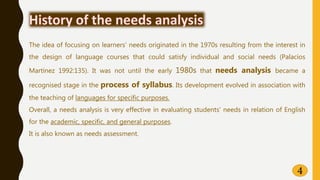
The idea of focusing on learners’ needs originated in the 1970s resulting from the interest in
the design of language courses that could satisfy individual and social needs (Palacios
Martínez 1992:135). It was not until the early 1980s that needs analysis became a
recognised stage in the process of syllabus. Its development evolved in association with
the teaching of languages for specific purposes.
Overall, a needs analysis is very effective in evaluating students’ needs in relation of English
for the academic, specific, and general purposes.
It is also known as needs assessment.
5
 Purposes of the needs analysis
6
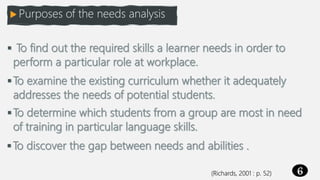
 Purposes of the needs analysis
7
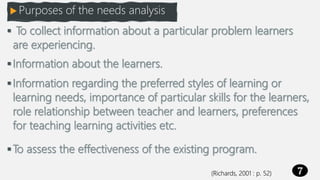
 Purposes of the needs analysis
8
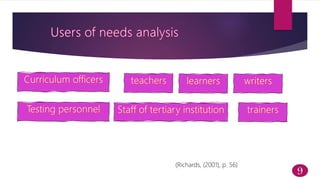
9
(Richards, (2001), p. 56)
10
11
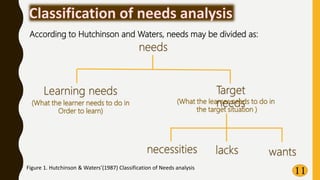
According to Hutchinson and Waters, needs may be divided as:
Figure 1. Hutchinson & Waters’(1987) Classification of Needs analysis
(What the learner needs to do in
Order to learn)
(What the learner needs to do in
the target situation )
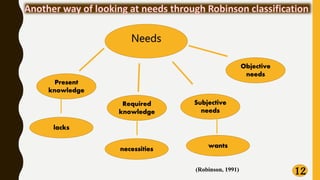
Needs
Subjective
needs
Required
knowledge
Present
knowledge
(Robinson, 1991)
12
Objective
needs
necessities
lacks
wants
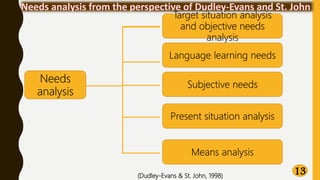
(Dudley-Evans & St. John, 1998) 13
Needs
analysis
Target situation analysis
and objective needs
analysis
Language learning needs
Subjective needs
Present situation analysis
Means analysis
(Figure 2. Dudley-Evans & St. John,
1998Insiders/outsiders Viewpoints on Needs)
14
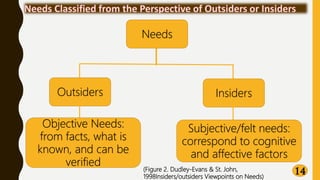
Needs
Outsiders Insiders
Objective Needs:
from facts, what is
known, and can be
verified
Subjective/felt needs:
correspond to cognitive
and affective factors
(Hutchinson and Waters 1987:58;
Palacios Martínez 1994:143) 15
17
Using Needs Analysis to form an English
Syllabus
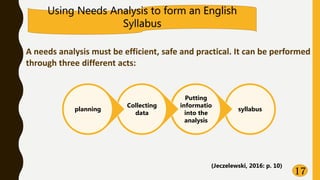
A needs analysis must be efficient, safe and practical. It can be performed
through three different acts:
syllabus
Putting
informatio
into the
analysis
Collecting
data
planning
(Jeczelewski, 2016: p. 10)
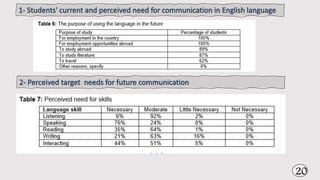
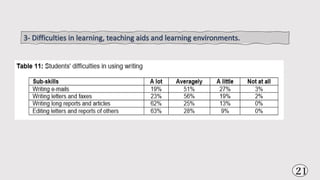
This study was conducted by Elsa Zela (2018) on
• Setting : Agricultural University of Tirana, Albania.
• Methods: Quantitative.
• Journal: Academic Journal of Interdisciplinary Studies
• Sample: 420 students (145 boys, and275 girls) of the 1st year of Faculty of Economics and Agribussines.
• Aim: This study aimed to identify their needs for language and communication for future use either for
employment or further education purposes. Program design and course development of Business English needs
to respond to future student needs for future employment or study purpose.
• Instruments: Questionnaire was used as a major instrument for collecting data and was based on the model
of Dudley-Evans and St John (1998) on need analysis.
18
The research questions
19
20
21
This study was conducted by Elsa Zela (2018) on
• Result: The results of this study will serve as input to be taken into account
for the design of the Business English course at the Faculty of Economics at
AUT. The analysis of the research data has provided teachers insights into
issues related to business English teaching.
22
23
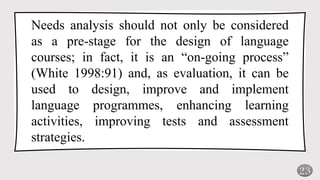
Needs analysis should not only be considered
as a pre-stage for the design of language
courses; in fact, it is an “on-going process”
(White 1998:91) and, as evaluation, it can be
used to design, improve and implement
language programmes, enhancing learning
activities, improving tests and assessment
strategies.
24
25
26
27
28
29
The teacher and needs analysis
30
Reference
■ Brindley, G. 1984. Needs Analysis and objective setting in the adult migrant education program.
Sydney: N. S.W. Adult Migrant Education Service.
■ Brown, J, The elements of language curriculum:A systematic approach to program development,
New York: Heinle &Heinle Publishers,1995.
■ Gürbüz, A. (2013). Proposing a Syllabus Desıgn for Oral Communicative Classes Regarding
Teachers’And Students’ Perceptions of Modified Output. Unpublished Master’s thesis,
University of Gaziantep:Gaziantep.
■ Hutchinson, T., & Waters, A. (1987). English for specific purposes: A learning-centered approach.
Cambridge: Cambridge University Press.
31
Reference
■ Nunan, D. (1988). Syllabus design. Oxford: Oxford University Press.
■ Richards, J. (2001). Curriculum Development in Language Teaching. Cambridge: Cambridge
University Press.
■ Robinson, P. (1991). ESP today: a practitioner’s guide. Hemel Hempstead: Prentice Hall
International.
■ Palacios, M. (1994). Ignacio. La enseñanza del inglés en España a debate. Santiago de Compostela:
Servicio de Publicacións e Intercambio Científico da Universidade de Santiago de Compostela,
143-144.
■ White, R. V. (1998). The ELT Curriculum. Cambridge: Basil Blackwell.
32
29
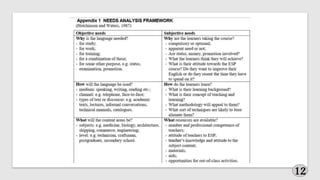
12
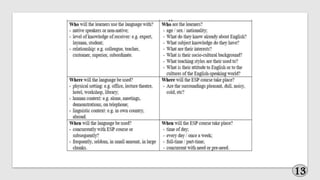
13

Needs analysis in syllabus design.pptx

  • 1.
    King Saud University Collegeof Education Department of Curriculum and Instruction Major TESOL
  • 2.
    1 Definitions of needsanalysis - syllabus design History of the needs analysis Purposes of the needs analysis Classification of the needs analysis Steps of designing the syllabus based on needs analysis A research study An example
  • 3.
  • 4.
    Syllabus design Definition 3 Syllabus designcan be defined as selection and organization of instructional content including suggested strategy for presenting content and evaluation (Brown, 1995). Gürbüz (2013)indicated that “syllabus design involves a logical sequence of three main stages, that is, (1) needs analysis, (2) content specification, and (3) syllabus organization” (p. 37) .
  • 5.
    4 The idea offocusing on learners’ needs originated in the 1970s resulting from the interest in the design of language courses that could satisfy individual and social needs (Palacios Martínez 1992:135). It was not until the early 1980s that needs analysis became a recognised stage in the process of syllabus. Its development evolved in association with the teaching of languages for specific purposes. Overall, a needs analysis is very effective in evaluating students’ needs in relation of English for the academic, specific, and general purposes. It is also known as needs assessment.
  • 6.
    5  Purposes ofthe needs analysis
  • 7.
    6  Purposes ofthe needs analysis
  • 8.
    7  Purposes ofthe needs analysis
  • 9.
  • 10.
  • 11.
  • 12.
    11 According to Hutchinsonand Waters, needs may be divided as: Figure 1. Hutchinson & Waters’(1987) Classification of Needs analysis (What the learner needs to do in Order to learn) (What the learner needs to do in the target situation )
  • 13.
  • 14.
    (Dudley-Evans & St.John, 1998) 13 Needs analysis Target situation analysis and objective needs analysis Language learning needs Subjective needs Present situation analysis Means analysis
  • 15.
    (Figure 2. Dudley-Evans& St. John, 1998Insiders/outsiders Viewpoints on Needs) 14 Needs Outsiders Insiders Objective Needs: from facts, what is known, and can be verified Subjective/felt needs: correspond to cognitive and affective factors
  • 16.
    (Hutchinson and Waters1987:58; Palacios Martínez 1994:143) 15
  • 18.
    17 Using Needs Analysisto form an English Syllabus A needs analysis must be efficient, safe and practical. It can be performed through three different acts: syllabus Putting informatio into the analysis Collecting data planning (Jeczelewski, 2016: p. 10)
  • 19.
    This study wasconducted by Elsa Zela (2018) on • Setting : Agricultural University of Tirana, Albania. • Methods: Quantitative. • Journal: Academic Journal of Interdisciplinary Studies • Sample: 420 students (145 boys, and275 girls) of the 1st year of Faculty of Economics and Agribussines. • Aim: This study aimed to identify their needs for language and communication for future use either for employment or further education purposes. Program design and course development of Business English needs to respond to future student needs for future employment or study purpose. • Instruments: Questionnaire was used as a major instrument for collecting data and was based on the model of Dudley-Evans and St John (1998) on need analysis. 18
  • 20.
  • 21.
  • 22.
  • 23.
    This study wasconducted by Elsa Zela (2018) on • Result: The results of this study will serve as input to be taken into account for the design of the Business English course at the Faculty of Economics at AUT. The analysis of the research data has provided teachers insights into issues related to business English teaching. 22
  • 24.
    23 Needs analysis shouldnot only be considered as a pre-stage for the design of language courses; in fact, it is an “on-going process” (White 1998:91) and, as evaluation, it can be used to design, improve and implement language programmes, enhancing learning activities, improving tests and assessment strategies.
  • 25.
  • 26.
  • 27.
  • 28.
  • 29.
  • 30.
  • 31.
    The teacher andneeds analysis 30
  • 32.
    Reference ■ Brindley, G.1984. Needs Analysis and objective setting in the adult migrant education program. Sydney: N. S.W. Adult Migrant Education Service. ■ Brown, J, The elements of language curriculum:A systematic approach to program development, New York: Heinle &Heinle Publishers,1995. ■ Gürbüz, A. (2013). Proposing a Syllabus Desıgn for Oral Communicative Classes Regarding Teachers’And Students’ Perceptions of Modified Output. Unpublished Master’s thesis, University of Gaziantep:Gaziantep. ■ Hutchinson, T., & Waters, A. (1987). English for specific purposes: A learning-centered approach. Cambridge: Cambridge University Press. 31
  • 33.
    Reference ■ Nunan, D.(1988). Syllabus design. Oxford: Oxford University Press. ■ Richards, J. (2001). Curriculum Development in Language Teaching. Cambridge: Cambridge University Press. ■ Robinson, P. (1991). ESP today: a practitioner’s guide. Hemel Hempstead: Prentice Hall International. ■ Palacios, M. (1994). Ignacio. La enseñanza del inglés en España a debate. Santiago de Compostela: Servicio de Publicacións e Intercambio Científico da Universidade de Santiago de Compostela, 143-144. ■ White, R. V. (1998). The ELT Curriculum. Cambridge: Basil Blackwell. 32
  • 34.
  • 35.
  • 36.