Product-oriented Syllabus
and
Process-oriented Syllabus
Comparison between Product-oriented and Process-oriented Syllabus
Product oriented Syllabus
“Product oriented syllabuses are those in which the focus is on the
knowledge and skills which learners should gain as result of
instruction.” – Nunan (1988)
— Product-oriented syllabus focuses on outcomes
(what is learnt at the end of a learning session)
— Focuses on things learnt at the end of a learning process
(things that are instructed by teachers/instructors)
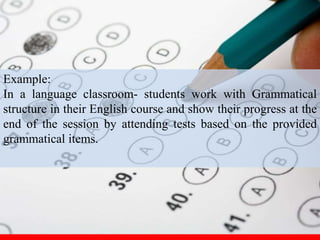
Example:
In a language classroom- students work with Grammatical
structure in their English course and show their progress at the
end of the session by attending tests based on the provided
grammatical items.
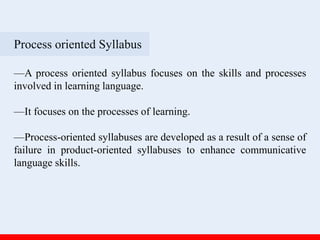
Process oriented Syllabus
—A process oriented syllabus focuses on the skills and processes
involved in learning language.
—It focuses on the processes of learning.
—Process-oriented syllabuses are developed as a result of a sense of
failure in product-oriented syllabuses to enhance communicative
language skills.
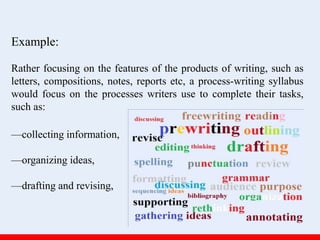
Example:
Rather focusing on the features of the products of writing, such as
letters, compositions, notes, reports etc, a process-writing syllabus
would focus on the processes writers use to complete their tasks,
such as:
—collecting information,
—organizing ideas,
—drafting and revising,
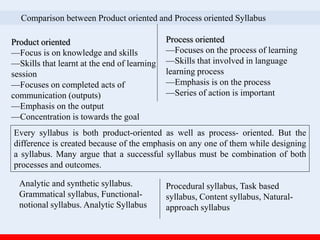
Comparison between Product oriented and Process oriented Syllabus
Product oriented
—Focus is on knowledge and skills
—Skills that learnt at the end of learning
session
—Focuses on completed acts of
communication (outputs)
—Emphasis on the output
—Concentration is towards the goal
Process oriented
—Focuses on the process of learning
—Skills that involved in language
learning process
—Emphasis is on the process
—Series of action is important
Every syllabus is both product-oriented as well as process- oriented. But the
difference is created because of the emphasis on any one of them while designing
a syllabus. Many argue that a successful syllabus must be combination of both
processes and outcomes.
Analytic and synthetic syllabus.
Grammatical syllabus, Functional-
notional syllabus. Analytic Syllabus
Procedural syllabus, Task based
syllabus, Content syllabus, Natural-
approach syllabus
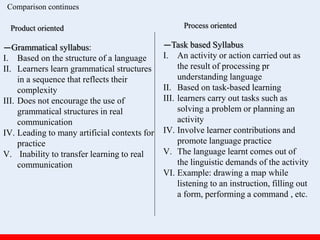
Comparison continues
Product oriented Process oriented
—Grammatical syllabus:
I. Based on the structure of a language
II. Learners learn grammatical structures
in a sequence that reflects their
complexity
III. Does not encourage the use of
grammatical structures in real
communication
IV. Leading to many artificial contexts for
practice
V. Inability to transfer learning to real
communication
—Task based Syllabus
I. An activity or action carried out as
the result of processing pr
understanding language
II. Based on task-based learning
III. learners carry out tasks such as
solving a problem or planning an
activity
IV. Involve learner contributions and
promote language practice
V. The language learnt comes out of
the linguistic demands of the activity
VI. Example: drawing a map while
listening to an instruction, filling out
a form, performing a command , etc.
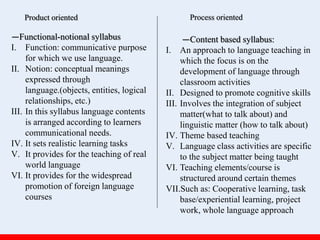
—Functional-notional syllabus
I. Function: communicative purpose
for which we use language.
II. Notion: conceptual meanings
expressed through
language.(objects, entities, logical
relationships, etc.)
III. In this syllabus language contents
is arranged according to learners
communicational needs.
IV. It sets realistic learning tasks
V. It provides for the teaching of real
world language
VI. It provides for the widespread
promotion of foreign language
courses
—Content based syllabus:
I. An approach to language teaching in
which the focus is on the
development of language through
classroom activities
II. Designed to promote cognitive skills
III. Involves the integration of subject
matter(what to talk about) and
linguistic matter (how to talk about)
IV. Theme based teaching
V. Language class activities are specific
to the subject matter being taught
VI. Teaching elements/course is
structured around certain themes
VII.Such as: Cooperative learning, task
base/experiential learning, project
work, whole language approach
Product oriented Process oriented
Process oriented
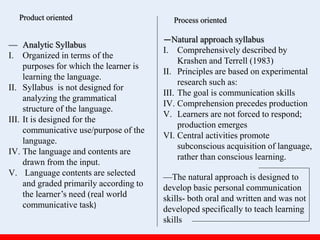
—Natural approach syllabus
I. Comprehensively described by
Krashen and Terrell (1983)
II. Principles are based on experimental
research such as:
III. The goal is communication skills
IV. Comprehension precedes production
V. Learners are not forced to respond;
production emerges
VI. Central activities promote
subconscious acquisition of language,
rather than conscious learning.
—The natural approach is designed to
develop basic personal communication
skills- both oral and written and was not
developed specifically to teach learning
skills
Product oriented
— Analytic Syllabus
I. Organized in terms of the
purposes for which the learner is
learning the language.
II. Syllabus is not designed for
analyzing the grammatical
structure of the language.
III. It is designed for the
communicative use/purpose of the
language.
IV. The language and contents are
drawn from the input.
V. Language contents are selected
and graded primarily according to
the learner’s need (real world
communicative task)
Learners working with a product-oriented syllabus can be supported with
other approaches and techniques. For example:
—teachers can incorporate elements of learner training and development from
learner-centered syllabi
or
— Use activities from process-oriented syllabi such as task-based learning.
—working on the language processes ( writingspeaking) is hard work for
learners. It involves thinking, organizing and planning.
—If time well-invested in skills- that will enable the learner to become an
autonomous writerspeaker.
Conclusion
End of Slides

Product oriented syllabus and process oriented syllsbus

  • 1.
    Product-oriented Syllabus and Process-oriented Syllabus Comparisonbetween Product-oriented and Process-oriented Syllabus
  • 2.
    Product oriented Syllabus “Productoriented syllabuses are those in which the focus is on the knowledge and skills which learners should gain as result of instruction.” – Nunan (1988) — Product-oriented syllabus focuses on outcomes (what is learnt at the end of a learning session) — Focuses on things learnt at the end of a learning process (things that are instructed by teachers/instructors)
  • 3.
    Example: In a languageclassroom- students work with Grammatical structure in their English course and show their progress at the end of the session by attending tests based on the provided grammatical items.
  • 4.
    Process oriented Syllabus —Aprocess oriented syllabus focuses on the skills and processes involved in learning language. —It focuses on the processes of learning. —Process-oriented syllabuses are developed as a result of a sense of failure in product-oriented syllabuses to enhance communicative language skills.
  • 5.
    Example: Rather focusing onthe features of the products of writing, such as letters, compositions, notes, reports etc, a process-writing syllabus would focus on the processes writers use to complete their tasks, such as: —collecting information, —organizing ideas, —drafting and revising,
  • 6.
    Comparison between Productoriented and Process oriented Syllabus Product oriented —Focus is on knowledge and skills —Skills that learnt at the end of learning session —Focuses on completed acts of communication (outputs) —Emphasis on the output —Concentration is towards the goal Process oriented —Focuses on the process of learning —Skills that involved in language learning process —Emphasis is on the process —Series of action is important Every syllabus is both product-oriented as well as process- oriented. But the difference is created because of the emphasis on any one of them while designing a syllabus. Many argue that a successful syllabus must be combination of both processes and outcomes. Analytic and synthetic syllabus. Grammatical syllabus, Functional- notional syllabus. Analytic Syllabus Procedural syllabus, Task based syllabus, Content syllabus, Natural- approach syllabus
  • 7.
    Comparison continues Product orientedProcess oriented —Grammatical syllabus: I. Based on the structure of a language II. Learners learn grammatical structures in a sequence that reflects their complexity III. Does not encourage the use of grammatical structures in real communication IV. Leading to many artificial contexts for practice V. Inability to transfer learning to real communication —Task based Syllabus I. An activity or action carried out as the result of processing pr understanding language II. Based on task-based learning III. learners carry out tasks such as solving a problem or planning an activity IV. Involve learner contributions and promote language practice V. The language learnt comes out of the linguistic demands of the activity VI. Example: drawing a map while listening to an instruction, filling out a form, performing a command , etc.
  • 8.
    —Functional-notional syllabus I. Function:communicative purpose for which we use language. II. Notion: conceptual meanings expressed through language.(objects, entities, logical relationships, etc.) III. In this syllabus language contents is arranged according to learners communicational needs. IV. It sets realistic learning tasks V. It provides for the teaching of real world language VI. It provides for the widespread promotion of foreign language courses —Content based syllabus: I. An approach to language teaching in which the focus is on the development of language through classroom activities II. Designed to promote cognitive skills III. Involves the integration of subject matter(what to talk about) and linguistic matter (how to talk about) IV. Theme based teaching V. Language class activities are specific to the subject matter being taught VI. Teaching elements/course is structured around certain themes VII.Such as: Cooperative learning, task base/experiential learning, project work, whole language approach Product oriented Process oriented
  • 9.
    Process oriented —Natural approachsyllabus I. Comprehensively described by Krashen and Terrell (1983) II. Principles are based on experimental research such as: III. The goal is communication skills IV. Comprehension precedes production V. Learners are not forced to respond; production emerges VI. Central activities promote subconscious acquisition of language, rather than conscious learning. —The natural approach is designed to develop basic personal communication skills- both oral and written and was not developed specifically to teach learning skills Product oriented — Analytic Syllabus I. Organized in terms of the purposes for which the learner is learning the language. II. Syllabus is not designed for analyzing the grammatical structure of the language. III. It is designed for the communicative use/purpose of the language. IV. The language and contents are drawn from the input. V. Language contents are selected and graded primarily according to the learner’s need (real world communicative task)
  • 10.
    Learners working witha product-oriented syllabus can be supported with other approaches and techniques. For example: —teachers can incorporate elements of learner training and development from learner-centered syllabi or — Use activities from process-oriented syllabi such as task-based learning. —working on the language processes ( writingspeaking) is hard work for learners. It involves thinking, organizing and planning. —If time well-invested in skills- that will enable the learner to become an autonomous writerspeaker. Conclusion
  • 11.