ESP PPT : GROUP 3 SYLLABUS AND COURSE DESIGN IN ESP
The document discusses course design and syllabus for English for Specific Purposes. It describes language-centered, skill-centered, and learning-centered approaches to course design. The types and purposes of different syllabi are outlined. A syllabus plays an important role in organizing content and sequencing lessons according to the chosen approach to course design, whether it is language-centered, skill-centered, learning-centered, or learner-centered. Criteria for organizing a syllabus include focusing on key materials, selecting and subdividing topics, and deciding on sequencing.
Introduction to the syllabus and course design in English for Specific Purposes (ESP). Overview includes course design, syllabus, questions, and conclusions.
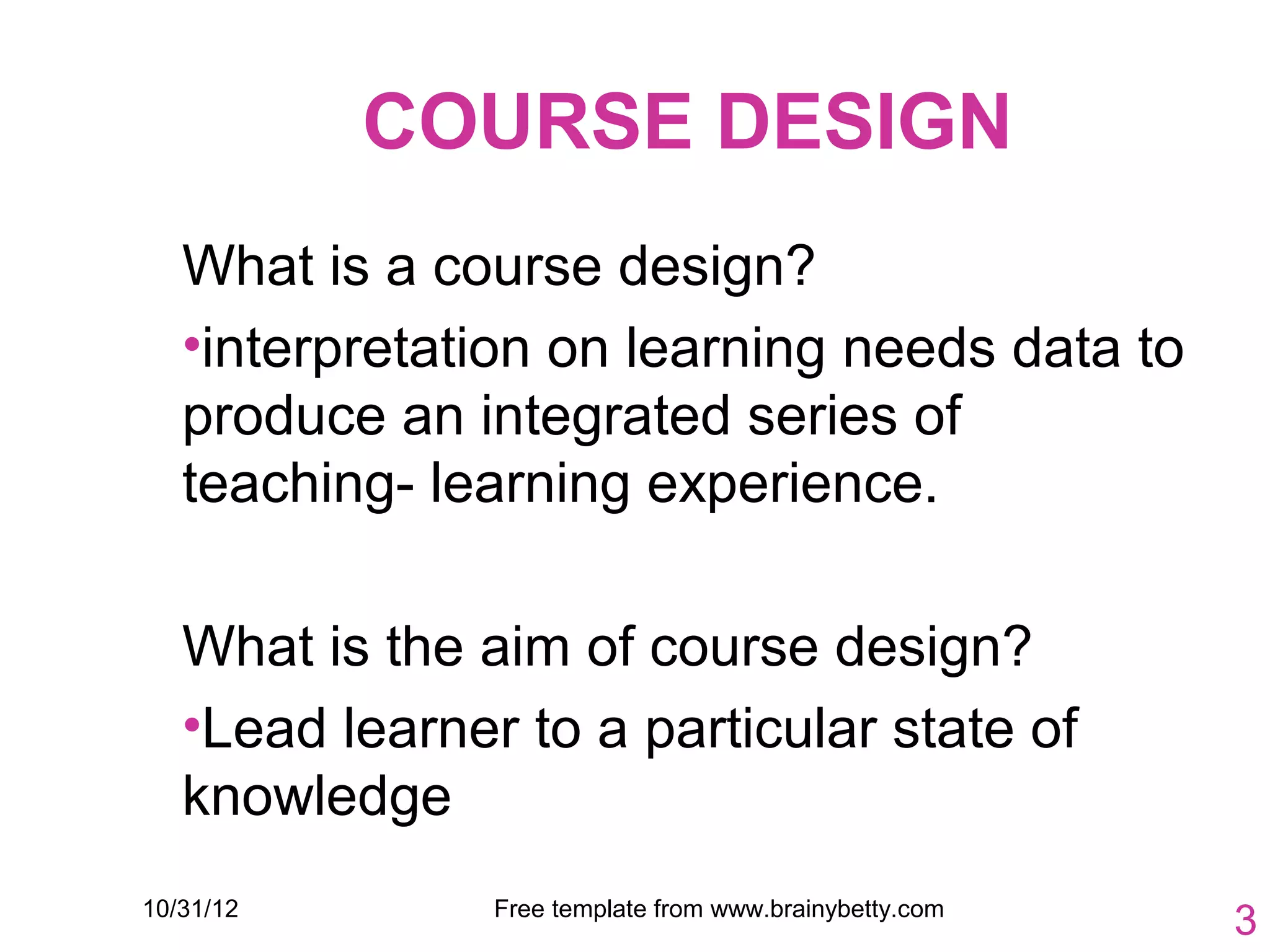
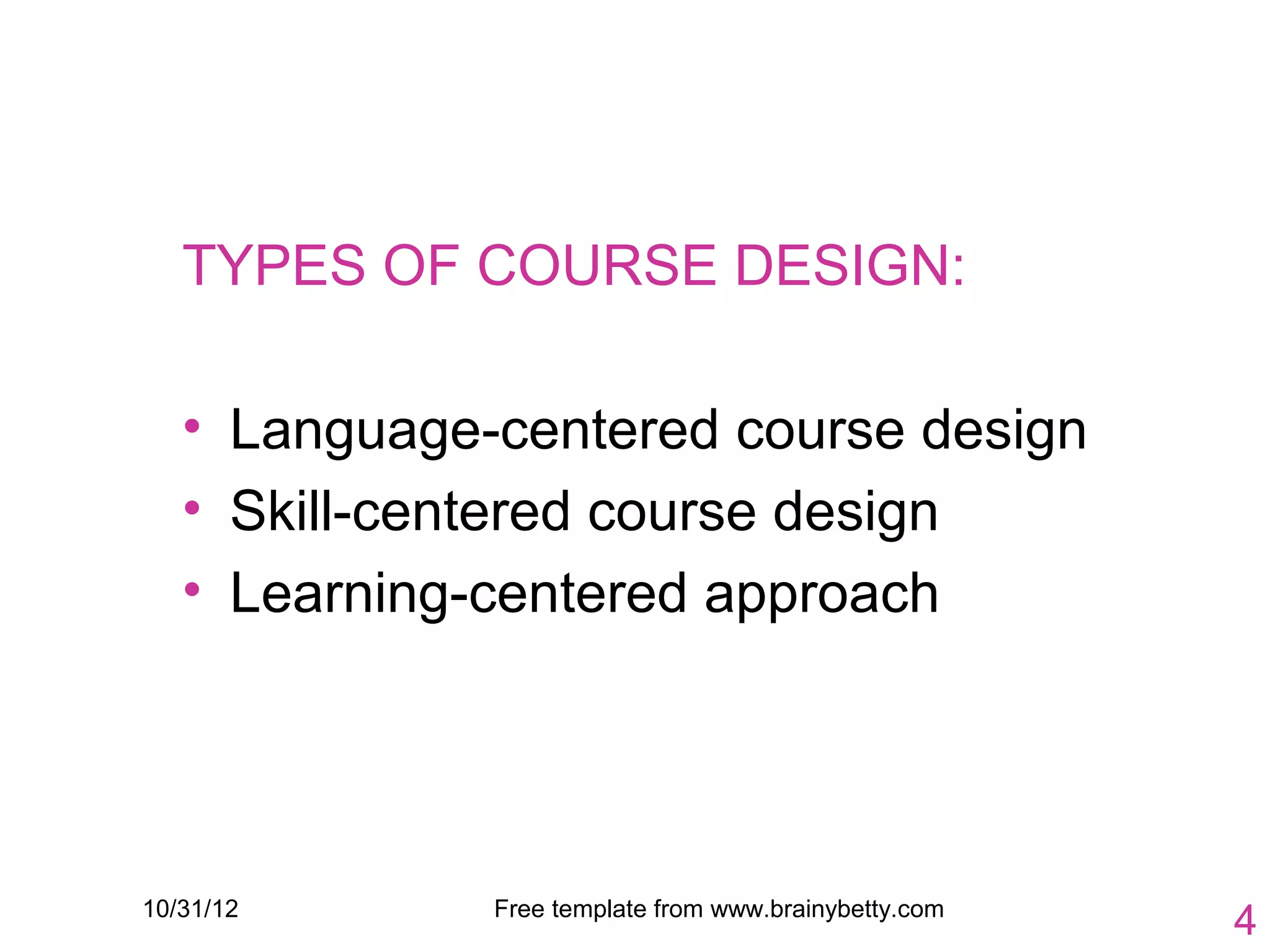
Explains course design and its aim to fulfill learners' needs, highlighting types: language-centered, skill-centered, and learning-centered approaches.
Describes language-centered design, connecting target situations to ESP courses. Discusses weaknesses like lack of learner focus and inflexibility.
Outlines skill-centered approach principles including theoretical and pragmatic. Discusses benefits of flexibility and learner involvement.
Focuses on students' learning, driven by learners' experiences. Highlights change practices for effective learning.
Defines syllabus and presents various types including evaluation, organizational, materials, teacher, classroom, and learner syllabi.
Explores reasons for syllabus necessity and criteria for organization. Discusses types of syllabi like topic, notional, functional, situational.
Examines different approaches including language-centered, skill-centered, learning-centered, and learner-centered with respective processes.
Ends with a Q&A session addressing course design, syllabus inquiries, and organizing criteria.
COURSE DESIGN
What is a course design?
•interpretation on learning needs data to
produce an integrated series of
teaching- learning experience.
What is the aim of course design?
•Lead learner to a particular state of
knowledge
10/31/12 Free template from www.brainybetty.com
3
4.
TYPES OF COURSEDESIGN:
• Language-centered course design
• Skill-centered course design
• Learning-centered approach
10/31/12 Free template from www.brainybetty.com
4
5.
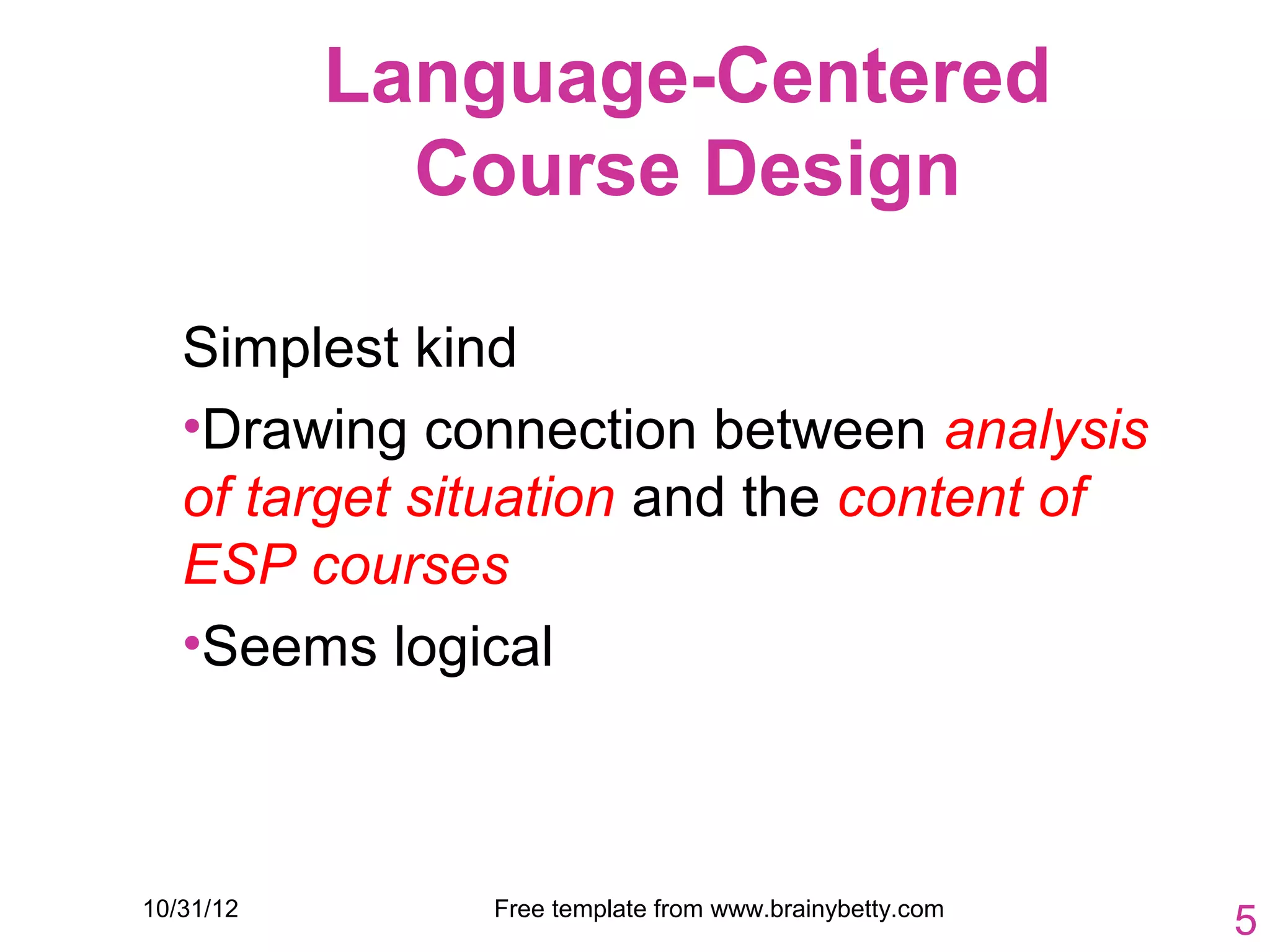
Language-Centered
Course Design
Simplest kind
•Drawing connection between analysis
of target situation and the content of
ESP courses
•Seems logical
10/31/12 Free template from www.brainybetty.com
5
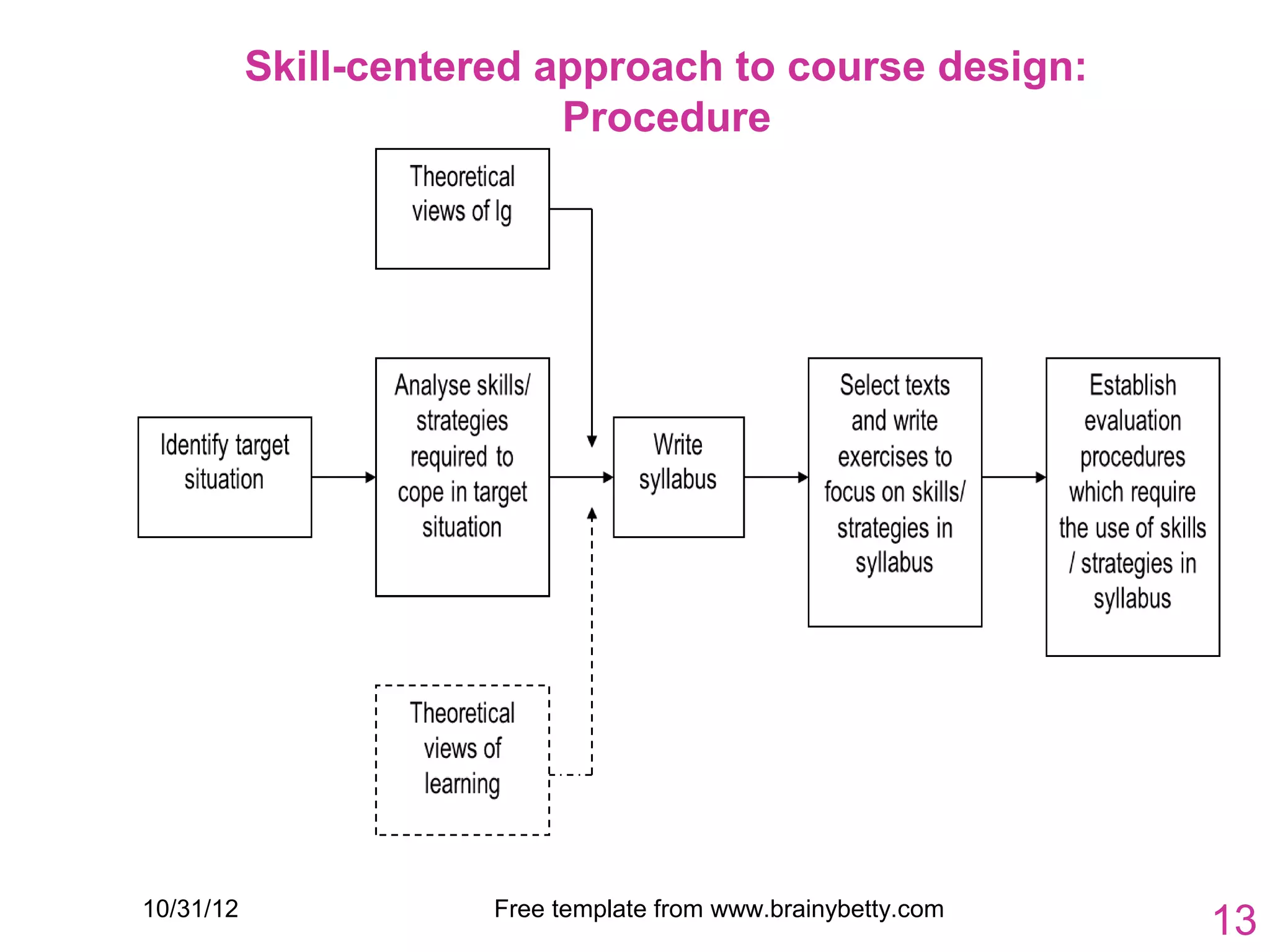
6.
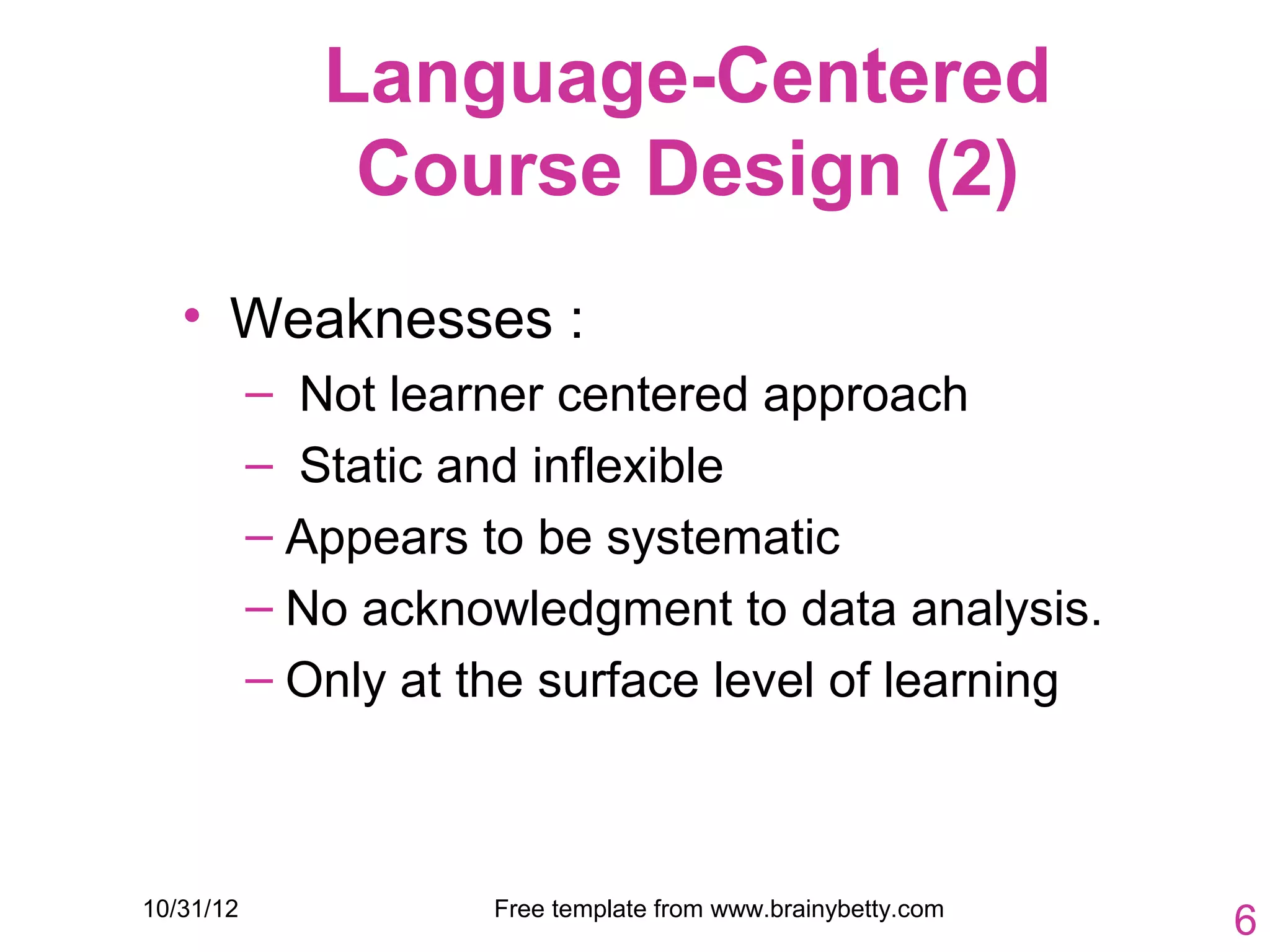
Language-Centered
Course Design (2)
• Weaknesses :
– Not learner centered approach
– Static and inflexible
– Appears to be systematic
– No acknowledgment to data analysis.
– Only at the surface level of learning
10/31/12 Free template from www.brainybetty.com
6
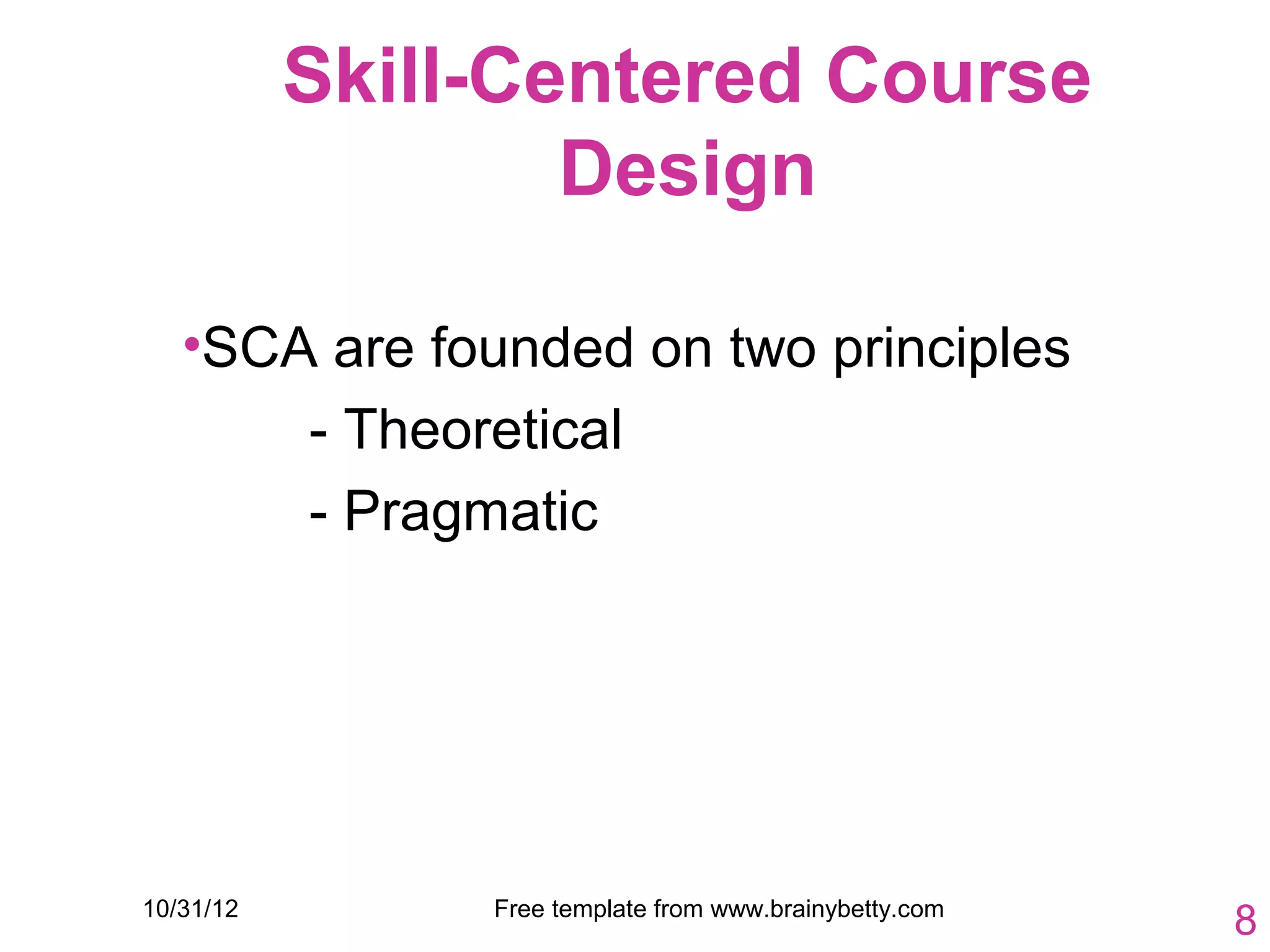
Skill-Centered Course
Design
•SCA are founded on two principles
- Theoretical
- Pragmatic
10/31/12 Free template from www.brainybetty.com
8
9.
Theoretical Principle:
Iceberg theory
- Underlying any language are skills and
strategies used by learners to produce
or understand discourse
- Thus, SCA will combine the
performance and competence when
presenting its learning objective
10/31/12 Free template from www.brainybetty.com
9
10.
• Pragmatic Principle:
Based on goal oriented and process
oriented course ( Widdowson, 1981)
Problem :
- Time : Not enough time to master
intended subject
- Experience : 1st year student
have little
experience
10/31/12 Free template from www.brainybetty.com
10
11.
SCA in General:
• SCA is not about achieving set of goals.
• It lets the learners achieve what they can
with own experience and time constraint
• It is a (continuum process) which means
there is no cut of point of success and failure.
• Learner will simultaneously learn and develop
degree of proficiency
10/31/12 Free template from www.brainybetty.com
11
12.
SCA: Conclusion
•Take moreof learners into account than LCA
•Still take the learner as the user of language
instead of a learner
•Still concern with the process of language use not
of language learning
10/31/12 Free template from www.brainybetty.com
12
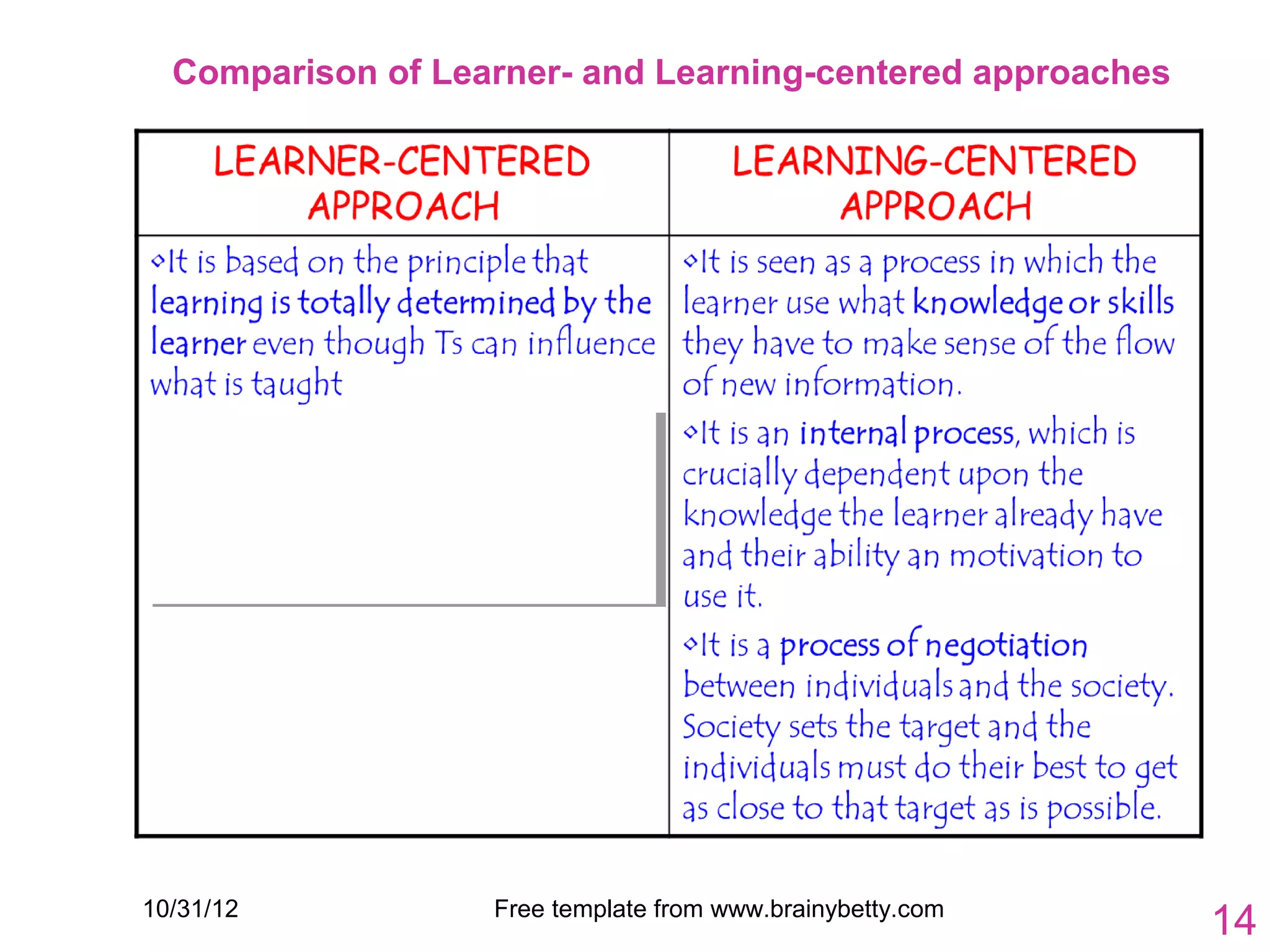
Comparison of Learner-and Learning-centered approaches
•(Other factors)
10/31/12 Free template from www.brainybetty.com
14
15.
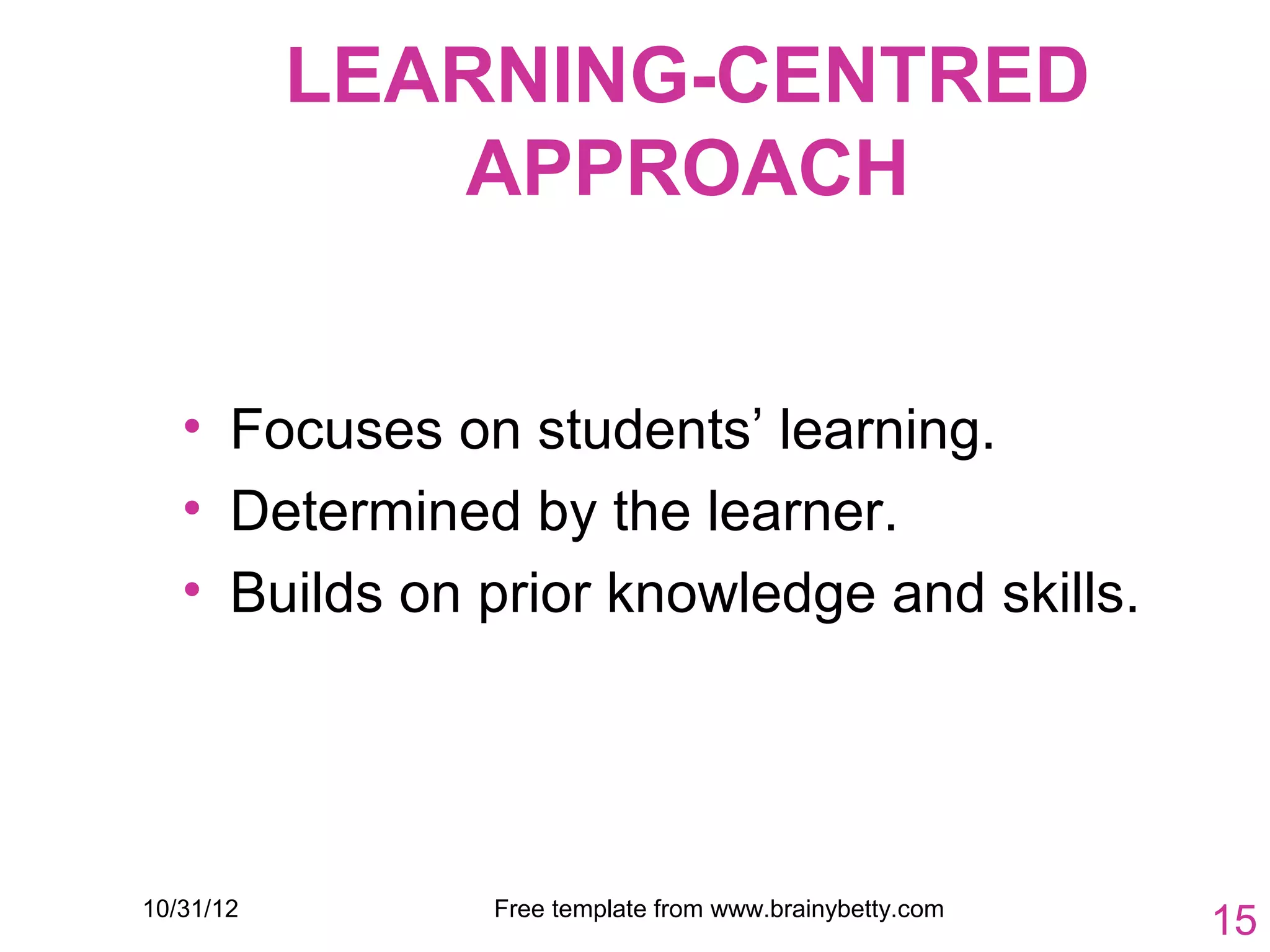
LEARNING-CENTRED
APPROACH
• Focuses on students’ learning.
• Determined by the learner.
• Builds on prior knowledge and skills.
10/31/12 Free template from www.brainybetty.com
15
16.
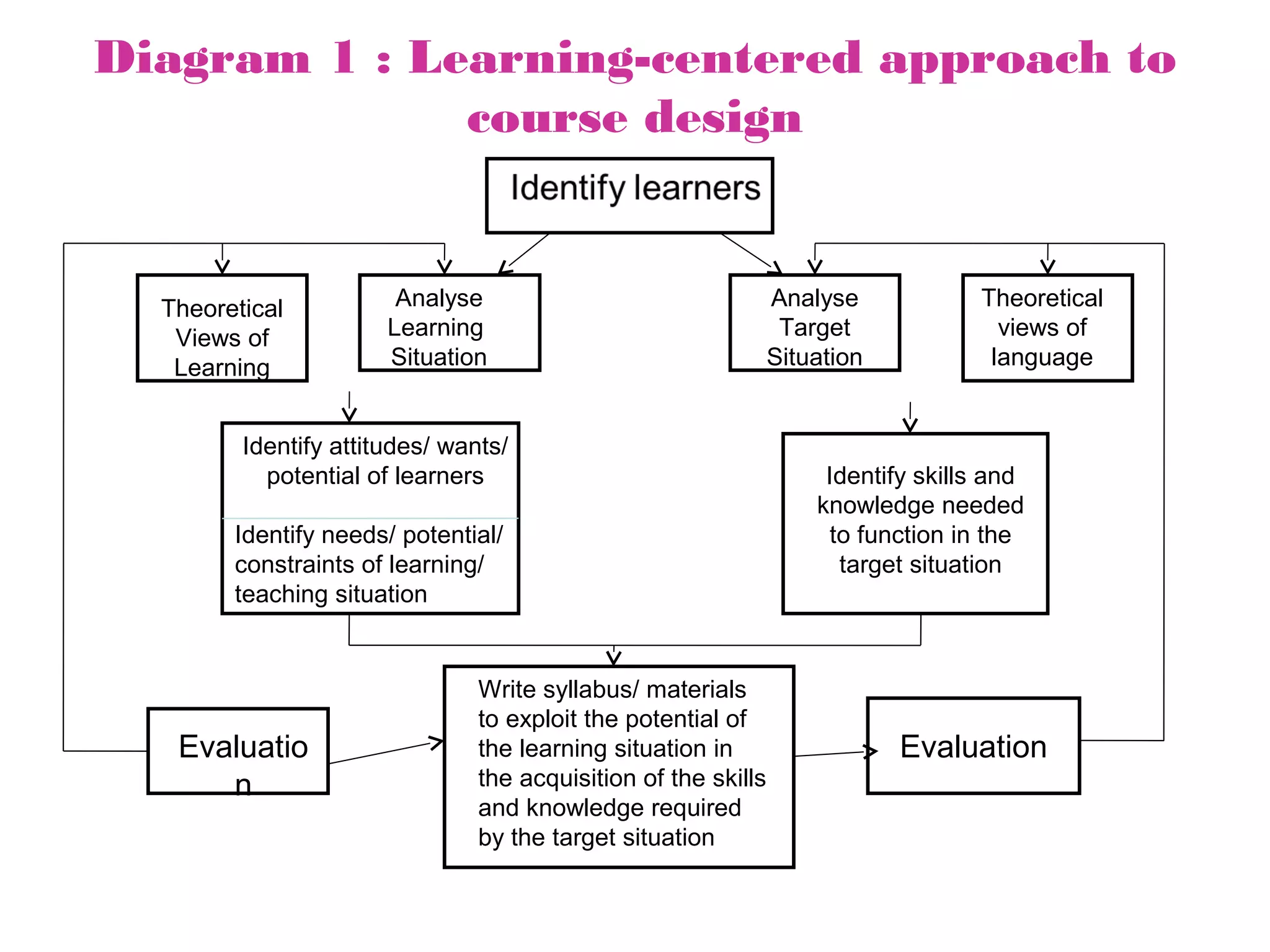
Diagram 1 :Learning-centered approach to
course design
Theoretical Analyse Analyse Theoretical
Views of Learning Target views of
Learning Situation Situation language
Identify attitudes/ wants/
potential of learners Identify skills and
knowledge needed
Identify needs/ potential/ to function in the
constraints of learning/ target situation
teaching situation
Write syllabus/ materials
to exploit the potential of
Evaluatio the learning situation in Evaluation
n the acquisition of the skills
and knowledge required
by the target situation
17.
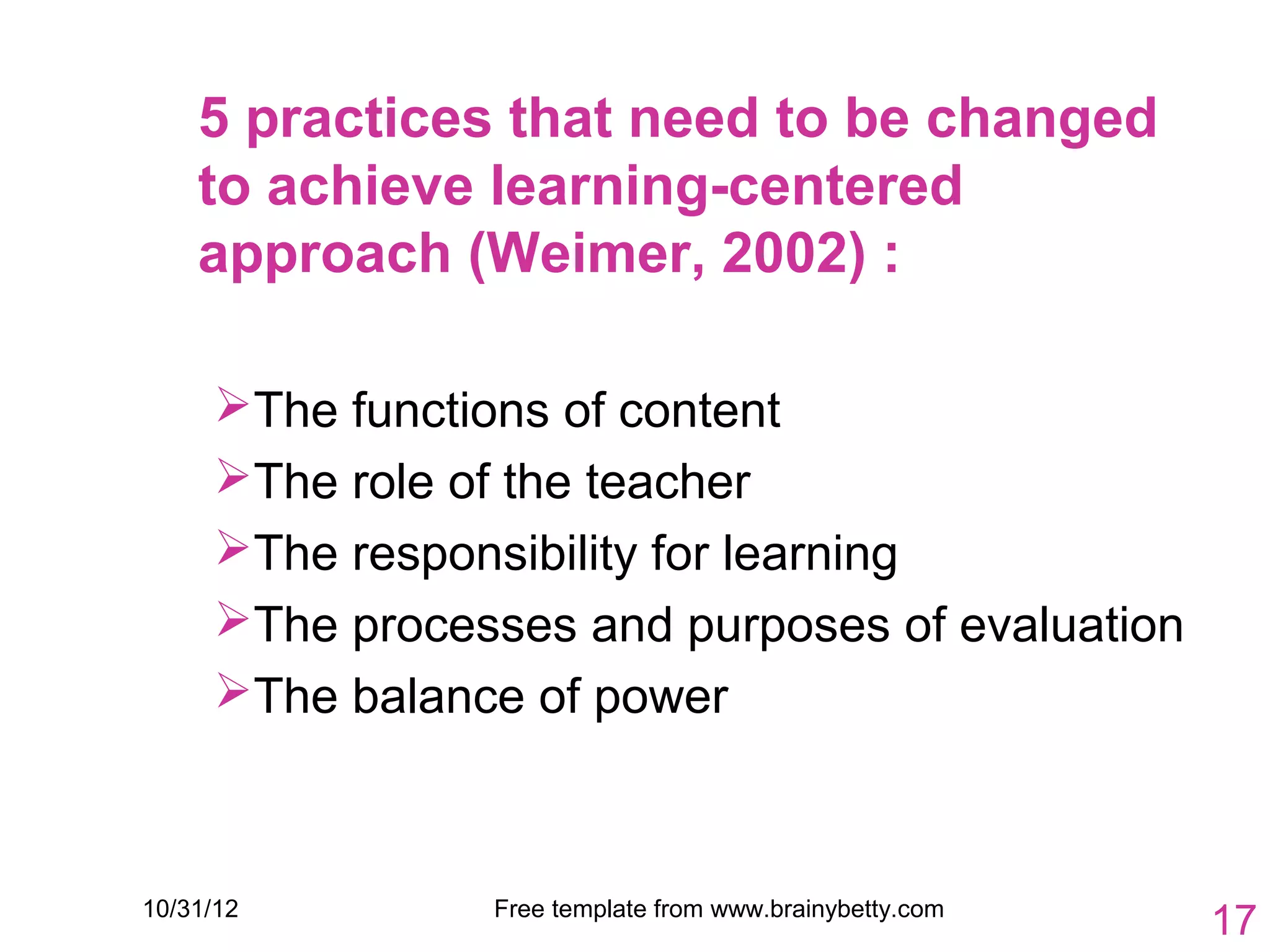
5 practices thatneed to be changed
to achieve learning-centered
approach (Weimer, 2002) :
The functions of content
The role of the teacher
The responsibility for learning
The processes and purposes of evaluation
The balance of power
10/31/12 Free template from www.brainybetty.com
17
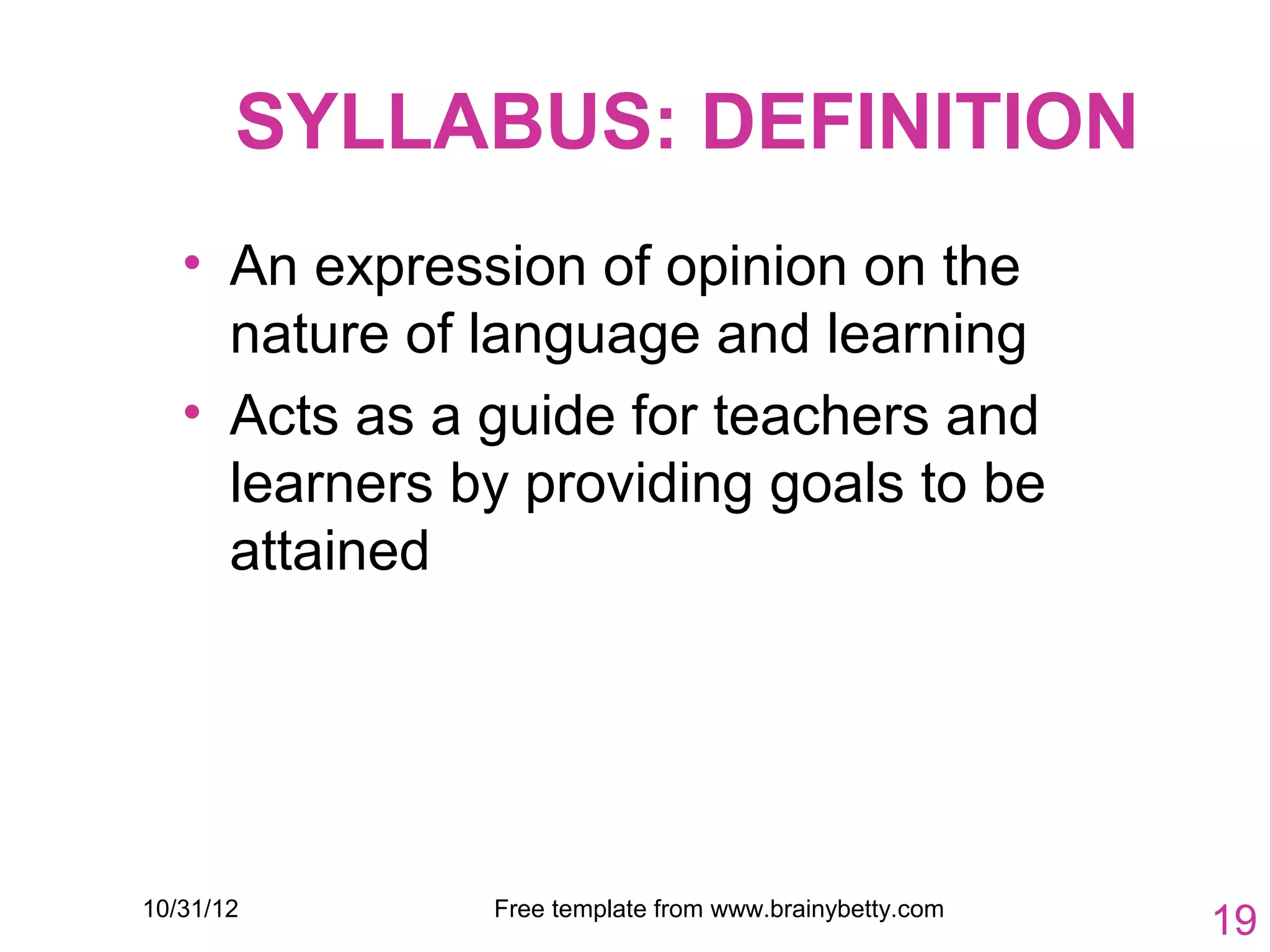
SYLLABUS: DEFINITION
• An expression of opinion on the
nature of language and learning
• Acts as a guide for teachers and
learners by providing goals to be
attained
10/31/12 Free template from www.brainybetty.com
19
20.
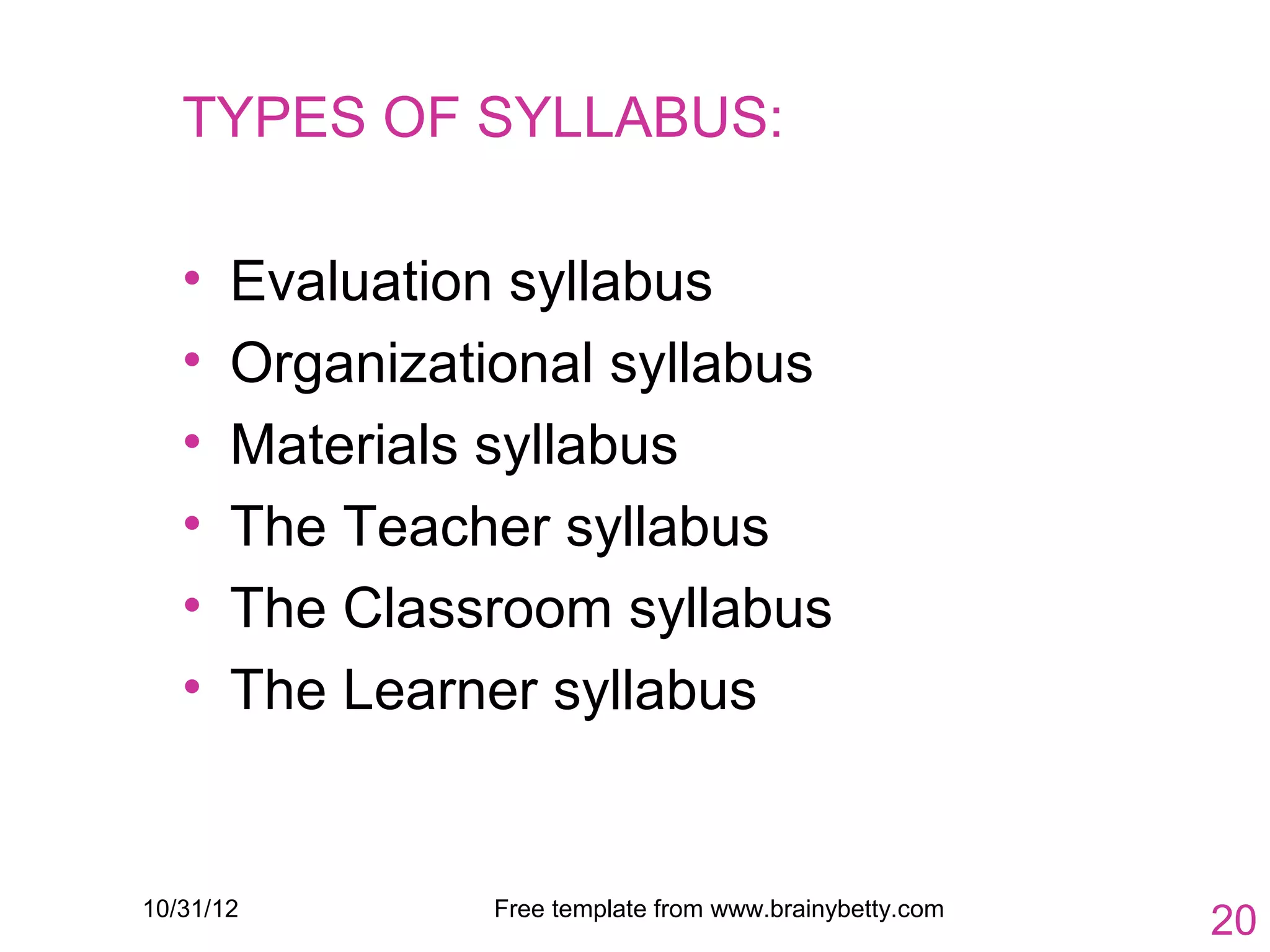
TYPES OF SYLLABUS:
• Evaluation syllabus
• Organizational syllabus
• Materials syllabus
• The Teacher syllabus
• The Classroom syllabus
• The Learner syllabus
10/31/12 Free template from www.brainybetty.com
20
21.
EVALUATION SYLLABUS
• To put on record the basis on which
success or failure will be evaluated.
• To reflect an official assumption as to
the nature of language and linguistic
performance.
10/31/12 Free template from www.brainybetty.com
21
22.
ORGANIZATIONAL
SYLLABUS
• A list of what should be learnt will be
organized
• Factors which depend upon a view of
how people learn will be considered in
order to determine the order of terms.
10/31/12 Free template from www.brainybetty.com
22
23.
MATERIALS SYLLABUS
• Additional assumptions about the nature of
language in terms of :
i. Contexts of language
ii. Relative weightings and integration of skills
iii.Number and type of exercises
iv.Degree of recycling or revision will be
decided by the author.
10/31/12 Free template from www.brainybetty.com
23
24.
THE TEACHER SYLLABUS
• Teacher influence the clarity, intensity
and frequency of any item, and
thereby affect the image that the
learners receive
10/31/12 Free template from www.brainybetty.com
24
25.
THE CLASSROOM
SYLLABUS
• Is a planned lesson done by the
teacher.
• Although it is well planned by the
teacher, it can be affected by all sorts
of unexpected conditions while
conducting the lesson.
10/31/12 Free template from www.brainybetty.com
25
26.
THE LEARNER SYLLABUS
• Also known as the internal syllabus.
• The network of knowledge that
develops in the learner’s brain,
enables learner to comprehend and
store the later information.
10/31/12 Free template from www.brainybetty.com
26
WHY IS ASYLLABUS
REQUIRED?
10/31/12 Free template from www.brainybetty.com
28
29.
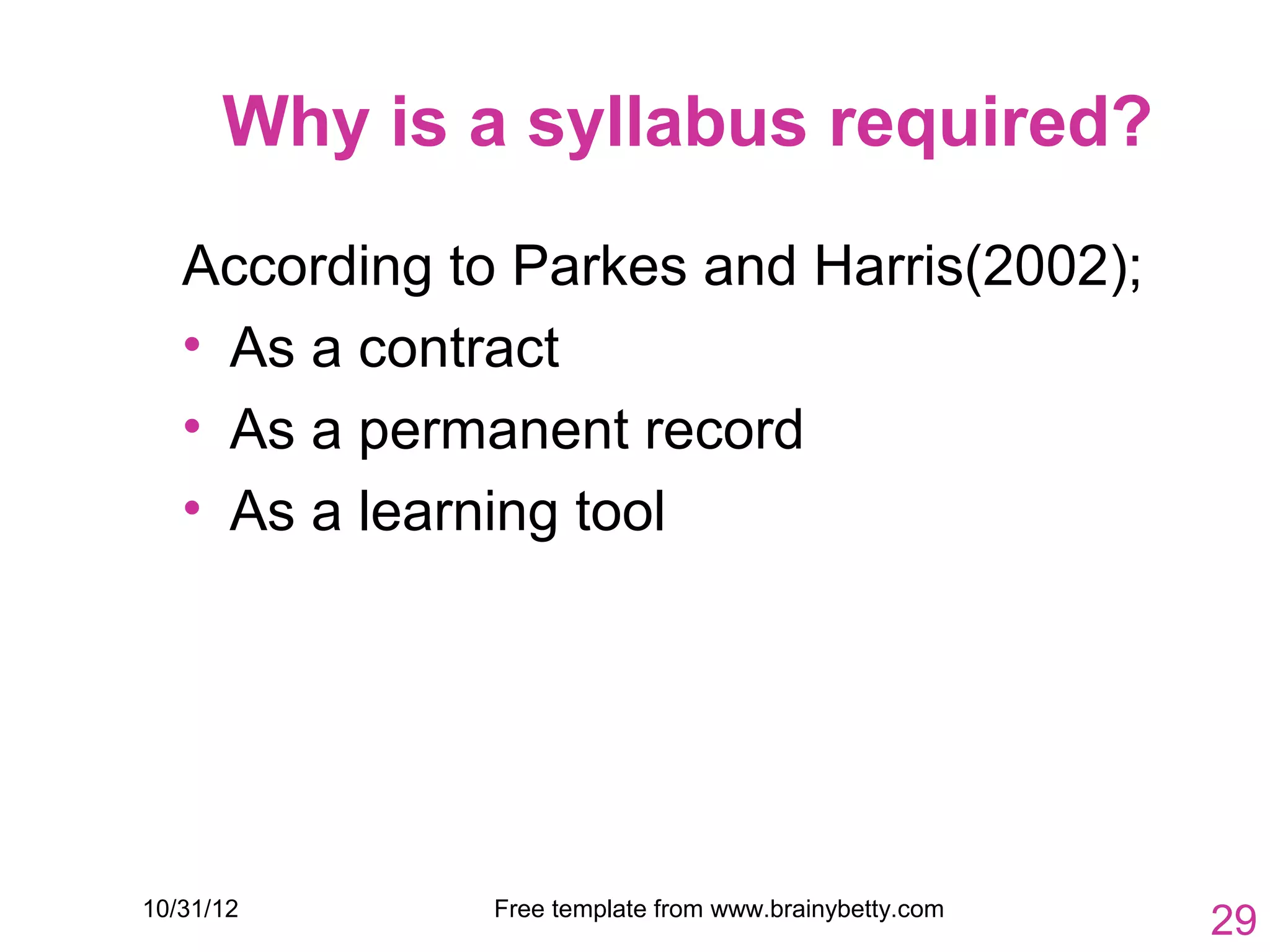
Why is asyllabus required?
According to Parkes and Harris(2002);
• As a contract
• As a permanent record
• As a learning tool
10/31/12 Free template from www.brainybetty.com
29
30.
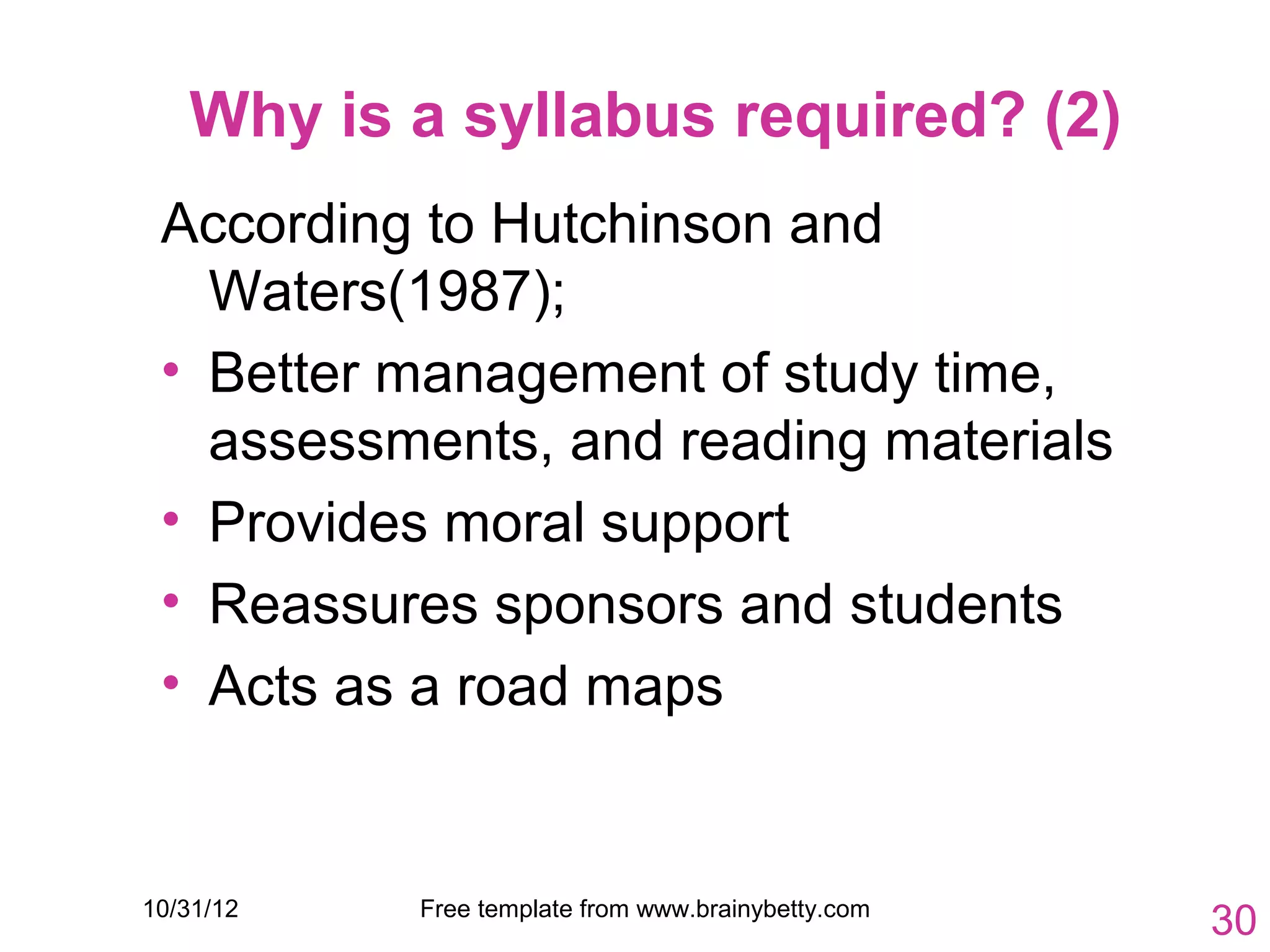
Why is asyllabus required? (2)
According to Hutchinson and
Waters(1987);
• Better management of study time,
assessments, and reading materials
• Provides moral support
• Reassures sponsors and students
• Acts as a road maps
10/31/12 Free template from www.brainybetty.com
30
31.
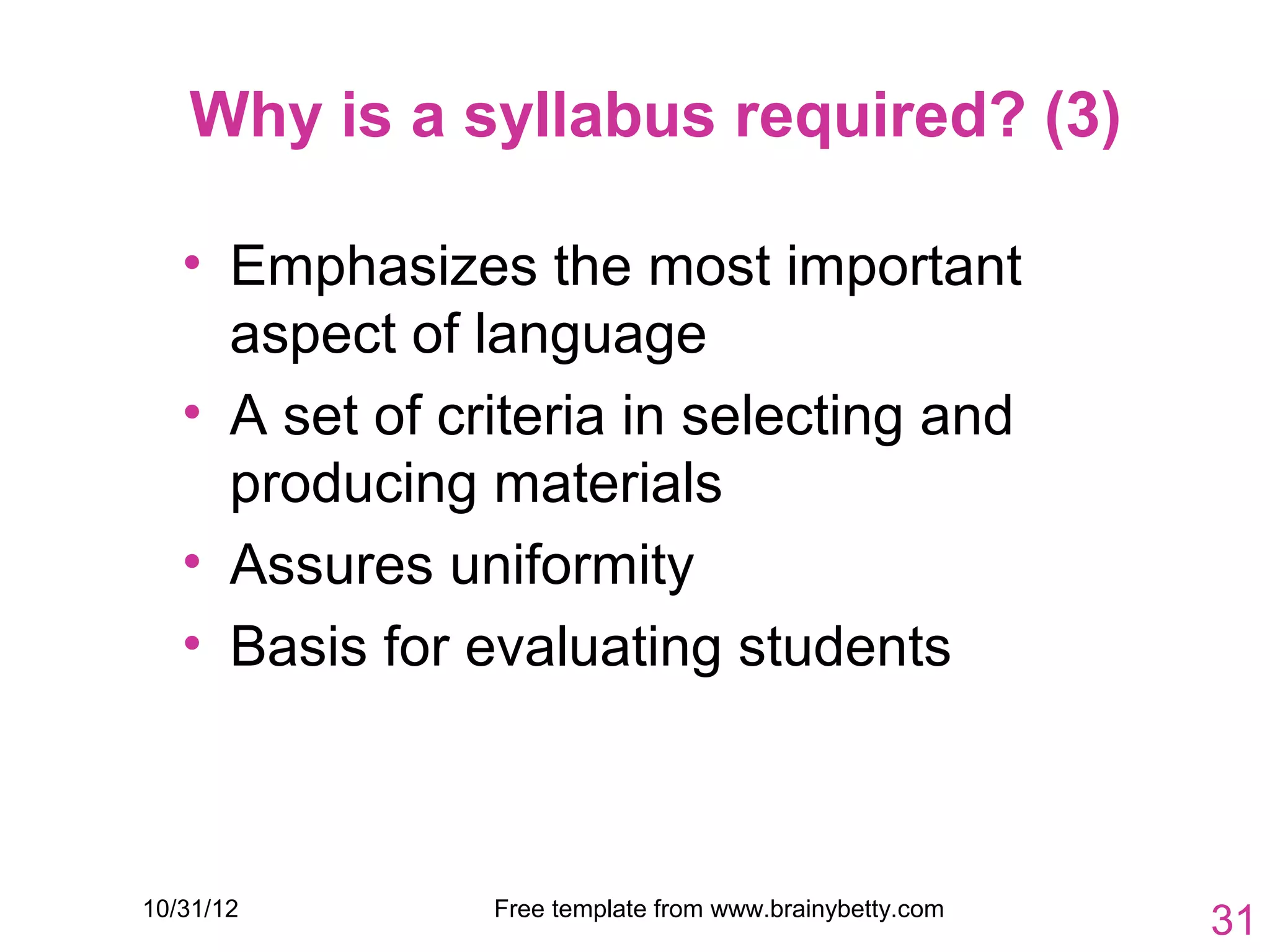
Why is asyllabus required? (3)
• Emphasizes the most important
aspect of language
• A set of criteria in selecting and
producing materials
• Assures uniformity
• Basis for evaluating students
10/31/12 Free template from www.brainybetty.com
31
32.
ON WHAT CRITERIA
SHOULD A SYLLABUS BE
ORGANIZED?
10/31/12 Free template from www.brainybetty.com
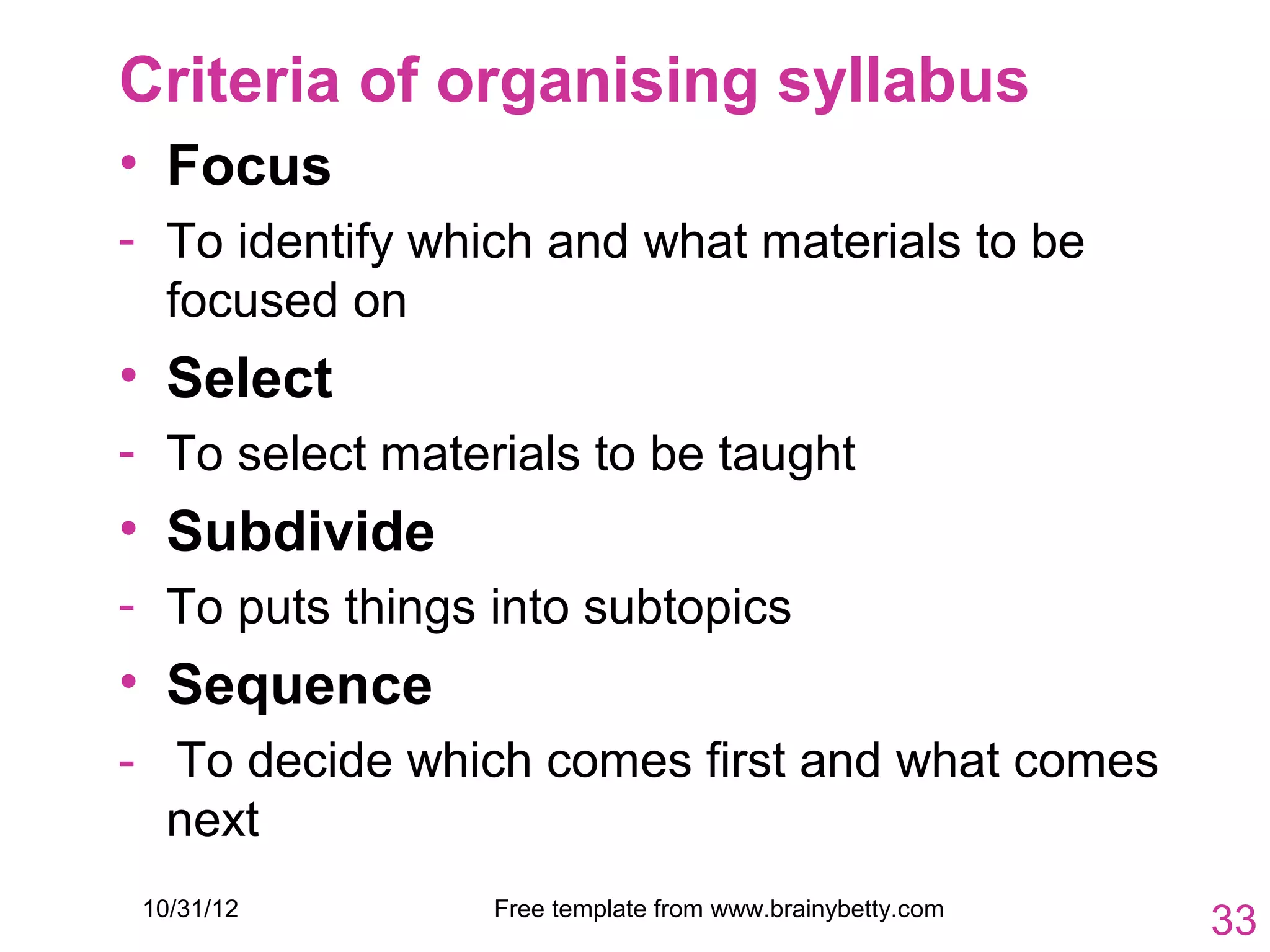
32
33.
Criteria of organisingsyllabus
• Focus
- To identify which and what materials to be
focused on
• Select
- To select materials to be taught
• Subdivide
- To puts things into subtopics
• Sequence
- To decide which comes first and what comes
next
10/31/12 Free template from www.brainybetty.com
33
34.
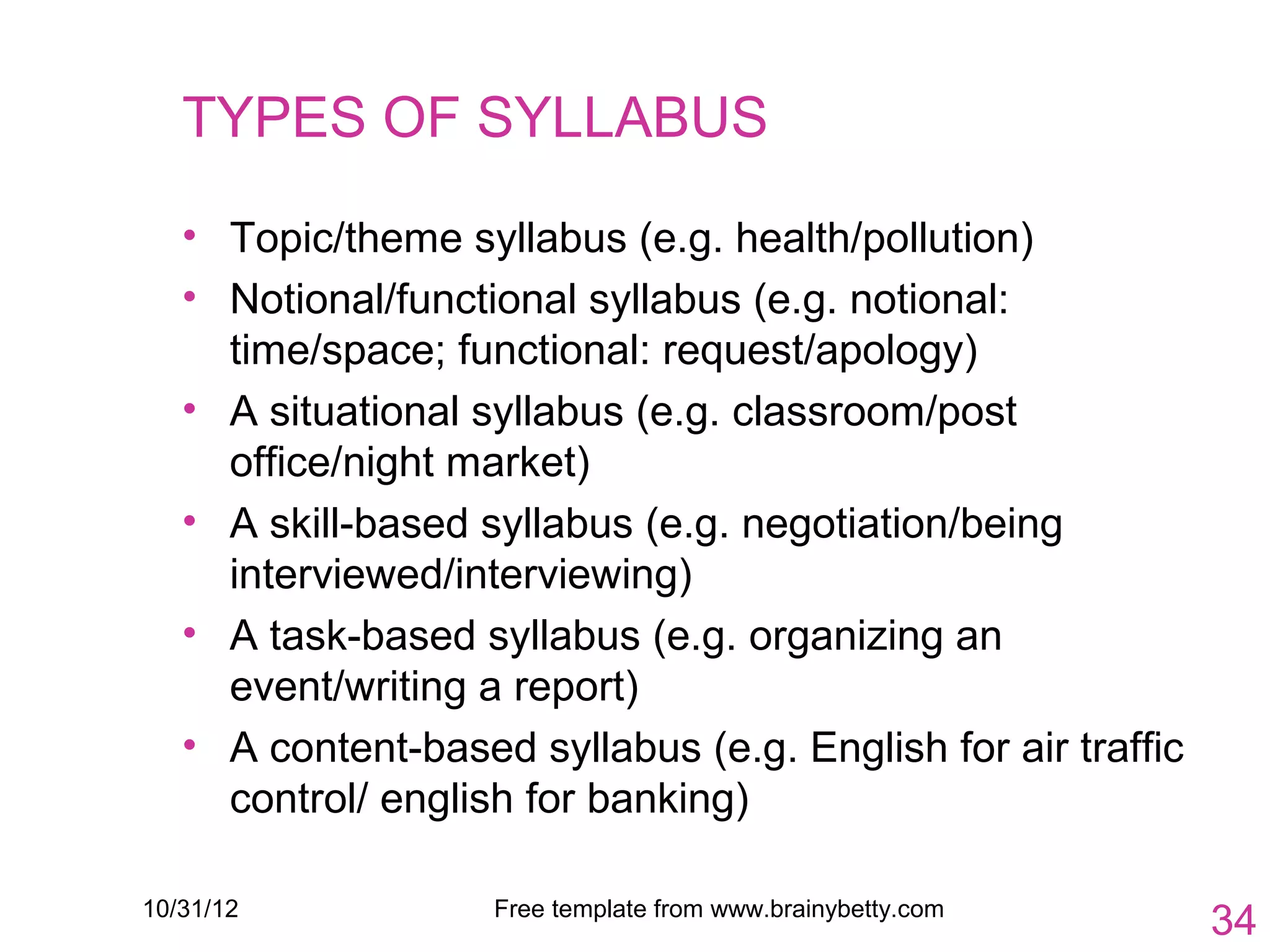
TYPES OF SYLLABUS
• Topic/theme syllabus (e.g. health/pollution)
• Notional/functional syllabus (e.g. notional:
time/space; functional: request/apology)
• A situational syllabus (e.g. classroom/post
office/night market)
• A skill-based syllabus (e.g. negotiation/being
interviewed/interviewing)
• A task-based syllabus (e.g. organizing an
event/writing a report)
• A content-based syllabus (e.g. English for air traffic
control/ english for banking)
10/31/12 Free template from www.brainybetty.com
34
35.
WHAT ROLE SHOULDA
SYLLABUS PLAY IN THE
APPROACHES TO
COURSE DESIGN?
10/31/12 Free template from www.brainybetty.com
35
36.
Approaches to coursedesign
• A Language-centred approach
• A Skills-centred approach
• A Learning-centred approach
• A Learner-centred approach
10/31/12 Free template from www.brainybetty.com
36
37.
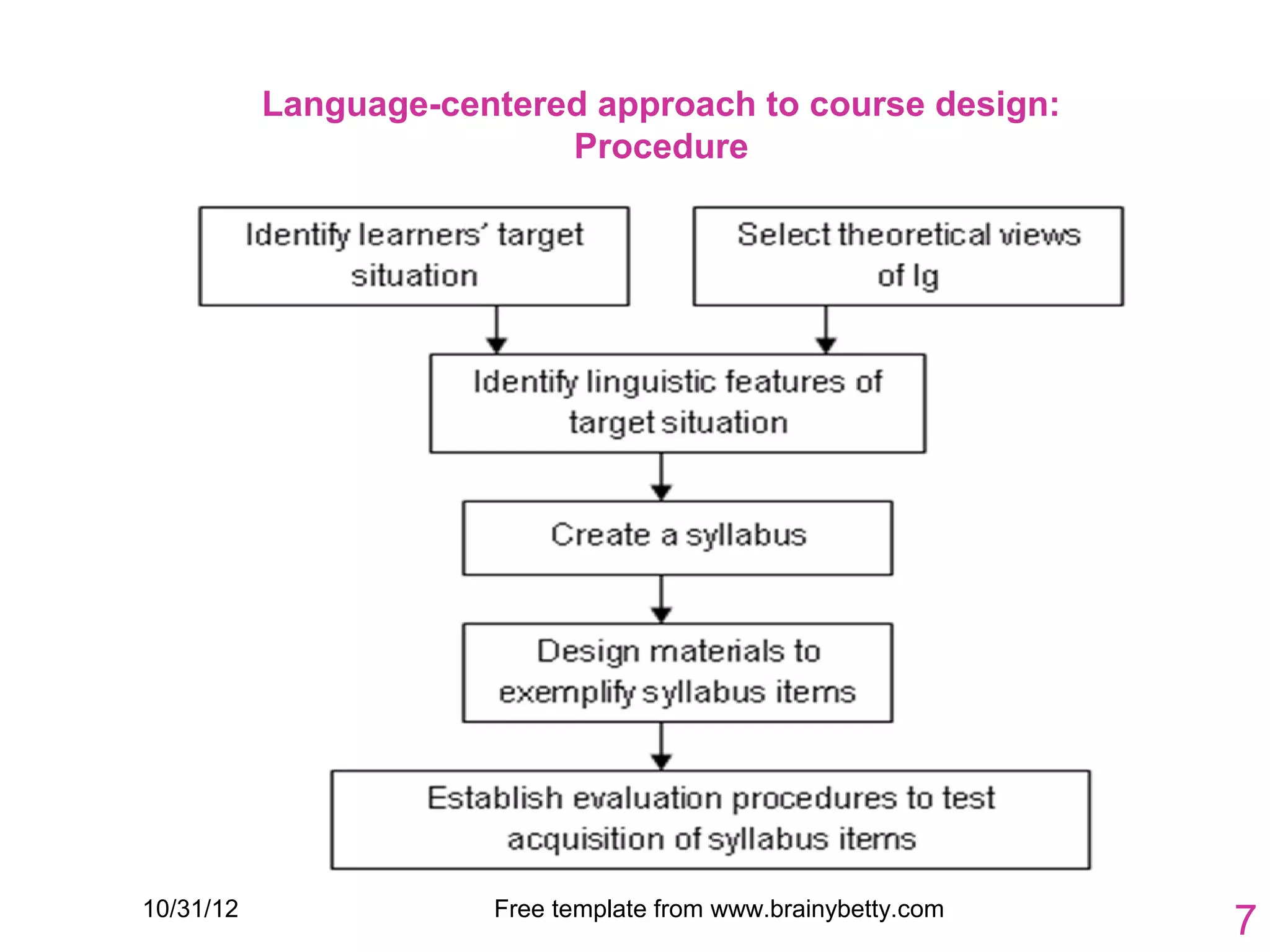
A LANGUAGE-CENTRED
APPROACH
- Generates teaching materials
1. analyse target situation
2. write syllabus
3. write/select texts to illustrate items in syllabus
4. write exercises to practise items in syllabus
5. devise tests for assessing knowledge of terms in
syllabus
10/31/12 Free template from www.brainybetty.com
37
38.
SKILLS-CENTRED
APPROACH (Holmes, 1981)
- Presents opportunities for students to
practise and evaluate skills and
strategies
1. analyze target needs
2. select interesting and representative texts
3. devise a hierarchy of skills to exploit the
texts
10/31/12 Free template from www.brainybetty.com
38
39.
SKILLS-CENTRED APPROACH
(Holmes, 1981) (2)
4. order and adapt the texts as necessary to
enable a focus on the required skills
5. devise activities/techniques to teach those
skills
6. devise a system to assess the acquisition
of the skills
10/31/12 Free template from www.brainybetty.com
39
40.
A LEARNING-CENTRED
APPROACH
- Focus on learning process
- instead of a linear approach, divides
the design process into two levels
L1. analysis –
a)actual learning situation,
b)target situation
10/31/12 Free template from www.brainybetty.com
40
41.
A LEARNING-CENTRED
APPROACH (2)
L2. generation of :
c) language syllabus based on (a)
d) skills syllabus based on (b)
e) complement results of each analysis
to form new syllabus
10/31/12 Free template from www.brainybetty.com
41
42.
A LEARNER-CENTRED
APPROACH
- Focus on the learners
1. identify the purpose of the course
2. develop learner-centered objectives
3. structure course according to objectives -
course outline
4. structure course according to goals - build
lessons
5. calendar
6. support pieces
10/31/12 Free template from www.brainybetty.com
42
43.
QUESTIONS AND
ANSWERS
1. What is course design?
2. What is a syllabus?
3. In your opinion, which one is the best
approach in the course design
mentioned previously?
4. Briefly describe the criteria of how a
syllabus should be organized in
general.
10/31/12 Free template from www.brainybetty.com
43