FORMULATING
GOALS AND
OBJECTIVES
What are goals and objectives and
what is their relationship?
A- GOALS:
1- Goals are a way of putting into words the main
purposes and intended outcomes of your course.
2- Goals are generally statements, but they are not vague.
For example:
- “Students will improve their writing” is vague.
- Compare the above with “By the end of the
course students will have become more aware of their
writing in general and be able to identify specific areas
in which improvement is needed”
What are goals and objectives and
what is their relationship? (cont.)
3- A goal states an aim that the course will
explicitly address in some way.
For example: if one of the goals of a course is to
help students develop learning strategies, then
the class time will be explicitly devoted to that
goal.
4- Goals should be realistically achieved within the
constraints and resources of your course.
What are goals and objectives and
what is their relationship? (cont.)
5- Goals are future-oriented. J.D Brown (1995) pointed
out that goals are “what the students should be able
to do when they leave the program”
For example: “ By the end of the course students
will have developed the ability to write letters for a
variety of purposes”
6- Goals are the benchmark of success for a course. If
we consider our course as a journey, the destination
is the goal(s) and the objectives are the different
points you pass through on the journey to the
destination. The course is successful and effective if
the objectives and goals are reached.
What are goals and objectives and
what is their relationship? (cont.)
B- OBJECTIVES
1- Objectives are statements about how the
goals will be achieved. Through objectives,
a goal is broken down into learnable and
teachable units. Course designer should ask
himself “ Will achieving this objective help
to reach the goal?”
OBJECTIVES (cont.)
2- Objectives are in hierarchy relationship
to goals. Goals are more general and
objectives are more specific.
3- The relationship between goals and
objectives is that of CAUSE and EFFECT.
If the goal remains important and is not
achieved through the means of objectives
then the objectives may need to be
examined and changed or refined.
FORMULATING GOALS
 Step1: List all the possible goals you could have
for your particular course, based on your
conceptualization of content, your beliefs, and
your assessment of students’ needs.
 Step 2: Look for redundancies/overlapping,
and identify priorities based on your beliefs and
your context.
 Step 3: Organize your list of goals into a
coherent plan using the following suggestions:
FORMULATING GOALS (cont.)
 Suggestion 1: Use the framework of KASA
(Knowledge, Awareness, Skills, Attitude)
- Knowledge goals address what students will know and
understand.
- Awareness goals address what students need to be
aware of when learning a language.
- Skills goals address what students can do with the
language.
- Attitude goals are those that address the affective and
value-based dimensions of learning: students’ feeling
towards themselves, towards others, the target language
and culture.
FORMULATING GOALS (cont.)
 Suggestion 2: use Stern’s framework (1992)
(Cognitive goals, Proficiency goals, Affective goals, Transfer goals)
- Cognitive goals: include explicit knowledge,
information and conceptual learning about language
(e.g., grammar and other system aspects of
communication) and about culture (e.g., rules of
conduct, norms, values)
- Proficiency goals: include what students will be able to
do with the language (e.g., mastery of skills, ability to
carry out functions)
- Affective goals: include achieving positive attitudes
towards the target language and culture as well as to
one’s own learning of them.
- Transfer goals: include learning how to transfer what
one learns/does in classroom to situations outside
classroom to continue learning.
AN EXAMPLE OF A SET OF GOALS
FORMULATED USING STERN’S FRAMEWORK
1- Proficiency:
- Students will develop effective writing
skills transferable to any context.
2- Cognitive:
-Students will gain awareness of the influence
of socio-cultural issues on their writing.
AN EXAMPLE (cont.)
3- Affective:
- Students will develop confidence in their ability
to write in English.
- Students will develop an appreciation for the
contribution of their knowledge and experience
(and that of their peers) makes to the learning
process.
4- Transfer:
- Students will gain an understanding of how they
can continue to improve their writing skills.
FORMULATING GOALS (cont.)
 Suggestion 3: use framework by Genesee and
Upshur (1996):
- Language goals: language skills learners are expected to
acquire in the classroom.
- Strategic goals: strategies learners use to learn the
language.
- Socio-affective goals: changes in values, attitudes or
social behaviors that result from classroom instruction.
- Philosophical goals: changes in values, attitudes and
beliefs of a more general nature.
- Method or process goals: the activities learners will
engage in.
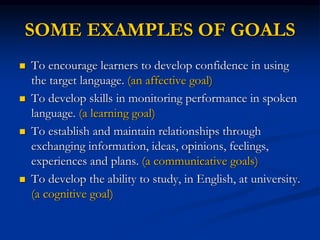
SOME EXAMPLES OF GOALS
 To encourage learners to develop confidence in using
the target language. (an affective goal)
 To develop skills in monitoring performance in spoken
language. (a learning goal)
 To establish and maintain relationships through
exchanging information, ideas, opinions, feelings,
experiences and plans. (a communicative goals)
 To develop the ability to study, in English, at university.
(a cognitive goal)
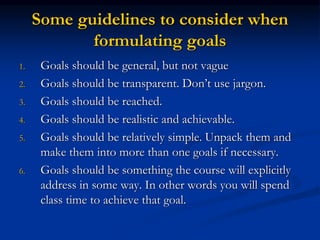
Some guidelines to consider when
formulating goals
1. Goals should be general, but not vague
2. Goals should be transparent. Don’t use jargon.
3. Goals should be reached.
4. Goals should be realistic and achievable.
5. Goals should be relatively simple. Unpack them and
make them into more than one goals if necessary.
6. Goals should be something the course will explicitly
address in some way. In other words you will spend
class time to achieve that goal.
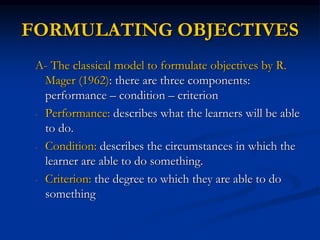
FORMULATING OBJECTIVES
A- The classical model to formulate objectives by R.
Mager (1962): there are three components:
performance – condition – criterion
- Performance: describes what the learners will be able
to do.
- Condition: describes the circumstances in which the
learner are able to do something.
- Criterion: the degree to which they are able to do
something
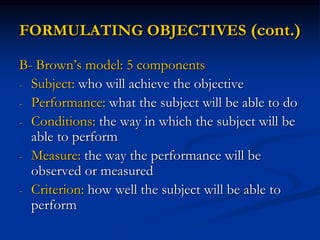
FORMULATING OBJECTIVES (cont.)
B- Brown’s model: 5 components
- Subject: who will achieve the objective
- Performance: what the subject will be able to do
- Conditions: the way in which the subject will be
able to perform
- Measure: the way the performance will be
observed or measured
- Criterion: how well the subject will be able to
perform
FORMULATING OBJECTIVES (cont.)
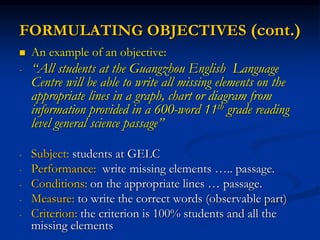
 An example of an objective:
- “All students at the Guangzhou English Language
Centre will be able to write all missing elements on the
appropriate lines in a graph, chart or diagram from
information provided in a 600-word 11th grade reading
level general science passage”
- Subject: students at GELC
- Performance: write missing elements ….. passage.
- Conditions: on the appropriate lines … passage.
- Measure: to write the correct words (observable part)
- Criterion: the criterion is 100% students and all the
missing elements
FORMULATING OBJECTIVES (cont.)
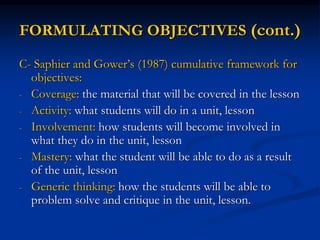
C- Saphier and Gower’s (1987) cumulative framework for
objectives:
- Coverage: the material that will be covered in the lesson
- Activity: what students will do in a unit, lesson
- Involvement: how students will become involved in
what they do in the unit, lesson
- Mastery: what the student will be able to do as a result
of the unit, lesson
- Generic thinking: how the students will be able to
problem solve and critique in the unit, lesson.
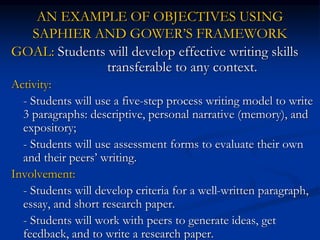
AN EXAMPLE OF OBJECTIVES USING
SAPHIER AND GOWER’S FRAMEWORK
GOAL: Students will develop effective writing skills
transferable to any context.
Activity:
- Students will use a five-step process writing model to write
3 paragraphs: descriptive, personal narrative (memory), and
expository;
- Students will use assessment forms to evaluate their own
and their peers’ writing.
Involvement:
- Students will develop criteria for a well-written paragraph,
essay, and short research paper.
- Students will work with peers to generate ideas, get
feedback, and to write a research paper.
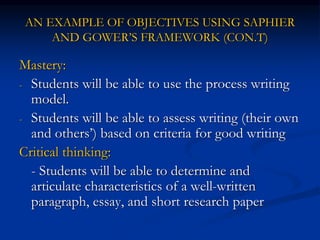
AN EXAMPLE OF OBJECTIVES USING SAPHIER
AND GOWER’S FRAMEWORK (CON.T)
Mastery:
- Students will be able to use the process writing
model.
- Students will be able to assess writing (their own
and others’) based on criteria for good writing
Critical thinking:
- Students will be able to determine and
articulate characteristics of a well-written
paragraph, essay, and short research paper
More focus on and examples of
goals and performance objectives
General standard 1: Students will be able to use English
for communication.
General standard 2: Students will develop cross-cultural
skills and understanding.
Goal 1: Students will be able to utilize the skills of
listening and speaking for the purposes of: socializing,
providing and obtaining information, expressing
personal feelings and opinions, persuading others to
adopt a course of action, in the targeted topics by:
Objectives: Students will be able to:
1. Comprehend messages and short conversations when
listening to peers, familiar adults, and providers of
public services in face-to-face interactions.
More focus and examples of goals
and performance objectives
2. Understand the main ideas of some discrete
information in television and radio or live
presentation.
3. Initiate and sustain conversation, face-to-face, with
native speakers or fluent individuals.
4. Select vocabulary appropriate to a range of topics,
employing simple and complex sentences in present,
past and future time frames.
5. Exhibit spontaneity in their interactions, particularly
when the topic is familiar, but often relying on
familiar utterances.
More examples of performance objectives
 By the end of the training period the trainees should be
able to undertake the following to a level acceptable to
the Diplomatic Service:
1- Deal with enquiries and requests by supplying pertinent
and accurate information in a succinct and acceptable
letter form.
2- Initiate correspondence by requesting and conveying
information concerning routine letters.
3- Deal with written requests, arrangements and
coordination of diplomatic activity using acceptable
letter forms. Respond accurately to specific requests.
4- Organize, through correspondence, arrangements and
schedules for visitors including initial contacts,
suggested venue and schedules, selection of guests and
confirmation.
More examples of
performance objectives
 Students (Indonesians studying engineering in the UK)
should be able to:
1- follow formal lectures in a range of native speaker
accents
2- relate spoken information in a lecture to accompanying
notes.
3- understand the explanation of practical tasks in a range
of native speaker accents.
4- ask for clarification, explanation, advice and assistance,
and understand the response.
More examples of performance
objectives
5- understand the requirements of test questions and
assignments
6- write answers to test questions under a time limit.
7- plan, write and edit formal reports on practical
assignments.
8- locate and understand specific information in a written
text.
9- communicate adequately in everyday situations for
social survival.
More examples: Enabling skills
expressed as objectives
After completing a reading course, the students will be able to:
1- use skimming when appropriate to ensure that they read only
what is relevant and to help subsequent comprehension.
2- Make use of non-text information (especially diagrams etc.) to
supplement the text and increasing understanding.
3- read in different ways according to their purpose and the type of
text.
4- not worry if they do not understand every word, except when
complete accuracy is important.
5- recognize that a good writer chooses his words carefully and
would have meant something different if he had chosen A rather
than B.
6- make use of the reference system, discourse makers… to help
them understand the meaning of difficult passages
Some guidelines to consider when
formulating objectives
1- Objectives are more specific than goals and
should directly relate to goals.
2- Objectives and goals should be in a cause-effect
relationship.
3- Objectives are relatively short-term. Goals are
relatively long-term.
4- Objectives should focus on what students will
learn, not simply on the activity.
5- There should be more objectives than goals.
However, one objective may relate to more than
one goal
SOME GUIDELINES (cont.)
6- Don’t try to pack too much on one objective.
Limit each objective to a specific skill or
language area.
7- The goals and the objectives give a sense of
the syllabus of the course. Objectives are like the
building blocks of the syllabus.
8- A clear set of goals and objectives provides
the basis for evaluation of the course (goals) and
assessment of students’ learning (objectives)

FORMULATING GOALS AND OBJECTIVES.ppt

  • 1.
  • 2.
    What are goalsand objectives and what is their relationship? A- GOALS: 1- Goals are a way of putting into words the main purposes and intended outcomes of your course. 2- Goals are generally statements, but they are not vague. For example: - “Students will improve their writing” is vague. - Compare the above with “By the end of the course students will have become more aware of their writing in general and be able to identify specific areas in which improvement is needed”
  • 3.
    What are goalsand objectives and what is their relationship? (cont.) 3- A goal states an aim that the course will explicitly address in some way. For example: if one of the goals of a course is to help students develop learning strategies, then the class time will be explicitly devoted to that goal. 4- Goals should be realistically achieved within the constraints and resources of your course.
  • 4.
    What are goalsand objectives and what is their relationship? (cont.) 5- Goals are future-oriented. J.D Brown (1995) pointed out that goals are “what the students should be able to do when they leave the program” For example: “ By the end of the course students will have developed the ability to write letters for a variety of purposes” 6- Goals are the benchmark of success for a course. If we consider our course as a journey, the destination is the goal(s) and the objectives are the different points you pass through on the journey to the destination. The course is successful and effective if the objectives and goals are reached.
  • 5.
    What are goalsand objectives and what is their relationship? (cont.) B- OBJECTIVES 1- Objectives are statements about how the goals will be achieved. Through objectives, a goal is broken down into learnable and teachable units. Course designer should ask himself “ Will achieving this objective help to reach the goal?”
  • 6.
    OBJECTIVES (cont.) 2- Objectivesare in hierarchy relationship to goals. Goals are more general and objectives are more specific. 3- The relationship between goals and objectives is that of CAUSE and EFFECT. If the goal remains important and is not achieved through the means of objectives then the objectives may need to be examined and changed or refined.
  • 7.
    FORMULATING GOALS  Step1:List all the possible goals you could have for your particular course, based on your conceptualization of content, your beliefs, and your assessment of students’ needs.  Step 2: Look for redundancies/overlapping, and identify priorities based on your beliefs and your context.  Step 3: Organize your list of goals into a coherent plan using the following suggestions:
  • 8.
    FORMULATING GOALS (cont.) Suggestion 1: Use the framework of KASA (Knowledge, Awareness, Skills, Attitude) - Knowledge goals address what students will know and understand. - Awareness goals address what students need to be aware of when learning a language. - Skills goals address what students can do with the language. - Attitude goals are those that address the affective and value-based dimensions of learning: students’ feeling towards themselves, towards others, the target language and culture.
  • 9.
    FORMULATING GOALS (cont.) Suggestion 2: use Stern’s framework (1992) (Cognitive goals, Proficiency goals, Affective goals, Transfer goals) - Cognitive goals: include explicit knowledge, information and conceptual learning about language (e.g., grammar and other system aspects of communication) and about culture (e.g., rules of conduct, norms, values) - Proficiency goals: include what students will be able to do with the language (e.g., mastery of skills, ability to carry out functions) - Affective goals: include achieving positive attitudes towards the target language and culture as well as to one’s own learning of them. - Transfer goals: include learning how to transfer what one learns/does in classroom to situations outside classroom to continue learning.
  • 10.
    AN EXAMPLE OFA SET OF GOALS FORMULATED USING STERN’S FRAMEWORK 1- Proficiency: - Students will develop effective writing skills transferable to any context. 2- Cognitive: -Students will gain awareness of the influence of socio-cultural issues on their writing.
  • 11.
    AN EXAMPLE (cont.) 3-Affective: - Students will develop confidence in their ability to write in English. - Students will develop an appreciation for the contribution of their knowledge and experience (and that of their peers) makes to the learning process. 4- Transfer: - Students will gain an understanding of how they can continue to improve their writing skills.
  • 12.
    FORMULATING GOALS (cont.) Suggestion 3: use framework by Genesee and Upshur (1996): - Language goals: language skills learners are expected to acquire in the classroom. - Strategic goals: strategies learners use to learn the language. - Socio-affective goals: changes in values, attitudes or social behaviors that result from classroom instruction. - Philosophical goals: changes in values, attitudes and beliefs of a more general nature. - Method or process goals: the activities learners will engage in.
  • 13.
    SOME EXAMPLES OFGOALS  To encourage learners to develop confidence in using the target language. (an affective goal)  To develop skills in monitoring performance in spoken language. (a learning goal)  To establish and maintain relationships through exchanging information, ideas, opinions, feelings, experiences and plans. (a communicative goals)  To develop the ability to study, in English, at university. (a cognitive goal)
  • 14.
    Some guidelines toconsider when formulating goals 1. Goals should be general, but not vague 2. Goals should be transparent. Don’t use jargon. 3. Goals should be reached. 4. Goals should be realistic and achievable. 5. Goals should be relatively simple. Unpack them and make them into more than one goals if necessary. 6. Goals should be something the course will explicitly address in some way. In other words you will spend class time to achieve that goal.
  • 15.
    FORMULATING OBJECTIVES A- Theclassical model to formulate objectives by R. Mager (1962): there are three components: performance – condition – criterion - Performance: describes what the learners will be able to do. - Condition: describes the circumstances in which the learner are able to do something. - Criterion: the degree to which they are able to do something
  • 16.
    FORMULATING OBJECTIVES (cont.) B-Brown’s model: 5 components - Subject: who will achieve the objective - Performance: what the subject will be able to do - Conditions: the way in which the subject will be able to perform - Measure: the way the performance will be observed or measured - Criterion: how well the subject will be able to perform
  • 17.
    FORMULATING OBJECTIVES (cont.) An example of an objective: - “All students at the Guangzhou English Language Centre will be able to write all missing elements on the appropriate lines in a graph, chart or diagram from information provided in a 600-word 11th grade reading level general science passage” - Subject: students at GELC - Performance: write missing elements ….. passage. - Conditions: on the appropriate lines … passage. - Measure: to write the correct words (observable part) - Criterion: the criterion is 100% students and all the missing elements
  • 18.
    FORMULATING OBJECTIVES (cont.) C-Saphier and Gower’s (1987) cumulative framework for objectives: - Coverage: the material that will be covered in the lesson - Activity: what students will do in a unit, lesson - Involvement: how students will become involved in what they do in the unit, lesson - Mastery: what the student will be able to do as a result of the unit, lesson - Generic thinking: how the students will be able to problem solve and critique in the unit, lesson.
  • 19.
    AN EXAMPLE OFOBJECTIVES USING SAPHIER AND GOWER’S FRAMEWORK GOAL: Students will develop effective writing skills transferable to any context. Activity: - Students will use a five-step process writing model to write 3 paragraphs: descriptive, personal narrative (memory), and expository; - Students will use assessment forms to evaluate their own and their peers’ writing. Involvement: - Students will develop criteria for a well-written paragraph, essay, and short research paper. - Students will work with peers to generate ideas, get feedback, and to write a research paper.
  • 20.
    AN EXAMPLE OFOBJECTIVES USING SAPHIER AND GOWER’S FRAMEWORK (CON.T) Mastery: - Students will be able to use the process writing model. - Students will be able to assess writing (their own and others’) based on criteria for good writing Critical thinking: - Students will be able to determine and articulate characteristics of a well-written paragraph, essay, and short research paper
  • 21.
    More focus onand examples of goals and performance objectives General standard 1: Students will be able to use English for communication. General standard 2: Students will develop cross-cultural skills and understanding. Goal 1: Students will be able to utilize the skills of listening and speaking for the purposes of: socializing, providing and obtaining information, expressing personal feelings and opinions, persuading others to adopt a course of action, in the targeted topics by: Objectives: Students will be able to: 1. Comprehend messages and short conversations when listening to peers, familiar adults, and providers of public services in face-to-face interactions.
  • 22.
    More focus andexamples of goals and performance objectives 2. Understand the main ideas of some discrete information in television and radio or live presentation. 3. Initiate and sustain conversation, face-to-face, with native speakers or fluent individuals. 4. Select vocabulary appropriate to a range of topics, employing simple and complex sentences in present, past and future time frames. 5. Exhibit spontaneity in their interactions, particularly when the topic is familiar, but often relying on familiar utterances.
  • 23.
    More examples ofperformance objectives  By the end of the training period the trainees should be able to undertake the following to a level acceptable to the Diplomatic Service: 1- Deal with enquiries and requests by supplying pertinent and accurate information in a succinct and acceptable letter form. 2- Initiate correspondence by requesting and conveying information concerning routine letters. 3- Deal with written requests, arrangements and coordination of diplomatic activity using acceptable letter forms. Respond accurately to specific requests. 4- Organize, through correspondence, arrangements and schedules for visitors including initial contacts, suggested venue and schedules, selection of guests and confirmation.
  • 24.
    More examples of performanceobjectives  Students (Indonesians studying engineering in the UK) should be able to: 1- follow formal lectures in a range of native speaker accents 2- relate spoken information in a lecture to accompanying notes. 3- understand the explanation of practical tasks in a range of native speaker accents. 4- ask for clarification, explanation, advice and assistance, and understand the response.
  • 25.
    More examples ofperformance objectives 5- understand the requirements of test questions and assignments 6- write answers to test questions under a time limit. 7- plan, write and edit formal reports on practical assignments. 8- locate and understand specific information in a written text. 9- communicate adequately in everyday situations for social survival.
  • 26.
    More examples: Enablingskills expressed as objectives After completing a reading course, the students will be able to: 1- use skimming when appropriate to ensure that they read only what is relevant and to help subsequent comprehension. 2- Make use of non-text information (especially diagrams etc.) to supplement the text and increasing understanding. 3- read in different ways according to their purpose and the type of text. 4- not worry if they do not understand every word, except when complete accuracy is important. 5- recognize that a good writer chooses his words carefully and would have meant something different if he had chosen A rather than B. 6- make use of the reference system, discourse makers… to help them understand the meaning of difficult passages
  • 27.
    Some guidelines toconsider when formulating objectives 1- Objectives are more specific than goals and should directly relate to goals. 2- Objectives and goals should be in a cause-effect relationship. 3- Objectives are relatively short-term. Goals are relatively long-term. 4- Objectives should focus on what students will learn, not simply on the activity. 5- There should be more objectives than goals. However, one objective may relate to more than one goal
  • 28.
    SOME GUIDELINES (cont.) 6-Don’t try to pack too much on one objective. Limit each objective to a specific skill or language area. 7- The goals and the objectives give a sense of the syllabus of the course. Objectives are like the building blocks of the syllabus. 8- A clear set of goals and objectives provides the basis for evaluation of the course (goals) and assessment of students’ learning (objectives)