Group 5
1. Wuwuh Kanthi Rahayu (2080730106)
2. Dyah Mrih Lestari (2100730131)

3. Khosinol Asror (2100730150)
NEEDS
ANALYSIS
• WHY DO LEARNERS NEED TO LEARN
ENGLISH?
• All courses are based on a perceived need
of some sort.
• WHAT IS THE DIFFERENCE BETWEEN
ESP AND GE?
• “In theory nothing, in practice a great
deal”.
GENERAL ENGLISH (GE)

• GE learner’s needs are not specifiable.
• This is the weakest of all arguments
• It is always possible to specify needs
• There is always an identifiable need of some
sort.
What Distinguishes ESP from GE?
ANALYSIS FOR ESP AND GE:
WHAT DO WE MEAN BY “NEEDS”?
According
to
the
language-centered
approach: it is “the ability to comprehend
and/or produce the linguistic features of the
target situation.”

Target needs: what the students needs to
do in the target situation
Learning needs: what the students needs to
do in order to learn.
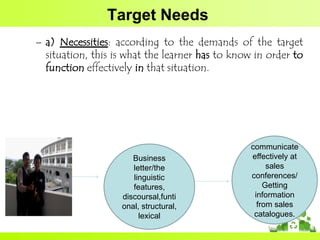
Target Needs
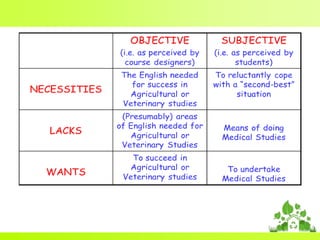
– a) Necessities: according to the demands of the target
situation, this is what the learner has to know in order to
function effectively in that situation.

Business
letter/the
linguistic
features,
discoursal,funti
onal, structural,
lexical

communicate
effectively at
sales
conferences/
Getting
information
from sales
catalogues.
– b) Lacks: according to what the learner already knows, we
decide what necessities are missing. There is a gap
between the existing proficiency and the target
proficiency.

– c) Wants: according to what we have considered from an
objective POV, we have to say that „a need does not exist
independent of a person.
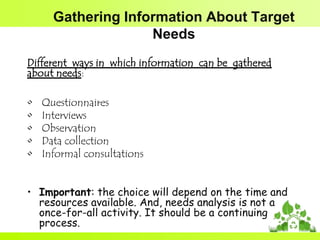
Gathering Information About Target
Needs
Different ways in which information can be gathered
about needs:
•
•
•
•
•

Questionnaires
Interviews
Observation
Data collection
Informal consultations

• Important: the choice will depend on the time and
resources available. And, needs analysis is not a
once-for-all activity. It should be a continuing
process.
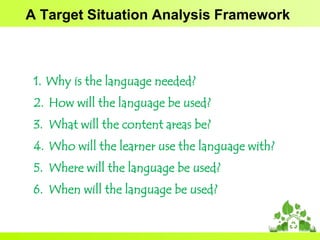
A Target Situation Analysis Framework

1. Why is the language needed?
2. How will the language be used?
3. What will the content areas be?
4. Who will the learner use the language with?
5. Where will the language be used?

6. When will the language be used?
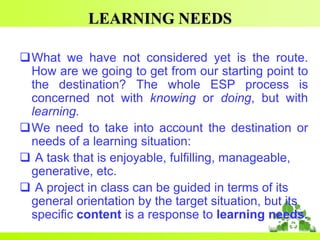
LEARNING NEEDS
What we have not considered yet is the route.
How are we going to get from our starting point to
the destination? The whole ESP process is
concerned not with knowing or doing, but with
learning.
We need to take into account the destination or
needs of a learning situation:
 A task that is enjoyable, fulfilling, manageable,
generative, etc.
 A project in class can be guided in terms of its
general orientation by the target situation, but its
specific content is a response to learning needs.
 For example, in a target situation students may need
to read long, dull, complex texts, but their motivation
may be high because:
1. They like the subject in general
2. Job/Promotion prospects may be involved
3. They will carry out interesting experiments or
practical work (based on
the texts)
4. They like and/or respect the teacher/boss.
ANALYSING LEARNING NEEDS
A framework for analysing learning
needs:
•
•
•
•
•
•

Why are the learners taking the course?
How do the learners learn?
What resources are available?
Who are the learners?
Where will the ESP course take place?
When will the ESP course take place?
Case Study
In a class, there is one ESP student who feels
bored when he is learning (not only in the class but
also out of the class). For example: when his
friends anthuciastic to speak and discuss, he stays
silent. As a teacher, could you make an order
based on the target needs from necessities, lacks
and wants to solve the problem?
Questions and Comments
Thank You

Esp Needs Analysis

  • 1.
    Group 5 1. WuwuhKanthi Rahayu (2080730106) 2. Dyah Mrih Lestari (2100730131) 3. Khosinol Asror (2100730150)
  • 2.
  • 3.
    • WHY DOLEARNERS NEED TO LEARN ENGLISH? • All courses are based on a perceived need of some sort. • WHAT IS THE DIFFERENCE BETWEEN ESP AND GE? • “In theory nothing, in practice a great deal”.
  • 4.
    GENERAL ENGLISH (GE) •GE learner’s needs are not specifiable. • This is the weakest of all arguments • It is always possible to specify needs • There is always an identifiable need of some sort.
  • 5.
  • 6.
    ANALYSIS FOR ESPAND GE: WHAT DO WE MEAN BY “NEEDS”? According to the language-centered approach: it is “the ability to comprehend and/or produce the linguistic features of the target situation.” Target needs: what the students needs to do in the target situation Learning needs: what the students needs to do in order to learn.
  • 7.
    Target Needs – a)Necessities: according to the demands of the target situation, this is what the learner has to know in order to function effectively in that situation. Business letter/the linguistic features, discoursal,funti onal, structural, lexical communicate effectively at sales conferences/ Getting information from sales catalogues.
  • 8.
    – b) Lacks:according to what the learner already knows, we decide what necessities are missing. There is a gap between the existing proficiency and the target proficiency. – c) Wants: according to what we have considered from an objective POV, we have to say that „a need does not exist independent of a person.
  • 10.
    Gathering Information AboutTarget Needs Different ways in which information can be gathered about needs: • • • • • Questionnaires Interviews Observation Data collection Informal consultations • Important: the choice will depend on the time and resources available. And, needs analysis is not a once-for-all activity. It should be a continuing process.
  • 11.
    A Target SituationAnalysis Framework 1. Why is the language needed? 2. How will the language be used? 3. What will the content areas be? 4. Who will the learner use the language with? 5. Where will the language be used? 6. When will the language be used?
  • 12.
    LEARNING NEEDS What wehave not considered yet is the route. How are we going to get from our starting point to the destination? The whole ESP process is concerned not with knowing or doing, but with learning. We need to take into account the destination or needs of a learning situation:  A task that is enjoyable, fulfilling, manageable, generative, etc.  A project in class can be guided in terms of its general orientation by the target situation, but its specific content is a response to learning needs.
  • 13.
     For example,in a target situation students may need to read long, dull, complex texts, but their motivation may be high because: 1. They like the subject in general 2. Job/Promotion prospects may be involved 3. They will carry out interesting experiments or practical work (based on the texts) 4. They like and/or respect the teacher/boss.
  • 14.
    ANALYSING LEARNING NEEDS Aframework for analysing learning needs: • • • • • • Why are the learners taking the course? How do the learners learn? What resources are available? Who are the learners? Where will the ESP course take place? When will the ESP course take place?
  • 15.
    Case Study In aclass, there is one ESP student who feels bored when he is learning (not only in the class but also out of the class). For example: when his friends anthuciastic to speak and discuss, he stays silent. As a teacher, could you make an order based on the target needs from necessities, lacks and wants to solve the problem?
  • 16.
  • 17.