1
Pharmaceutical Quality Management
GMP and cGMP
Considerations
By:
Dr. Fahad Pervaiz
2
Introduction:
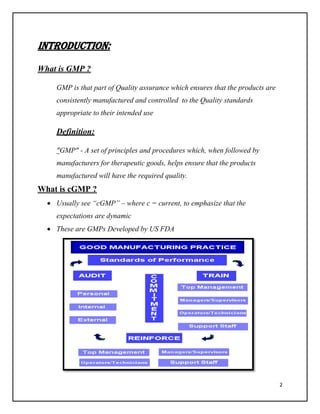
What is GMP ?
GMP is that part of Quality assurance which ensures that the products are
consistently manufactured and controlled to the Quality standards
appropriate to their intended use
Definition:
"GMP" - A set of principles and procedures which, when followed by
manufacturers for therapeutic goods, helps ensure that the products
manufactured will have the required quality.
What is cGMP ?
 Usually see “cGMP” – where c = current, to emphasize that the
expectations are dynamic
 These are GMPs Developed by US FDA
3
 Good Manufacturing Practices
 A basic tenet of GMP is that quality cannot be tested into a batch of product
but must be built into each batch of product during all stages of the
manufacturing process.
 It is designed to minimize the risks involved in any pharmaceutical
production that cannot be eliminated through testing the final product.
a. Some of the main risks are
 Unexpected contamination of products, causing damage to health or
even death.
 Incorrect labels on containers, which could mean that patients receive
the wrong medicine.
 Insufficient or too much active ingredient, resulting in ineffective
treatment or adverse effects.
b. GMP helps boost pharmaceutical export opportunities
 Most countries will only accept import and sale of medicines that
have been manufactured to internationally recognized GMP.
 Governments seeking to promote their countries export of
pharmaceuticals can do so by making GMP mandatory for all
pharmaceutical production and by training their inspectors in GMP
requirements.
c. GMP Covers…
 ALL aspects of production; from the starting materials, premises and
equipment to the training and personal hygiene of staff.
4
 Detailed, written procedures are essential for each process that could
affect the quality of the finished product.
 There must be systems to provide documented proof that correct
procedures are consistently followed at each step in the manufacturing
process - every time a product is made.
d. GMP guidelines
 cGMP as per US FDA
 www.fda.gov
 GMP as per WHO
 www.who.int
 GMP as per ICH guidelines
 www.ich.org
 GMP as per MCA now known as MHRA
 www.mca.gov.uk
 GMP as per TGA
 www.tga.gov.au
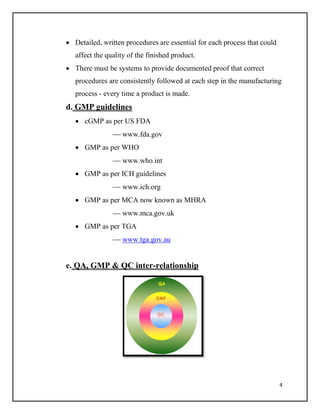
e. QA, GMP & QC inter-relationship
5
1. GMP
 GMP in solid dosage forms
 GMP in semisolid dosage forms
 GMP in Liquid orals
 GMP in Parenterals Production
 GMP in Ayurvedic medicines
 GMP in Bio technological products
 GMP in Nutraceuticals and cosmeceuticals
 GMP in Homeopathic medicines
 1.1. Ten Principles of GMP
1. Design and construct the facilities and equipments properly
2. Follow written procedures and Instructions
3. Document work
4. Validate work
5. Monitor facilities and equipment
6. Write step by step operating procedures and work on instructions
7. Design, develop and demonstrate job competence
8. Protect against contamination
9. Control components and product related processes
10.Conduct planned and periodic audits
 1.2. Beyond GMP
 Reduce pollution - Zero discharge
 Adaptation of environment friendly methods
 Consideration for better and healthier life tomorrow
6
 Consideration of ethics in life
 One should begin with end in mind otherwise it will be the
beginning of the end
 1.3. Cost of effective GMP
 In fact Cost benefits – positive cost benefits of GMP/QA
 Good plant lay out, Smooth work flows, Efficient documentation
systems, well controlled process, good stores lay outs and stores
records- These are Good manufacturing practices
 Reduction in work in process and inventory holding costs
 Avoidance of cost of Quality failure ( cost of waste, of rework, of
recall, of consumer compensation and of loss of company
reputation)
 1.4. List of important documents in GMP
i. Policies
ii. SOP
iii. Specifications
iv. MFR (Master Formula Record)
v. BMR
vi. Manuals
vii. Master plans/ files
viii. Validation protocols
ix. Forms and Formats
x. Records
7
 cGMP For Finished Pharmaceuticals
1. General Provision
2. Organization & Personnel
3. Building & Facilities
4. Equipment
5. Control of Components & Drug Product Containers & Closures
6. Production & Process Control
7. Packaging & Labeling Control
8. Handling & Distribution
9. Laboratory Control
10. Records & Reports
11. Returned & Salvaged Drugs
ORGANIZATION & PERSONNEL
 Responsibilities of quality control unit.
 Personnel qualifications.
 Personnel responsibilities.
 Consultants.
BUILDING & FACILITIES
1. Design and construction features.
2. Lighting.
3. Ventilation, air filtration, air heating and cooling.
4. Plumbing.
5. Sewage and refuse.
6. Washing and toilet facilities.
8
7. Sanitation.
8. Maintenance
FLOORING
CEILING
9
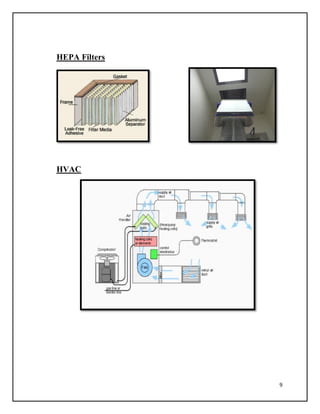
HEPA Filters
HVAC
10
Plumbing
Sewage
Sanitation
11
EQUIPMENT
1. Equipment design, size, and location.
2. Equipment construction.
3. Equipment cleaning and maintenance.
4. Automatic, mechanical, and electronic equipment.
5. Filters.
CONTROL OF COMPONENTS & DRUG PRODUCT
CONTAINERS & CLOSURES
1. General requirements.
2. Receipt & storage of untested components, drug product containers, and
closures.
3. Testing and approval or rejection of components, drug product
containers, and closures.
4. Use of approved components, drug product containers, and closures.
5. Retesting of approved components, drug product containers, and
closures.
6. Rejected components, drug product containers, and closures.
7. Drug product containers and closures.
12
PRODUCTION & PROCESS CONTROL
1. Written procedures; deviations.
2. Charge-in of components.
3. Calculation of yield.
4. Equipment identification.
5. Sampling and testing of in-process materials and drug products.
6. Time limitations on production.
7. Control of microbiological contamination.
8. Reprocessing.
PACKAGING & LABELING CONTROL
1. Materials examination and usage criteria.
2. Labeling issuance.
3. Packaging and labeling operations.
4. Tamper-evident packaging requirements for over-the-counter (OTC)
human drug products.
5. Drug product inspection.
6. Expiration dating.
HANDLING & DISTRIBUTION
1. Warehousing procedures.
2. Distribution procedures.
13
LABORATORY CONTROL
1. General requirements.
2. Testing and release for distribution.
3. Stability testing.
4. Special testing requirements.
5. Reserve samples.
6. Laboratory animals.
7. Penicillin contamination.
RECORDS & REPORTS
1. General requirements.
2. Equipment cleaning and use log.
3. Component, drug product container, closure, and labeling records.
4. Master production and control records.
5. Batch production and control records.
6. Production record review.
7. Laboratory records.
8. Distribution records.
9. Complaint files.
RETURNED & SALVAGED DRUG PRODUCTS
1. Returned drug products.
2. Drug product salvaging.

GMP CGMP .pdf

  • 1.
    1 Pharmaceutical Quality Management GMPand cGMP Considerations By: Dr. Fahad Pervaiz
  • 2.
    2 Introduction: What is GMP? GMP is that part of Quality assurance which ensures that the products are consistently manufactured and controlled to the Quality standards appropriate to their intended use Definition: "GMP" - A set of principles and procedures which, when followed by manufacturers for therapeutic goods, helps ensure that the products manufactured will have the required quality. What is cGMP ?  Usually see “cGMP” – where c = current, to emphasize that the expectations are dynamic  These are GMPs Developed by US FDA
  • 3.
    3  Good ManufacturingPractices  A basic tenet of GMP is that quality cannot be tested into a batch of product but must be built into each batch of product during all stages of the manufacturing process.  It is designed to minimize the risks involved in any pharmaceutical production that cannot be eliminated through testing the final product. a. Some of the main risks are  Unexpected contamination of products, causing damage to health or even death.  Incorrect labels on containers, which could mean that patients receive the wrong medicine.  Insufficient or too much active ingredient, resulting in ineffective treatment or adverse effects. b. GMP helps boost pharmaceutical export opportunities  Most countries will only accept import and sale of medicines that have been manufactured to internationally recognized GMP.  Governments seeking to promote their countries export of pharmaceuticals can do so by making GMP mandatory for all pharmaceutical production and by training their inspectors in GMP requirements. c. GMP Covers…  ALL aspects of production; from the starting materials, premises and equipment to the training and personal hygiene of staff.
  • 4.
    4  Detailed, writtenprocedures are essential for each process that could affect the quality of the finished product.  There must be systems to provide documented proof that correct procedures are consistently followed at each step in the manufacturing process - every time a product is made. d. GMP guidelines  cGMP as per US FDA  www.fda.gov  GMP as per WHO  www.who.int  GMP as per ICH guidelines  www.ich.org  GMP as per MCA now known as MHRA  www.mca.gov.uk  GMP as per TGA  www.tga.gov.au e. QA, GMP & QC inter-relationship
  • 5.
    5 1. GMP  GMPin solid dosage forms  GMP in semisolid dosage forms  GMP in Liquid orals  GMP in Parenterals Production  GMP in Ayurvedic medicines  GMP in Bio technological products  GMP in Nutraceuticals and cosmeceuticals  GMP in Homeopathic medicines  1.1. Ten Principles of GMP 1. Design and construct the facilities and equipments properly 2. Follow written procedures and Instructions 3. Document work 4. Validate work 5. Monitor facilities and equipment 6. Write step by step operating procedures and work on instructions 7. Design, develop and demonstrate job competence 8. Protect against contamination 9. Control components and product related processes 10.Conduct planned and periodic audits  1.2. Beyond GMP  Reduce pollution - Zero discharge  Adaptation of environment friendly methods  Consideration for better and healthier life tomorrow
  • 6.
    6  Consideration ofethics in life  One should begin with end in mind otherwise it will be the beginning of the end  1.3. Cost of effective GMP  In fact Cost benefits – positive cost benefits of GMP/QA  Good plant lay out, Smooth work flows, Efficient documentation systems, well controlled process, good stores lay outs and stores records- These are Good manufacturing practices  Reduction in work in process and inventory holding costs  Avoidance of cost of Quality failure ( cost of waste, of rework, of recall, of consumer compensation and of loss of company reputation)  1.4. List of important documents in GMP i. Policies ii. SOP iii. Specifications iv. MFR (Master Formula Record) v. BMR vi. Manuals vii. Master plans/ files viii. Validation protocols ix. Forms and Formats x. Records
  • 7.
    7  cGMP ForFinished Pharmaceuticals 1. General Provision 2. Organization & Personnel 3. Building & Facilities 4. Equipment 5. Control of Components & Drug Product Containers & Closures 6. Production & Process Control 7. Packaging & Labeling Control 8. Handling & Distribution 9. Laboratory Control 10. Records & Reports 11. Returned & Salvaged Drugs ORGANIZATION & PERSONNEL  Responsibilities of quality control unit.  Personnel qualifications.  Personnel responsibilities.  Consultants. BUILDING & FACILITIES 1. Design and construction features. 2. Lighting. 3. Ventilation, air filtration, air heating and cooling. 4. Plumbing. 5. Sewage and refuse. 6. Washing and toilet facilities.
  • 8.
  • 9.
  • 10.
  • 11.
    11 EQUIPMENT 1. Equipment design,size, and location. 2. Equipment construction. 3. Equipment cleaning and maintenance. 4. Automatic, mechanical, and electronic equipment. 5. Filters. CONTROL OF COMPONENTS & DRUG PRODUCT CONTAINERS & CLOSURES 1. General requirements. 2. Receipt & storage of untested components, drug product containers, and closures. 3. Testing and approval or rejection of components, drug product containers, and closures. 4. Use of approved components, drug product containers, and closures. 5. Retesting of approved components, drug product containers, and closures. 6. Rejected components, drug product containers, and closures. 7. Drug product containers and closures.
  • 12.
    12 PRODUCTION & PROCESSCONTROL 1. Written procedures; deviations. 2. Charge-in of components. 3. Calculation of yield. 4. Equipment identification. 5. Sampling and testing of in-process materials and drug products. 6. Time limitations on production. 7. Control of microbiological contamination. 8. Reprocessing. PACKAGING & LABELING CONTROL 1. Materials examination and usage criteria. 2. Labeling issuance. 3. Packaging and labeling operations. 4. Tamper-evident packaging requirements for over-the-counter (OTC) human drug products. 5. Drug product inspection. 6. Expiration dating. HANDLING & DISTRIBUTION 1. Warehousing procedures. 2. Distribution procedures.
  • 13.
    13 LABORATORY CONTROL 1. Generalrequirements. 2. Testing and release for distribution. 3. Stability testing. 4. Special testing requirements. 5. Reserve samples. 6. Laboratory animals. 7. Penicillin contamination. RECORDS & REPORTS 1. General requirements. 2. Equipment cleaning and use log. 3. Component, drug product container, closure, and labeling records. 4. Master production and control records. 5. Batch production and control records. 6. Production record review. 7. Laboratory records. 8. Distribution records. 9. Complaint files. RETURNED & SALVAGED DRUG PRODUCTS 1. Returned drug products. 2. Drug product salvaging.