GOOD MANUFACTURING
PRACTICES FOR
PHARMACEUTICALS
1
CONTENTS
•
•
•
•
•
•
•
•
•
•
•
•
•
•
•
•
•
Current GMP in manufacturing processes
Packaging and holding of drugs
Finished pharmaceuticals
General provisions
Organization and personnel
Building and facilities
Equipment
Control of components
Containers and closures
Production and process control
Packaging and labeling control
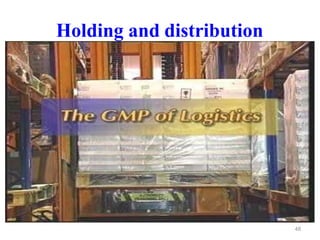
Holding and distribution
Records and reports
Returned savaged drug products
The inspection for compliance with GMP regulations
Controlled substances safeguards
References
2
Introduction
3
What is GMP ?
(Good Manufacturing Practices)
• GMP is that part of Quality assurance which ensures
that the products are consistently manufactured and
controlled to the Quality standards appropriate to
their intended use
• A set of principles and procedures which, when
followed by manufacturers for therapeutic goods,
helps ensure that the products manufacture will have
the required quality.
4
Good Manufacturing Practices
• A basic tenet of GMP is that quality cannot be
tested into a batch of product but must be built
into each batch of product during all stages of
the manufacturing process.
• It is designed to minimize the risks involved in
any pharmaceutical production that cannot be
eliminated through testing the final product.
5
Some of the main risks are
– Unexpected contamination of products, causing
damage to health or even death.
– Incorrect labels on containers, which could mean
that patients receive the wrong medicine.
– Insufficient or too much active ingredient,
resulting in ineffective treatment or adverse
effects.
6
Why GMP is important
• A poor quality medicine may contain toxic
substances that have been unintentionally added.
• A medicine that contains little or none of the
claimed ingredient will not have the intended
therapeutic effect.
7
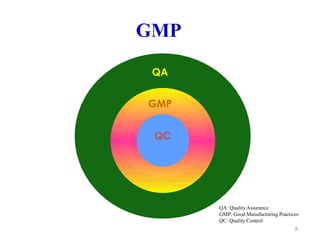
QA
GMP
QC
GMP
QA: Quality Assurance
GMP: Good Manufacturing Practices
QC: Quality Control
8
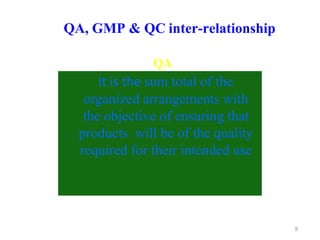
QA, GMP & QC inter-relationship
QA
It is the sum total of the
organized arrangements with
the objective of ensuring that
products will be of the quality
required for their intended use
9
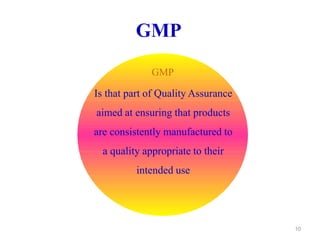
GMP
Is that part of Quality Assurance
aimed at ensuring that products
are consistently manufactured to
a quality appropriate to their
intended use
GMP
10
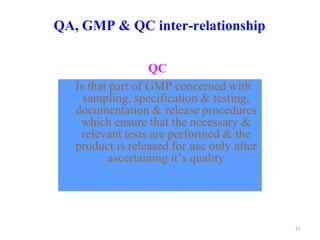
QA, GMP & QC inter-relationship
QC
Is that part of GMP concerned with
sampling, specification & testing,
documentation & release procedures
which ensure that the necessary &
relevant tests are performed & the
product is released for use only after
ascertaining it’s quality
11
QC and QA
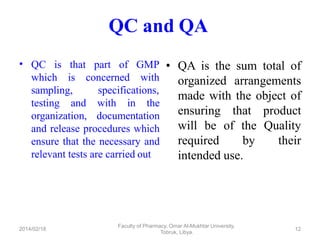
• QC is
which
that part of GMP
is concerned with
sampling, specifications,
testing and with in the
organization, documentation
and release procedures which
ensure that the necessary and
relevant tests are carried out
• QA is the sum total of
organized arrangements
made with the object of
ensuring that product
will be of the Quality
required by their
intended use.
Faculty of Pharmacy, Omar Al-Mukhtar University,
Tobruk, Libya.
2014/02/18 12
QC and QA
used to fulfill the
requirement of Quality
• Operational laboratory • All
techniques and activities
those planned or
actions
to provide
systematic
necessary
adequate confidence
that a product will
satisfy the requirements
for quality
13
QC and QA
• QC is lab based • QA is company based
14
GMP
• The Quality of a formulation or a bulk drug
depends on the Quality of those producing it
• GMP is the magic key that opens the door of
the Quality
• In matter of GMP, swim with the current and
in matter of Quality stand like a rock!
15
GMP helps boost pharmaceutical
export opportunities
• Most countries will only accept import and
sale of medicines that have been manufactured
to internationally recognized GMP.
• Governments seeking to promote their
countries export of pharmaceuticals can do so
by making GMP mandatory for all
pharmaceutical production and by training
their inspectors in GMP requirements.
16
GMP Covers…
• All aspects of production; from the starting materials,
premises and equipment to the training and personal
hygiene of staff.
• Detailed, written procedures are essential for each
process that could affect the quality of the finished
product.
• There must be systems to provide documented proof
that correct procedures are consistently followed at
each step in the manufacturing process - every time a
product is made.
17
GMP guidelines
• GMP as per Schedule “M”
• GMP as per WHO
• GMP as per MCA now known as MHRA
• GMP as per TGA
• GMP as per US FDA
• GMP as per ICH guidelines
WHO: World Health Organization
MHRA: Ministry of Health and Regulatory Affairs
TGA: Therapeutic Goods Affairs
FDA: Food And Drug Administration
ICH: International Conference on Harmonization
18
GMP guidelines
• GMP as per Schedule “M”
www.cdsco.nic.in
GMP as per WHO
www.who.int
GMP as per MCA now known as MHRA
www.mca.gov.uk
GMP as per TGA
www.tga.gov.au
GMP as per US FDA
www.fda.gov
GMP as per ICH guidelines
www.ich.org
•
•
•
•
•
19
GMP
• GMP in solid dosage forms
• GMP in semisolid dosage forms
• GMP in Liquid orals
• GMP in Parenterals Production
• GMP in Ayurvedic medicines
• GMP in Bio technological products
• GMP in Nutraceuticals and cosmeceuticals
20
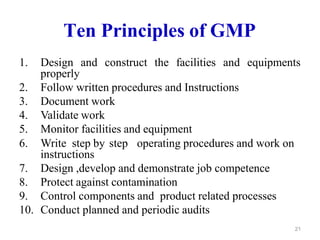
Ten Principles of GMP
1. Design and construct the facilities and equipments
properly
2. Follow written procedures and Instructions
3. Document work
4. Validate work
5. Monitor facilities and equipment
6. Write step by step operating procedures and work on
instructions
7. Design ,develop and demonstrate job competence
8. Protect against contamination
9. Control components and product related processes
10. Conduct planned and periodic audits
21
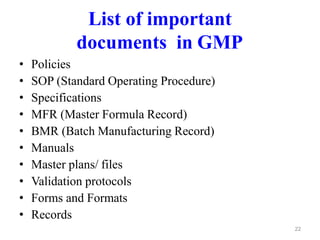
List of important
documents in GMP
• Policies
• SOP (Standard Operating Procedure)
• Specifications
• MFR (Master Formula Record)
• BMR (Batch Manufacturing Record)
• Manuals
• Master plans/ files
• Validation protocols
• Forms and Formats
• Records
22
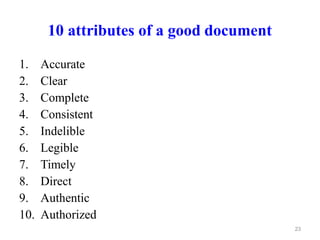
10 attributes of a good document
1. Accurate
2. Clear
3. Complete
4. Consistent
5. Indelible
6. Legible
7. Timely
8. Direct
9. Authentic
10. Authorized
23
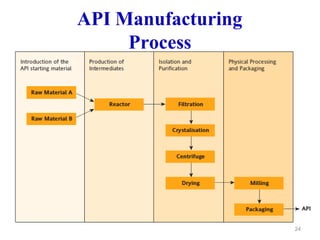
API Manufacturing
Process
24
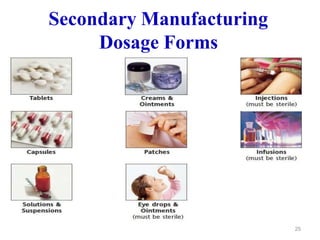
Secondary Manufacturing
Dosage Forms
25
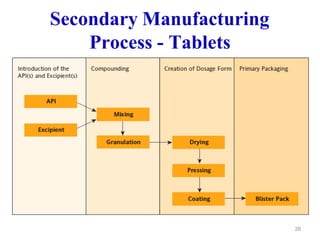
Secondary Manufacturing
Process - Tablets
26
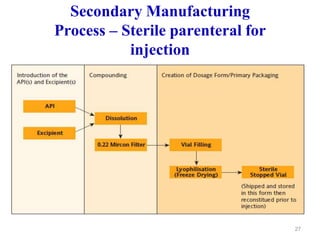
Secondary Manufacturing
Process – Sterile parenteral for
injection
27
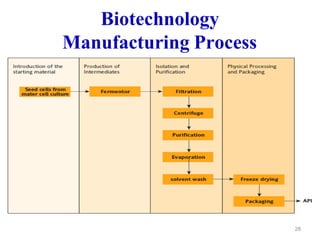
Biotechnology
Manufacturing Process
28
Current GMP in manufacturing
processes (cGMP)
29
What are cGMPs?
• cGMP refers to the Current Good Manufacturing
Practice regulations enforced by the US Food and
Drug Administration (FDA).
• cGMP provide for systems that assure proper design,
monitoring and control of manufacturing processes
and facilities.
• Adherence to the cGMP regulations assures the
identity, strength, quality and purity of drug products
by requiring that manufacturers of medications
adequately control manufacturing operations
30
Why are cGMP so important
• A consumer usually cannot detect (through smell,
touch, or sight) that a drug product is safe or if it will
work.
• While cGMPs require testing, testing alone is not
adequate to ensure quality.
• In most instances testing is done on a small sample of
a batch (for example, a drug manufacturer may test
1000 tablets from a batch that contains 2 million
tablets), so that most of the batch can be used for
patients rather than destroyed by testing.
31
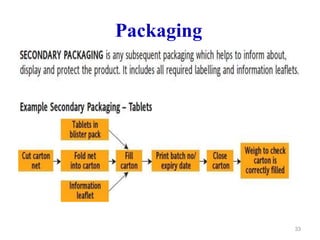
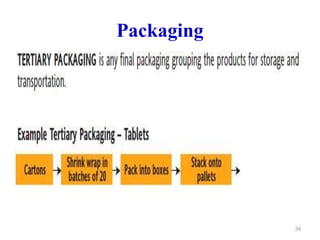
Packaging
32
Packaging
33
Packaging
34
Packaging and holding of
drugs
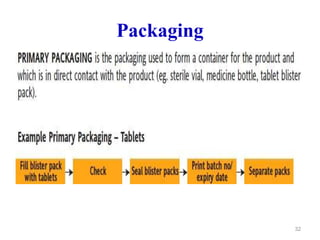
• Care shall be taken when using automatic
tablet and capsule counting, strip and blister
packaging equipment to ensure that all ‘rogue’
tablets, capsules or foils from packaging
operation are removed before a new packaging
operation is commenced.
• There shall be an independent recorded check
of the equipment before a new batch of tablets
or capsules is handled.
35
Finished pharmaceuticals
Appropriate specifications for finished products
shall include: -
• The designated name of the product and the code
reference.
• The formula or a reference to the formula and the
pharmacopoeial reference.
• Directions for sampling and testing or a reference
to procedures.
36
General provisions
• The processing of dry materials and products
creates problems of dust control and cross-
contamination. Special attention is therefore,
needed in the design, maintenance and use of
premises and equipment in order to overcome
these problems. Wherever required, enclosed
dust control manufacturing systems shall be
employed.
37
Organization and personnel
1. Responsibilities of quality control unit.
2. Personnel qualifications.
3. Personnel responsibilities.
4. Consultants.
38
Building and facilities
1. Design and construction features.
2. Lighting.
3. Ventilation, air filtration, air heating and
cooling.
4. Plumbing.
5. Sewage and refuse.
6. Washing and toilet facilities.
7. Sanitation.
8. Maintenance.
39
Equipment
1. Equipment design, size, and location.
2. Equipment construction.
3. Equipment cleaning and maintenance.
4. Automatic, mechanical, and electronic
equipment.
5. Filters.
40
Control of components
1. General requirements.
2. Receipt & storage of untested components, drug
product containers and closures.
3. Testing and approval or rejection of components,
drug product containers and closures.
4. Use of approved components, drug product
containers, and closures.
5. Retesting of approved components, drug product
containers, and closures.
6. Rejected components, drug product containers, and
closures.
7. Drug product containers and closures.
41
Containers and closures
• All containers and closures intended for use shall
comply with the pharmacopoeial requirements.
Suitable validated test methods, sample sizes,
specifications, cleaning procedure and
sterilization procedure, wherever indicated, shall
be strictly followed to ensure that these are not
reactive, additive, absorptive, or leach to an extent
that significantly affects the quality or purity of
the drug. No second hand or used containers and
closures shall be used.
Faculty of Pharmacy, Omar Al-Mukhtar University,
Tobruk, Libya.
2014/02/18 42
Production and process
control
1. Written procedures; deviations.
2. Charge-in of components.
3. Calculation of yield.
4. Equipment identification.
5. Sampling and testing of in-process materials
and drug products.
6. Time limitations on production.
7. Control of microbiological contamination.
8. Reprocessing.
43
Packaging and labeling
control
1. Materials examination and usage criteria.
2. Labeling issuance.
3. Packaging and labeling operations.
4. Tamper-evident packaging requirements for
over-the-counter (OTC) human drug
products.
5. Drug product inspection.
6. Expiration dating.
44
Packaging and labeling
control
45
Holding and distribution
1. Warehousing procedures.
2. Distribution procedures.
Faculty of Pharmacy, Omar Al-Mukhtar University,
Tobruk, Libya.
2014/02/18 46
Holding and distribution
• Prior to distribution or dispatch of given batch of a drug, it
shall be ensure that the batch has been duly tested, approved
and released by the quality control personnel. Pre-dispatch
inspection shall be performed on each consignment on a
random basis to ensure that only the correct goods are
dispatched. Detailed instructions for warehousing and stocking
of Large Volume Parenterals, if stocked, shall be in existence
and shall be complied with after the batch is released for
distribution. Periodic audits of warehousing practices followed
at distribution centers shall be carried out and records thereof
shall be maintained. Standard Operating Procedures shall be
developed for warehousing of products.
47
Holding and distribution
48
Records and reports
1. General requirements.
2. Equipment cleaning and use log.
3. Component, drug product container, closure, and
labeling records.
4. Master production and control records.
5. Batch production and control records.
6. Production record review.
7. Laboratory records.
8. Distribution records.
9. Complaint files.
49
Returned savaged drug
products
1. Returned drug products.
2. Drug product salvaging.
50
Returned savaged drug
products
• Adequate areas shall be designed to allow
sufficient and orderly warehousing of returned
or recalled products.
• Segregation shall be provided for the storage
of rejected, recalled or returned materials or
products.
51
The inspection for compliance
with GMP regulations
• Short description of the self inspection system
indicating whether an outside, independent
and experienced external export was involved
in evaluating the manufacturer’s compliance
with Good manufacturing Practices in all
aspects of production.
• Periodic inspection of the garments shall be
done by responsible staff.
52
Controlled substances
safeguards
• Hazardous, toxic substances and flammable materials
shall be stored in suitably designed and segregated,
enclosed areas in conformity with Central and State
Legislations.
• Highly hazardous, poisonous and explosive materials
such as narcotics, psychotropic drugs and substances
presenting potential risks of abuse, fire or explosion
shall be stored in safe and secure areas. Adequate fire
protection measures shall be provided in conformity
with the rules of the concerned civic authority.
53
References
• EU Good Manufacturing Practice (GMP)
Guidelines, Volume 4 of “The rules governing
medicinal products in the European Union”
• US FDA
Practice
current Good Manufacturing
(cGMP) for finished
pharmaceuticals, 21 CFR, 210 and 211
• WHO Good Manufacturing Practices for
pharmaceutical products, Annex 4 to WHO
Technical Report Series, No. 908, 2003
54
55

Good Manufacture Practices Pharmaceutical technology

  • 1.
  • 2.
    CONTENTS • • • • • • • • • • • • • • • • • Current GMP inmanufacturing processes Packaging and holding of drugs Finished pharmaceuticals General provisions Organization and personnel Building and facilities Equipment Control of components Containers and closures Production and process control Packaging and labeling control Holding and distribution Records and reports Returned savaged drug products The inspection for compliance with GMP regulations Controlled substances safeguards References 2
  • 3.
  • 4.
    What is GMP? (Good Manufacturing Practices) • GMP is that part of Quality assurance which ensures that the products are consistently manufactured and controlled to the Quality standards appropriate to their intended use • A set of principles and procedures which, when followed by manufacturers for therapeutic goods, helps ensure that the products manufacture will have the required quality. 4
  • 5.
    Good Manufacturing Practices •A basic tenet of GMP is that quality cannot be tested into a batch of product but must be built into each batch of product during all stages of the manufacturing process. • It is designed to minimize the risks involved in any pharmaceutical production that cannot be eliminated through testing the final product. 5
  • 6.
    Some of themain risks are – Unexpected contamination of products, causing damage to health or even death. – Incorrect labels on containers, which could mean that patients receive the wrong medicine. – Insufficient or too much active ingredient, resulting in ineffective treatment or adverse effects. 6
  • 7.
    Why GMP isimportant • A poor quality medicine may contain toxic substances that have been unintentionally added. • A medicine that contains little or none of the claimed ingredient will not have the intended therapeutic effect. 7
  • 8.
    QA GMP QC GMP QA: Quality Assurance GMP:Good Manufacturing Practices QC: Quality Control 8
  • 9.
    QA, GMP &QC inter-relationship QA It is the sum total of the organized arrangements with the objective of ensuring that products will be of the quality required for their intended use 9
  • 10.
    GMP Is that partof Quality Assurance aimed at ensuring that products are consistently manufactured to a quality appropriate to their intended use GMP 10
  • 11.
    QA, GMP &QC inter-relationship QC Is that part of GMP concerned with sampling, specification & testing, documentation & release procedures which ensure that the necessary & relevant tests are performed & the product is released for use only after ascertaining it’s quality 11
  • 12.
    QC and QA •QC is which that part of GMP is concerned with sampling, specifications, testing and with in the organization, documentation and release procedures which ensure that the necessary and relevant tests are carried out • QA is the sum total of organized arrangements made with the object of ensuring that product will be of the Quality required by their intended use. Faculty of Pharmacy, Omar Al-Mukhtar University, Tobruk, Libya. 2014/02/18 12
  • 13.
    QC and QA usedto fulfill the requirement of Quality • Operational laboratory • All techniques and activities those planned or actions to provide systematic necessary adequate confidence that a product will satisfy the requirements for quality 13
  • 14.
    QC and QA •QC is lab based • QA is company based 14
  • 15.
    GMP • The Qualityof a formulation or a bulk drug depends on the Quality of those producing it • GMP is the magic key that opens the door of the Quality • In matter of GMP, swim with the current and in matter of Quality stand like a rock! 15
  • 16.
    GMP helps boostpharmaceutical export opportunities • Most countries will only accept import and sale of medicines that have been manufactured to internationally recognized GMP. • Governments seeking to promote their countries export of pharmaceuticals can do so by making GMP mandatory for all pharmaceutical production and by training their inspectors in GMP requirements. 16
  • 17.
    GMP Covers… • Allaspects of production; from the starting materials, premises and equipment to the training and personal hygiene of staff. • Detailed, written procedures are essential for each process that could affect the quality of the finished product. • There must be systems to provide documented proof that correct procedures are consistently followed at each step in the manufacturing process - every time a product is made. 17
  • 18.
    GMP guidelines • GMPas per Schedule “M” • GMP as per WHO • GMP as per MCA now known as MHRA • GMP as per TGA • GMP as per US FDA • GMP as per ICH guidelines WHO: World Health Organization MHRA: Ministry of Health and Regulatory Affairs TGA: Therapeutic Goods Affairs FDA: Food And Drug Administration ICH: International Conference on Harmonization 18
  • 19.
    GMP guidelines • GMPas per Schedule “M” www.cdsco.nic.in GMP as per WHO www.who.int GMP as per MCA now known as MHRA www.mca.gov.uk GMP as per TGA www.tga.gov.au GMP as per US FDA www.fda.gov GMP as per ICH guidelines www.ich.org • • • • • 19
  • 20.
    GMP • GMP insolid dosage forms • GMP in semisolid dosage forms • GMP in Liquid orals • GMP in Parenterals Production • GMP in Ayurvedic medicines • GMP in Bio technological products • GMP in Nutraceuticals and cosmeceuticals 20
  • 21.
    Ten Principles ofGMP 1. Design and construct the facilities and equipments properly 2. Follow written procedures and Instructions 3. Document work 4. Validate work 5. Monitor facilities and equipment 6. Write step by step operating procedures and work on instructions 7. Design ,develop and demonstrate job competence 8. Protect against contamination 9. Control components and product related processes 10. Conduct planned and periodic audits 21
  • 22.
    List of important documentsin GMP • Policies • SOP (Standard Operating Procedure) • Specifications • MFR (Master Formula Record) • BMR (Batch Manufacturing Record) • Manuals • Master plans/ files • Validation protocols • Forms and Formats • Records 22
  • 23.
    10 attributes ofa good document 1. Accurate 2. Clear 3. Complete 4. Consistent 5. Indelible 6. Legible 7. Timely 8. Direct 9. Authentic 10. Authorized 23
  • 24.
  • 25.
  • 26.
  • 27.
    Secondary Manufacturing Process –Sterile parenteral for injection 27
  • 28.
  • 29.
    Current GMP inmanufacturing processes (cGMP) 29
  • 30.
    What are cGMPs? •cGMP refers to the Current Good Manufacturing Practice regulations enforced by the US Food and Drug Administration (FDA). • cGMP provide for systems that assure proper design, monitoring and control of manufacturing processes and facilities. • Adherence to the cGMP regulations assures the identity, strength, quality and purity of drug products by requiring that manufacturers of medications adequately control manufacturing operations 30
  • 31.
    Why are cGMPso important • A consumer usually cannot detect (through smell, touch, or sight) that a drug product is safe or if it will work. • While cGMPs require testing, testing alone is not adequate to ensure quality. • In most instances testing is done on a small sample of a batch (for example, a drug manufacturer may test 1000 tablets from a batch that contains 2 million tablets), so that most of the batch can be used for patients rather than destroyed by testing. 31
  • 32.
  • 33.
  • 34.
  • 35.
    Packaging and holdingof drugs • Care shall be taken when using automatic tablet and capsule counting, strip and blister packaging equipment to ensure that all ‘rogue’ tablets, capsules or foils from packaging operation are removed before a new packaging operation is commenced. • There shall be an independent recorded check of the equipment before a new batch of tablets or capsules is handled. 35
  • 36.
    Finished pharmaceuticals Appropriate specificationsfor finished products shall include: - • The designated name of the product and the code reference. • The formula or a reference to the formula and the pharmacopoeial reference. • Directions for sampling and testing or a reference to procedures. 36
  • 37.
    General provisions • Theprocessing of dry materials and products creates problems of dust control and cross- contamination. Special attention is therefore, needed in the design, maintenance and use of premises and equipment in order to overcome these problems. Wherever required, enclosed dust control manufacturing systems shall be employed. 37
  • 38.
    Organization and personnel 1.Responsibilities of quality control unit. 2. Personnel qualifications. 3. Personnel responsibilities. 4. Consultants. 38
  • 39.
    Building and facilities 1.Design and construction features. 2. Lighting. 3. Ventilation, air filtration, air heating and cooling. 4. Plumbing. 5. Sewage and refuse. 6. Washing and toilet facilities. 7. Sanitation. 8. Maintenance. 39
  • 40.
    Equipment 1. Equipment design,size, and location. 2. Equipment construction. 3. Equipment cleaning and maintenance. 4. Automatic, mechanical, and electronic equipment. 5. Filters. 40
  • 41.
    Control of components 1.General requirements. 2. Receipt & storage of untested components, drug product containers and closures. 3. Testing and approval or rejection of components, drug product containers and closures. 4. Use of approved components, drug product containers, and closures. 5. Retesting of approved components, drug product containers, and closures. 6. Rejected components, drug product containers, and closures. 7. Drug product containers and closures. 41
  • 42.
    Containers and closures •All containers and closures intended for use shall comply with the pharmacopoeial requirements. Suitable validated test methods, sample sizes, specifications, cleaning procedure and sterilization procedure, wherever indicated, shall be strictly followed to ensure that these are not reactive, additive, absorptive, or leach to an extent that significantly affects the quality or purity of the drug. No second hand or used containers and closures shall be used. Faculty of Pharmacy, Omar Al-Mukhtar University, Tobruk, Libya. 2014/02/18 42
  • 43.
    Production and process control 1.Written procedures; deviations. 2. Charge-in of components. 3. Calculation of yield. 4. Equipment identification. 5. Sampling and testing of in-process materials and drug products. 6. Time limitations on production. 7. Control of microbiological contamination. 8. Reprocessing. 43
  • 44.
    Packaging and labeling control 1.Materials examination and usage criteria. 2. Labeling issuance. 3. Packaging and labeling operations. 4. Tamper-evident packaging requirements for over-the-counter (OTC) human drug products. 5. Drug product inspection. 6. Expiration dating. 44
  • 45.
  • 46.
    Holding and distribution 1.Warehousing procedures. 2. Distribution procedures. Faculty of Pharmacy, Omar Al-Mukhtar University, Tobruk, Libya. 2014/02/18 46
  • 47.
    Holding and distribution •Prior to distribution or dispatch of given batch of a drug, it shall be ensure that the batch has been duly tested, approved and released by the quality control personnel. Pre-dispatch inspection shall be performed on each consignment on a random basis to ensure that only the correct goods are dispatched. Detailed instructions for warehousing and stocking of Large Volume Parenterals, if stocked, shall be in existence and shall be complied with after the batch is released for distribution. Periodic audits of warehousing practices followed at distribution centers shall be carried out and records thereof shall be maintained. Standard Operating Procedures shall be developed for warehousing of products. 47
  • 48.
  • 49.
    Records and reports 1.General requirements. 2. Equipment cleaning and use log. 3. Component, drug product container, closure, and labeling records. 4. Master production and control records. 5. Batch production and control records. 6. Production record review. 7. Laboratory records. 8. Distribution records. 9. Complaint files. 49
  • 50.
    Returned savaged drug products 1.Returned drug products. 2. Drug product salvaging. 50
  • 51.
    Returned savaged drug products •Adequate areas shall be designed to allow sufficient and orderly warehousing of returned or recalled products. • Segregation shall be provided for the storage of rejected, recalled or returned materials or products. 51
  • 52.
    The inspection forcompliance with GMP regulations • Short description of the self inspection system indicating whether an outside, independent and experienced external export was involved in evaluating the manufacturer’s compliance with Good manufacturing Practices in all aspects of production. • Periodic inspection of the garments shall be done by responsible staff. 52
  • 53.
    Controlled substances safeguards • Hazardous,toxic substances and flammable materials shall be stored in suitably designed and segregated, enclosed areas in conformity with Central and State Legislations. • Highly hazardous, poisonous and explosive materials such as narcotics, psychotropic drugs and substances presenting potential risks of abuse, fire or explosion shall be stored in safe and secure areas. Adequate fire protection measures shall be provided in conformity with the rules of the concerned civic authority. 53
  • 54.
    References • EU GoodManufacturing Practice (GMP) Guidelines, Volume 4 of “The rules governing medicinal products in the European Union” • US FDA Practice current Good Manufacturing (cGMP) for finished pharmaceuticals, 21 CFR, 210 and 211 • WHO Good Manufacturing Practices for pharmaceutical products, Annex 4 to WHO Technical Report Series, No. 908, 2003 54
  • 55.