Program: Pharm-D 4th
Semester: II (2019-20)
Course: Bio-Statistics
Course code: PHAR-03428
Class Teacher: DR. LIAQUAT AHMAD
email: liaquatahmad@uvas.edu.pk
Lecture # 34
Statistical Inference
The process of drawing inferences about a
population on the basis of information contained
in a sample taken from the population is called
Statistical Inference.
Areas of Statistical Inference
1. Estimation of Parameters
2. Testing of Hypothesis
Estimation
Estimation is procedure by which we obtain an
estimate of the true but unknown value of a
population parameter by using the sample
information from the population.
Categories of Estimation
1. Point estimates
2. Interval estimates
Testing of Hypothesis
Testing of Hypothesis is a procedure which
enables us to decide on the basis of information
obtained by the sampling whether to accept or
reject any specified statement or hypothesis
regarding the value of the parameter in a
statistical problem.
1. Point estimates
• Point estimation of a population parameter
provides as an estimate of a single value
calculated from the sample that is likely to be
close in value to the unknown parameter.
• It is to be noted that a Point estimate will not
in general be equal to the population parameter
as the random sample used is one of the many
possible samples which could be chosen from
the population.
Properties of a Good Estimator
1. Unbiasedness
2. Consistency
3. Efficiency
4. Sufficiency
Interval estimation
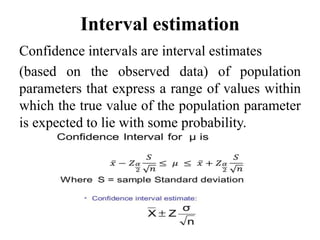
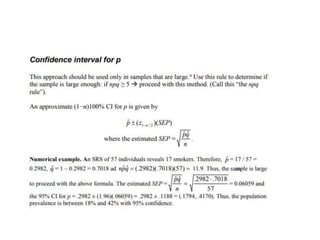
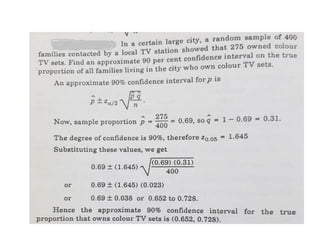
Confidence intervals are interval estimates
(based on the observed data) of population
parameters that express a range of values within
which the true value of the population parameter
is expected to lie with some probability.
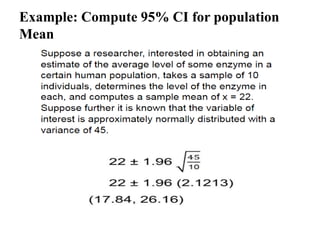
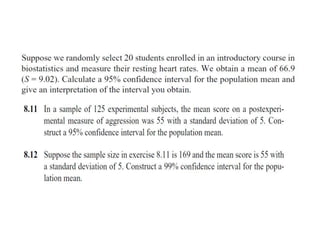
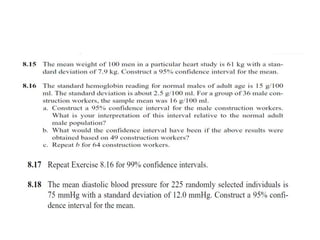
Example: Compute 95% CI for population
Mean
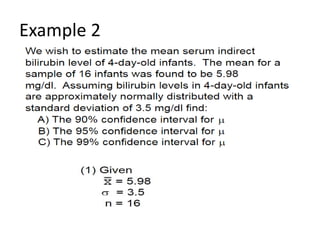
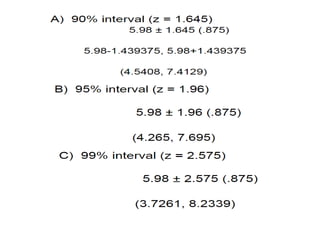
Example 2
Confidence Interval Estimation detail.pptx

Confidence Interval Estimation detail.pptx

  • 1.
    Program: Pharm-D 4th Semester:II (2019-20) Course: Bio-Statistics Course code: PHAR-03428 Class Teacher: DR. LIAQUAT AHMAD email: liaquatahmad@uvas.edu.pk Lecture # 34
  • 2.
    Statistical Inference The processof drawing inferences about a population on the basis of information contained in a sample taken from the population is called Statistical Inference. Areas of Statistical Inference 1. Estimation of Parameters 2. Testing of Hypothesis
  • 3.
    Estimation Estimation is procedureby which we obtain an estimate of the true but unknown value of a population parameter by using the sample information from the population. Categories of Estimation 1. Point estimates 2. Interval estimates
  • 4.
    Testing of Hypothesis Testingof Hypothesis is a procedure which enables us to decide on the basis of information obtained by the sampling whether to accept or reject any specified statement or hypothesis regarding the value of the parameter in a statistical problem.
  • 5.
    1. Point estimates •Point estimation of a population parameter provides as an estimate of a single value calculated from the sample that is likely to be close in value to the unknown parameter. • It is to be noted that a Point estimate will not in general be equal to the population parameter as the random sample used is one of the many possible samples which could be chosen from the population.
  • 6.
    Properties of aGood Estimator 1. Unbiasedness 2. Consistency 3. Efficiency 4. Sufficiency
  • 7.
    Interval estimation Confidence intervalsare interval estimates (based on the observed data) of population parameters that express a range of values within which the true value of the population parameter is expected to lie with some probability.
  • 9.
    Example: Compute 95%CI for population Mean
  • 10.