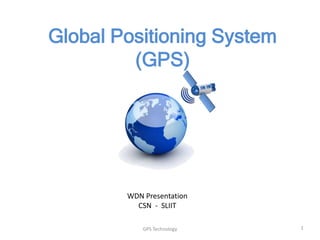
Global Positioning System
(GPS)

WDN Presentation
CSN - SLIIT
GPS Technology

1
Team Members
1. Sachin Thishnika
2. Kusal Indika
3. Vidusha Rathnayaka
4. Nadeendra Yashaswin
5. Janaka Poddalgoda (Absent)
GPS Technology

2
Content
1. Introduction

2. What is GPS ?
3. How GPS Works

4. Applications of GPS
5. Drawbacks of GPS
6. Future Development
GPS Technology

3
Introduction
Navigation in early days
 North Star
 Compass
 LORAN & Decca Navigator

GPS project
 Developed under Department of Defense

GPS is not alone
GPS Technology

4
What is GPS ?
Global Navigation Satellite System (GNSS)
Provide
 Position
 Timing
 Navigation

Three segments
 Space
 Control
 User
GPS Technology

5
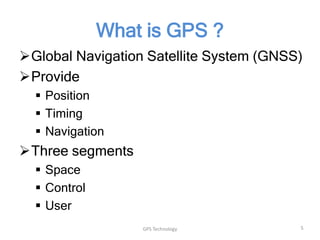
What is GPS ? Cont.
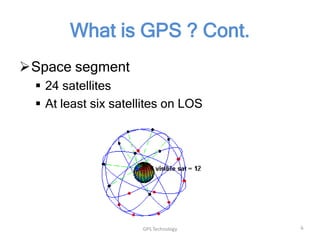
Space segment
 24 satellites
 At least six satellites on LOS

GPS Technology

6
What is GPS ? Cont.
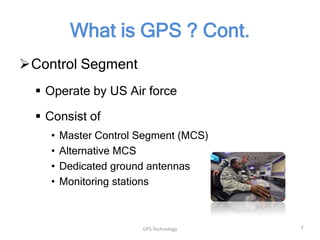
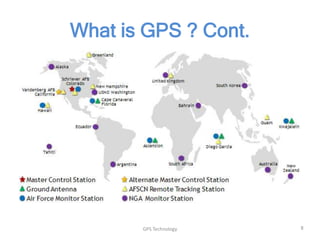
Control Segment
 Operate by US Air force
 Consist of
•
•
•
•

Master Control Segment (MCS)
Alternative MCS
Dedicated ground antennas
Monitoring stations

GPS Technology

7
What is GPS ? Cont.

GPS Technology

8
What is GPS ? Cont.
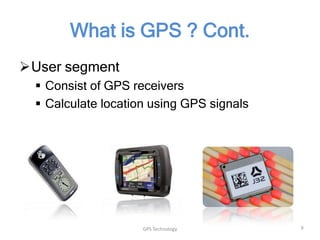
User segment
 Consist of GPS receivers
 Calculate location using GPS signals

GPS Technology

9
How GPS Works
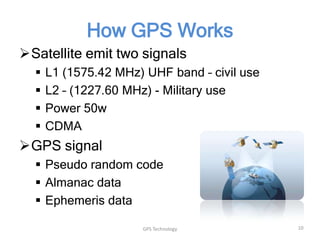
Satellite emit two signals





L1 (1575.42 MHz) UHF band – civil use
L2 – (1227.60 MHz) - Military use
Power 50w
CDMA

GPS signal
 Pseudo random code
 Almanac data
 Ephemeris data
GPS Technology

10
How GPS Works
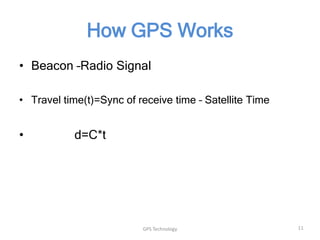
• Beacon –Radio Signal
• Travel time(t)=Sync of receive time – Satellite Time

•

d=C*t

GPS Technology

11
How GPS Works Cont.
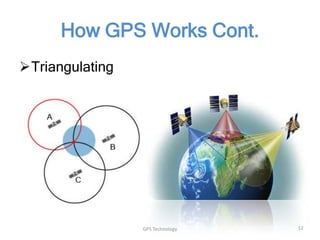
Triangulating

GPS Technology

12
Applications of GPS
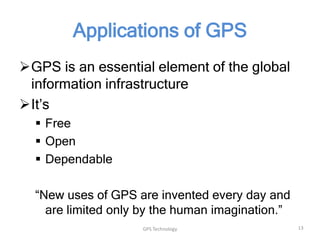
GPS is an essential element of the global
information infrastructure
It’s
 Free
 Open
 Dependable

“New uses of GPS are invented every day and
are limited only by the human imagination.”
GPS Technology

13
Applications of GPS cont.
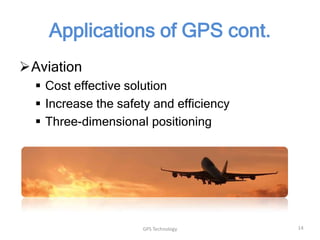
Aviation
 Cost effective solution
 Increase the safety and efficiency
 Three-dimensional positioning

GPS Technology

14
Applications of GPS cont.
Space
 Navigation solutions
 Altitude solutions
 Timing solutions & etc.

GPS Technology

15
Applications of GPS cont.
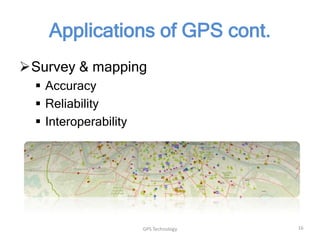
Survey & mapping
 Accuracy
 Reliability
 Interoperability

GPS Technology

16
Applications of GPS cont.
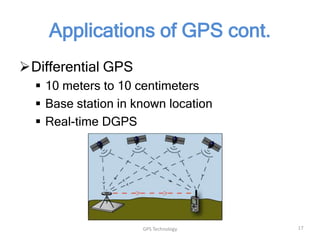
Differential GPS
 10 meters to 10 centimeters
 Base station in known location
 Real-time DGPS

GPS Technology

17
Drawbacks of GPS
Signal multipath
Atmospheric effect
No GPS signals in
 Indoor
 Under water
 Under ground

Attacks
GPS Technology

18
Future Development
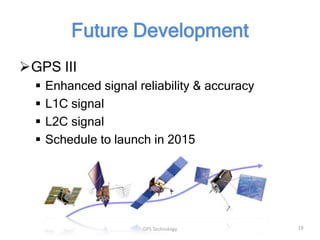
GPS III





Enhanced signal reliability & accuracy
L1C signal
L2C signal
Schedule to launch in 2015

GPS Technology

19
Future Development Cont.
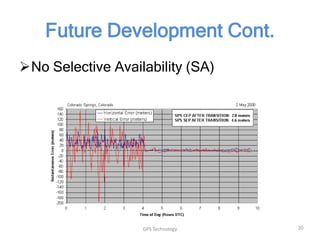
No Selective Availability (SA)

GPS Technology

20
Future Development Cont.
L5 “safety-of-life” signal
 Two times powerful as L2C
 Focus on aviation & transportation
 Resistant to jamming & interference

High gain directional antenna
 100 times more powerful than wide angle
antenna
 M-coded military signal
GPS Technology

21
Future Development Cont.
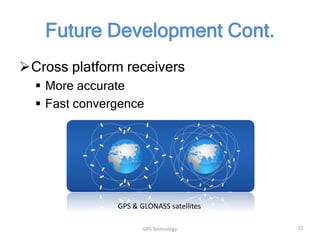
Cross platform receivers
 More accurate
 Fast convergence

GPS & GLONASS satellites
GPS Technology

22
GPS Technology

23
GPS Technology

24

Global Positioning System (GPS)

  • 1.
    Global Positioning System (GPS) WDNPresentation CSN - SLIIT GPS Technology 1
  • 2.
    Team Members 1. SachinThishnika 2. Kusal Indika 3. Vidusha Rathnayaka 4. Nadeendra Yashaswin 5. Janaka Poddalgoda (Absent) GPS Technology 2
  • 3.
    Content 1. Introduction 2. Whatis GPS ? 3. How GPS Works 4. Applications of GPS 5. Drawbacks of GPS 6. Future Development GPS Technology 3
  • 4.
    Introduction Navigation in earlydays  North Star  Compass  LORAN & Decca Navigator GPS project  Developed under Department of Defense GPS is not alone GPS Technology 4
  • 5.
    What is GPS? Global Navigation Satellite System (GNSS) Provide  Position  Timing  Navigation Three segments  Space  Control  User GPS Technology 5
  • 6.
    What is GPS? Cont. Space segment  24 satellites  At least six satellites on LOS GPS Technology 6
  • 7.
    What is GPS? Cont. Control Segment  Operate by US Air force  Consist of • • • • Master Control Segment (MCS) Alternative MCS Dedicated ground antennas Monitoring stations GPS Technology 7
  • 8.
    What is GPS? Cont. GPS Technology 8
  • 9.
    What is GPS? Cont. User segment  Consist of GPS receivers  Calculate location using GPS signals GPS Technology 9
  • 10.
    How GPS Works Satelliteemit two signals     L1 (1575.42 MHz) UHF band – civil use L2 – (1227.60 MHz) - Military use Power 50w CDMA GPS signal  Pseudo random code  Almanac data  Ephemeris data GPS Technology 10
  • 11.
    How GPS Works •Beacon –Radio Signal • Travel time(t)=Sync of receive time – Satellite Time • d=C*t GPS Technology 11
  • 12.
    How GPS WorksCont. Triangulating GPS Technology 12
  • 13.
    Applications of GPS GPSis an essential element of the global information infrastructure It’s  Free  Open  Dependable “New uses of GPS are invented every day and are limited only by the human imagination.” GPS Technology 13
  • 14.
    Applications of GPScont. Aviation  Cost effective solution  Increase the safety and efficiency  Three-dimensional positioning GPS Technology 14
  • 15.
    Applications of GPScont. Space  Navigation solutions  Altitude solutions  Timing solutions & etc. GPS Technology 15
  • 16.
    Applications of GPScont. Survey & mapping  Accuracy  Reliability  Interoperability GPS Technology 16
  • 17.
    Applications of GPScont. Differential GPS  10 meters to 10 centimeters  Base station in known location  Real-time DGPS GPS Technology 17
  • 18.
    Drawbacks of GPS Signalmultipath Atmospheric effect No GPS signals in  Indoor  Under water  Under ground Attacks GPS Technology 18
  • 19.
    Future Development GPS III     Enhancedsignal reliability & accuracy L1C signal L2C signal Schedule to launch in 2015 GPS Technology 19
  • 20.
    Future Development Cont. NoSelective Availability (SA) GPS Technology 20
  • 21.
    Future Development Cont. L5“safety-of-life” signal  Two times powerful as L2C  Focus on aviation & transportation  Resistant to jamming & interference High gain directional antenna  100 times more powerful than wide angle antenna  M-coded military signal GPS Technology 21
  • 22.
    Future Development Cont. Crossplatform receivers  More accurate  Fast convergence GPS & GLONASS satellites GPS Technology 22
  • 23.
  • 24.

Editor's Notes

  • #5 http://www.slideshare.net/maggiearya/gps-20816234 - slide 5,6LORAN & Deca - ground-based radio-navigation systems, such as LORAN and the Decca Navigator, developed in the early 1940s and used by the British Royal Navy during World War II.The GPS project was developed in 1973 to overcome the limitations of previous navigation systems. It became fully operational in 1995. intended to military use later became publically available In addition to GPS, other systems are in use or under development. The Russian Global Navigation Satellite System (GLONASS)  There are also the planned European Union Galileo positioning system, Chinese Compass navigation system.
  • #7 http://www.gps.gov/systems/gps/space/The GPS space segment consists of a constellation of satellites transmitting radio signals to users.GPS satellites fly in medium Earth orbit (MEO) at an altitude of approximately 20,200 km. Each satellite circles the Earth twice a dayhttp://en.wikipedia.org/wiki/Global_Positioning_System#Space_segmentAs of December 2012,[65] there are 32 satellites in the GPS constellation.
  • #8 http://www.gps.gov/systems/gps/control/
  • #10 http://en.wikipedia.org/wiki/Global_Positioning_System#User_segment
  • #11 http://www.pocketgpsworld.com/howgpsworks.php
  • #13 http://en.wikipedia.org/wiki/Global_Positioning_System#Navigation_equationshttp://www.trimble.com/gps_tutorial/howgps-triangulating.aspxhttp://www.youtube.com/watch?v=PLjld-edVj8
  • #14 http://www.gps.gov/applications/
  • #15 http://www.gps.gov/applications/aviation/
  • #17 http://www.gps.gov/applications/survey/
  • #19 Attack – jmming sig. or altering iran capture US drone
  • #22 http://www.webmapsolutions.com/future-developments-gps-technology