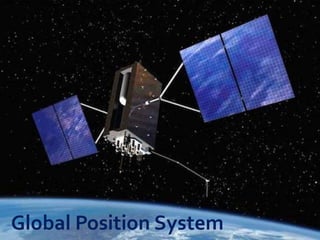
Global Position System
 What is GPS..?
 History of GPS
 GPS Elements
 Working of GPS
 GPS Signals and Frequencies
 GPS Applications
 Sources of Signal Errors
 Limitations
 Methods of improving accuracy
 Future of GPS
 Conclusions
Objectives of Discussion
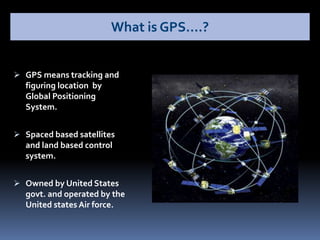
 GPS means tracking and
figuring location by
Global Positioning
System.
 Spaced based satellites
and land based control
system.
 Owned by United States
govt. and operated by the
United states Air force.
What is GPS….?
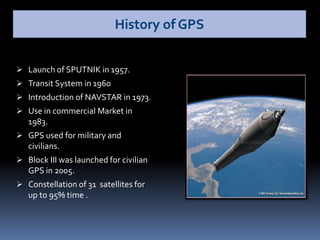
 Launch of SPUTNIK in 1957.
 Transit System in 1960
 Introduction of NAVSTAR in 1973.
 Use in commercial Market in
1983.
 GPS used for military and
civilians.
 Block III was launched for civilian
GPS in 2005.
 Constellation of 31 satellites for
up to 95% time .
History of GPS
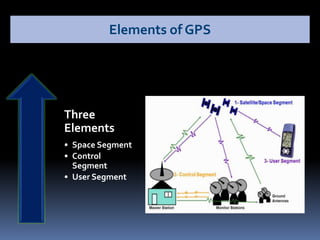
Three
Elements
• Space Segment
• Control
Segment
• User Segment
Elements of GPS
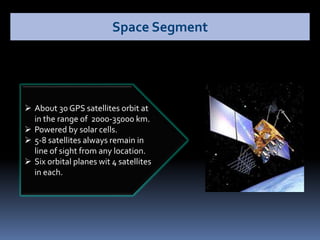
 About 30 GPS satellites orbit at
in the range of 2000-35000 km.
 Powered by solar cells.
 5-8 satellites always remain in
line of sight from any location.
 Six orbital planes wit 4 satellites
in each.
Space Segment
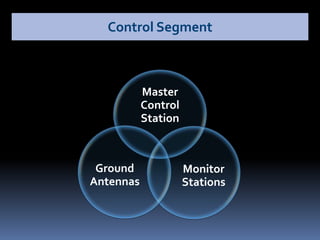
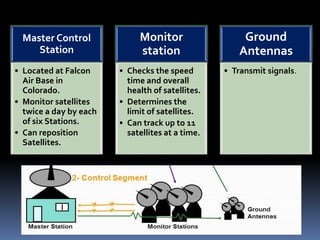
Master
Control
Station
Monitor
Stations
Ground
Antennas
Control Segment
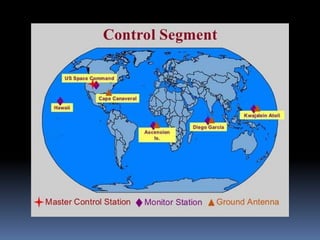
Master Control
Station
• Located at Falcon
Air Base in
Colorado.
• Monitor satellites
twice a day by each
of six Stations.
• Can reposition
Satellites.
Monitor
station
• Checks the speed
time and overall
health of satellites.
• Determines the
limit of satellites.
• Can track up to 11
satellites at a time.
Ground
Antennas
• Transmit signals.
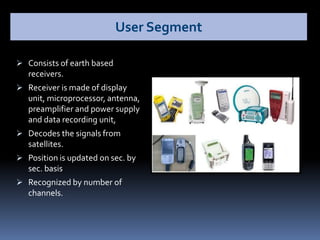
 Consists of earth based
receivers.
 Receiver is made of display
unit, microprocessor, antenna,
preamplifier and power supply
and data recording unit,
 Decodes the signals from
satellites.
 Position is updated on sec. by
sec. basis
 Recognized by number of
channels.
User Segment
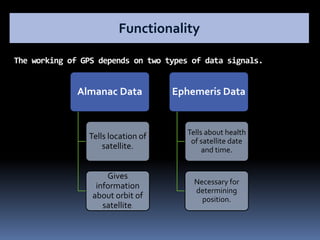
Almanac Data
Tells location of
satellite.
Gives
information
about orbit of
satellite.
Ephemeris Data
Tells about health
of satellite date
and time.
Necessary for
determining
position.
The working of GPS depends on two types of data signals.
Functionality
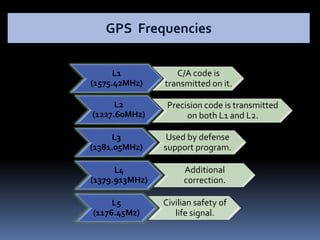
L1
(1575.42MHz)
C/A code is
transmitted on it.
L2
(1227.60MHz)
Precision code is transmitted
on both L1 and L2.
L3
(1381.05MHz)
Used by defense
support program.
L4
(1379.913MHz)
Additional
correction.
L5
(1176.45Mz)
Civilian safety of
life signal.
GPS Frequencies
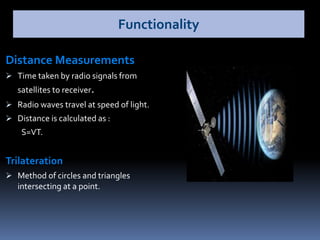
Distance Measurements
 Time taken by radio signals from
satellites to receiver.
 Radio waves travel at speed of light.
 Distance is calculated as :
S=VT.
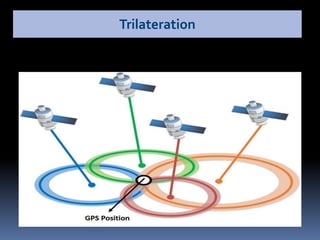
Trilateration
 Method of circles and triangles
intersecting at a point.
Functionality
Trilateration
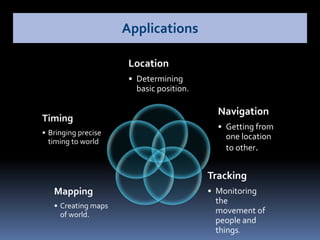
Location
• Determining
basic position.
Navigation
• Getting from
one location
to other.
Tracking
• Monitoring
the
movement of
people and
things.
Mapping
• Creating maps
of world.
Timing
• Bringing precise
timing to world
Applications
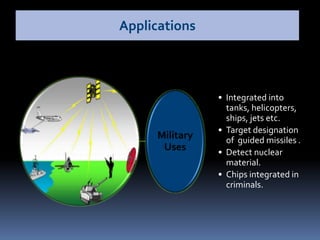
Military
Uses
• Integrated into
tanks, helicopters,
ships, jets etc.
• Target designation
of guided missiles .
• Detect nuclear
material.
• Chips integrated in
criminals.
Applications
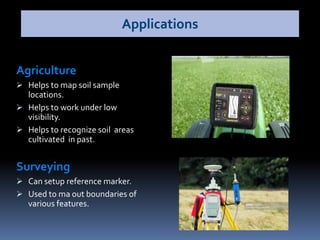
Agriculture
 Helps to map soil sample
locations.
 Helps to work under low
visibility.
 Helps to recognize soil areas
cultivated in past.
Surveying
 Can setup reference marker.
 Used to ma out boundaries of
various features.
Applications
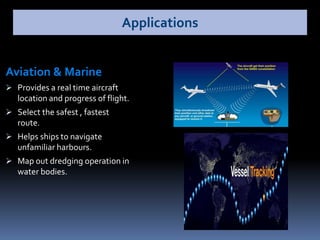
Aviation & Marine
 Provides a real time aircraft
location and progress of flight.
 Select the safest , fastest
route.
 Helps ships to navigate
unfamiliar harbours.
 Map out dredging operation in
water bodies.
Applications
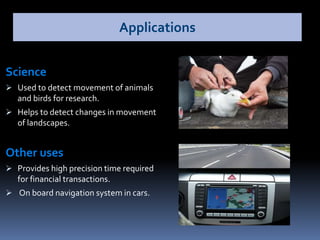
Science
 Used to detect movement of animals
and birds for research.
 Helps to detect changes in movement
of landscapes.
Other uses
 Provides high precision time required
for financial transactions.
 On board navigation system in cars.
Applications
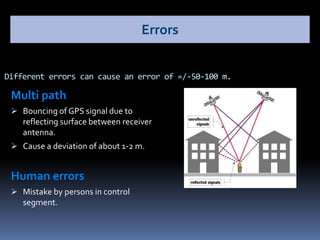
Multi path
 Bouncing of GPS signal due to
reflecting surface between receiver
antenna.
 Cause a deviation of about 1-2 m.
Human errors
 Mistake by persons in control
segment.
Different errors can cause an error of =/-50-100 m.
Errors
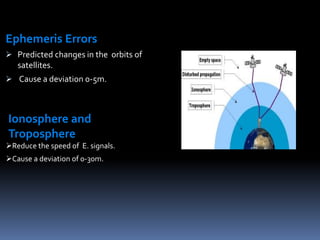
Ephemeris Errors
 Predicted changes in the orbits of
satellites.
 Cause a deviation 0-5m.
Ionosphere and
Troposphere
Reduce the speed of E. signals.
Cause a deviation of 0-30m.
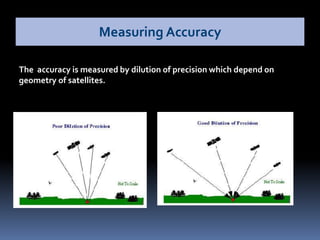
The accuracy is measured by dilution of precision which depend on
geometry of satellites.
Measuring Accuracy
 Establish protocols for your
applications.
 Use two frequencies to
improve precision.
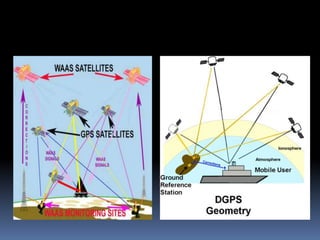
 Use DGPS andWAAS.
Methods of improving accuracy
 Very costly and required professional
experience.
 Requires4-5 satellites to give accurate
locations.
 Cannot trace out any object if receiver
is switched off or facing power failure
 Cannot be retraced if kept under highly
insulation.
 Have no Backups.
Drawback
 Will reduce human effort .
 Driver less cars will be introduced.
 Agricultural systems and air traffic will be
made self driven.
 Will have a ground based backup.
Risks
 Threats of solar interference ,equipped radio
signal spectrum and jamming are present.
 Any one can block .
Future of GPS
 Had made convenient the transport and
navigation facilities.
 Helps to Monitor persons for smooth and
reliable working.
 Have improved agricultural and other
systems.
CONCLUSIONS
GPS World wide navigation and tracking system

GPS World wide navigation and tracking system

  • 2.
  • 3.
     What isGPS..?  History of GPS  GPS Elements  Working of GPS  GPS Signals and Frequencies  GPS Applications  Sources of Signal Errors  Limitations  Methods of improving accuracy  Future of GPS  Conclusions Objectives of Discussion
  • 4.
     GPS meanstracking and figuring location by Global Positioning System.  Spaced based satellites and land based control system.  Owned by United States govt. and operated by the United states Air force. What is GPS….?
  • 5.
     Launch ofSPUTNIK in 1957.  Transit System in 1960  Introduction of NAVSTAR in 1973.  Use in commercial Market in 1983.  GPS used for military and civilians.  Block III was launched for civilian GPS in 2005.  Constellation of 31 satellites for up to 95% time . History of GPS
  • 6.
    Three Elements • Space Segment •Control Segment • User Segment Elements of GPS
  • 7.
     About 30GPS satellites orbit at in the range of 2000-35000 km.  Powered by solar cells.  5-8 satellites always remain in line of sight from any location.  Six orbital planes wit 4 satellites in each. Space Segment
  • 8.
  • 10.
    Master Control Station • Locatedat Falcon Air Base in Colorado. • Monitor satellites twice a day by each of six Stations. • Can reposition Satellites. Monitor station • Checks the speed time and overall health of satellites. • Determines the limit of satellites. • Can track up to 11 satellites at a time. Ground Antennas • Transmit signals.
  • 11.
     Consists ofearth based receivers.  Receiver is made of display unit, microprocessor, antenna, preamplifier and power supply and data recording unit,  Decodes the signals from satellites.  Position is updated on sec. by sec. basis  Recognized by number of channels. User Segment
  • 12.
    Almanac Data Tells locationof satellite. Gives information about orbit of satellite. Ephemeris Data Tells about health of satellite date and time. Necessary for determining position. The working of GPS depends on two types of data signals. Functionality
  • 13.
    L1 (1575.42MHz) C/A code is transmittedon it. L2 (1227.60MHz) Precision code is transmitted on both L1 and L2. L3 (1381.05MHz) Used by defense support program. L4 (1379.913MHz) Additional correction. L5 (1176.45Mz) Civilian safety of life signal. GPS Frequencies
  • 14.
    Distance Measurements  Timetaken by radio signals from satellites to receiver.  Radio waves travel at speed of light.  Distance is calculated as : S=VT. Trilateration  Method of circles and triangles intersecting at a point. Functionality
  • 15.
  • 16.
    Location • Determining basic position. Navigation •Getting from one location to other. Tracking • Monitoring the movement of people and things. Mapping • Creating maps of world. Timing • Bringing precise timing to world Applications
  • 17.
    Military Uses • Integrated into tanks,helicopters, ships, jets etc. • Target designation of guided missiles . • Detect nuclear material. • Chips integrated in criminals. Applications
  • 18.
    Agriculture  Helps tomap soil sample locations.  Helps to work under low visibility.  Helps to recognize soil areas cultivated in past. Surveying  Can setup reference marker.  Used to ma out boundaries of various features. Applications
  • 19.
    Aviation & Marine Provides a real time aircraft location and progress of flight.  Select the safest , fastest route.  Helps ships to navigate unfamiliar harbours.  Map out dredging operation in water bodies. Applications
  • 20.
    Science  Used todetect movement of animals and birds for research.  Helps to detect changes in movement of landscapes. Other uses  Provides high precision time required for financial transactions.  On board navigation system in cars. Applications
  • 21.
    Multi path  Bouncingof GPS signal due to reflecting surface between receiver antenna.  Cause a deviation of about 1-2 m. Human errors  Mistake by persons in control segment. Different errors can cause an error of =/-50-100 m. Errors
  • 22.
    Ephemeris Errors  Predictedchanges in the orbits of satellites.  Cause a deviation 0-5m. Ionosphere and Troposphere Reduce the speed of E. signals. Cause a deviation of 0-30m.
  • 23.
    The accuracy ismeasured by dilution of precision which depend on geometry of satellites. Measuring Accuracy
  • 24.
     Establish protocolsfor your applications.  Use two frequencies to improve precision.  Use DGPS andWAAS. Methods of improving accuracy
  • 25.
     Very costlyand required professional experience.  Requires4-5 satellites to give accurate locations.  Cannot trace out any object if receiver is switched off or facing power failure  Cannot be retraced if kept under highly insulation.  Have no Backups. Drawback
  • 27.
     Will reducehuman effort .  Driver less cars will be introduced.  Agricultural systems and air traffic will be made self driven.  Will have a ground based backup. Risks  Threats of solar interference ,equipped radio signal spectrum and jamming are present.  Any one can block . Future of GPS
  • 28.
     Had madeconvenient the transport and navigation facilities.  Helps to Monitor persons for smooth and reliable working.  Have improved agricultural and other systems. CONCLUSIONS