Introduction to the
Global Positioning System
An AAPT/PTRA Workshop
Fred Nelson
Manhattan High School
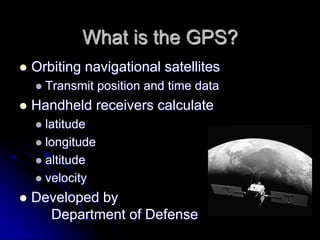
What is the GPS?
 Orbiting navigational satellites
 Transmit position and time data
 Handheld receivers calculate
 latitude
 longitude
 altitude
 velocity
 Developed by
Department of Defense
History of the GPS
 1969—Defense Navigation Satellite
System (DNSS) formed
 1973—NAVSTAR Global Positioning
System developed
 1978—first 4 satellites
launched
Delta rocket launch
History of the GPS
 1993—24th satellite
launched; initial
operational capability
 1995—full operational
capability
 May 2000—Military
accuracy available to
all users
Components of the System
Space segment
 24 satellite vehicles
 Six orbital planes
 Inclined 55o with respect to
equator
 Orbits separated by 60o
 20,200 km elevation above
Earth
 Orbital period of 11 hr 55
min
 Five to eight satellites
visible from any point on
Earth
Block I Satellite Vehicle
The GPS Constellation
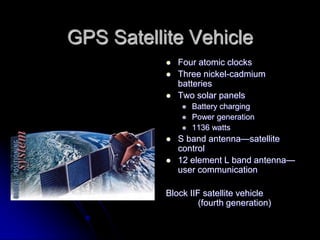
GPS Satellite Vehicle
 Four atomic clocks
 Three nickel-cadmium
batteries
 Two solar panels
 Battery charging
 Power generation
 1136 watts
 S band antenna—satellite
control
 12 element L band antenna—
user communication
Block IIF satellite vehicle
(fourth generation)
GPS Satellite Vehicle
 Weight
 2370 pounds
 Height
 16.25 feet
 Width
 38.025 feet including
wing span
 Design life—10 years
Block IIR satellite vehicle
assembly at Lockheed
Martin, Valley Forge, PA
Components of the System
User segment
 GPS antennas & receiver/processors
 Position
 Velocity
 Precise timing
 Used by
 Aircraft
 Ground vehicles
 Ships
 Individuals
Components of the System
Ground control segment
 Master control station
 Schreiver AFB, Colorado
 Five monitor stations
 Three ground antennas
 Backup control system
GPS Communication and Control
GPS Ground Control Stations
How does GPS work?
 Satellite ranging
 Satellite locations
 Satellite to user distance
 Need four satellites to determine position
 Distance measurement
 Radio signal traveling at speed of light
 Measure time from satellite to user
 Low-tech simulation
How does GPS work?
Pseudo-Random Code
 Complex signal
 Unique to each
satellite
 All satellites use
same frequency
 “Amplified” by
information theory
 Economical
How does GPS work?
 Distance to a satellite is determined by measuring how
long a radio signal takes to reach us from that satellite.
 To make the measurement we assume that both the
satellite and our receiver are generating the same
pseudo-random codes at exactly the same time.
 By comparing how late the satellite's pseudo-random
code appears compared to our receiver's code, we
determine how long it took to reach us.
 Multiply that travel time by the speed of light and you've
got distance.
 High-tech simulation
How does GPS work?
 Accurate timing is the key to measuring
distance to satellites.
 Satellites are accurate because they have
four atomic clocks ($100,000 each) on
board.
 Receiver clocks don't have to be too
accurate because an extra satellite range
measurement can remove errors.
How does GPS work?
 To use the satellites as references for range
measurements we need to know exactly where they are.
 GPS satellites are so high up their orbits are very
predictable.
 All GPS receivers have an almanac programmed into
their computers that tells them where in the sky each
satellite is, moment by moment.
 Minor variations in their orbits are measured by the
Department of Defense.
 The error information is sent to the satellites, to be
transmitted along with the timing signals.
GPS Position Determination
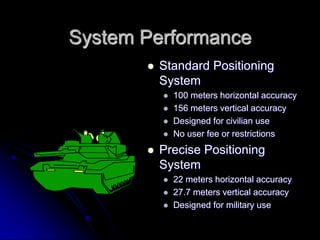
System Performance
 Standard Positioning
System
 100 meters horizontal accuracy
 156 meters vertical accuracy
 Designed for civilian use
 No user fee or restrictions
 Precise Positioning
System
 22 meters horizontal accuracy
 27.7 meters vertical accuracy
 Designed for military use
System Performance
Selective availability
 Intentional degradation of signal
 Controls availability of system’s full capabilities
 Set to zero May 2000
 Reasons
 Enhanced 911 service
 Car navigation
 Adoption of GPS time standard
 Recreation
System Performance
 The earth's ionosphere and atmosphere
cause delays in the GPS signal that
translate into position errors.
 Some errors can be factored out using
mathematics and modeling.
 The configuration of the satellites in the
sky can magnify other errors.
 Differential GPS can reduce errors.
Application of GPS Technology
 Location - determining a basic position
 Navigation - getting from one location to
another
 Tracking - monitoring the movement of
people and things
 Mapping - creating maps of the world
 Timing - bringing precise timing to the
world
Application of GPS Technology
 Private and recreation
 Traveling by car
 Hiking, climbing, biking
 Vehicle control
 Mapping, survey, geology
 English Channel Tunnel
 Agriculture
 Aviation
 General and commercial
 Spacecraft
 Maritime
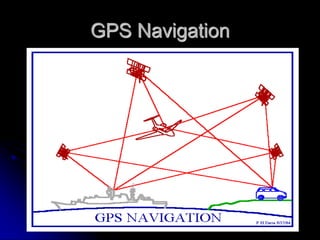
GPS Navigation
GPS News
 http://www.gpseducationresource.com/gps
news.htm
 One–page reading exercise
 Center of page—main topic
 Four corners—questions & answers from
reading
 Four sides—specific facts from reading
 Spaces between—supporting ideas,
diagrams, definitions
 Article citation on back of page
Military Uses for the GPS
Operation Desert Storm
 Featureless terrain
 Initial purchase of 1000 portable commercial
receivers
 More than 9000 receivers in use by end of the
conflict
 Foot soldiers
 Vehicles
 Aircraft
 Marine vessels
Geocaching
 Cache of goodies
established by individuals
 Coordinates published on
Web
 Find cache
 Leave a message
 Leave some treasure
 Take some treasure
 http://www.geocaching.com/
Handheld GPS Receivers
 Garmin eTrex
 ~$100
 Garmin-12
 ~$150
 Casio GPS
wristwatch
 ~$300
 The GPS Store
GPS Operation Jargon
 “Waypoint” or “Landmark”
 “Track” or “Heading”
 “Bearing”
 CDI
 Route
 Mark
 GOTO
GPS/Digital Telephone
GPS Websites
 USNO NAVSTAR Homepage
 Info on the GPS constellation
 How Stuff Works GPS
 Good everyday language explanation
 Trimble GPS tutorial
 Flash animations
 GPS Waypoint registry
 Database of coordinates
Classroom Applications
 Physics
 Distance, velocity, time
 Orbital concepts
 Earth Science
 Mapping
 Spacecraft
 Environmental Science
 Migratory patterns
 Population distributions
 GLOBE Program
 Mathematics
 Geography
 Technology
Classroom Applications
Careers
 Aerospace
 Satellite vehicles
 Launch vehicles
 Hardware engineering
 Ground control systems
 User systems
 Software engineering
 Research careers
In and Out of the Classroom
Problem Solving
Sometimes the solution is over
your head . . .
Kansas Science Education
Standards
Students will:
 demonstrate the fundamental abilities
necessary to do scientific inquiry
 apply different kinds of investigations to
different kinds of questions
 expand their use and understanding of
science and technology
National Science Education
Teaching Standards
Teachers of science
 Plan an inquiry-based science program for
their students
 Guide and facilitate learning
 Design and manage learning
environments that provide students with
the time, space, and resources needed for
learning science
National Science Education
Content Standards
. . . all students should develop
 Abilities necessary to do scientific inquiry
 Understandings about scientific inquiry
 Abilities of technological design
 Understandings about science and technology
 Understandings about
 Motions and forces
 Population growth
 Natural resources
 Environmental quality
 Science and technology in local, national, and global challenges
“Where does he get those
wonderful toys?”
 Student-centered
 High interest
 Outdoors
 High visibility
 Integrated curriculum
 Inquiry
Thanks for your interest in the
Global Positioning System
For more information or a copy of
these slides
fredlori768@cs.com

GPS.pdf

  • 1.
    Introduction to the GlobalPositioning System An AAPT/PTRA Workshop Fred Nelson Manhattan High School
  • 2.
    What is theGPS?  Orbiting navigational satellites  Transmit position and time data  Handheld receivers calculate  latitude  longitude  altitude  velocity  Developed by Department of Defense
  • 3.
    History of theGPS  1969—Defense Navigation Satellite System (DNSS) formed  1973—NAVSTAR Global Positioning System developed  1978—first 4 satellites launched Delta rocket launch
  • 4.
    History of theGPS  1993—24th satellite launched; initial operational capability  1995—full operational capability  May 2000—Military accuracy available to all users
  • 5.
    Components of theSystem Space segment  24 satellite vehicles  Six orbital planes  Inclined 55o with respect to equator  Orbits separated by 60o  20,200 km elevation above Earth  Orbital period of 11 hr 55 min  Five to eight satellites visible from any point on Earth Block I Satellite Vehicle
  • 6.
  • 7.
    GPS Satellite Vehicle Four atomic clocks  Three nickel-cadmium batteries  Two solar panels  Battery charging  Power generation  1136 watts  S band antenna—satellite control  12 element L band antenna— user communication Block IIF satellite vehicle (fourth generation)
  • 8.
    GPS Satellite Vehicle Weight  2370 pounds  Height  16.25 feet  Width  38.025 feet including wing span  Design life—10 years Block IIR satellite vehicle assembly at Lockheed Martin, Valley Forge, PA
  • 9.
    Components of theSystem User segment  GPS antennas & receiver/processors  Position  Velocity  Precise timing  Used by  Aircraft  Ground vehicles  Ships  Individuals
  • 10.
    Components of theSystem Ground control segment  Master control station  Schreiver AFB, Colorado  Five monitor stations  Three ground antennas  Backup control system
  • 11.
  • 12.
  • 13.
    How does GPSwork?  Satellite ranging  Satellite locations  Satellite to user distance  Need four satellites to determine position  Distance measurement  Radio signal traveling at speed of light  Measure time from satellite to user  Low-tech simulation
  • 14.
    How does GPSwork? Pseudo-Random Code  Complex signal  Unique to each satellite  All satellites use same frequency  “Amplified” by information theory  Economical
  • 15.
    How does GPSwork?  Distance to a satellite is determined by measuring how long a radio signal takes to reach us from that satellite.  To make the measurement we assume that both the satellite and our receiver are generating the same pseudo-random codes at exactly the same time.  By comparing how late the satellite's pseudo-random code appears compared to our receiver's code, we determine how long it took to reach us.  Multiply that travel time by the speed of light and you've got distance.  High-tech simulation
  • 16.
    How does GPSwork?  Accurate timing is the key to measuring distance to satellites.  Satellites are accurate because they have four atomic clocks ($100,000 each) on board.  Receiver clocks don't have to be too accurate because an extra satellite range measurement can remove errors.
  • 17.
    How does GPSwork?  To use the satellites as references for range measurements we need to know exactly where they are.  GPS satellites are so high up their orbits are very predictable.  All GPS receivers have an almanac programmed into their computers that tells them where in the sky each satellite is, moment by moment.  Minor variations in their orbits are measured by the Department of Defense.  The error information is sent to the satellites, to be transmitted along with the timing signals.
  • 18.
  • 19.
    System Performance  StandardPositioning System  100 meters horizontal accuracy  156 meters vertical accuracy  Designed for civilian use  No user fee or restrictions  Precise Positioning System  22 meters horizontal accuracy  27.7 meters vertical accuracy  Designed for military use
  • 20.
    System Performance Selective availability Intentional degradation of signal  Controls availability of system’s full capabilities  Set to zero May 2000  Reasons  Enhanced 911 service  Car navigation  Adoption of GPS time standard  Recreation
  • 21.
    System Performance  Theearth's ionosphere and atmosphere cause delays in the GPS signal that translate into position errors.  Some errors can be factored out using mathematics and modeling.  The configuration of the satellites in the sky can magnify other errors.  Differential GPS can reduce errors.
  • 22.
    Application of GPSTechnology  Location - determining a basic position  Navigation - getting from one location to another  Tracking - monitoring the movement of people and things  Mapping - creating maps of the world  Timing - bringing precise timing to the world
  • 23.
    Application of GPSTechnology  Private and recreation  Traveling by car  Hiking, climbing, biking  Vehicle control  Mapping, survey, geology  English Channel Tunnel  Agriculture  Aviation  General and commercial  Spacecraft  Maritime
  • 24.
  • 25.
    GPS News  http://www.gpseducationresource.com/gps news.htm One–page reading exercise  Center of page—main topic  Four corners—questions & answers from reading  Four sides—specific facts from reading  Spaces between—supporting ideas, diagrams, definitions  Article citation on back of page
  • 26.
    Military Uses forthe GPS Operation Desert Storm  Featureless terrain  Initial purchase of 1000 portable commercial receivers  More than 9000 receivers in use by end of the conflict  Foot soldiers  Vehicles  Aircraft  Marine vessels
  • 27.
    Geocaching  Cache ofgoodies established by individuals  Coordinates published on Web  Find cache  Leave a message  Leave some treasure  Take some treasure  http://www.geocaching.com/
  • 28.
    Handheld GPS Receivers Garmin eTrex  ~$100  Garmin-12  ~$150  Casio GPS wristwatch  ~$300  The GPS Store
  • 29.
    GPS Operation Jargon “Waypoint” or “Landmark”  “Track” or “Heading”  “Bearing”  CDI  Route  Mark  GOTO GPS/Digital Telephone
  • 30.
    GPS Websites  USNONAVSTAR Homepage  Info on the GPS constellation  How Stuff Works GPS  Good everyday language explanation  Trimble GPS tutorial  Flash animations  GPS Waypoint registry  Database of coordinates
  • 31.
    Classroom Applications  Physics Distance, velocity, time  Orbital concepts  Earth Science  Mapping  Spacecraft  Environmental Science  Migratory patterns  Population distributions  GLOBE Program  Mathematics  Geography  Technology
  • 32.
    Classroom Applications Careers  Aerospace Satellite vehicles  Launch vehicles  Hardware engineering  Ground control systems  User systems  Software engineering  Research careers
  • 33.
    In and Outof the Classroom
  • 34.
  • 35.
    Sometimes the solutionis over your head . . .
  • 36.
    Kansas Science Education Standards Studentswill:  demonstrate the fundamental abilities necessary to do scientific inquiry  apply different kinds of investigations to different kinds of questions  expand their use and understanding of science and technology
  • 37.
    National Science Education TeachingStandards Teachers of science  Plan an inquiry-based science program for their students  Guide and facilitate learning  Design and manage learning environments that provide students with the time, space, and resources needed for learning science
  • 38.
    National Science Education ContentStandards . . . all students should develop  Abilities necessary to do scientific inquiry  Understandings about scientific inquiry  Abilities of technological design  Understandings about science and technology  Understandings about  Motions and forces  Population growth  Natural resources  Environmental quality  Science and technology in local, national, and global challenges
  • 39.
    “Where does heget those wonderful toys?”  Student-centered  High interest  Outdoors  High visibility  Integrated curriculum  Inquiry
  • 40.
    Thanks for yourinterest in the Global Positioning System For more information or a copy of these slides fredlori768@cs.com