Global Positioning
          System

Pratyush Rajput
  Rajat Gupta
Rishabh Shukla
Global Positioning
            System
•   What is GPS?
•   Working of GPS
•   GPS Functionality
•   GPS Signals & Frequencies
•   Accuracy – Issues & Methods for Improvement
•   Applications
Overview
•   Official name of GPS is NAVigational Satellite Timing And Ranging Global
    Positioning System (NAVSTAR GPS).
•   First developed by the United States Department of Defense.
•   Consists of 30+ GPS satellites in medium Earth orbit (2000km - 35,000
    km).
•   Made up of two dozen satellites working in unison are known as a satellite
    constellation.
•   This constellation is currently controlled by the
    United States Air Force.
•   It costs about $750 million to manage and maintain
    the system per year.
•   Mainly used for navigation, map-making and
    surveying, etc.
Working Of GPS
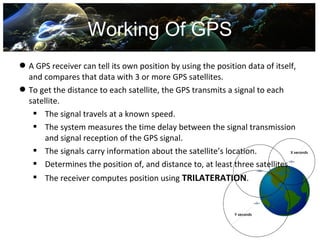
 A GPS receiver can tell its own position by using the position data of itself,
  and compares that data with 3 or more GPS satellites.
 To get the distance to each satellite, the GPS transmits a signal to each
  satellite.
    The signal travels at a known speed.
    The system measures the time delay between the signal transmission
       and signal reception of the GPS signal.
    The signals carry information about the satellite’s location.
    Determines the position of, and distance to, at least three satellites.
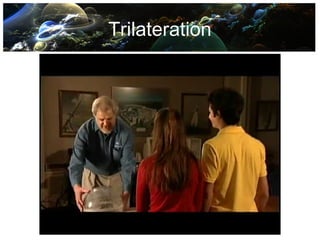
    The receiver computes position using TRILATERATION.
Trilateration
GPS Functionality
• GPS systems are made up of 3 segments
   – Space Segment (SS)
   – Control Segment (CS)
   – User Segment (US)
Space Segment
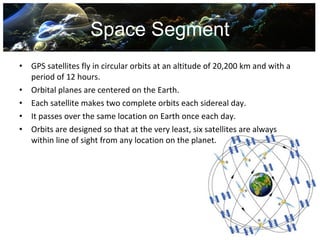
•   GPS satellites fly in circular orbits at an altitude of 20,200 km and with a
    period of 12 hours.
•   Orbital planes are centered on the Earth.
•   Each satellite makes two complete orbits each sidereal day.
•   It passes over the same location on Earth once each day.
•   Orbits are designed so that at the very least, six satellites are always
    within line of sight from any location on the planet.
Control Segment
• The Control Segment consists of 3 entities:
   – Master Control Station
   – Monitor Stations
   – Ground Antennas
   – NGA Monitor Stations
   – Air Force Satellite Control Network (AFSCN) Remote
     Tracking Stations
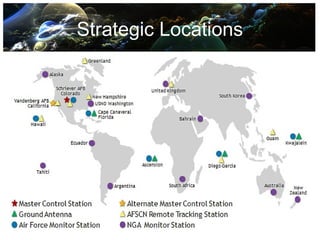
Strategic Locations
Master Control Station
•   The master control station, located at Falcon Air Force Base in Colorado
    Springs, Colorado, is responsible for overall management of the remote
    monitoring and transmission sites.
•   Performs the primary control segment functions, providing command and
    control of the GPS constellation.
•   Generates and uploads navigation messages and ensures the health and
    accuracy of the satellite constellation.
•   Monitors navigation messages and system integrity, can reposition
    satellites to maintain an optimal GPS constellation.
Monitor Stations
•   Six monitor stations are located at Falcon Air Force Base in Colorado, Cape
    Canaveral, Florida, Hawaii, Ascension Island in the Atlantic Ocean, Diego
    Garcia, and in the South Pacific Ocean.
•   Checks the exact altitude, position, speed, and overall health of the
    orbiting satellites.
•   The control segment uses measurements collected by the monitor
    stations to predict the behavior of each satellite's orbit and clock.
•   The prediction data is up-linked, or transmitted, to the satellites for
    transmission back to the users.
•   The control segment also ensures that the GPS satellite orbits and clocks
    remain within acceptable limits.
•   A station can track up to 11 satellites at a time.
•   This "check-up" is performed twice a day, by each station.
Ground Antennas
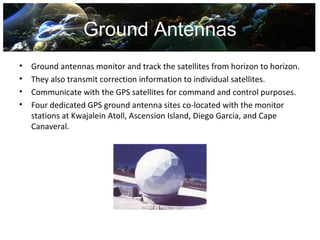
•   Ground antennas monitor and track the satellites from horizon to horizon.
•   They also transmit correction information to individual satellites.
•   Communicate with the GPS satellites for command and control purposes.
•   Four dedicated GPS ground antenna sites co-located with the monitor
    stations at Kwajalein Atoll, Ascension Island, Diego Garcia, and Cape
    Canaveral.
AFSCN Remote Tracking
            Stations
•    Air Force Satellite Control Network (AFSCN) provides support for the
    operation, control, and maintenance of a variety of United States
    Department of Defense satellites.
•   This involves continual Tracking, Telemetry, and Command (TT&C).
•   It also provides prelaunch simulation, launch support, and early orbit
    support while satellites are in initial or transfer orbits and require
    maneuvering to their final orbit.
NGA Monitor Stations
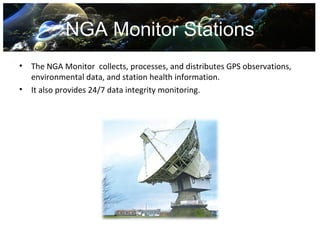
•   The NGA Monitor collects, processes, and distributes GPS observations,
    environmental data, and station health information.
•   It also provides 24/7 data integrity monitoring.
User Segment
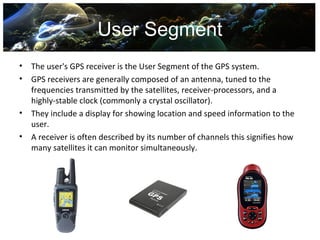
•   The user's GPS receiver is the User Segment of the GPS system.
•   GPS receivers are generally composed of an antenna, tuned to the
    frequencies transmitted by the satellites, receiver-processors, and a
    highly-stable clock (commonly a crystal oscillator).
•   They include a display for showing location and speed information to the
    user.
•   A receiver is often described by its number of channels this signifies how
    many satellites it can monitor simultaneously.
GPS Signals
•   Coarse/Acquisition code
•   Precision code
•   Navigation message
•   Almanac
•   Data updates
GPS Frequencies
•   L1 (1575.42 MHz)
•   L2 (1227.60 MHz)
•   L3 (1381.05 MHz)
•   L4 (1379.913 MHz)
•   L5 (1176.45 MHz)
Frequency Information
•   The C/A code is transmitted on the L1 frequency as a 1.023 MHz signal.
•   The P(Y)-code is transmitted on both the L1 and L2 frequencies as a
    10.23 MHz signal.
•   L3 is used by the Defense Support Program to signal detection of missile
    launches, nuclear detonations, and other applications.
•   L4 is used for additional correction to the part of the atmosphere that is
    ionized by solar radiation.
•   L5 is used as a civilian safety-of-life (SoL) signal.
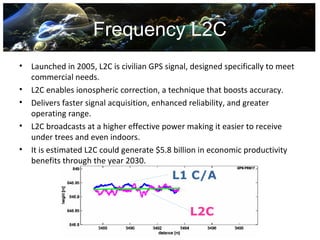
Frequency L2C
•   Launched in 2005, L2C is civilian GPS signal, designed specifically to meet
    commercial needs.
•   L2C enables ionospheric correction, a technique that boosts accuracy.
•   Delivers faster signal acquisition, enhanced reliability, and greater
    operating range.
•   L2C broadcasts at a higher effective power making it easier to receive
    under trees and even indoors.
•   It is estimated L2C could generate $5.8 billion in economic productivity
    benefits through the year 2030.
Accuracy
•   The position calculated by a GPS receiver relies on three accurate
    measurements:
     – Current time
     – Position of the satellite
     – Time delay for the signal
•   The GPS signal in space will provide a "worst case" accuracy of 7.8 meters
    at a 95% confidence level.
•   GPS time is accurate to about 14 nanoseconds.
•   Higher accuracy is available today by using GPS in combination with
    augmentation systems. These enable real-time positioning to within a few
    centimeters.
Issues That Affect Accuracy
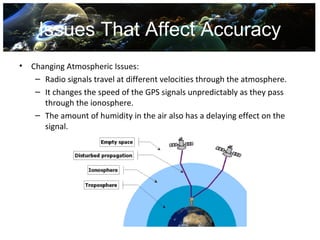
•   Changing Atmospheric Issues:
     – Radio signals travel at different velocities through the atmosphere.
     – It changes the speed of the GPS signals unpredictably as they pass
       through the ionosphere.
     – The amount of humidity in the air also has a delaying effect on the
       signal.
Issues That Affect Accuracy
                (cont’d)
•   Clock Errors :
     – Can occur when a GPS satellite is boosted back into a proper orbit.
     – The satellite's atomic clocks experience noise and clock drift errors.
•   GPS Jamming :
     – It limits the effectiveness of the GPS signal.
     – GPS jammer is a low cost device to temporarily disable the reception
        of the civilian coarse acquisition (C/A) code.
Issues That Affect Accuracy
                (cont’d)
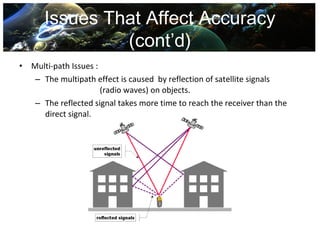
•   Multi-path Issues :
     – The multipath effect is caused by reflection of satellite signals
                        (radio waves) on objects.
     – The reflected signal takes more time to reach the receiver than the
       direct signal.
Methods of Improving
           Accuracy
• Precision monitoring
  – Dual Frequency Monitoring
  – Carrier-Phase Enhancement (CPGPS)
  – Relative Kinematic Positioning (RKP)


• Augmentation
A. Dual Frequency Monitoring
   • Refers to systems that can compare two or more
     signals.
   • These two frequencies are affected in two different
     ways.
   • After monitoring these signals, it’s possible to calculate
     what the error is and eliminate it.
   • Receivers that have the correct decryption key can
     decode the P(Y)-code transmitted on signals to
     measure the error.
B. Carrier-Phase Enhancement (CPGPS)
   • CPGPS uses the L1 carrier wave, which has a period
     1000 times smaller than that of the C/A bit period, to
     act as an additional clock signal and resolve
     uncertainty.
   • The phase difference error in the normal GPS amounts
     to between 2 and 3 meters (6 to 10 ft) of ambiguity.
   • CPGPS works to within 1% of perfect transition to
     reduce the error to 3 centimeters (1 inch) of ambiguity.
   • By eliminating this source of error, CPGPS coupled with
     DGPS normally realizes between 20 and 30 centimeters
     (8 to 12 inches) of absolute accuracy.
C. Relative Kinematic Positioning (RKP)
   • Determination of range signal can be resolved to an
     accuracy of less than 10 centimeters (4 in).
   • Resolves the number of cycles in which the signal is
     transmitted and received by the receiver.
   • Accomplished by using a combination of DGPS
     correction data, transmitting GPS signal phase
     information and ambiguity resolution techniques via
     statistical tests — possibly with processing in real-time.
• Augmentation
  – Relies on external information being integrated into the calculation
    process.
  – Some augmentation systems transmit additional information about
    sources of error.
  – Some provide direct measurements of how much the signal was off in
    the past
  – Another group could provide additional navigational or vehicle
    information to be integrated in the calculation process.
Augmentation Systems
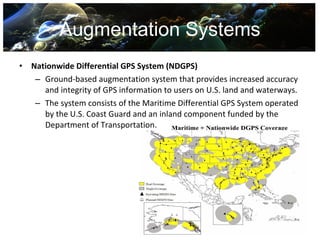
•   Nationwide Differential GPS System (NDGPS)
     – Ground-based augmentation system that provides increased accuracy
       and integrity of GPS information to users on U.S. land and waterways.
     – The system consists of the Maritime Differential GPS System operated
       by the U.S. Coast Guard and an inland component funded by the
       Department of Transportation.
Augmentation Systems (cont’d)
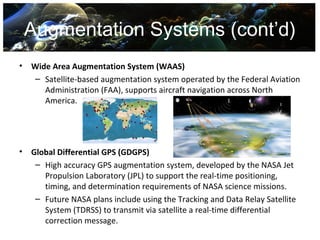
•   Wide Area Augmentation System (WAAS)
    – Satellite-based augmentation system operated by the Federal Aviation
       Administration (FAA), supports aircraft navigation across North
       America.


•   Global Differential GPS (GDGPS)
     – High accuracy GPS augmentation system, developed by the NASA Jet
       Propulsion Laboratory (JPL) to support the real-time positioning,
       timing, and determination requirements of NASA science missions.
     – Future NASA plans include using the Tracking and Data Relay Satellite
       System (TDRSS) to transmit via satellite a real-time differential
       correction message.
Applications

• Civilian
  – Geotagging : Applying location coordinates to digital objects such as
    photographs and other documents.
  – Disaster Relief/Emergency Services
  – Vehicle Tracking Systems
  – Person Tracking Systems
  – GPS Aircraft Tracking
  – Telematics: GPS technology integrated with computers and mobile
    communications technology in automotive navigation systems.
Applications (cont’d)

• Military
  – Target Tracking: Tracking potential ground and air targets before
    flagging them as hostile.
  – Navigation
  – Missile and Projectile Guidance: Allows accurate targeting of various
    military weapons including cruise missiles and precision-guided
    munitions
  – Reconnaissance
  – Search and Rescue: Downed pilots can be located faster if their
    position is known.
Applications (cont’d)

• Other Applications
  –   Railroad Systems
  –   Recreational Activities
  –   Weather Prediction
  –   Skydiving
  –   And many more!
Global Positioning System

Global Positioning System

  • 1.
    Global Positioning System Pratyush Rajput Rajat Gupta Rishabh Shukla
  • 2.
    Global Positioning System • What is GPS? • Working of GPS • GPS Functionality • GPS Signals & Frequencies • Accuracy – Issues & Methods for Improvement • Applications
  • 3.
    Overview • Official name of GPS is NAVigational Satellite Timing And Ranging Global Positioning System (NAVSTAR GPS). • First developed by the United States Department of Defense. • Consists of 30+ GPS satellites in medium Earth orbit (2000km - 35,000 km). • Made up of two dozen satellites working in unison are known as a satellite constellation. • This constellation is currently controlled by the United States Air Force. • It costs about $750 million to manage and maintain the system per year. • Mainly used for navigation, map-making and surveying, etc.
  • 4.
    Working Of GPS A GPS receiver can tell its own position by using the position data of itself, and compares that data with 3 or more GPS satellites.  To get the distance to each satellite, the GPS transmits a signal to each satellite.  The signal travels at a known speed.  The system measures the time delay between the signal transmission and signal reception of the GPS signal.  The signals carry information about the satellite’s location.  Determines the position of, and distance to, at least three satellites.  The receiver computes position using TRILATERATION.
  • 5.
  • 6.
    GPS Functionality • GPSsystems are made up of 3 segments – Space Segment (SS) – Control Segment (CS) – User Segment (US)
  • 7.
    Space Segment • GPS satellites fly in circular orbits at an altitude of 20,200 km and with a period of 12 hours. • Orbital planes are centered on the Earth. • Each satellite makes two complete orbits each sidereal day. • It passes over the same location on Earth once each day. • Orbits are designed so that at the very least, six satellites are always within line of sight from any location on the planet.
  • 8.
    Control Segment • TheControl Segment consists of 3 entities: – Master Control Station – Monitor Stations – Ground Antennas – NGA Monitor Stations – Air Force Satellite Control Network (AFSCN) Remote Tracking Stations
  • 9.
  • 10.
    Master Control Station • The master control station, located at Falcon Air Force Base in Colorado Springs, Colorado, is responsible for overall management of the remote monitoring and transmission sites. • Performs the primary control segment functions, providing command and control of the GPS constellation. • Generates and uploads navigation messages and ensures the health and accuracy of the satellite constellation. • Monitors navigation messages and system integrity, can reposition satellites to maintain an optimal GPS constellation.
  • 11.
    Monitor Stations • Six monitor stations are located at Falcon Air Force Base in Colorado, Cape Canaveral, Florida, Hawaii, Ascension Island in the Atlantic Ocean, Diego Garcia, and in the South Pacific Ocean. • Checks the exact altitude, position, speed, and overall health of the orbiting satellites. • The control segment uses measurements collected by the monitor stations to predict the behavior of each satellite's orbit and clock. • The prediction data is up-linked, or transmitted, to the satellites for transmission back to the users. • The control segment also ensures that the GPS satellite orbits and clocks remain within acceptable limits. • A station can track up to 11 satellites at a time. • This "check-up" is performed twice a day, by each station.
  • 12.
    Ground Antennas • Ground antennas monitor and track the satellites from horizon to horizon. • They also transmit correction information to individual satellites. • Communicate with the GPS satellites for command and control purposes. • Four dedicated GPS ground antenna sites co-located with the monitor stations at Kwajalein Atoll, Ascension Island, Diego Garcia, and Cape Canaveral.
  • 13.
    AFSCN Remote Tracking Stations • Air Force Satellite Control Network (AFSCN) provides support for the operation, control, and maintenance of a variety of United States Department of Defense satellites. • This involves continual Tracking, Telemetry, and Command (TT&C). • It also provides prelaunch simulation, launch support, and early orbit support while satellites are in initial or transfer orbits and require maneuvering to their final orbit.
  • 14.
    NGA Monitor Stations • The NGA Monitor collects, processes, and distributes GPS observations, environmental data, and station health information. • It also provides 24/7 data integrity monitoring.
  • 15.
    User Segment • The user's GPS receiver is the User Segment of the GPS system. • GPS receivers are generally composed of an antenna, tuned to the frequencies transmitted by the satellites, receiver-processors, and a highly-stable clock (commonly a crystal oscillator). • They include a display for showing location and speed information to the user. • A receiver is often described by its number of channels this signifies how many satellites it can monitor simultaneously.
  • 16.
    GPS Signals • Coarse/Acquisition code • Precision code • Navigation message • Almanac • Data updates
  • 17.
    GPS Frequencies • L1 (1575.42 MHz) • L2 (1227.60 MHz) • L3 (1381.05 MHz) • L4 (1379.913 MHz) • L5 (1176.45 MHz)
  • 18.
    Frequency Information • The C/A code is transmitted on the L1 frequency as a 1.023 MHz signal. • The P(Y)-code is transmitted on both the L1 and L2 frequencies as a 10.23 MHz signal. • L3 is used by the Defense Support Program to signal detection of missile launches, nuclear detonations, and other applications. • L4 is used for additional correction to the part of the atmosphere that is ionized by solar radiation. • L5 is used as a civilian safety-of-life (SoL) signal.
  • 19.
    Frequency L2C • Launched in 2005, L2C is civilian GPS signal, designed specifically to meet commercial needs. • L2C enables ionospheric correction, a technique that boosts accuracy. • Delivers faster signal acquisition, enhanced reliability, and greater operating range. • L2C broadcasts at a higher effective power making it easier to receive under trees and even indoors. • It is estimated L2C could generate $5.8 billion in economic productivity benefits through the year 2030.
  • 20.
    Accuracy • The position calculated by a GPS receiver relies on three accurate measurements: – Current time – Position of the satellite – Time delay for the signal • The GPS signal in space will provide a "worst case" accuracy of 7.8 meters at a 95% confidence level. • GPS time is accurate to about 14 nanoseconds. • Higher accuracy is available today by using GPS in combination with augmentation systems. These enable real-time positioning to within a few centimeters.
  • 21.
    Issues That AffectAccuracy • Changing Atmospheric Issues: – Radio signals travel at different velocities through the atmosphere. – It changes the speed of the GPS signals unpredictably as they pass through the ionosphere. – The amount of humidity in the air also has a delaying effect on the signal.
  • 22.
    Issues That AffectAccuracy (cont’d) • Clock Errors : – Can occur when a GPS satellite is boosted back into a proper orbit. – The satellite's atomic clocks experience noise and clock drift errors. • GPS Jamming : – It limits the effectiveness of the GPS signal. – GPS jammer is a low cost device to temporarily disable the reception of the civilian coarse acquisition (C/A) code.
  • 23.
    Issues That AffectAccuracy (cont’d) • Multi-path Issues : – The multipath effect is caused by reflection of satellite signals (radio waves) on objects. – The reflected signal takes more time to reach the receiver than the direct signal.
  • 24.
    Methods of Improving Accuracy • Precision monitoring – Dual Frequency Monitoring – Carrier-Phase Enhancement (CPGPS) – Relative Kinematic Positioning (RKP) • Augmentation
  • 25.
    A. Dual FrequencyMonitoring • Refers to systems that can compare two or more signals. • These two frequencies are affected in two different ways. • After monitoring these signals, it’s possible to calculate what the error is and eliminate it. • Receivers that have the correct decryption key can decode the P(Y)-code transmitted on signals to measure the error.
  • 26.
    B. Carrier-Phase Enhancement(CPGPS) • CPGPS uses the L1 carrier wave, which has a period 1000 times smaller than that of the C/A bit period, to act as an additional clock signal and resolve uncertainty. • The phase difference error in the normal GPS amounts to between 2 and 3 meters (6 to 10 ft) of ambiguity. • CPGPS works to within 1% of perfect transition to reduce the error to 3 centimeters (1 inch) of ambiguity. • By eliminating this source of error, CPGPS coupled with DGPS normally realizes between 20 and 30 centimeters (8 to 12 inches) of absolute accuracy.

  • 27.
    C. Relative KinematicPositioning (RKP) • Determination of range signal can be resolved to an accuracy of less than 10 centimeters (4 in). • Resolves the number of cycles in which the signal is transmitted and received by the receiver. • Accomplished by using a combination of DGPS correction data, transmitting GPS signal phase information and ambiguity resolution techniques via statistical tests — possibly with processing in real-time.
  • 28.
    • Augmentation – Relies on external information being integrated into the calculation process. – Some augmentation systems transmit additional information about sources of error. – Some provide direct measurements of how much the signal was off in the past – Another group could provide additional navigational or vehicle information to be integrated in the calculation process.
  • 29.
    Augmentation Systems • Nationwide Differential GPS System (NDGPS) – Ground-based augmentation system that provides increased accuracy and integrity of GPS information to users on U.S. land and waterways. – The system consists of the Maritime Differential GPS System operated by the U.S. Coast Guard and an inland component funded by the Department of Transportation.
  • 30.
    Augmentation Systems (cont’d) • Wide Area Augmentation System (WAAS) – Satellite-based augmentation system operated by the Federal Aviation Administration (FAA), supports aircraft navigation across North America. • Global Differential GPS (GDGPS) – High accuracy GPS augmentation system, developed by the NASA Jet Propulsion Laboratory (JPL) to support the real-time positioning, timing, and determination requirements of NASA science missions. – Future NASA plans include using the Tracking and Data Relay Satellite System (TDRSS) to transmit via satellite a real-time differential correction message.
  • 31.
    Applications • Civilian – Geotagging : Applying location coordinates to digital objects such as photographs and other documents. – Disaster Relief/Emergency Services – Vehicle Tracking Systems – Person Tracking Systems – GPS Aircraft Tracking – Telematics: GPS technology integrated with computers and mobile communications technology in automotive navigation systems.
  • 32.
    Applications (cont’d) • Military – Target Tracking: Tracking potential ground and air targets before flagging them as hostile. – Navigation – Missile and Projectile Guidance: Allows accurate targeting of various military weapons including cruise missiles and precision-guided munitions – Reconnaissance – Search and Rescue: Downed pilots can be located faster if their position is known.
  • 33.
    Applications (cont’d) • OtherApplications – Railroad Systems – Recreational Activities – Weather Prediction – Skydiving – And many more!