Global Positioning System
What is the GPS?
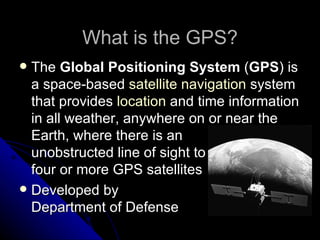
 The Global Positioning System (GPS) is
  a space-based satellite navigation system
  that provides location and time information
  in all weather, anywhere on or near the
  Earth, where there is an
  unobstructed line of sight to
  four or more GPS satellites
 Developed by
  Department of Defense
History of the GPS
 1973—The GPS project was developed to
  overcome the limitations of previous
  navigation systems
 1994—GPS Was Created and realized by
  U.S. Department of Defense (DoD)
     and was originally run with 24
  satellites
History of the GPS
   1993—Indicating a
    full constellation (24
    satellites) was
    available
   1995—full operational
    capability
   May 2000—Military
    accuracy available to
    all users
Components of the System
Space segment
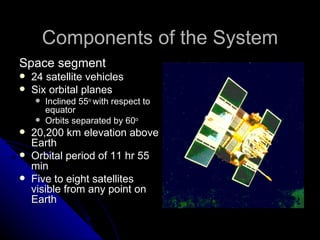
   24 satellite vehicles
   Six orbital planes
       Inclined 55o with respect to
        equator
       Orbits separated by 60o
   20,200 km elevation above
    Earth
   Orbital period of 11 hr 55
    min
   Five to eight satellites
    visible from any point on
    Earth
The GPS Constellation
GPS Satellite Vehicle
              Four atomic clocks
              Three nickel-cadmium
               batteries
              Two solar panels
                  Battery charging
                  Power generation
                  1136 watts
              S band antenna—satellite
               control
              12 element L band antenna—
               user communication

           Block IIF satellite vehicle
              (fourth generation)
GPS Satellite Vehicle
   Weight
       2370 pounds

   Height
       16.25 feet

   Width
       38.025 feet including
        wing span

   Design life—10 years
Components of the System
User segment
   GPS antennas & receiver/processors
   Position
   Velocity
   Precise timing
   Used by
       Aircraft
       Ground vehicles
       Ships
       Individuals
Components of the System

Ground control segment
   Master control station
       Schreiver AFB, Colorado
 Five monitor stations
 Three ground antennas
 Backup control system
GPS Communication and Control
GPS Ground Control Stations
How does GPS work?
   Satellite ranging
     Satellite locations
     Satellite to user distance
     Need four satellites to determine position
   Distance measurement
     Radio signal traveling at speed of light
     Measure time from satellite to user
   Low-tech simulation
How does GPS work?
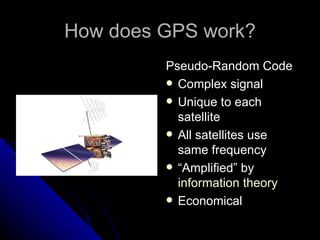
         Pseudo-Random Code
          Complex signal
          Unique to each
           satellite
          All satellites use
           same frequency
          “Amplified” by
           information theory
          Economical
How does GPS work?
   Distance to a satellite is determined by measuring how
    long a radio signal takes to reach us from that satellite.
   To make the measurement we assume that both the
    satellite and our receiver are generating the same
    pseudo-random codes at exactly the same time.
   By comparing how late the satellite's pseudo-random
    code appears compared to our receiver's code, we
    determine how long it took to reach us.
   Multiply that travel time by the speed of light and you've
    got distance.
   High-tech simulation
How does GPS work?
 Accurate timing is the key to measuring
  distance to satellites.
 Satellites are accurate because they have
  four atomic clocks ($100,000 each) on
  board.
 Receiver clocks don't have to be too
  accurate because an extra satellite range
  measurement can remove errors.
How does GPS work?
   To use the satellites as references for range
    measurements we need to know exactly where they are.
   GPS satellites are so high up their orbits are very
    predictable.
   All GPS receivers have an almanac programmed into
    their computers that tells them where in the sky each
    satellite is, moment by moment.
   Minor variations in their orbits are measured by the
    Department of Defense.
   The error information is sent to the satellites, to be
    transmitted along with the timing signals.
GPS Position Determination
System Performance
          Standard Positioning
           System
              100 meters horizontal accuracy
              156 meters vertical accuracy
              Designed for civilian use
              No user fee or restrictions
          Precise Positioning
           System
              22 meters horizontal accuracy
              27.7 meters vertical accuracy
              Designed for military use
System Performance
Selective availability
   Intentional degradation of signal
   Controls availability of system’s full capabilities
   Set to zero May 2000
   Reasons
       Car navigation
       Adoption of GPS time standard
       Recreation
System Performance
 The earth's ionosphere and atmosphere
  cause delays in the GPS signal that
  translate into position errors.
 Some errors can be factored out using
  mathematics and modeling.
 The configuration of the satellites in the
  sky can magnify other errors.
 Differential GPS can reduce errors.
Application of GPS Technology
 Location - determining a basic position
 Navigation - getting from one location to
  another
 Tracking - monitoring the movement of
  people and things
 Mapping - creating maps of the world
 Timing - bringing precise timing to the
  world
Application of GPS Technology
   Private and recreation
       Traveling by car
       Hiking, climbing, biking
       Vehicle control
   Mapping, survey, geology
   English Channel Tunnel
   Agriculture
   Aviation
       General and commercial
       Spacecraft
   Maritime
GPS Navigation
Military Uses for the GPS
Operation Desert Storm
   Featureless terrain
   Initial purchase of 1000 portable commercial
    receivers
   More than 9000 receivers in use by end of the
    conflict
   Foot soldiers
   Vehicles
   Aircraft
   Marine vessels
Handheld GPS Receivers
 Lowrance iWay350c
   This is great value for
  a full-featured turn-by
   turn GPS navigation
  system.
 Cobra NavOne 450

  This system's 5-inch
  screen and integrated
  live traffic data set it
  apart from other GPS
  devices.
GPS Operation
   “Waypoint” or “Landmark”
   “Track” or “Heading”
   “Bearing”
   CDI
   Route
   Mark
   GOTO

       Mobile phone GPS tracking
Gps

Gps

  • 1.
  • 2.
    What is theGPS?  The Global Positioning System (GPS) is a space-based satellite navigation system that provides location and time information in all weather, anywhere on or near the Earth, where there is an unobstructed line of sight to four or more GPS satellites  Developed by Department of Defense
  • 3.
    History of theGPS  1973—The GPS project was developed to overcome the limitations of previous navigation systems  1994—GPS Was Created and realized by U.S. Department of Defense (DoD) and was originally run with 24 satellites
  • 4.
    History of theGPS  1993—Indicating a full constellation (24 satellites) was available  1995—full operational capability  May 2000—Military accuracy available to all users
  • 5.
    Components of theSystem Space segment  24 satellite vehicles  Six orbital planes  Inclined 55o with respect to equator  Orbits separated by 60o  20,200 km elevation above Earth  Orbital period of 11 hr 55 min  Five to eight satellites visible from any point on Earth
  • 6.
  • 7.
    GPS Satellite Vehicle  Four atomic clocks  Three nickel-cadmium batteries  Two solar panels  Battery charging  Power generation  1136 watts  S band antenna—satellite control  12 element L band antenna— user communication Block IIF satellite vehicle (fourth generation)
  • 8.
    GPS Satellite Vehicle  Weight  2370 pounds  Height  16.25 feet  Width  38.025 feet including wing span  Design life—10 years
  • 9.
    Components of theSystem User segment  GPS antennas & receiver/processors  Position  Velocity  Precise timing  Used by  Aircraft  Ground vehicles  Ships  Individuals
  • 10.
    Components of theSystem Ground control segment  Master control station  Schreiver AFB, Colorado  Five monitor stations  Three ground antennas  Backup control system
  • 11.
  • 12.
  • 13.
    How does GPSwork?  Satellite ranging  Satellite locations  Satellite to user distance  Need four satellites to determine position  Distance measurement  Radio signal traveling at speed of light  Measure time from satellite to user  Low-tech simulation
  • 14.
    How does GPSwork? Pseudo-Random Code  Complex signal  Unique to each satellite  All satellites use same frequency  “Amplified” by information theory  Economical
  • 15.
    How does GPSwork?  Distance to a satellite is determined by measuring how long a radio signal takes to reach us from that satellite.  To make the measurement we assume that both the satellite and our receiver are generating the same pseudo-random codes at exactly the same time.  By comparing how late the satellite's pseudo-random code appears compared to our receiver's code, we determine how long it took to reach us.  Multiply that travel time by the speed of light and you've got distance.  High-tech simulation
  • 16.
    How does GPSwork?  Accurate timing is the key to measuring distance to satellites.  Satellites are accurate because they have four atomic clocks ($100,000 each) on board.  Receiver clocks don't have to be too accurate because an extra satellite range measurement can remove errors.
  • 17.
    How does GPSwork?  To use the satellites as references for range measurements we need to know exactly where they are.  GPS satellites are so high up their orbits are very predictable.  All GPS receivers have an almanac programmed into their computers that tells them where in the sky each satellite is, moment by moment.  Minor variations in their orbits are measured by the Department of Defense.  The error information is sent to the satellites, to be transmitted along with the timing signals.
  • 18.
  • 19.
    System Performance  Standard Positioning System  100 meters horizontal accuracy  156 meters vertical accuracy  Designed for civilian use  No user fee or restrictions  Precise Positioning System  22 meters horizontal accuracy  27.7 meters vertical accuracy  Designed for military use
  • 20.
    System Performance Selective availability  Intentional degradation of signal  Controls availability of system’s full capabilities  Set to zero May 2000  Reasons  Car navigation  Adoption of GPS time standard  Recreation
  • 21.
    System Performance  Theearth's ionosphere and atmosphere cause delays in the GPS signal that translate into position errors.  Some errors can be factored out using mathematics and modeling.  The configuration of the satellites in the sky can magnify other errors.  Differential GPS can reduce errors.
  • 22.
    Application of GPSTechnology  Location - determining a basic position  Navigation - getting from one location to another  Tracking - monitoring the movement of people and things  Mapping - creating maps of the world  Timing - bringing precise timing to the world
  • 23.
    Application of GPSTechnology  Private and recreation  Traveling by car  Hiking, climbing, biking  Vehicle control  Mapping, survey, geology  English Channel Tunnel  Agriculture  Aviation  General and commercial  Spacecraft  Maritime
  • 24.
  • 25.
    Military Uses forthe GPS Operation Desert Storm  Featureless terrain  Initial purchase of 1000 portable commercial receivers  More than 9000 receivers in use by end of the conflict  Foot soldiers  Vehicles  Aircraft  Marine vessels
  • 26.
    Handheld GPS Receivers Lowrance iWay350c This is great value for a full-featured turn-by turn GPS navigation system.  Cobra NavOne 450 This system's 5-inch screen and integrated live traffic data set it apart from other GPS devices.
  • 27.
    GPS Operation  “Waypoint” or “Landmark”  “Track” or “Heading”  “Bearing”  CDI  Route  Mark  GOTO Mobile phone GPS tracking