Introduction to the
Global Positioning System
S.M.J.S.Samarasinghe
Superintendent of Surveys
Institute of Surveying and Mapping
Diyatalawa - Sri Lanka.
What is the GPS?
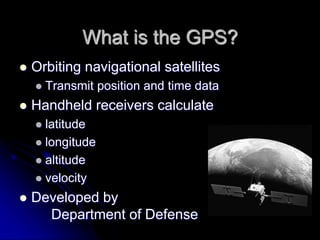
 Orbiting navigational satellites
 Transmit position and time data
 Handheld receivers calculate
 latitude
 longitude
 altitude
 velocity
 Developed by
Department of Defense
History of the GPS
 1969—Defense Navigation Satellite
System (DNSS) formed
 1973—NAVSTAR Global Positioning
System developed
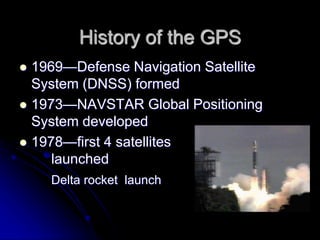
 1978—first 4 satellites
launched
Delta rocket launch
History of the GPS
 1993—24th satellite
launched; initial
operational capability
 1995—full operational
capability
 May 2000—Military
accuracy available to
all users
Components of the System
GPS Communication and Control
Components of the System
Space segment
 24 satellite vehicles
 Six orbital planes
 Inclined 55o with respect to
equator
 Orbits separated by 60o
 20,200 km elevation above
Earth
 Orbital period of 11 hr 55
min
 Five to eight satellites
visible from any point on
Earth
Block I Satellite Vehicle
The GPS Constellation
Space segment
GPS Satellite Vehicle
 Four atomic clocks
 Three nickel-cadmium
batteries
 Two solar panels
 Battery charging
 Power generation
 1136 watts
 S band antenna—satellite
control
 12 element L band antenna—
user communication
Block IIF satellite vehicle
(fourth generation)
Space segment
GPS Satellite Vehicle
 Weight
 2370 pounds
 Height
 16.25 feet
 Width
 38.025 feet including
wing span
 Design life—10 years
Block IIR satellite vehicle
assembly at Lockheed
Martin, Valley Forge, PA
Space segment
Components of the System
User segment
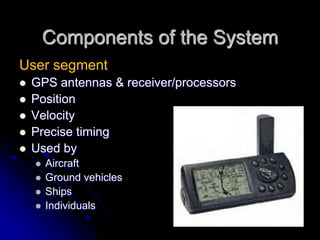
 GPS antennas & receiver/processors
 Position
 Velocity
 Precise timing
 Used by
 Aircraft
 Ground vehicles
 Ships
 Individuals
Components of the System
User segment
How does GPS work?
Pseudo-Random Code
 Complex signal
 Unique to each
satellite
 All satellites use
same frequency
 “Amplified” by
information theory
 Economical
Handheld GPS Receivers
 Garmin eTrex
 ~$100
 Garmin-12
 ~$150
 Casio GPS
wristwatch
 ~$300
 The GPS Store
GPS Operation Jargon
 “Waypoint” or “Landmark”
 “Track” or “Heading” (Heading is
the direction in which you are currently
moving)
 “Bearing”
 CDI(The Course Deviation Indicator, CDI, is key
to maintaining your position as you traverse from
one waypoint to another in water or air)
 Route
 Mark
 GOTO
GPS/Digital Telephone
GPS Operation Jargon
“Waypoint”
GPS Operation Jargon
Route
Components of the System
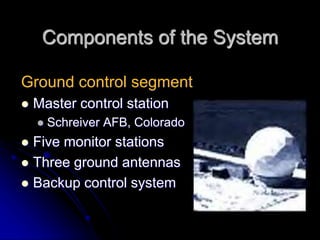
Ground control segment
 Master control station
 Schreiver AFB, Colorado
 Five monitor stations
 Three ground antennas
 Backup control system
GPS Ground Control Stations
Ground control segment
GPS Ground Control Stations
Ground control segment
How does GPS work?
 Satellite ranging
 Satellite locations
 Satellite to user distance
 Need four satellites to determine position
 Distance measurement
 Radio signal traveling at speed of light
 Measure time from satellite to user
 Low-tech simulation
How does GPS work?
 Distance to a satellite is determined by measuring how
long a radio signal takes to reach us from that satellite.
 To make the measurement we assume that both the
satellite and our receiver are generating the same
pseudo-random codes at exactly the same time.
 By comparing how late the satellite's pseudo-random
code appears compared to our receiver's code, we
determine how long it took to reach us.
 Multiply that travel time by the speed of light and you've
got distance.
 High-tech simulation
How does GPS work?
 Accurate timing is the key to measuring
distance to satellites.
 Satellites are accurate because they have
four atomic clocks ($100,000 each) on
board.
 Receiver clocks don't have to be too
accurate because an extra satellite range
measurement can remove errors.
How does GPS work?
 To use the satellites as references for range
measurements we need to know exactly where they are.
 GPS satellites are so high up their orbits are very
predictable.
 All GPS receivers have an almanac programmed into
their computers that tells them where in the sky each
satellite is, moment by moment.
 Minor variations in their orbits are measured by the
Department of Defense.
 The error information is sent to the satellites, to be
transmitted along with the timing signals.
GPS Position Determination
System Performance
 Standard Positioning
System
 100 meters horizontal accuracy
 156 meters vertical accuracy
 Designed for civilian use
 No user fee or restrictions
 Precise Positioning
System
 22 meters horizontal accuracy
 27.7 meters vertical accuracy
 Designed for military use
System Performance
Selective availability
 Intentional degradation of signal
 Controls availability of system’s full capabilities
 Set to zero May 2000
 Reasons
 Enhanced 911 service
 Car navigation
 Adoption of GPS time standard
 Recreation
System Performance
 The earth's ionosphere and atmosphere
cause delays in the GPS signal that
translate into position errors.
 Some errors can be factored out using
mathematics and modeling.
 The configuration of the satellites in the
sky can magnify other errors.
 Differential GPS can reduce errors.
System Performance
Application of GPS Technology
 Location - determining a basic position
 Navigation - getting from one location to
another
 Tracking - monitoring the movement of
people and things
 Mapping - creating maps of the world
 Timing - bringing precise timing to the
world
Application of GPS Technology
 Private and recreation
 Traveling by car
 Hiking, climbing, biking
 Vehicle control
 Mapping, survey, geology
 English Channel Tunnel
 Agriculture
 Aviation
 General and commercial
 Spacecraft
 Maritime
Positioning
Dam /Hydro Power Monitoring
Victoria Dam Monitoring
Beacon 8
Beacon 5
Vehicle Monitoring System
Eagles Eye
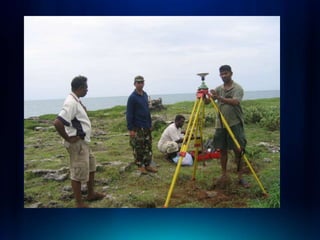
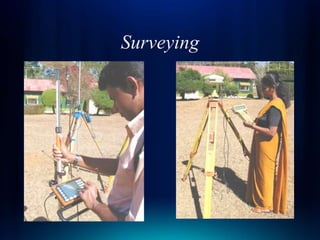
Surveying
Precise Positioning
GPS Navigation
Tracking
Tracking
Tracking
Environmental Monitoring
Global Navigation Satellite
Systems (GNSS)
Global Navigation Satellite
Systems (GNSS)
GPS News
 http://www.gpseducationresource.com/gps
news.htm
 One–page reading exercise
 Center of page—main topic
 Four corners—questions & answers from
reading
 Four sides—specific facts from reading
 Spaces between—supporting ideas,
diagrams, definitions
 Article citation on back of page
Military Uses for the GPS
Operation Desert Storm
 Featureless terrain
 Initial purchase of 1000 portable commercial
receivers
 More than 9000 receivers in use by end of the
conflict
 Foot soldiers
 Vehicles
 Aircraft
 Marine vessels
GPS for Gunners
On Target
Attached to
GPS Guided Artillery Shell
JDAM
Precision Guided Air Drop
the Marine Corps has been utilizing a
different style of parachute than the
traditional round system used to
airdrop heavy packages. This new
parachute system, the Sherpa, has the
ability to guide itself to the drop zone
from up to 25,000 feet in the air and
15 miles away, landing within 100
yards of the targeted point of impact
while carrying up to 2,200 pounds of
supplies.
Equipped with a 1,200-square-foot canopy, the Sherpa is
programmed with the information of where it needs to go, as well as
how long after it falls from the aircraft before it opens the
parachute. After it is programmed, the GPS-guided parachute
attached to its cargo is loaded aboard an aircraft, flown close to the
drop zone and tossed from the plane to make the rest of the way on
its own.
The main canopy steering lines are connected to the control lines in
the airborne guidance unit, which operates with two servo
motors.The motors turn to 'reel in' the control lines, allowing for the
parachute to turn. The turns are determined by the mission that is
programmed into it and based on winds and the target point. The
GPS allows for the system to know where it is in the sky and then
determine how it needs to get to where it is going."
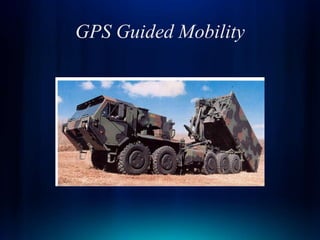
GPS Guided Mobility
GPS Guided Mobility
Geocaching
 Cache(Cell) of goodies
established by individuals
 Coordinates published on
Web
 Find cache
 Leave a message
 Leave some treasure(Ex Gem)
 Take some treasure
 http://www.geocaching.com/
GPS Websites
 USNO NAVSTAR Homepage
 Info on the GPS constellation
 How Stuff Works GPS
 Good everyday language explanation
 Trimble GPS tutorial
 Flash animations
 GPS Waypoint registry
 Database of coordinates
Classroom Applications
 Physics
 Distance, velocity, time
 Orbital concepts
 Earth Science
 Mapping
 Spacecraft
 Environmental Science
 Migratory patterns
 Population distributions
 GLOBE Program
 Mathematics
 Geography
 Technology
Classroom Applications
Careers
 Aerospace
 Satellite vehicles
 Launch vehicles
 Hardware engineering
 Ground control systems
 User systems
 Software engineering
 Research careers
Thanks for your interest in the Global
Positioning System

GPS introduction

  • 1.
    Introduction to the GlobalPositioning System S.M.J.S.Samarasinghe Superintendent of Surveys Institute of Surveying and Mapping Diyatalawa - Sri Lanka.
  • 2.
    What is theGPS?  Orbiting navigational satellites  Transmit position and time data  Handheld receivers calculate  latitude  longitude  altitude  velocity  Developed by Department of Defense
  • 3.
    History of theGPS  1969—Defense Navigation Satellite System (DNSS) formed  1973—NAVSTAR Global Positioning System developed  1978—first 4 satellites launched Delta rocket launch
  • 4.
    History of theGPS  1993—24th satellite launched; initial operational capability  1995—full operational capability  May 2000—Military accuracy available to all users
  • 5.
  • 6.
  • 7.
    Components of theSystem Space segment  24 satellite vehicles  Six orbital planes  Inclined 55o with respect to equator  Orbits separated by 60o  20,200 km elevation above Earth  Orbital period of 11 hr 55 min  Five to eight satellites visible from any point on Earth Block I Satellite Vehicle
  • 8.
  • 9.
    GPS Satellite Vehicle Four atomic clocks  Three nickel-cadmium batteries  Two solar panels  Battery charging  Power generation  1136 watts  S band antenna—satellite control  12 element L band antenna— user communication Block IIF satellite vehicle (fourth generation) Space segment
  • 10.
    GPS Satellite Vehicle Weight  2370 pounds  Height  16.25 feet  Width  38.025 feet including wing span  Design life—10 years Block IIR satellite vehicle assembly at Lockheed Martin, Valley Forge, PA Space segment
  • 11.
    Components of theSystem User segment  GPS antennas & receiver/processors  Position  Velocity  Precise timing  Used by  Aircraft  Ground vehicles  Ships  Individuals
  • 12.
    Components of theSystem User segment
  • 13.
    How does GPSwork? Pseudo-Random Code  Complex signal  Unique to each satellite  All satellites use same frequency  “Amplified” by information theory  Economical
  • 14.
    Handheld GPS Receivers Garmin eTrex  ~$100  Garmin-12  ~$150  Casio GPS wristwatch  ~$300  The GPS Store
  • 15.
    GPS Operation Jargon “Waypoint” or “Landmark”  “Track” or “Heading” (Heading is the direction in which you are currently moving)  “Bearing”  CDI(The Course Deviation Indicator, CDI, is key to maintaining your position as you traverse from one waypoint to another in water or air)  Route  Mark  GOTO GPS/Digital Telephone
  • 16.
  • 17.
  • 18.
    Components of theSystem Ground control segment  Master control station  Schreiver AFB, Colorado  Five monitor stations  Three ground antennas  Backup control system
  • 19.
    GPS Ground ControlStations Ground control segment
  • 20.
    GPS Ground ControlStations Ground control segment
  • 21.
    How does GPSwork?  Satellite ranging  Satellite locations  Satellite to user distance  Need four satellites to determine position  Distance measurement  Radio signal traveling at speed of light  Measure time from satellite to user  Low-tech simulation
  • 22.
    How does GPSwork?  Distance to a satellite is determined by measuring how long a radio signal takes to reach us from that satellite.  To make the measurement we assume that both the satellite and our receiver are generating the same pseudo-random codes at exactly the same time.  By comparing how late the satellite's pseudo-random code appears compared to our receiver's code, we determine how long it took to reach us.  Multiply that travel time by the speed of light and you've got distance.  High-tech simulation
  • 23.
    How does GPSwork?  Accurate timing is the key to measuring distance to satellites.  Satellites are accurate because they have four atomic clocks ($100,000 each) on board.  Receiver clocks don't have to be too accurate because an extra satellite range measurement can remove errors.
  • 24.
    How does GPSwork?  To use the satellites as references for range measurements we need to know exactly where they are.  GPS satellites are so high up their orbits are very predictable.  All GPS receivers have an almanac programmed into their computers that tells them where in the sky each satellite is, moment by moment.  Minor variations in their orbits are measured by the Department of Defense.  The error information is sent to the satellites, to be transmitted along with the timing signals.
  • 25.
  • 26.
    System Performance  StandardPositioning System  100 meters horizontal accuracy  156 meters vertical accuracy  Designed for civilian use  No user fee or restrictions  Precise Positioning System  22 meters horizontal accuracy  27.7 meters vertical accuracy  Designed for military use
  • 27.
    System Performance Selective availability Intentional degradation of signal  Controls availability of system’s full capabilities  Set to zero May 2000  Reasons  Enhanced 911 service  Car navigation  Adoption of GPS time standard  Recreation
  • 28.
    System Performance  Theearth's ionosphere and atmosphere cause delays in the GPS signal that translate into position errors.  Some errors can be factored out using mathematics and modeling.  The configuration of the satellites in the sky can magnify other errors.  Differential GPS can reduce errors.
  • 29.
  • 30.
    Application of GPSTechnology  Location - determining a basic position  Navigation - getting from one location to another  Tracking - monitoring the movement of people and things  Mapping - creating maps of the world  Timing - bringing precise timing to the world
  • 31.
    Application of GPSTechnology  Private and recreation  Traveling by car  Hiking, climbing, biking  Vehicle control  Mapping, survey, geology  English Channel Tunnel  Agriculture  Aviation  General and commercial  Spacecraft  Maritime
  • 32.
  • 33.
    Dam /Hydro PowerMonitoring
  • 34.
  • 35.
  • 36.
  • 38.
  • 39.
  • 42.
  • 43.
  • 44.
  • 45.
  • 46.
  • 47.
  • 48.
  • 49.
    GPS News  http://www.gpseducationresource.com/gps news.htm One–page reading exercise  Center of page—main topic  Four corners—questions & answers from reading  Four sides—specific facts from reading  Spaces between—supporting ideas, diagrams, definitions  Article citation on back of page
  • 50.
    Military Uses forthe GPS Operation Desert Storm  Featureless terrain  Initial purchase of 1000 portable commercial receivers  More than 9000 receivers in use by end of the conflict  Foot soldiers  Vehicles  Aircraft  Marine vessels
  • 51.
  • 52.
  • 53.
  • 54.
  • 55.
  • 56.
    Precision Guided AirDrop the Marine Corps has been utilizing a different style of parachute than the traditional round system used to airdrop heavy packages. This new parachute system, the Sherpa, has the ability to guide itself to the drop zone from up to 25,000 feet in the air and 15 miles away, landing within 100 yards of the targeted point of impact while carrying up to 2,200 pounds of supplies.
  • 57.
    Equipped with a1,200-square-foot canopy, the Sherpa is programmed with the information of where it needs to go, as well as how long after it falls from the aircraft before it opens the parachute. After it is programmed, the GPS-guided parachute attached to its cargo is loaded aboard an aircraft, flown close to the drop zone and tossed from the plane to make the rest of the way on its own. The main canopy steering lines are connected to the control lines in the airborne guidance unit, which operates with two servo motors.The motors turn to 'reel in' the control lines, allowing for the parachute to turn. The turns are determined by the mission that is programmed into it and based on winds and the target point. The GPS allows for the system to know where it is in the sky and then determine how it needs to get to where it is going."
  • 59.
  • 60.
  • 61.
    Geocaching  Cache(Cell) ofgoodies established by individuals  Coordinates published on Web  Find cache  Leave a message  Leave some treasure(Ex Gem)  Take some treasure  http://www.geocaching.com/
  • 62.
    GPS Websites  USNONAVSTAR Homepage  Info on the GPS constellation  How Stuff Works GPS  Good everyday language explanation  Trimble GPS tutorial  Flash animations  GPS Waypoint registry  Database of coordinates
  • 63.
    Classroom Applications  Physics Distance, velocity, time  Orbital concepts  Earth Science  Mapping  Spacecraft  Environmental Science  Migratory patterns  Population distributions  GLOBE Program  Mathematics  Geography  Technology
  • 64.
    Classroom Applications Careers  Aerospace Satellite vehicles  Launch vehicles  Hardware engineering  Ground control systems  User systems  Software engineering  Research careers
  • 65.
    Thanks for yourinterest in the Global Positioning System