
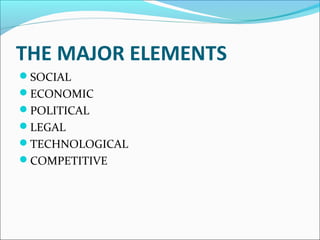
THE MAJOR ELEMENTS 
SOCIAL 
ECONOMIC 
POLITICAL 
LEGAL 
TECHNOLOGICAL 
COMPETITIVE
GLOBAL ENVIRONMENT AFFECTS 
decisions about 
• the marketing strategies 
• activities 
• Positions 
• institutions employed by your organization 
The decisions you can control depend upon the 
uncontrollable factors in the market. 
• Identify strengths, weakness, opportunity and threat.
MARKET OPPORTUNITY AND 
THREATS 
Changes in the marketing environment can directly 
affect specific markets. 
Market opportunities typically arise when markets 
increase in size or new markets are created. 
population growth, increases in income, and lower 
interest rates should present market opportunities.
OPPORTUNITY CONTD… 
Social changes, such as more women in the workforce 
and as heads of households, can affect who makes the 
car buying decision, thus creating market 
opportunities.
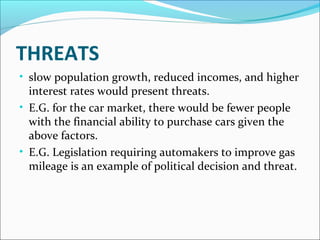
THREATS 
• slow population growth, reduced incomes, and higher 
interest rates would present threats. 
• E.G. for the car market, there would be fewer people 
with the financial ability to purchase cars given the 
above factors. 
• E.G. Legislation requiring automakers to improve gas 
mileage is an example of political decision and threat.
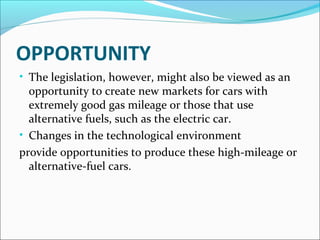
OPPORTUNITY 
• The legislation, however, might also be viewed as an 
opportunity to create new markets for cars with 
extremely good gas mileage or those that use 
alternative fuels, such as the electric car. 
• Changes in the technological environment 
provide opportunities to produce these high-mileage or 
alternative-fuel cars.
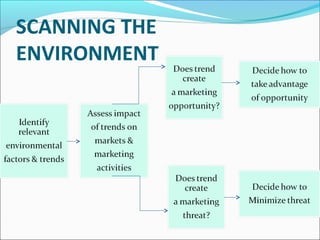
SCANNING THE 
ENVIRONMENT
THE SOCIAL ENVIRONMENT 
Includes all factors and trends related to groups of 
people, including their number, characteristics, 
behavior, and growth projections. 
Consists of: Demographic and cultural environment.
DEMOGRAPHIC ENVIRONMENT 
• The demographic environment refers to the size, 
distribution, and growth rate of groups of people with 
different characteristics. 
• The demographic characteristics of interest to 
marketers relate in some way to purchasing behavior, 
because people from different 
countries, cultures, age groups, or household 
arrangement often exhibit different purchasing 
behaviors.
GLOBAL PERSPECTIVE 
Marketers have to be familiar with the demographics 
of different countries. 
Population size and growth rate 
Must consider developing countries as well. 
Urban and rural population. 
Population age 
Family trends- married people with children
CULTURAL ENVIRONMENT 
• factors and trends related to how people live 
and behave. 
• values, ideas, attitudes, beliefs, and 
activities of specific population subgroups, greatly affect 
consumers’ purchasing 
behavior.
ISLAMIC COUNTRIES 
United in Faith. 
Islam -submission to the will of God. 
Islam consumer practices fast (ramzan), prayers, 
zakat (charity), pilgrimage (hajj). 
Source of Law: Quran. 
Properly slaughtered meat can be consumed. 
Swine, dead meat etc prohibited.
ISLAMIC COUNTRIES CONTD… 
Women should guard their beauty. 
Should not display beauty to strangers.
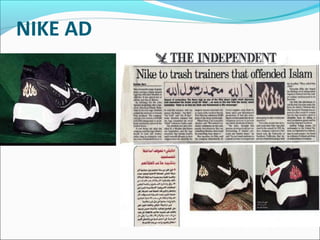
NIKE AD
CULTURAL DIVERSITY 
A cultural group’s characteristics affect the types of 
products it desires and how it purchases and uses 
those products. 
E.G. Canned food will have a bigger market in U.S.A. 
than in India.
CHANGING ROLES 
More women enter the workforce and household 
compositions change, typical household roles are 
altered. 
Women also support financially. 
Therefore, household activities will be equally shared. 
Shopping will be done by both men and women.
EMPHASIS ON HEALTH AND 
FITNESS • Eating nutritious food. 
• Diet conscious customers.- E.G. Diet drinks. 
DESIRE FOR CONVINIENCE 
• More working women. 
• Increase in purchasing power. 
• Save time. 
• Increase in products that provide convenience such as 
vacuum cleaner, microwave, etc.
CONSUMERISM 
• Protect the rights of consumers. 
• Consumer awareness and education. 
• Legal rights of the consumers. 
• Demand for higher quality and service. 
• Increase in environmentalism.
ECONOMIC ENVIRONMENT 
factors and trends related to income levels 
and the production of goods and services. 
affect the purchasing power of the markets. 
E.G. Tax free U.A.E. is a trade hub. 
E.G. Currency fluctuations. 
E.G. India has low per capita income, but potential 
market for MNCs such as KFC, Coca Cola, Pepsi. Sub 
groups have power .
POLITICAL / LEGAL ENVIRONMENT 
factors and trends related to governmental activities 
and specific laws and regulations that affect 
marketing practice. 
closely tied to the social and economic environments. 
international, state, and local levels.
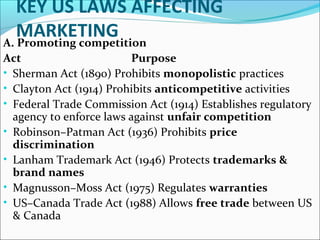
KEY US LAWS AFFECTING 
MARKETING 
A. Promoting competition 
Act Purpose 
• Sherman Act (1890) Prohibits monopolistic practices 
• Clayton Act (1914) Prohibits anticompetitive activities 
• Federal Trade Commission Act (1914) Establishes regulatory 
agency to enforce laws against unfair competition 
• Robinson–Patman Act (1936) Prohibits price 
discrimination 
• Lanham Trademark Act (1946) Protects trademarks & 
brand names 
• Magnusson–Moss Act (1975) Regulates warranties 
• US–Canada Trade Act (1988) Allows free trade between US 
& Canada
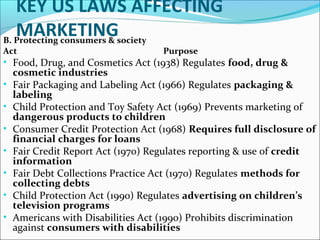
KEY US LAWS AFFECTING 
MARKETING B. Protecting consumers & society 
Act Purpose 
• Food, Drug, and Cosmetics Act (1938) Regulates food, drug & 
cosmetic industries 
• Fair Packaging and Labeling Act (1966) Regulates packaging & 
labeling 
• Child Protection and Toy Safety Act (1969) Prevents marketing of 
dangerous products to children 
• Consumer Credit Protection Act (1968) Requires full disclosure of 
financial charges for loans 
• Fair Credit Report Act (1970) Regulates reporting & use of credit 
information 
• Fair Debt Collections Practice Act (1970) Regulates methods for 
collecting debts 
• Child Protection Act (1990) Regulates advertising on children’s 
television programs 
• Americans with Disabilities Act (1990) Prohibits discrimination 
against consumers with disabilities
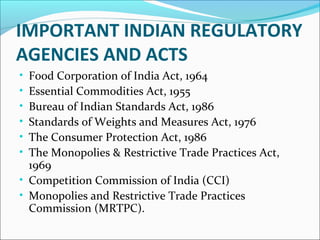
IMPORTANT INDIAN REGULATORY 
AGENCIES AND ACTS 
• Food Corporation of India Act, 1964 
• Essential Commodities Act, 1955 
• Bureau of Indian Standards Act, 1986 
• Standards of Weights and Measures Act, 1976 
• The Consumer Protection Act, 1986 
• The Monopolies & Restrictive Trade Practices Act, 
1969 
• Competition Commission of India (CCI) 
• Monopolies and Restrictive Trade Practices 
Commission (MRTPC).
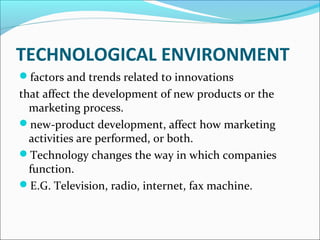
TECHNOLOGICAL ENVIRONMENT 
factors and trends related to innovations 
that affect the development of new products or the 
marketing process. 
new-product development, affect how marketing 
activities are performed, or both. 
Technology changes the way in which companies 
function. 
E.G. Television, radio, internet, fax machine.
COMPETITION 
Brand Competition- E.G. Nike, Reebok, Adidas all 
provide the same products under different brand 
name. 
Product Competition- E.G. Food Chains, Dominos, 
KFC, Pizza Hut, McDonalds. 
Expand product offerings. 
Competitive advertising.

Global marketing

  • 2.
    THE MAJOR ELEMENTS SOCIAL ECONOMIC POLITICAL LEGAL TECHNOLOGICAL COMPETITIVE
  • 3.
    GLOBAL ENVIRONMENT AFFECTS decisions about • the marketing strategies • activities • Positions • institutions employed by your organization The decisions you can control depend upon the uncontrollable factors in the market. • Identify strengths, weakness, opportunity and threat.
  • 4.
    MARKET OPPORTUNITY AND THREATS Changes in the marketing environment can directly affect specific markets. Market opportunities typically arise when markets increase in size or new markets are created. population growth, increases in income, and lower interest rates should present market opportunities.
  • 5.
    OPPORTUNITY CONTD… Socialchanges, such as more women in the workforce and as heads of households, can affect who makes the car buying decision, thus creating market opportunities.
  • 6.
    THREATS • slowpopulation growth, reduced incomes, and higher interest rates would present threats. • E.G. for the car market, there would be fewer people with the financial ability to purchase cars given the above factors. • E.G. Legislation requiring automakers to improve gas mileage is an example of political decision and threat.
  • 7.
    OPPORTUNITY • Thelegislation, however, might also be viewed as an opportunity to create new markets for cars with extremely good gas mileage or those that use alternative fuels, such as the electric car. • Changes in the technological environment provide opportunities to produce these high-mileage or alternative-fuel cars.
  • 8.
  • 9.
    THE SOCIAL ENVIRONMENT Includes all factors and trends related to groups of people, including their number, characteristics, behavior, and growth projections. Consists of: Demographic and cultural environment.
  • 10.
    DEMOGRAPHIC ENVIRONMENT •The demographic environment refers to the size, distribution, and growth rate of groups of people with different characteristics. • The demographic characteristics of interest to marketers relate in some way to purchasing behavior, because people from different countries, cultures, age groups, or household arrangement often exhibit different purchasing behaviors.
  • 11.
    GLOBAL PERSPECTIVE Marketershave to be familiar with the demographics of different countries. Population size and growth rate Must consider developing countries as well. Urban and rural population. Population age Family trends- married people with children
  • 12.
    CULTURAL ENVIRONMENT •factors and trends related to how people live and behave. • values, ideas, attitudes, beliefs, and activities of specific population subgroups, greatly affect consumers’ purchasing behavior.
  • 13.
    ISLAMIC COUNTRIES Unitedin Faith. Islam -submission to the will of God. Islam consumer practices fast (ramzan), prayers, zakat (charity), pilgrimage (hajj). Source of Law: Quran. Properly slaughtered meat can be consumed. Swine, dead meat etc prohibited.
  • 14.
    ISLAMIC COUNTRIES CONTD… Women should guard their beauty. Should not display beauty to strangers.
  • 15.
  • 16.
    CULTURAL DIVERSITY Acultural group’s characteristics affect the types of products it desires and how it purchases and uses those products. E.G. Canned food will have a bigger market in U.S.A. than in India.
  • 17.
    CHANGING ROLES Morewomen enter the workforce and household compositions change, typical household roles are altered. Women also support financially. Therefore, household activities will be equally shared. Shopping will be done by both men and women.
  • 18.
    EMPHASIS ON HEALTHAND FITNESS • Eating nutritious food. • Diet conscious customers.- E.G. Diet drinks. DESIRE FOR CONVINIENCE • More working women. • Increase in purchasing power. • Save time. • Increase in products that provide convenience such as vacuum cleaner, microwave, etc.
  • 19.
    CONSUMERISM • Protectthe rights of consumers. • Consumer awareness and education. • Legal rights of the consumers. • Demand for higher quality and service. • Increase in environmentalism.
  • 20.
    ECONOMIC ENVIRONMENT factorsand trends related to income levels and the production of goods and services. affect the purchasing power of the markets. E.G. Tax free U.A.E. is a trade hub. E.G. Currency fluctuations. E.G. India has low per capita income, but potential market for MNCs such as KFC, Coca Cola, Pepsi. Sub groups have power .
  • 21.
    POLITICAL / LEGALENVIRONMENT factors and trends related to governmental activities and specific laws and regulations that affect marketing practice. closely tied to the social and economic environments. international, state, and local levels.
  • 22.
    KEY US LAWSAFFECTING MARKETING A. Promoting competition Act Purpose • Sherman Act (1890) Prohibits monopolistic practices • Clayton Act (1914) Prohibits anticompetitive activities • Federal Trade Commission Act (1914) Establishes regulatory agency to enforce laws against unfair competition • Robinson–Patman Act (1936) Prohibits price discrimination • Lanham Trademark Act (1946) Protects trademarks & brand names • Magnusson–Moss Act (1975) Regulates warranties • US–Canada Trade Act (1988) Allows free trade between US & Canada
  • 23.
    KEY US LAWSAFFECTING MARKETING B. Protecting consumers & society Act Purpose • Food, Drug, and Cosmetics Act (1938) Regulates food, drug & cosmetic industries • Fair Packaging and Labeling Act (1966) Regulates packaging & labeling • Child Protection and Toy Safety Act (1969) Prevents marketing of dangerous products to children • Consumer Credit Protection Act (1968) Requires full disclosure of financial charges for loans • Fair Credit Report Act (1970) Regulates reporting & use of credit information • Fair Debt Collections Practice Act (1970) Regulates methods for collecting debts • Child Protection Act (1990) Regulates advertising on children’s television programs • Americans with Disabilities Act (1990) Prohibits discrimination against consumers with disabilities
  • 24.
    IMPORTANT INDIAN REGULATORY AGENCIES AND ACTS • Food Corporation of India Act, 1964 • Essential Commodities Act, 1955 • Bureau of Indian Standards Act, 1986 • Standards of Weights and Measures Act, 1976 • The Consumer Protection Act, 1986 • The Monopolies & Restrictive Trade Practices Act, 1969 • Competition Commission of India (CCI) • Monopolies and Restrictive Trade Practices Commission (MRTPC).
  • 25.
    TECHNOLOGICAL ENVIRONMENT factorsand trends related to innovations that affect the development of new products or the marketing process. new-product development, affect how marketing activities are performed, or both. Technology changes the way in which companies function. E.G. Television, radio, internet, fax machine.
  • 26.
    COMPETITION Brand Competition-E.G. Nike, Reebok, Adidas all provide the same products under different brand name. Product Competition- E.G. Food Chains, Dominos, KFC, Pizza Hut, McDonalds. Expand product offerings. Competitive advertising.

Editor's Notes

  • #3 Uncontrollable factors
  • #5 A market is a group of people or organizations with common needs to satisfy or problems to solve, with the money to spend to satisfy needs or solve problems, and with the authority to make expenditure decisions. population growth, increases in income- DEMOGRAPHIC INFORMATION
  • #7 E.G. Legislation requiring automakers to improve gas mileage is an example.- political factor Carmakers have to redesign their cars according to the law. The law can be viewed as a threat, at least in the short run, because it limits the number of current models carmakers can sell and forces them to design new models with better gas mileage. This adds to the cost of making a car, which can either reduce sales, if car prices are raised to cover the additional costs, or reduce profits, if prices are not raised. The legislation, however, might also be viewed as an opportunity to create new markets for cars with extremely good gas mileage or those that use alternative fuels, such as the electric car.
  • #12 China currently has the largest population, followed by India, with the US a distant third. The rapid growth of the Indian population is expected to make it the world’s most populous nation by the year 2100. Other countries with large and growing populations are the developing nations of Indonesia, Brazil, Pakistan, Bangladesh, and Nigeria. marketers cannot rely on population growth in developed countries alone for general increases in market size. The largest growth markets, measured by population size, are in the developing countries. Yet, lower income levels in developing countries may limit the actual market size for many products. Thus, marketers will have to look hard to find attractive growth markets in developed and developing countries. An important trend in many countries is growth of the urban population. In general, the largest cities and the highest city growth rates are in developing countries such as Mexico, Brazil, and India the largest and fastest-growing markets for many products are located in the urban areas of most countries. The aging of the population is especially evident in Italy, Japan, Britain, and the US. However, the relatively young populations in the developing countries, such as India, Nigeria, Mexico, Brazil, and China. Populations in developed countries are aging, while those in developing countries are much younger. These different demographic trends represent challenging marketing opportunities for many firms.
  • #16 http://www.infocera.com/Nike_Puma_shoes_with_Allah_in_Arabic_style_as_logo_controversy_7735.htm
  • #25 http://india.gov.in/govt/rules.php http://www.competition-commission-india.nic.in/faq.htm