Global Marketing By Usman Waheed +923006641921
Chap 01 Global Marketing
GLOBAL MARKETING Overview Global marketers consider the world as their market and different country markets as components of this world market
Defining Global Marketing AMA’s Definition of  Marketing:  Marketing is the process of planning and executing the conception, pricing, promotion, and distribution of ideas, goods, and services to create exchanges that satisfy individual and organizational objectives
Defining Global Marketing Distinguishing Features of AMA’s Definition 1. Includes nonprofit and for profit activities 2. Includes products, ideas, and services 3. Includes activities that precede and follow the  production process 4. Includes the four P’s and regards them each as equally important
Defining Global Marketing Global Marketing Defined:   …  the coordinated performance of marketing activities to create exchanges across countries that satisfy individual, organizational , and societal objectives
Defining Global Marketing Global marketing is conducted across countries (not domestic or foreign) Global marketing coordinates activities across different country markets Global marketing should be motivated by individual, organizational, and societal goals
The Global Marketing Environment Focal Point--Consumer Use the Four P’s to Satisfy Consumers Economic, Financial, Political, and Cultural  Environmental of Each Country Affect marketing Regional and Global Environments Affect Marketing
Why Should Firms Engage in Global Marketing? To Survive and Grow 1. Learn to satisfy consumers in diverse conditions 2. Manage marketing tasks more efficiently and effectively 3. Preempt or counter competitive attacks in more than one market 4. Expand customer base to include developed and developing nations
Why Should Firms Engage in Global Marketing? To Diversify Product and Market Portfolios and Improve competitiveness 1. Effects of seasonal and cyclical fluctuations in one market offset by others 2. Diversification increases market size and enhances economies of scale
Why Should Firms Engage in Global Marketing? To Capitalize on the Attractiveness of Additional Country Markets 1. The U.S. is attractive-but won’t accommodate unlimited growth  2. Expand market size by expanding into other countries 3. Maurice G. Hardy: Why expand into other countries? A. Keep competitors in their own countries;  b. Take advantage of growing opportunities in Europe and the Pacific
Why Should Firms Engage in Global Marketing? To Operate Within a Global Marketplace 1.  Goods, services, capital, technology, and labor are going global 2. Reduced government restrictions are affecting global marketing 3. Bilateral and multilateral negotiations are reducing restrictions
What is Unique about Global Marketing?  Country market environments different  Economic Environment ( Purchasing Power, Competitive Intensity, Economy’s Health) 1. Fiscal policies - tax rates and spending  programs of government  2. Monetary policies -  regulate money supply
What is Unique about Global Marketing?  Country market environments different  Financial Environment 1. Exchange rate -  price of one currency in relation to another 2. Exchange rate fluctuations can adversely  or favorably affect performance of a firm
What is Unique about Global Marketing? Country market environments different  Political Environment 1. Tariff barriers -  taxes on imports paid to customs officials - include  a.  Specific -  fixed amount per physical unit of import b. Ad -valorem ( on the value ) -  percentage of estimated value of import 2. Nontariff barriers include a. Import quotas  b. Exchange controls c. Buy-domestic policies d. administrative red tape
What is Unique about Global Marketing? Country market environments different ? Cultural Environment 1. Differences encourage marketing adaptations 2. Similarities encourage standardization 3. Balancing the two is a key to success
Marketing Mix Politics - How Do Government Influence the Four P’s ? Product - Local Content Law Price - Government Approval for Price Changes Promotion -  Permissible Budget Determined by Local Authorities Place -  Mandated Distribution Channel or Territory
Why Should We Study Global Marketing ? Influences Product Choices of Consumers Influences standard of living Influences Job Opportunities Influences the society
Thank You!
The Global Economic Environment Global Marketing
What’s happening? Asia Pacific Western Europe North America South America Why and what are the implications?
THE ECONOMIC ENVIRONMENT Overview Local, regional, and global economic environments are interactive. What happens within and among them profoundly influences marketing mix decisions.
The Local Economy - The Country Where Marketing Takes Place The Consumers 1. Disposable income (after-tax income) 2. What, when, where, and how much consumers buy is influenced by disposable income
The Local Economy - The Country Where Marketing Takes Place The Country 1. Healthy economies facilitate higher purchasing power for consumers
The Local Economy - The Country Where Marketing Takes Place 2 . Economic variables: GDP; GDP per capita; GDP  growth rates; savings and investments rates; inflation and unemployment rates; imports and exports; inflow and outflow of FDI;  number of global corporations in the country; structure of industries; commercial, fiscal, and monetary policies of the central government 3. These variables reflect the overall country, not specific groups of consumers--don’t generalize
The Local Economy - The Country Where Marketing Takes Place The Competition - Know Where You Stand in Relation to the Competition 1. Porter’s five forces determining the state of competition: rivalry among existing firms, potential impact of newcomers, power of suppliers, power of buyers, substitute goods 2. Prominence of each force varies by industry
The Regional Economy Agreements Among Nations Include 1. Free-trade areas - no barriers among members, national barriers against the rest of the would  2. Customs unions - no barriers among members, adopt common barriers against the rest of the world 3. Common markets - form customs unions with free movement of labor and capital 4. Economic unions - one economy, one currency, unified fiscal and monetary policies
The Regional Economy The European Economic Integration 1.  15 Western European countries moving towards economic union 2. EU - to enhance competitive edge of EU firms in relation to non - EU firms
The Regional economy The Asian Pacific Economies 1. The NICs - South Korea, Taiwan, Hong Kong, Singapore - high-value-added competitors 2. Malaysia, Indonesia, Thailand, Philippines - entering high-value-added marketers 3. Trade in region has been fueled by a.  Increasing domestic demand  b.  Expanding business involvement overseas c. Growing competitiveness of firms based in region
The Regional Economy The north America Free Trade Agreement  (NAFTA) 1.  U.S., Canada, Mexico 2. Designed to increase size of north American market, reduce trade barriers within, increase competitive edge of member firms
The Global economy Increasing Trade and Investment 1. Why exports increased a . Businesses - to improve competitiveness and performance b. Governments - to stimulate domestic economic growth 2.  Foreign direct investment growing faster than exports a . Role in transferring technology, managerial expertise, financial resources b. Five major sources: U.S., United Kingdom, Germany, France, Japan
The Global Economy Increasing Interdependence - Our fate is tied to that of others Increasing Competition - More players, More intensive competition Increasing Complexity -  Policies designed for one country affect the performance of others
THE GLOBALIZATION OF THE U.S. ECONOMY Future Growth Cannot Rely Exclusively on Domestic Market Firms with Global Operations can Better 1. Develop new products 2. Establish new markets 3. Cross-subsidize products and markets - use financial resources from one market to fight in another
Thank You!
Chapter 03 The Financial Environment
The Financial Environment Overview Understanding and managing the key elements of the financial environment are requisites for successful global marketing
Key Features of the global Financial System Acceptability and Convertibility of Currencies from Different countries Hard Currencies Are Freely Traded in Foreign Exchange markets  Soft Currencies Are Not Freely Traded
Key Feature of the Global Financial System Exchange Rates - The Price of One Currency in Terms of Another 1.  Floating exchange rates are determined by market conditions alone 2.  Managed float  is determined by government-managed demand and supply
Key Feature of the Global Financial System Depreciation and Appreciation of One currency in Relation to Another Price Demand Profit Market penetration
Managing exchange Risks Through Spot Transactions and Forward Transactions Four Types of exchange Risks 1. Transaction exposure - when converting currencies at a later date 2. Translation exposure - when exchange rates upon consolidation differ from those at time of transaction 3. Tax exposure - when changing exchange rates result in a different tax liability 4. Economic exposure - long-term exposure and its affect on present value of future cash flow
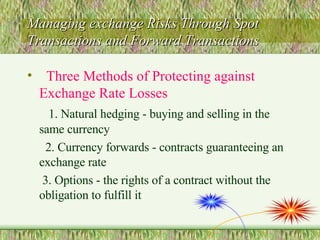
Managing exchange Risks Through Spot Transactions and Forward Transactions Three Methods of Protecting against Exchange Rate Losses 1. Natural hedging - buying and selling in the same currency 2. Currency forwards - contracts guaranteeing an exchange rate 3. Options - the rights of a contract without the obligation to fulfill it
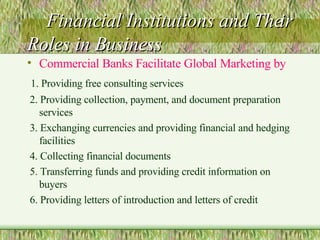
Financial Institutions and Their Roles in Business Commercial Banks Facilitate Global Marketing by 1. Providing free consulting services 2. Providing collection, payment, and document preparation  services 3. Exchanging currencies and providing financial and hedging facilities 4. Collecting financial documents 5. Transferring funds and providing credit information on buyers 6. Providing letters of introduction and letters of credit
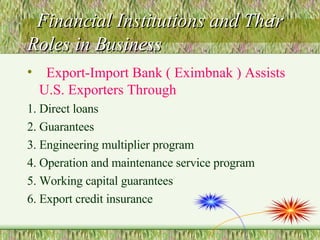
Financial Institutions and Their Roles in Business Export-Import Bank ( Eximbnak ) Assists U.S. Exporters Through 1. Direct loans 2. Guarantees 3. Engineering multiplier program 4. Operation and maintenance service program 5. Working capital guarantees 6. Export credit insurance
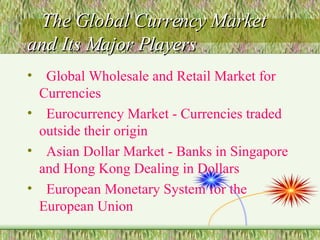
The Global Currency Market and Its Major Players Global Wholesale and Retail Market for Currencies Eurocurrency Market - Currencies traded outside their origin Asian Dollar Market - Banks in Singapore and Hong Kong Dealing in Dollars European Monetary System for the European Union
Thank You!
Chapter 04 THE POLITICAL AND  LEGAL ENVIRONMENT
THE POLITICAL AND LEGAL ENVIRONMENT Overview After global marketers understand why and how governments regulate their business activities, they can better analyze and respond to governmental actions
Why Do Governments Intervene? To stay in power To achieve socioeconomic goals Macro-systemic concerns identified by Boddewyn and Cracco 1. To protect the national interest  2. To maintain national sovereignty 3. To preserve the national identity
Types of Interventions In ownership and Control   1. Confiscation - takeover without compensation 2. Expropriation - takeover with compensation 3. Domestication - relinquishment of ownership and control to locals
Types of Interventions Other Forms of Intervention 1. Exchange controls 2. Export requirement as percentage of local output 3. Import restrictions 4. Taxation increases
Types of Intervention Some Marketing Mix Regulations 1. Local content law (product) 2. Price ceiling (price) 3. Distribution territory specifications (place) 4. Local advertising agency requirement (promotion)
Assessing Political Risk - Estimating the likelihood of Governmental Intervention Seeking Experts’ Opinions   1. Current and retired government officials familiar with the local situation 2. Academics specializing in a region and its politics Conducting In-House Research to Monitor Political developments
Assessing Political Risk - Estimating the likelihood of Governmental Intervention Utilizing Secondary Sources Who Provide Risk Indexes 1. BERI (Business Environment Risk Index) 2. Business International (BI) 3. Frost & Sullivan 4. PSSI (Political System Stability Index)
Managing Political Risk Through Lobbying, Proactive Measures, and Insurance Identify with the country - Don’t maintain a foreign image Help the host country achieve its societal goals 1. Improve local management skills 2. Increase local productivity 3. Increase local employment
Managing Political Risk Through Lobbying, Proactive Measures, and Insurance Promote Vertical Integration by Linking Corporate Activities Across Countries Stay Ahead of Intervention by Upgrading Bargaining Power 1. Keep introducing new products and technology 2. Increase exports
Managing Political Risk Through Lobbying, Proactive Measures, and Insurance Insure Against Political Risk 1. Overseas Private Investment Corporation (OPIC) 2. Foreign Credit Insurance Association (FCIA)
Thank you!
Chapter 05 The Culture Enviroment
THE CULTURAL ENVIRONMENT Overview Developing marketing activities in harmony with the local culture can mean the difference between success and failure in a market
Characteristics of Culture - What They All Have in Common Culture Is Prescriptive -Defines What Is Acceptable Culture Is Learned - not Genetic Culture is Dynamic - An Interactive Relationship Between Behavior and Culture Culture Is Subjective - Meanings Vary by Culture
Low-Context and High-Context Cultures - Verbal And Nonverbal Messages Determine meaning Low-Context Cultures - What Is Said Is More Important Than How or Where It Is Said 1.  U.S. 2. Germany High-Context cultures - What Is Said and How or Where It is Said Are Significant 1.  Asia 2. Latin America 3. Middle East
Monochronic and Polychronc Cultures - Hall and Hall Monochronic 1. Linear information processing 2. Focus on one thing at a time 3. Hold to rigid schedules Polychronic 1. Work on several tasks at a time 2. Human transactions are important
Culture and Verbal Communications - Understanding Through language One Language - English -Meaning can Vary by Country Using Language to Interpret the World What Works here May Not Work There
Culture and Nonverbal Communication -  Can Actions Speak Louder Than Words ? Perception of Time Affects the Quality of Marketing Interactions 1.  For some, time is linear and fixed 2.  For others, time is on a continuum Perception of Space Influences Business Decisions 1.  Product size  2.  Retail store layout  3.  Office design 4.  Feng Shui
Culture and Nonverbal Communication -  Can Actions Speak Louder Than Words ? Symbols Are Communication Shorthand 1.  Colors convey symbolic meaning 2.  Numbers - lucky or unlucky 3.  Products - luxury or necessary Negotiations -  Sometimes a Handshake Seals the Deal  Gift Giving
Self-Reference Criterion - Unconscious Reference to One’s Own Cultural Values Lee’s Four-Step Process to Avoid Self-Reference Mistakes 1.  Define goal in terms of own cultural traits 2.  Define goal in terms of foreign cultural traits 3.  Isolate SRC influence and anticipate the complications 4.  Redefine problem without SRC influence and find solution Multicultural Training Programs to Improve Cross-Cultural Interactions
Understanding Cultural Universals Can Help Marketers Develop effective Product Strategies
Thank you!
Chap 06 Global Product Strategies
GLOBAL PRODUCT STRATEGIES Overview Although all four elements of the marketing mix are essential for success, a product’s performance determines whether consumers will engage in repeat purchases
What Is a Product ? Anything with exchange Value (Objects, Ideas, Organizations, People) The Total Product  1. Tangible attributes: raw materials, size, weight, features, design, packaging 2. Intangibles: brand image, styling, other benefits (installation, delivery, credit, warranty, after-sale service, return policy)
The Product Development Process Generating Ideas 1. To tap new or existing markets, complement product lines, improve products 2. From consumers, competitors, employees, inventors, research organizations, universities 3. Global firms’ advantage - exposure to numerous country markets
The Product Development Process Screening Ideas 1. Acceptable versus unacceptable 2. Criteria: compatibility, production fit ,  philosophical fit, competitive fit, potential  3. Misclassifying or ignoring ideas can be costly Business Evaluation 1. Cost-benefit analysis 2. Commercial viability-existing and prospective markets
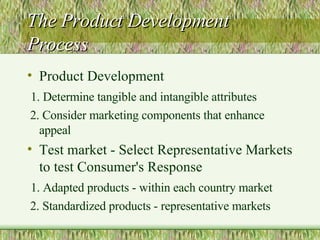
The Product Development Process Product Development 1. Determine tangible and intangible attributes 2. Consider marketing components that enhance appeal Test market - Select Representative Markets to test Consumer's Response 1. Adapted products - within each country market 2. Standardized products - representative markets
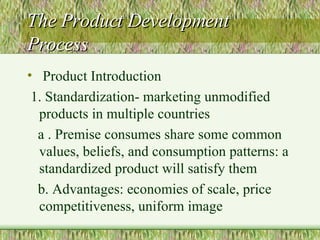
The Product Development Process Product Introduction 1. Standardization- marketing unmodified products in multiple countries  a . Premise consumes share some common values, beliefs, and consumption patterns: a standardized product will satisfy them b. Advantages: economies of scale, price competitiveness, uniform image
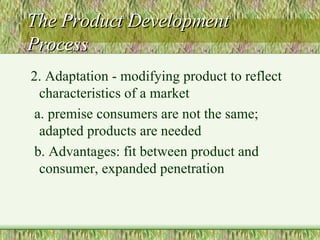
The Product Development Process 2. Adaptation - modifying product to reflect characteristics of a market  a. premise consumers are not the same; adapted products are needed  b. Advantages: fit between product and consumer, expanded penetration
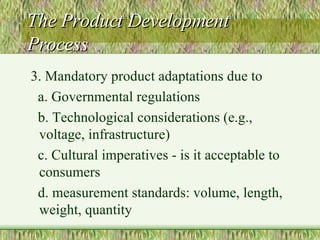
The Product Development Process 3. Mandatory product adaptations due to a. Governmental regulations b. Technological considerations (e.g.,  voltage, infrastructure) c. Cultural imperatives - is it acceptable to consumers d. measurement standards: volume, length, weight, quantity
Product Adoption Relative Advantage - To satisfy Needs Better Than the Competition Compatibility - The Fit of Product to Norms, Values, and Tastes of Market Trialability - Ease of Sampling a New Product Complexity - Easier to Use, More Likely to Be Adopted Observability - To What Extent Benefits Can Be Observed and Understood
Product management (Product-Market Portfolio Matrix) Competitive Strength: Market Share, Product’s Fit to Customer Expectations, Marketing Ability, Product Positioning, Channel Cooperation, Profit Potential  Country Attractiveness: Market Size, Growth Rate, Competitive Environment, Governmental Regulations, Political Stability
The U.S. Economy and the Product Composition of Its exports ( Largely High-Value-Added Products )
Competitive Product Developments
Chap 07 Global Pricing Decision
Global Pricing Decisions Overview Of the four P’s, price alone generates revenue.  Competitive pricing enhances market position and earnings
Pricing Methods Cost-Oriented Methods - Focus on Cost, Not Market Conditions 1. Markup pricing - adding markup to unit cost of product a. Information needed: fixed cost, variable cost, expected sales, markup b. Appeal is simplicity c. Risks: overpricing and underpricing
Pricing Methods 2. Standard pricing - charging the same price in all countries a. Drawbacks: lacks marketing orientation, difficult to implement b. Advantage: firm won’t be blamed for price discrimination
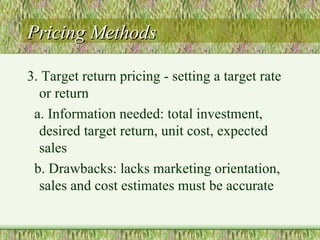
Pricing Methods 3. Target return pricing - setting a target rate or return a. Information needed: total investment, desired target return, unit cost, expected sales b. Drawbacks: lacks marketing orientation, sales and cost estimates must be accurate
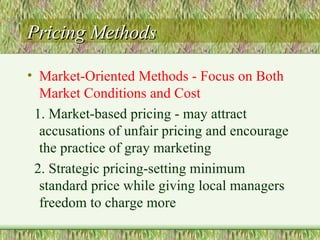
Pricing Methods Market-Oriented Methods - Focus on Both Market Conditions and Cost 1. Market-based pricing - may attract accusations of unfair pricing and encourage the practice of gray marketing 2. Strategic pricing-setting minimum standard price while giving local managers freedom to charge more
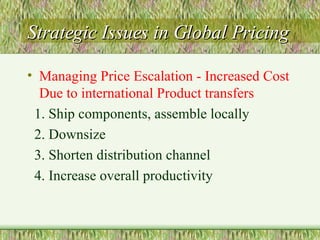
Strategic Issues in Global Pricing Managing Price Escalation - Increased Cost Due to international Product transfers 1. Ship components, assemble locally 2. Downsize 3. Shorten distribution channel 4. Increase overall productivity
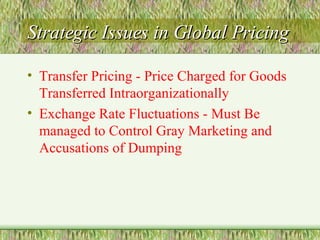
Strategic Issues in Global Pricing Transfer Pricing - Price Charged for Goods Transferred Intraorganizationally  Exchange Rate Fluctuations - Must Be managed to Control Gray Marketing and Accusations of Dumping
Strategic Issues in Global Pricing Gray marketing or Parallel Imports - Buying in Low-Price Countries, Selling in High-Price Countries 1. Causes: market-based pricing and exchange rate fluctuations 2. Remedial measures: narrow price differential, differentiate product
Strategic Issues in Global Pricing Dumping - Selling at Price Below Normal Value in Export Market 1. Sporadic - to reduce surplus inventory 2. Predatory - to drive out competitors, to gain market control 3. Persistent - high prices in protected markets,low in competitive markets
Terms of Payment EXW (Ex Works) - For Goods at Point of Origin FAS (Free Alongside Ship) - For Goods Delivered Alongside Vessel FOB (Free on Board) - For Goods Aboard Vessel C&F (Cost and Freight) - For Goods at Overseas Port
Terms of Payment CIF (Cost, Insurance, Freight) - For Goods at Point of Debarkation CPT (Carriage Paid To) -  same as C&F for Nonwater Transportation CIP (Carriage and Insurance Paid To) - Same as CIF for nonwater Modes
Modes of Payment Cash in Advance  Open Account - Payment for Goods at Future Date
Modes of Payment Letter of Credit - Issued by a Bank 1. Revocable - can be altered by buyer after issuance 2. Irrevocable -  cannot be altered without an agreement between the buyer and the seller 3. Confirmed -seller assured of payment by seller’s bank 4. Confirmed Irrevocable
Modes of Payment Draft or Bill of Exchange - Negotiable Instrument 1. Sight ---payable upon presentation 2. Time ---payable within specified period 3. Date - payable on specific future date
Modes of Payment Forfating - seller Paid by Bank, Not Buyer Countertrade -  Payment in Whole or in Part by Goods or Services 1. Barter - no money changes hands 2. Counterpurchse - goods purchased from each other with cash 3. Compensation deals - payment in both cash and goods 4. Buyback arrangements
Chap 08 Global Logistics Channels
GLOBAL LOGISTICS CHANNELS Overview Moving raw materials and finished products from one country to another creates challenges unique to global distribution
Features of Global Logistics Global Flow of Materials - Components Moved Elsewhere for Assembly Global Distribution of Products - Finished Products Moved to Final Markets
Features of Global Logistics Functions of the Global Distribution Channels Can Include 1. Collect, analyze, and transmit information 2. Initiate and maintain contacts with buyers 3. Receive, process, and execute orders 4. Arrange shipping, insurance, and delivery 5. Take title to goods 6. Make the sale
Features of Global Logistics Channel Intermediaries Include  1. Merchant middlemen - take title and assume risks 2. Agent middlemen - do not take title Goals of Channel Management 1. Efficiently move products from home country to host country 2. Deliver satisfaction t final customers competitively
The Direct Channel of Global Distribution - Dealing directly with Overseas Middlemen or Consumers Host Country Distributors Are Merchant Middlemen 1. Buy from firm, sell to retailers or final consumes 2. Often enjoy exclusive rights for product or region 3. It is a long-term commitment - choose carefully 4. Robinson listed provisions of what to include in the contract
The Direct Channel of Global Distribution - Dealing directly with Overseas Middlemen or Consumers Host Country Retailers Are Merchant Middlemen 1. Buy from firm, sell to final consumes 2. Japanese retailers - greater in number, serve fewer customers than U.S. counterparts 3. International retail outlets in the rise
The Direct Channel of Global Distribution - Dealing directly with Overseas Middlemen or Consumers Import Jobbers Are Merchant Middlemen in Host Country 1. Buy from firm, sell to intermediaries or final consumers 2. Do not have exclusive territories 3. Firm may employ several in one country
The Direct Channel of Global Distribution - Dealing directly with Overseas Middlemen or Consumers Manufacturer’s representatives are Agent Middlemen 1. Do not take title but represent firm 2. Choose carefully - often difficult to terminate relationships Consumers - No Intermediaries
The Indirect Channel of Global Distribution -Relying on Home-Country Intermediaries Export Drop Shippers 1. Take orders from buyer and tell seller to ship to buyer 2. Buyer pays drop shipper who pays firm 3. Do not hold inventories, offer minimal promotional help
The Indirect Channel of Global Distribution -Relying on Home-Country Intermediaries Export Merchants 1. Buy from firm, sell abroad 2. Assume risk 3. Advantage to firm: easy to establish marketing presence Export Trading Companies (ETCs) Can Act as Export Department for Firm or Take Title to Products
The Indirect Channel of Global Distribution -Relying on Home-Country Intermediaries Manufacturer’s Export Agents (MEAs) Are Agent Middlemen 1. Represent firm and provide selling services 2. Use own name, not the firm’s  3. Services are specified in contract
The Indirect Channel of Global Distribution -Relying on Home-Country Intermediaries Export Management Companies (EMCs) Are Agent Middlemen 1. Provide extensive marketing services 2. Earn commission, or salary, or work on retainer
The Indirect Channel of Global Distribution -Relying on Home-Country Intermediaries 3. Advantages a. Are helpful in markets where firm has little experience b. Require less investment (financial and personnel) in market
The Indirect Channel of Global Distribution -Relying on Home-Country Intermediaries 4. Disadvantages a. May not make necessary investments b. May demand startup costs c. May underrepresent firm d. reduce gross margins, impede customer communications, hinder market assessment
The Indirect Channel of Global Distribution -Relying on Home-Country Intermediaries Export Brokers Are Agent Middlemen 1. Work for fee or commission 2. Relationship is sporadic
The Indirect Channel of Global Distribution -Relying on Home-Country Intermediaries Webb-Pomerence Association 1. U.S. firms can legally combine resources to expand exports 2. Cannot reduce U.S. competition by doing so  3. Association performs functions for members
Designing a Distribution Channel Within a Host Country - Important Factors Consumer Characteristics - Know Where , When, What, How and Why They Buy Product Characteristics Influence Channel Decisions Market Characteristics   1. Assess strengths of existing distribution structure 2. Adapt to local conditions as needed
The Indirect Channel of Global Distribution -Relying on Home-Country Intermediaries Channel Costs 1. Development costs - initial outlay 2. Maintenance costs - operation expenses 3. Level of customer service directly related to cost   Coverage -  Concentrated Within Major Cities or Spanning the Whole Country
Managing Channel Alliances - Relationships Evolve Communicating with Channel Members 1. Communicate goals to them 2. Receive feedback from them 3. Employ telecommunications technology to achieve goals
Managing Channel Alliances - Relationships Evolve Motivating Channel Members 1. Offer training  2. Provide promotional displays 3. Participate in cooperative advertising
Managing Channel Alliances - Relationships Evolve Controlling Channel Members 1. Develop performance criteria 2. Evaluate performance against criteria 3. Take corrective actions if needed  4. Design system for timely attention to channel performance
Managing Channel Alliances - Relationships Evolve 5. Challenges for effective control a. Reliable performance data may be lacking b. cost of gaining data may exceed benefit c. Changes in environment may outdate criteria
Evaluating Channel Performance - Measurement  Criteria Sales Analysis - Actual Versus Expected  Level of Service - Does It meet Consumer Needs? Level of Inventory - Is it Adequate t Meet Demand?
Chap 09 Global Promotion Strategies
GLOBAL PROMOTION STRATEGIES Overview  Marketing communications include advertising, sales promotion, personal selling, and public relations. When communicating with publics in more than one country, firms must work within the limitations of each market to maximize their promotional objectives.
Elements of the Communication Process Sender  Encoding Message Medium of Transmission Receiver Decoding Response Feedback Noise
Global Advertising - Any Paid Form of Nonpersonal communication Where the Sponsor Is Identified Often Controversial Benefits Derived from Advertising 1. Economic  a. Sales increase  b. Production increases c. Per-unit cost of product goes down - economies of scale
Global Advertising - Any Paid Form of Nonpersonal communication Where the Sponsor Is Identified d. Price decreases e. Sales increase further f. Competition increases - yielding higher productivity and better product quality 2. Social  a. Employment is generated b. Higher standard of living
Planning an Advertising Campaign - Specify Objectives; Then Decide On   Advertising Message 1. Standardize when country markets are similar 2. Adapt when they are different 3. Avoid taboos of target market - don’t offend
Planning an Advertising Campaign - Specify Objectives; Then Decide On Budget and Allocation Based on Internal and External Conditions 1. Internal conditions a. management orientation b. Advertising objectives c. Resources available
Planning an Advertising Campaign - Specify Objectives; Then Decide On 2. External conditions a. Governmental regulations b. Competitors’ advertising strategies c. Market attractiveness d. Media restrictions
Planning an Advertising Campaign - Specify Objectives; Then Decide On Media Options and Country Characteristics - Effectiveness Versus Economy 1.  Television a. Developed countries (DCs) - countrywide availability  b. LDCs - concentrated in major cities, per capita ownership of TVs is lower c. Limitations: ads may be bunched, broadcasting times vary, ads regulated

Planning an Advertising Campaign - Specify Objectives; Then Decide On 2. Radio a. DCs - popularity on the rise, many program options available b. LDCs - good medium to reach uneducated urban and rural customers  3. Magazines
Planning an Advertising Campaign - Specify Objectives; Then Decide On 4. Newspapers a. Advantages: fast and economical b. Disadvantages: some LDCs don’t compile demographic data; they have space limitations and content specifications
Planning an Advertising Campaign - Specify Objectives; Then Decide On 5. Direct mail a. DCs - more common b. LDCs - limited opportunities, lack of reliable lists, undependable delivery, low literacy rates 6. Catalogs - limited to DCs for same reasons as for direct mail
Planning an Advertising Campaign - Specify Objectives; Then Decide On 7. Facsimile - controversial 8. Videos a. Time not limited to 30- or 60- second slots b. DCs - whole video can be an ad c. LDCs - movie d\videos contain ads 9. Cinema - these ads more common in LDCs  10. Billboards - all countries
Planning an Advertising Campaign - Specify Objectives; Then Decide On Advertising Regulations - Know Them and Adapt Message Accordingly Agency Selection 1. Global agency  2. Local agency 3. Combination of both
Global Sales Promotions - Short-Term Efforts to Increase Sales Consumer Sales Promotion Techniques - Can Foster Long- Term Objectives 1. Coupons - maintain current customers, attract new ones 2. Rebates - maintain current customers, attract new ones 3. Free samples - encourage new users by eliminating cost 4. Mail-in premiums
Global Sales Promotions - Short-Term Efforts to Increase Sales 5. In-pack premiums - promotional benefit packaged with the product 6. Bonus packs - more product for the same price 7. Trading stamps - increase store patronage 8. Contests and sweepstakes - enhance name recognition and stimulate sales
Global Sales Promotions - Short-Term Efforts to Increase Sales Trade Sales Promotion Techniques - Persuade Channel Members to Carry Products or to Increase Sales 1. Sales contests - increase sales 2. Price-off offers - push new products or move large quantities 3. Advertising allowances
Global Sales Promotions - Short-Term Efforts to Increase Sales 4. Display allowances 5. Free goods 6. Push money - money to carry and to push products
Global Personal Selling - Keeping Buyers Happy, the Firm Informed  The Personal Selling Process 1. Panning: what, how, when 2. Prospecting: who 3. Preparing:  what buyers need, competitors offer
Global Sales Promotions - Short-Term Efforts to Increase Sales 4.  Selling a. Approaching customer b. Making presentation c. Answering questions d. Closing sale 5. Following up - establishing solid link
Global Sales Promotions - Short-Term Efforts to Increase Sales Managing the Global Sales Force Sales Force Compensation 1.  Straight salary a. Advantages: sales force security, easy to administer b. Disadvantage: lower sales if unmotivated sales force
Global Sales Promotions - Short-Term Efforts to Increase Sales 2. Straight commission - fixed percentage or varying percentage a. Advantage:  encourages performance b. Disadvantage:  salespeople may stop with quotas 3. Combination salary and commission
Global Public Relations - Tools for Building a Favorable Image Employee Relations - Create Favorable Ambassadors to the Community Customer Relations - Show Firm Cares About Customers Press Relations - Keep Shapers of Public Opinion on Firm’s Side Government Relations - Be a Good Citizen
Chap 10 Global Business Involvement
GLOBAL BUSINESS INVOLVEMENT: MARKET ENTRY STRATEGIES Overview Entry strategies vary in terms of their advantages, disadvantages, and levels of involvement. The marketing options open to firms are in part determined by mode f entry.
Entry Strategies Exporting --Historically Most Popular 1. Types a. Direct - firm handles all tasks to sell within host country b. Indirect - firm delegates the tasks to an intermediary
Entry Strategies 2. Advantages a. Minimizes political risk b. Useful when market potential is hard to assess c. Offers channel flexibility d. Prepares firm for greater involvement e. Offers ease in market withdrawal
Entry Strategies 3. Disadvantages a. Exchange rate fluctuations and  governmental intervention can affect  earnings b. Lack of market presence can affect  response time c. Loss of marketing control can affect  corporate image
Entry Strategies Licensing - Payment of  Fee or Royalty for Use of Anything of Value 1. Advantages a. To firm, cost effective b. To importing country, brings technology and managerial expertise
Entry Strategies 2. Disadvantages a. Can restrict firm’s full realization of market potential  b. Can create third market competitors c. Can result in loss of control over technology and product quality d. Can result in conflicts between parties
Entry Strategies Franchising - Payment of Fee and Royalty in Exchange for Anything of Value Plus Operational and Managerial Help 1. Advantages: same as for licensing 2. Disadvantages: same as for licensing
Entry Strategies Contract Manufacturing - Contractual Partner manufactures Parts or Product for Firm 1. Advantages a.  Firm can focus exclusively on marketing b. Economical means of expansion
Entry Strategies 2. Disadvantages a. Partner may turn competitor b. Loss of control over manufacturing c. Products may not always be available on time
Entry Strategies Management Contracting - Selling Managerial or Technical Expertise 1. Advantages a. Utilizes excess managerial talent b. Establishes contacts in host country c. Offers ease of remitting consulting fees d. Provides resources t its nearby operations 2. Disadvantages: limited duration may necessitate withdrawal from country
Entry Strategies Turnkey Operations - Complete the Project Before Turning It Over to Owner 1. Advantages: projects are large, long-term, an profitable 2. Disadvantage: outcome is more uncertain over longer period of time
Entry Strategies Foreign Direct Investment 1. Joint ventures (JVs) - partners share ownership,  risk, profit, and control  a. Between foreign-owned firm and privately owned local firm b. Between foreign-owned firm and local state firm or government c. Between several foreign-owned firms with no local participation
Entry Strategies 2. Wholly-owned subsidiaries (WOSs) 3. Advantages of both JVs and WOSs a. Greater control b. Entry into closed markets c. Potential for vertical integration d. Access to supplies e. Ability to respond to competitive challenges
Entry Strategies 4. Disadvantage of JVs: potential for disagreements among partners 5. Disadvantage of WOSs: greater risk
Entry Strategies Strategic Alliances - Cooperation Between Firms Without creating a New Entry 1.  Advantages a. market access b. Shared R&D expenses, resources, and risks
Entry Strategies 2. Disadvantages a. Potential to lose competitive edge b. Possible ineffectual communications among partners from different cultures
Factors Influencing Entry Strategies Internal Conditions - Specific to the Firm 1. Objectives - what firm wants to achieve in relation to the product 2. Management orientation - biases affect entry strategy decisions 3. Resources - impose constraints that affect entry strategies 4. Type of product - what strategy best fits the characteristics of the product
Factors Influencing Entry Strategies External conditions 1. Market potential - which strategy will maximize market potential  2. Competitive environment - existing and expected
Factors Influencing Entry Strategies 3. Home country regulations - affect how and where firm can sell 4. Host country regulations - affect entry options 5. Political risk - high risk favors less involvement; low risk favors more
Stages of Business Involvement The International Product Life-Cycle Hypothesis 1. New-predate stage: manufactured at home, some exports to developed countries (DCs), domestic sales dominate, no competition, high price, patent protection
Stages of Business Involvement 2. Maturing-product stage: DC demand rises, increasing exports yield to production in DCs, domestic exports decline, competition increases, prices fall, DCs produce for selves and export 3. Standardized-product stage: fierce price competition, production shifts to developing countries, they start exporting to DCs who become net importers
Chap 11 Strategic Global
STRATEGIC GLOBAL MARKET MANAGEMENT Overview The nuts and bolts of strategies deal with when, where, how, why, and by whom the necessary actions are performed to achieve a firm’s objectives
Strategic Analysis Strengths and Weaknesses 1. Identify key success factors specific to a given business a. Technology - turning concepts into products b. Marketing - ability in product, price, place, and promotion
Strategic Analysis c. Information management - the acquisition an use f information d. management skill - decision making and behavior of managers 2. Rate self on key factors in relation to competitors
Strategic Analysis Opportunities and Threats - Existing and Potential 1. First identify; then rank order 2. Key areas: customers, special-interest groups, competitors, governments, technologies, markets
Strategies Product-market Growth matrix - Four Basic Growth Strategies 1. Market Penetration--use existing products to penetrate existing markets 2. Product development--sell new or adapted products in existing markets 3. Market development--sell existing products in new markets 4. Diversification--introduce new or adapted products into new markets
Strategies Strategic Business Unit (SBU) Portfolio Strategy Using the Boston Consulting Group’s Growth-Share Matrix 1. Stars: high-growth market, high market shares 2. Problem children: high-growth market, how market shares 3. Cash cows: low-growth market, high market shares 4. Dogs: low-growth market, low market shares
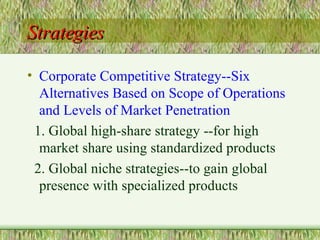
Strategies Corporate Competitive Strategy--Six Alternatives Based on Scope of Operations and Levels of Market Penetration 1. Global high-share strategy --for high market share using standardized products 2. Global niche strategies--to gain global presence with specialized products
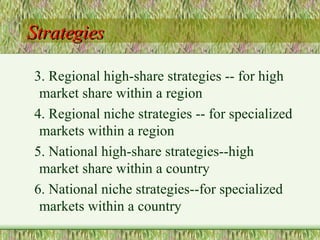
Strategies 3. Regional high-share strategies -- for high market share within a region 4. Regional niche strategies -- for specialized markets within a region 5. National high-share strategies--high market share within a country 6. National niche strategies--for specialized markets within a country
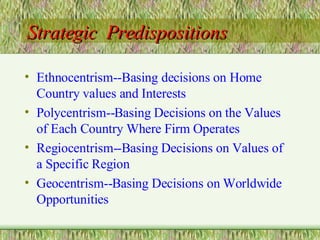
Strategic  Predispositions Ethnocentrism--Basing decisions on Home Country values and Interests Polycentrism--Basing Decisions on the Values of Each Country Where Firm Operates Regiocentrism--Basing Decisions on Values of a Specific Region Geocentrism--Basing Decisions on Worldwide Opportunities
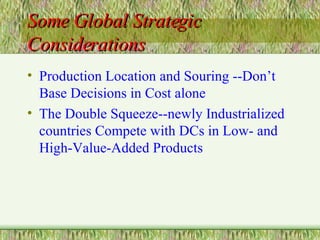
Some Global Strategic Considerations Production Location and Souring --Don’t Base Decisions in Cost alone The Double Squeeze--newly Industrialized countries Compete with DCs in Low- and High-Value-Added Products
Some Global Strategic Considerations Business and Politics--Government Influences Its Firm's Competitive Advantage Post-Marketing Concerns--Satisfying Consumers Within Environmental Constraints and in Harmony with Special-Interest Groups
Chap 12 Ethics and Global Marketing
ETHICS AND GLOBL MARKETING Overview Ethics is needed for long-term success. Internal and external forces encourage firms to become ethical global citizens.  Management strategies, codes of conduct, ethical philosophies, and decision-making checklists are some of the tools firms are using to foster ethical actions
Why Ethics? Gellerman: Manages Rationalize Unethical Actions 1. It is legal (ethical) 2. It is in our interest (mine, company’s) 3. We won’t get caught 4. The company will back me on this
Why Ethics? Cooke: Fourteen Signs of Ethical Risk Ethics Is Good for Long- Term Survival Sims’s Strategies for Promotion Ethical Behavior 1. CEO should encourage it 2. Develop formal process to reinforce it  3. Management’s philosophy should institutionalize it at all levels
Ethical Philosophies Utilitarianism 1. Focuses on consequences of action 2. Strives f r greatest good for greatest number of people  3. But what constitutes a society?
Ethical Philosophies Egoism 1. Focuses on consequences of action 2. Strives for greatest good for oneself 3. Inherent weaknesses a. Would not take stand against blatant infractions b. Cannot resolve conflicting interests of two or more parties
Ethical Philosophies Deontology 1. Focuses on universal principles of right and wrong 2. Motives and character of actor more important than consequences of action
Ethical Philosophies Relativism 1. Right and wrong are culture specific -- no universal rules 2. Can be used to defend actions harmful to customers in other countries
Ethical Codes for Marketing --How Some Firms Help manages Ask the Right Questions Before Making Decisions Codes  of Conduct Range from General to Specific Seven- Step Checklist for Ethical Decision making 1. Recognize and clarify dilemma 2. Get the facts 3. List the options
Ethical Codes for Marketing --How Some Firms Help manages Ask the Right Questions Before Making Decisions 4. Test each: Is it legal? right? beneficial ? 5. Make decision 6. Double check: How would I feel if my family found out? What if the paper found out? 7. Take action
Some External Factors Encouraging Ethical Consideration by Executives Information Technology -- Markets Are not Isolated; What Happens Here Is Reported There Visible Destruction of Environment Results from Unethical Practices
Some External Factors Encouraging Ethical Consideration by Executives Special- Interest Groups Are Gaining Power to Promote Ethical Corporate Behavior Market Forces Favor Ethical Companies in the Long- Run

Global Marketing

  • 1.
    Global Marketing ByUsman Waheed +923006641921
  • 2.
    Chap 01 GlobalMarketing
  • 3.
    GLOBAL MARKETING OverviewGlobal marketers consider the world as their market and different country markets as components of this world market
  • 4.
    Defining Global MarketingAMA’s Definition of Marketing: Marketing is the process of planning and executing the conception, pricing, promotion, and distribution of ideas, goods, and services to create exchanges that satisfy individual and organizational objectives
  • 5.
    Defining Global MarketingDistinguishing Features of AMA’s Definition 1. Includes nonprofit and for profit activities 2. Includes products, ideas, and services 3. Includes activities that precede and follow the production process 4. Includes the four P’s and regards them each as equally important
  • 6.
    Defining Global MarketingGlobal Marketing Defined: … the coordinated performance of marketing activities to create exchanges across countries that satisfy individual, organizational , and societal objectives
  • 7.
    Defining Global MarketingGlobal marketing is conducted across countries (not domestic or foreign) Global marketing coordinates activities across different country markets Global marketing should be motivated by individual, organizational, and societal goals
  • 8.
    The Global MarketingEnvironment Focal Point--Consumer Use the Four P’s to Satisfy Consumers Economic, Financial, Political, and Cultural Environmental of Each Country Affect marketing Regional and Global Environments Affect Marketing
  • 9.
    Why Should FirmsEngage in Global Marketing? To Survive and Grow 1. Learn to satisfy consumers in diverse conditions 2. Manage marketing tasks more efficiently and effectively 3. Preempt or counter competitive attacks in more than one market 4. Expand customer base to include developed and developing nations
  • 10.
    Why Should FirmsEngage in Global Marketing? To Diversify Product and Market Portfolios and Improve competitiveness 1. Effects of seasonal and cyclical fluctuations in one market offset by others 2. Diversification increases market size and enhances economies of scale
  • 11.
    Why Should FirmsEngage in Global Marketing? To Capitalize on the Attractiveness of Additional Country Markets 1. The U.S. is attractive-but won’t accommodate unlimited growth 2. Expand market size by expanding into other countries 3. Maurice G. Hardy: Why expand into other countries? A. Keep competitors in their own countries; b. Take advantage of growing opportunities in Europe and the Pacific
  • 12.
    Why Should FirmsEngage in Global Marketing? To Operate Within a Global Marketplace 1. Goods, services, capital, technology, and labor are going global 2. Reduced government restrictions are affecting global marketing 3. Bilateral and multilateral negotiations are reducing restrictions
  • 13.
    What is Uniqueabout Global Marketing? Country market environments different Economic Environment ( Purchasing Power, Competitive Intensity, Economy’s Health) 1. Fiscal policies - tax rates and spending programs of government 2. Monetary policies - regulate money supply
  • 14.
    What is Uniqueabout Global Marketing? Country market environments different Financial Environment 1. Exchange rate - price of one currency in relation to another 2. Exchange rate fluctuations can adversely or favorably affect performance of a firm
  • 15.
    What is Uniqueabout Global Marketing? Country market environments different Political Environment 1. Tariff barriers - taxes on imports paid to customs officials - include a. Specific - fixed amount per physical unit of import b. Ad -valorem ( on the value ) - percentage of estimated value of import 2. Nontariff barriers include a. Import quotas b. Exchange controls c. Buy-domestic policies d. administrative red tape
  • 16.
    What is Uniqueabout Global Marketing? Country market environments different ? Cultural Environment 1. Differences encourage marketing adaptations 2. Similarities encourage standardization 3. Balancing the two is a key to success
  • 17.
    Marketing Mix Politics- How Do Government Influence the Four P’s ? Product - Local Content Law Price - Government Approval for Price Changes Promotion - Permissible Budget Determined by Local Authorities Place - Mandated Distribution Channel or Territory
  • 18.
    Why Should WeStudy Global Marketing ? Influences Product Choices of Consumers Influences standard of living Influences Job Opportunities Influences the society
  • 19.
  • 20.
    The Global EconomicEnvironment Global Marketing
  • 21.
    What’s happening? AsiaPacific Western Europe North America South America Why and what are the implications?
  • 22.
    THE ECONOMIC ENVIRONMENTOverview Local, regional, and global economic environments are interactive. What happens within and among them profoundly influences marketing mix decisions.
  • 23.
    The Local Economy- The Country Where Marketing Takes Place The Consumers 1. Disposable income (after-tax income) 2. What, when, where, and how much consumers buy is influenced by disposable income
  • 24.
    The Local Economy- The Country Where Marketing Takes Place The Country 1. Healthy economies facilitate higher purchasing power for consumers
  • 25.
    The Local Economy- The Country Where Marketing Takes Place 2 . Economic variables: GDP; GDP per capita; GDP growth rates; savings and investments rates; inflation and unemployment rates; imports and exports; inflow and outflow of FDI; number of global corporations in the country; structure of industries; commercial, fiscal, and monetary policies of the central government 3. These variables reflect the overall country, not specific groups of consumers--don’t generalize
  • 26.
    The Local Economy- The Country Where Marketing Takes Place The Competition - Know Where You Stand in Relation to the Competition 1. Porter’s five forces determining the state of competition: rivalry among existing firms, potential impact of newcomers, power of suppliers, power of buyers, substitute goods 2. Prominence of each force varies by industry
  • 27.
    The Regional EconomyAgreements Among Nations Include 1. Free-trade areas - no barriers among members, national barriers against the rest of the would 2. Customs unions - no barriers among members, adopt common barriers against the rest of the world 3. Common markets - form customs unions with free movement of labor and capital 4. Economic unions - one economy, one currency, unified fiscal and monetary policies
  • 28.
    The Regional EconomyThe European Economic Integration 1. 15 Western European countries moving towards economic union 2. EU - to enhance competitive edge of EU firms in relation to non - EU firms
  • 29.
    The Regional economyThe Asian Pacific Economies 1. The NICs - South Korea, Taiwan, Hong Kong, Singapore - high-value-added competitors 2. Malaysia, Indonesia, Thailand, Philippines - entering high-value-added marketers 3. Trade in region has been fueled by a. Increasing domestic demand b. Expanding business involvement overseas c. Growing competitiveness of firms based in region
  • 30.
    The Regional EconomyThe north America Free Trade Agreement (NAFTA) 1. U.S., Canada, Mexico 2. Designed to increase size of north American market, reduce trade barriers within, increase competitive edge of member firms
  • 31.
    The Global economyIncreasing Trade and Investment 1. Why exports increased a . Businesses - to improve competitiveness and performance b. Governments - to stimulate domestic economic growth 2. Foreign direct investment growing faster than exports a . Role in transferring technology, managerial expertise, financial resources b. Five major sources: U.S., United Kingdom, Germany, France, Japan
  • 32.
    The Global EconomyIncreasing Interdependence - Our fate is tied to that of others Increasing Competition - More players, More intensive competition Increasing Complexity - Policies designed for one country affect the performance of others
  • 33.
    THE GLOBALIZATION OFTHE U.S. ECONOMY Future Growth Cannot Rely Exclusively on Domestic Market Firms with Global Operations can Better 1. Develop new products 2. Establish new markets 3. Cross-subsidize products and markets - use financial resources from one market to fight in another
  • 34.
  • 35.
    Chapter 03 TheFinancial Environment
  • 36.
    The Financial EnvironmentOverview Understanding and managing the key elements of the financial environment are requisites for successful global marketing
  • 37.
    Key Features ofthe global Financial System Acceptability and Convertibility of Currencies from Different countries Hard Currencies Are Freely Traded in Foreign Exchange markets Soft Currencies Are Not Freely Traded
  • 38.
    Key Feature ofthe Global Financial System Exchange Rates - The Price of One Currency in Terms of Another 1. Floating exchange rates are determined by market conditions alone 2. Managed float is determined by government-managed demand and supply
  • 39.
    Key Feature ofthe Global Financial System Depreciation and Appreciation of One currency in Relation to Another Price Demand Profit Market penetration
  • 40.
    Managing exchange RisksThrough Spot Transactions and Forward Transactions Four Types of exchange Risks 1. Transaction exposure - when converting currencies at a later date 2. Translation exposure - when exchange rates upon consolidation differ from those at time of transaction 3. Tax exposure - when changing exchange rates result in a different tax liability 4. Economic exposure - long-term exposure and its affect on present value of future cash flow
  • 41.
    Managing exchange RisksThrough Spot Transactions and Forward Transactions Three Methods of Protecting against Exchange Rate Losses 1. Natural hedging - buying and selling in the same currency 2. Currency forwards - contracts guaranteeing an exchange rate 3. Options - the rights of a contract without the obligation to fulfill it
  • 42.
    Financial Institutions andTheir Roles in Business Commercial Banks Facilitate Global Marketing by 1. Providing free consulting services 2. Providing collection, payment, and document preparation services 3. Exchanging currencies and providing financial and hedging facilities 4. Collecting financial documents 5. Transferring funds and providing credit information on buyers 6. Providing letters of introduction and letters of credit
  • 43.
    Financial Institutions andTheir Roles in Business Export-Import Bank ( Eximbnak ) Assists U.S. Exporters Through 1. Direct loans 2. Guarantees 3. Engineering multiplier program 4. Operation and maintenance service program 5. Working capital guarantees 6. Export credit insurance
  • 44.
    The Global CurrencyMarket and Its Major Players Global Wholesale and Retail Market for Currencies Eurocurrency Market - Currencies traded outside their origin Asian Dollar Market - Banks in Singapore and Hong Kong Dealing in Dollars European Monetary System for the European Union
  • 45.
  • 46.
    Chapter 04 THEPOLITICAL AND LEGAL ENVIRONMENT
  • 47.
    THE POLITICAL ANDLEGAL ENVIRONMENT Overview After global marketers understand why and how governments regulate their business activities, they can better analyze and respond to governmental actions
  • 48.
    Why Do GovernmentsIntervene? To stay in power To achieve socioeconomic goals Macro-systemic concerns identified by Boddewyn and Cracco 1. To protect the national interest 2. To maintain national sovereignty 3. To preserve the national identity
  • 49.
    Types of InterventionsIn ownership and Control 1. Confiscation - takeover without compensation 2. Expropriation - takeover with compensation 3. Domestication - relinquishment of ownership and control to locals
  • 50.
    Types of InterventionsOther Forms of Intervention 1. Exchange controls 2. Export requirement as percentage of local output 3. Import restrictions 4. Taxation increases
  • 51.
    Types of InterventionSome Marketing Mix Regulations 1. Local content law (product) 2. Price ceiling (price) 3. Distribution territory specifications (place) 4. Local advertising agency requirement (promotion)
  • 52.
    Assessing Political Risk- Estimating the likelihood of Governmental Intervention Seeking Experts’ Opinions 1. Current and retired government officials familiar with the local situation 2. Academics specializing in a region and its politics Conducting In-House Research to Monitor Political developments
  • 53.
    Assessing Political Risk- Estimating the likelihood of Governmental Intervention Utilizing Secondary Sources Who Provide Risk Indexes 1. BERI (Business Environment Risk Index) 2. Business International (BI) 3. Frost & Sullivan 4. PSSI (Political System Stability Index)
  • 54.
    Managing Political RiskThrough Lobbying, Proactive Measures, and Insurance Identify with the country - Don’t maintain a foreign image Help the host country achieve its societal goals 1. Improve local management skills 2. Increase local productivity 3. Increase local employment
  • 55.
    Managing Political RiskThrough Lobbying, Proactive Measures, and Insurance Promote Vertical Integration by Linking Corporate Activities Across Countries Stay Ahead of Intervention by Upgrading Bargaining Power 1. Keep introducing new products and technology 2. Increase exports
  • 56.
    Managing Political RiskThrough Lobbying, Proactive Measures, and Insurance Insure Against Political Risk 1. Overseas Private Investment Corporation (OPIC) 2. Foreign Credit Insurance Association (FCIA)
  • 57.
  • 58.
    Chapter 05 TheCulture Enviroment
  • 59.
    THE CULTURAL ENVIRONMENTOverview Developing marketing activities in harmony with the local culture can mean the difference between success and failure in a market
  • 60.
    Characteristics of Culture- What They All Have in Common Culture Is Prescriptive -Defines What Is Acceptable Culture Is Learned - not Genetic Culture is Dynamic - An Interactive Relationship Between Behavior and Culture Culture Is Subjective - Meanings Vary by Culture
  • 61.
    Low-Context and High-ContextCultures - Verbal And Nonverbal Messages Determine meaning Low-Context Cultures - What Is Said Is More Important Than How or Where It Is Said 1. U.S. 2. Germany High-Context cultures - What Is Said and How or Where It is Said Are Significant 1. Asia 2. Latin America 3. Middle East
  • 62.
    Monochronic and PolychroncCultures - Hall and Hall Monochronic 1. Linear information processing 2. Focus on one thing at a time 3. Hold to rigid schedules Polychronic 1. Work on several tasks at a time 2. Human transactions are important
  • 63.
    Culture and VerbalCommunications - Understanding Through language One Language - English -Meaning can Vary by Country Using Language to Interpret the World What Works here May Not Work There
  • 64.
    Culture and NonverbalCommunication - Can Actions Speak Louder Than Words ? Perception of Time Affects the Quality of Marketing Interactions 1. For some, time is linear and fixed 2. For others, time is on a continuum Perception of Space Influences Business Decisions 1. Product size 2. Retail store layout 3. Office design 4. Feng Shui
  • 65.
    Culture and NonverbalCommunication - Can Actions Speak Louder Than Words ? Symbols Are Communication Shorthand 1. Colors convey symbolic meaning 2. Numbers - lucky or unlucky 3. Products - luxury or necessary Negotiations - Sometimes a Handshake Seals the Deal Gift Giving

  • 66.
    Self-Reference Criterion -Unconscious Reference to One’s Own Cultural Values Lee’s Four-Step Process to Avoid Self-Reference Mistakes 1. Define goal in terms of own cultural traits 2. Define goal in terms of foreign cultural traits 3. Isolate SRC influence and anticipate the complications 4. Redefine problem without SRC influence and find solution Multicultural Training Programs to Improve Cross-Cultural Interactions
  • 67.
    Understanding Cultural UniversalsCan Help Marketers Develop effective Product Strategies
  • 68.
  • 69.
    Chap 06 GlobalProduct Strategies
  • 70.
    GLOBAL PRODUCT STRATEGIESOverview Although all four elements of the marketing mix are essential for success, a product’s performance determines whether consumers will engage in repeat purchases
  • 71.
    What Is aProduct ? Anything with exchange Value (Objects, Ideas, Organizations, People) The Total Product 1. Tangible attributes: raw materials, size, weight, features, design, packaging 2. Intangibles: brand image, styling, other benefits (installation, delivery, credit, warranty, after-sale service, return policy)
  • 72.
    The Product DevelopmentProcess Generating Ideas 1. To tap new or existing markets, complement product lines, improve products 2. From consumers, competitors, employees, inventors, research organizations, universities 3. Global firms’ advantage - exposure to numerous country markets
  • 73.
    The Product DevelopmentProcess Screening Ideas 1. Acceptable versus unacceptable 2. Criteria: compatibility, production fit , philosophical fit, competitive fit, potential 3. Misclassifying or ignoring ideas can be costly Business Evaluation 1. Cost-benefit analysis 2. Commercial viability-existing and prospective markets
  • 74.
    The Product DevelopmentProcess Product Development 1. Determine tangible and intangible attributes 2. Consider marketing components that enhance appeal Test market - Select Representative Markets to test Consumer's Response 1. Adapted products - within each country market 2. Standardized products - representative markets
  • 75.
    The Product DevelopmentProcess Product Introduction 1. Standardization- marketing unmodified products in multiple countries a . Premise consumes share some common values, beliefs, and consumption patterns: a standardized product will satisfy them b. Advantages: economies of scale, price competitiveness, uniform image
  • 76.
    The Product DevelopmentProcess 2. Adaptation - modifying product to reflect characteristics of a market a. premise consumers are not the same; adapted products are needed b. Advantages: fit between product and consumer, expanded penetration
  • 77.
    The Product DevelopmentProcess 3. Mandatory product adaptations due to a. Governmental regulations b. Technological considerations (e.g., voltage, infrastructure) c. Cultural imperatives - is it acceptable to consumers d. measurement standards: volume, length, weight, quantity
  • 78.
    Product Adoption RelativeAdvantage - To satisfy Needs Better Than the Competition Compatibility - The Fit of Product to Norms, Values, and Tastes of Market Trialability - Ease of Sampling a New Product Complexity - Easier to Use, More Likely to Be Adopted Observability - To What Extent Benefits Can Be Observed and Understood
  • 79.
    Product management (Product-MarketPortfolio Matrix) Competitive Strength: Market Share, Product’s Fit to Customer Expectations, Marketing Ability, Product Positioning, Channel Cooperation, Profit Potential Country Attractiveness: Market Size, Growth Rate, Competitive Environment, Governmental Regulations, Political Stability
  • 80.
    The U.S. Economyand the Product Composition of Its exports ( Largely High-Value-Added Products )
  • 81.
  • 82.
    Chap 07 GlobalPricing Decision
  • 83.
    Global Pricing DecisionsOverview Of the four P’s, price alone generates revenue. Competitive pricing enhances market position and earnings
  • 84.
    Pricing Methods Cost-OrientedMethods - Focus on Cost, Not Market Conditions 1. Markup pricing - adding markup to unit cost of product a. Information needed: fixed cost, variable cost, expected sales, markup b. Appeal is simplicity c. Risks: overpricing and underpricing
  • 85.
    Pricing Methods 2.Standard pricing - charging the same price in all countries a. Drawbacks: lacks marketing orientation, difficult to implement b. Advantage: firm won’t be blamed for price discrimination
  • 86.
    Pricing Methods 3.Target return pricing - setting a target rate or return a. Information needed: total investment, desired target return, unit cost, expected sales b. Drawbacks: lacks marketing orientation, sales and cost estimates must be accurate
  • 87.
    Pricing Methods Market-OrientedMethods - Focus on Both Market Conditions and Cost 1. Market-based pricing - may attract accusations of unfair pricing and encourage the practice of gray marketing 2. Strategic pricing-setting minimum standard price while giving local managers freedom to charge more
  • 88.
    Strategic Issues inGlobal Pricing Managing Price Escalation - Increased Cost Due to international Product transfers 1. Ship components, assemble locally 2. Downsize 3. Shorten distribution channel 4. Increase overall productivity
  • 89.
    Strategic Issues inGlobal Pricing Transfer Pricing - Price Charged for Goods Transferred Intraorganizationally Exchange Rate Fluctuations - Must Be managed to Control Gray Marketing and Accusations of Dumping
  • 90.
    Strategic Issues inGlobal Pricing Gray marketing or Parallel Imports - Buying in Low-Price Countries, Selling in High-Price Countries 1. Causes: market-based pricing and exchange rate fluctuations 2. Remedial measures: narrow price differential, differentiate product
  • 91.
    Strategic Issues inGlobal Pricing Dumping - Selling at Price Below Normal Value in Export Market 1. Sporadic - to reduce surplus inventory 2. Predatory - to drive out competitors, to gain market control 3. Persistent - high prices in protected markets,low in competitive markets
  • 92.
    Terms of PaymentEXW (Ex Works) - For Goods at Point of Origin FAS (Free Alongside Ship) - For Goods Delivered Alongside Vessel FOB (Free on Board) - For Goods Aboard Vessel C&F (Cost and Freight) - For Goods at Overseas Port
  • 93.
    Terms of PaymentCIF (Cost, Insurance, Freight) - For Goods at Point of Debarkation CPT (Carriage Paid To) - same as C&F for Nonwater Transportation CIP (Carriage and Insurance Paid To) - Same as CIF for nonwater Modes
  • 94.
    Modes of PaymentCash in Advance Open Account - Payment for Goods at Future Date
  • 95.
    Modes of PaymentLetter of Credit - Issued by a Bank 1. Revocable - can be altered by buyer after issuance 2. Irrevocable - cannot be altered without an agreement between the buyer and the seller 3. Confirmed -seller assured of payment by seller’s bank 4. Confirmed Irrevocable
  • 96.
    Modes of PaymentDraft or Bill of Exchange - Negotiable Instrument 1. Sight ---payable upon presentation 2. Time ---payable within specified period 3. Date - payable on specific future date
  • 97.
    Modes of PaymentForfating - seller Paid by Bank, Not Buyer Countertrade - Payment in Whole or in Part by Goods or Services 1. Barter - no money changes hands 2. Counterpurchse - goods purchased from each other with cash 3. Compensation deals - payment in both cash and goods 4. Buyback arrangements
  • 98.
    Chap 08 GlobalLogistics Channels
  • 99.
    GLOBAL LOGISTICS CHANNELSOverview Moving raw materials and finished products from one country to another creates challenges unique to global distribution
  • 100.
    Features of GlobalLogistics Global Flow of Materials - Components Moved Elsewhere for Assembly Global Distribution of Products - Finished Products Moved to Final Markets
  • 101.
    Features of GlobalLogistics Functions of the Global Distribution Channels Can Include 1. Collect, analyze, and transmit information 2. Initiate and maintain contacts with buyers 3. Receive, process, and execute orders 4. Arrange shipping, insurance, and delivery 5. Take title to goods 6. Make the sale
  • 102.
    Features of GlobalLogistics Channel Intermediaries Include 1. Merchant middlemen - take title and assume risks 2. Agent middlemen - do not take title Goals of Channel Management 1. Efficiently move products from home country to host country 2. Deliver satisfaction t final customers competitively
  • 103.
    The Direct Channelof Global Distribution - Dealing directly with Overseas Middlemen or Consumers Host Country Distributors Are Merchant Middlemen 1. Buy from firm, sell to retailers or final consumes 2. Often enjoy exclusive rights for product or region 3. It is a long-term commitment - choose carefully 4. Robinson listed provisions of what to include in the contract
  • 104.
    The Direct Channelof Global Distribution - Dealing directly with Overseas Middlemen or Consumers Host Country Retailers Are Merchant Middlemen 1. Buy from firm, sell to final consumes 2. Japanese retailers - greater in number, serve fewer customers than U.S. counterparts 3. International retail outlets in the rise
  • 105.
    The Direct Channelof Global Distribution - Dealing directly with Overseas Middlemen or Consumers Import Jobbers Are Merchant Middlemen in Host Country 1. Buy from firm, sell to intermediaries or final consumers 2. Do not have exclusive territories 3. Firm may employ several in one country
  • 106.
    The Direct Channelof Global Distribution - Dealing directly with Overseas Middlemen or Consumers Manufacturer’s representatives are Agent Middlemen 1. Do not take title but represent firm 2. Choose carefully - often difficult to terminate relationships Consumers - No Intermediaries
  • 107.
    The Indirect Channelof Global Distribution -Relying on Home-Country Intermediaries Export Drop Shippers 1. Take orders from buyer and tell seller to ship to buyer 2. Buyer pays drop shipper who pays firm 3. Do not hold inventories, offer minimal promotional help
  • 108.
    The Indirect Channelof Global Distribution -Relying on Home-Country Intermediaries Export Merchants 1. Buy from firm, sell abroad 2. Assume risk 3. Advantage to firm: easy to establish marketing presence Export Trading Companies (ETCs) Can Act as Export Department for Firm or Take Title to Products
  • 109.
    The Indirect Channelof Global Distribution -Relying on Home-Country Intermediaries Manufacturer’s Export Agents (MEAs) Are Agent Middlemen 1. Represent firm and provide selling services 2. Use own name, not the firm’s 3. Services are specified in contract
  • 110.
    The Indirect Channelof Global Distribution -Relying on Home-Country Intermediaries Export Management Companies (EMCs) Are Agent Middlemen 1. Provide extensive marketing services 2. Earn commission, or salary, or work on retainer
  • 111.
    The Indirect Channelof Global Distribution -Relying on Home-Country Intermediaries 3. Advantages a. Are helpful in markets where firm has little experience b. Require less investment (financial and personnel) in market
  • 112.
    The Indirect Channelof Global Distribution -Relying on Home-Country Intermediaries 4. Disadvantages a. May not make necessary investments b. May demand startup costs c. May underrepresent firm d. reduce gross margins, impede customer communications, hinder market assessment
  • 113.
    The Indirect Channelof Global Distribution -Relying on Home-Country Intermediaries Export Brokers Are Agent Middlemen 1. Work for fee or commission 2. Relationship is sporadic
  • 114.
    The Indirect Channelof Global Distribution -Relying on Home-Country Intermediaries Webb-Pomerence Association 1. U.S. firms can legally combine resources to expand exports 2. Cannot reduce U.S. competition by doing so 3. Association performs functions for members
  • 115.
    Designing a DistributionChannel Within a Host Country - Important Factors Consumer Characteristics - Know Where , When, What, How and Why They Buy Product Characteristics Influence Channel Decisions Market Characteristics 1. Assess strengths of existing distribution structure 2. Adapt to local conditions as needed
  • 116.
    The Indirect Channelof Global Distribution -Relying on Home-Country Intermediaries Channel Costs 1. Development costs - initial outlay 2. Maintenance costs - operation expenses 3. Level of customer service directly related to cost Coverage - Concentrated Within Major Cities or Spanning the Whole Country
  • 117.
    Managing Channel Alliances- Relationships Evolve Communicating with Channel Members 1. Communicate goals to them 2. Receive feedback from them 3. Employ telecommunications technology to achieve goals
  • 118.
    Managing Channel Alliances- Relationships Evolve Motivating Channel Members 1. Offer training 2. Provide promotional displays 3. Participate in cooperative advertising
  • 119.
    Managing Channel Alliances- Relationships Evolve Controlling Channel Members 1. Develop performance criteria 2. Evaluate performance against criteria 3. Take corrective actions if needed 4. Design system for timely attention to channel performance
  • 120.
    Managing Channel Alliances- Relationships Evolve 5. Challenges for effective control a. Reliable performance data may be lacking b. cost of gaining data may exceed benefit c. Changes in environment may outdate criteria
  • 121.
    Evaluating Channel Performance- Measurement Criteria Sales Analysis - Actual Versus Expected Level of Service - Does It meet Consumer Needs? Level of Inventory - Is it Adequate t Meet Demand?
  • 122.
    Chap 09 GlobalPromotion Strategies
  • 123.
    GLOBAL PROMOTION STRATEGIESOverview Marketing communications include advertising, sales promotion, personal selling, and public relations. When communicating with publics in more than one country, firms must work within the limitations of each market to maximize their promotional objectives.
  • 124.
    Elements of theCommunication Process Sender Encoding Message Medium of Transmission Receiver Decoding Response Feedback Noise
  • 125.
    Global Advertising -Any Paid Form of Nonpersonal communication Where the Sponsor Is Identified Often Controversial Benefits Derived from Advertising 1. Economic a. Sales increase b. Production increases c. Per-unit cost of product goes down - economies of scale
  • 126.
    Global Advertising -Any Paid Form of Nonpersonal communication Where the Sponsor Is Identified d. Price decreases e. Sales increase further f. Competition increases - yielding higher productivity and better product quality 2. Social a. Employment is generated b. Higher standard of living
  • 127.
    Planning an AdvertisingCampaign - Specify Objectives; Then Decide On Advertising Message 1. Standardize when country markets are similar 2. Adapt when they are different 3. Avoid taboos of target market - don’t offend
  • 128.
    Planning an AdvertisingCampaign - Specify Objectives; Then Decide On Budget and Allocation Based on Internal and External Conditions 1. Internal conditions a. management orientation b. Advertising objectives c. Resources available
  • 129.
    Planning an AdvertisingCampaign - Specify Objectives; Then Decide On 2. External conditions a. Governmental regulations b. Competitors’ advertising strategies c. Market attractiveness d. Media restrictions
  • 130.
    Planning an AdvertisingCampaign - Specify Objectives; Then Decide On Media Options and Country Characteristics - Effectiveness Versus Economy 1. Television a. Developed countries (DCs) - countrywide availability b. LDCs - concentrated in major cities, per capita ownership of TVs is lower c. Limitations: ads may be bunched, broadcasting times vary, ads regulated
  • 131.
    Planning an AdvertisingCampaign - Specify Objectives; Then Decide On 2. Radio a. DCs - popularity on the rise, many program options available b. LDCs - good medium to reach uneducated urban and rural customers 3. Magazines
  • 132.
    Planning an AdvertisingCampaign - Specify Objectives; Then Decide On 4. Newspapers a. Advantages: fast and economical b. Disadvantages: some LDCs don’t compile demographic data; they have space limitations and content specifications
  • 133.
    Planning an AdvertisingCampaign - Specify Objectives; Then Decide On 5. Direct mail a. DCs - more common b. LDCs - limited opportunities, lack of reliable lists, undependable delivery, low literacy rates 6. Catalogs - limited to DCs for same reasons as for direct mail
  • 134.
    Planning an AdvertisingCampaign - Specify Objectives; Then Decide On 7. Facsimile - controversial 8. Videos a. Time not limited to 30- or 60- second slots b. DCs - whole video can be an ad c. LDCs - movie d\videos contain ads 9. Cinema - these ads more common in LDCs 10. Billboards - all countries
  • 135.
    Planning an AdvertisingCampaign - Specify Objectives; Then Decide On Advertising Regulations - Know Them and Adapt Message Accordingly Agency Selection 1. Global agency 2. Local agency 3. Combination of both
  • 136.
    Global Sales Promotions- Short-Term Efforts to Increase Sales Consumer Sales Promotion Techniques - Can Foster Long- Term Objectives 1. Coupons - maintain current customers, attract new ones 2. Rebates - maintain current customers, attract new ones 3. Free samples - encourage new users by eliminating cost 4. Mail-in premiums
  • 137.
    Global Sales Promotions- Short-Term Efforts to Increase Sales 5. In-pack premiums - promotional benefit packaged with the product 6. Bonus packs - more product for the same price 7. Trading stamps - increase store patronage 8. Contests and sweepstakes - enhance name recognition and stimulate sales
  • 138.
    Global Sales Promotions- Short-Term Efforts to Increase Sales Trade Sales Promotion Techniques - Persuade Channel Members to Carry Products or to Increase Sales 1. Sales contests - increase sales 2. Price-off offers - push new products or move large quantities 3. Advertising allowances
  • 139.
    Global Sales Promotions- Short-Term Efforts to Increase Sales 4. Display allowances 5. Free goods 6. Push money - money to carry and to push products
  • 140.
    Global Personal Selling- Keeping Buyers Happy, the Firm Informed The Personal Selling Process 1. Panning: what, how, when 2. Prospecting: who 3. Preparing: what buyers need, competitors offer
  • 141.
    Global Sales Promotions- Short-Term Efforts to Increase Sales 4. Selling a. Approaching customer b. Making presentation c. Answering questions d. Closing sale 5. Following up - establishing solid link
  • 142.
    Global Sales Promotions- Short-Term Efforts to Increase Sales Managing the Global Sales Force Sales Force Compensation 1. Straight salary a. Advantages: sales force security, easy to administer b. Disadvantage: lower sales if unmotivated sales force
  • 143.
    Global Sales Promotions- Short-Term Efforts to Increase Sales 2. Straight commission - fixed percentage or varying percentage a. Advantage: encourages performance b. Disadvantage: salespeople may stop with quotas 3. Combination salary and commission
  • 144.
    Global Public Relations- Tools for Building a Favorable Image Employee Relations - Create Favorable Ambassadors to the Community Customer Relations - Show Firm Cares About Customers Press Relations - Keep Shapers of Public Opinion on Firm’s Side Government Relations - Be a Good Citizen
  • 145.
    Chap 10 GlobalBusiness Involvement
  • 146.
    GLOBAL BUSINESS INVOLVEMENT:MARKET ENTRY STRATEGIES Overview Entry strategies vary in terms of their advantages, disadvantages, and levels of involvement. The marketing options open to firms are in part determined by mode f entry.
  • 147.
    Entry Strategies Exporting--Historically Most Popular 1. Types a. Direct - firm handles all tasks to sell within host country b. Indirect - firm delegates the tasks to an intermediary
  • 148.
    Entry Strategies 2.Advantages a. Minimizes political risk b. Useful when market potential is hard to assess c. Offers channel flexibility d. Prepares firm for greater involvement e. Offers ease in market withdrawal
  • 149.
    Entry Strategies 3.Disadvantages a. Exchange rate fluctuations and governmental intervention can affect earnings b. Lack of market presence can affect response time c. Loss of marketing control can affect corporate image
  • 150.
    Entry Strategies Licensing- Payment of Fee or Royalty for Use of Anything of Value 1. Advantages a. To firm, cost effective b. To importing country, brings technology and managerial expertise
  • 151.
    Entry Strategies 2.Disadvantages a. Can restrict firm’s full realization of market potential b. Can create third market competitors c. Can result in loss of control over technology and product quality d. Can result in conflicts between parties
  • 152.
    Entry Strategies Franchising- Payment of Fee and Royalty in Exchange for Anything of Value Plus Operational and Managerial Help 1. Advantages: same as for licensing 2. Disadvantages: same as for licensing
  • 153.
    Entry Strategies ContractManufacturing - Contractual Partner manufactures Parts or Product for Firm 1. Advantages a. Firm can focus exclusively on marketing b. Economical means of expansion
  • 154.
    Entry Strategies 2.Disadvantages a. Partner may turn competitor b. Loss of control over manufacturing c. Products may not always be available on time
  • 155.
    Entry Strategies ManagementContracting - Selling Managerial or Technical Expertise 1. Advantages a. Utilizes excess managerial talent b. Establishes contacts in host country c. Offers ease of remitting consulting fees d. Provides resources t its nearby operations 2. Disadvantages: limited duration may necessitate withdrawal from country
  • 156.
    Entry Strategies TurnkeyOperations - Complete the Project Before Turning It Over to Owner 1. Advantages: projects are large, long-term, an profitable 2. Disadvantage: outcome is more uncertain over longer period of time
  • 157.
    Entry Strategies ForeignDirect Investment 1. Joint ventures (JVs) - partners share ownership, risk, profit, and control a. Between foreign-owned firm and privately owned local firm b. Between foreign-owned firm and local state firm or government c. Between several foreign-owned firms with no local participation
  • 158.
    Entry Strategies 2.Wholly-owned subsidiaries (WOSs) 3. Advantages of both JVs and WOSs a. Greater control b. Entry into closed markets c. Potential for vertical integration d. Access to supplies e. Ability to respond to competitive challenges
  • 159.
    Entry Strategies 4.Disadvantage of JVs: potential for disagreements among partners 5. Disadvantage of WOSs: greater risk
  • 160.
    Entry Strategies StrategicAlliances - Cooperation Between Firms Without creating a New Entry 1. Advantages a. market access b. Shared R&D expenses, resources, and risks
  • 161.
    Entry Strategies 2.Disadvantages a. Potential to lose competitive edge b. Possible ineffectual communications among partners from different cultures
  • 162.
    Factors Influencing EntryStrategies Internal Conditions - Specific to the Firm 1. Objectives - what firm wants to achieve in relation to the product 2. Management orientation - biases affect entry strategy decisions 3. Resources - impose constraints that affect entry strategies 4. Type of product - what strategy best fits the characteristics of the product
  • 163.
    Factors Influencing EntryStrategies External conditions 1. Market potential - which strategy will maximize market potential 2. Competitive environment - existing and expected
  • 164.
    Factors Influencing EntryStrategies 3. Home country regulations - affect how and where firm can sell 4. Host country regulations - affect entry options 5. Political risk - high risk favors less involvement; low risk favors more
  • 165.
    Stages of BusinessInvolvement The International Product Life-Cycle Hypothesis 1. New-predate stage: manufactured at home, some exports to developed countries (DCs), domestic sales dominate, no competition, high price, patent protection
  • 166.
    Stages of BusinessInvolvement 2. Maturing-product stage: DC demand rises, increasing exports yield to production in DCs, domestic exports decline, competition increases, prices fall, DCs produce for selves and export 3. Standardized-product stage: fierce price competition, production shifts to developing countries, they start exporting to DCs who become net importers
  • 167.
  • 168.
    STRATEGIC GLOBAL MARKETMANAGEMENT Overview The nuts and bolts of strategies deal with when, where, how, why, and by whom the necessary actions are performed to achieve a firm’s objectives
  • 169.
    Strategic Analysis Strengthsand Weaknesses 1. Identify key success factors specific to a given business a. Technology - turning concepts into products b. Marketing - ability in product, price, place, and promotion
  • 170.
    Strategic Analysis c.Information management - the acquisition an use f information d. management skill - decision making and behavior of managers 2. Rate self on key factors in relation to competitors
  • 171.
    Strategic Analysis Opportunitiesand Threats - Existing and Potential 1. First identify; then rank order 2. Key areas: customers, special-interest groups, competitors, governments, technologies, markets
  • 172.
    Strategies Product-market Growthmatrix - Four Basic Growth Strategies 1. Market Penetration--use existing products to penetrate existing markets 2. Product development--sell new or adapted products in existing markets 3. Market development--sell existing products in new markets 4. Diversification--introduce new or adapted products into new markets
  • 173.
    Strategies Strategic BusinessUnit (SBU) Portfolio Strategy Using the Boston Consulting Group’s Growth-Share Matrix 1. Stars: high-growth market, high market shares 2. Problem children: high-growth market, how market shares 3. Cash cows: low-growth market, high market shares 4. Dogs: low-growth market, low market shares
  • 174.
    Strategies Corporate CompetitiveStrategy--Six Alternatives Based on Scope of Operations and Levels of Market Penetration 1. Global high-share strategy --for high market share using standardized products 2. Global niche strategies--to gain global presence with specialized products
  • 175.
    Strategies 3. Regionalhigh-share strategies -- for high market share within a region 4. Regional niche strategies -- for specialized markets within a region 5. National high-share strategies--high market share within a country 6. National niche strategies--for specialized markets within a country
  • 176.
    Strategic PredispositionsEthnocentrism--Basing decisions on Home Country values and Interests Polycentrism--Basing Decisions on the Values of Each Country Where Firm Operates Regiocentrism--Basing Decisions on Values of a Specific Region Geocentrism--Basing Decisions on Worldwide Opportunities
  • 177.
    Some Global StrategicConsiderations Production Location and Souring --Don’t Base Decisions in Cost alone The Double Squeeze--newly Industrialized countries Compete with DCs in Low- and High-Value-Added Products
  • 178.
    Some Global StrategicConsiderations Business and Politics--Government Influences Its Firm's Competitive Advantage Post-Marketing Concerns--Satisfying Consumers Within Environmental Constraints and in Harmony with Special-Interest Groups
  • 179.
    Chap 12 Ethicsand Global Marketing
  • 180.
    ETHICS AND GLOBLMARKETING Overview Ethics is needed for long-term success. Internal and external forces encourage firms to become ethical global citizens. Management strategies, codes of conduct, ethical philosophies, and decision-making checklists are some of the tools firms are using to foster ethical actions
  • 181.
    Why Ethics? Gellerman:Manages Rationalize Unethical Actions 1. It is legal (ethical) 2. It is in our interest (mine, company’s) 3. We won’t get caught 4. The company will back me on this
  • 182.
    Why Ethics? Cooke:Fourteen Signs of Ethical Risk Ethics Is Good for Long- Term Survival Sims’s Strategies for Promotion Ethical Behavior 1. CEO should encourage it 2. Develop formal process to reinforce it 3. Management’s philosophy should institutionalize it at all levels
  • 183.
    Ethical Philosophies Utilitarianism1. Focuses on consequences of action 2. Strives f r greatest good for greatest number of people 3. But what constitutes a society?
  • 184.
    Ethical Philosophies Egoism1. Focuses on consequences of action 2. Strives for greatest good for oneself 3. Inherent weaknesses a. Would not take stand against blatant infractions b. Cannot resolve conflicting interests of two or more parties
  • 185.
    Ethical Philosophies Deontology1. Focuses on universal principles of right and wrong 2. Motives and character of actor more important than consequences of action
  • 186.
    Ethical Philosophies Relativism1. Right and wrong are culture specific -- no universal rules 2. Can be used to defend actions harmful to customers in other countries
  • 187.
    Ethical Codes forMarketing --How Some Firms Help manages Ask the Right Questions Before Making Decisions Codes of Conduct Range from General to Specific Seven- Step Checklist for Ethical Decision making 1. Recognize and clarify dilemma 2. Get the facts 3. List the options
  • 188.
    Ethical Codes forMarketing --How Some Firms Help manages Ask the Right Questions Before Making Decisions 4. Test each: Is it legal? right? beneficial ? 5. Make decision 6. Double check: How would I feel if my family found out? What if the paper found out? 7. Take action
  • 189.
    Some External FactorsEncouraging Ethical Consideration by Executives Information Technology -- Markets Are not Isolated; What Happens Here Is Reported There Visible Destruction of Environment Results from Unethical Practices
  • 190.
    Some External FactorsEncouraging Ethical Consideration by Executives Special- Interest Groups Are Gaining Power to Promote Ethical Corporate Behavior Market Forces Favor Ethical Companies in the Long- Run