

Marketing Environment
By
Oloba
+256-785-552288
jooloba@livingstone.ac.ug
MarketingManagement
Internal and External Forces
By the end of the learning sessions, all students should be able to:-
1. Describe the environmental forces that affect the company’s
ability to serve its customers
2. Explain how changes in the demographic and economic
environments affect marketing decisions
3. Identify the major trends in the firm’s natural and technological
environments
4. Explain the key changes in the political and cultural
environments
5. Discuss how companies can react to the marketing
environment
2
Internal and External Forces
By the end of the learning sessions, all students should be able to:-
1. Explain what is a SWOT Analysis, and its purpose within a
business.
2. Explain and identify key areas of a Pestel Analysis, and its key
function to a business.
3. Explain the key differences between Micro and Macro
Environment, and which External Force is currently present
within (U).
4. To explain SWOT and PESTELAnalysis through group
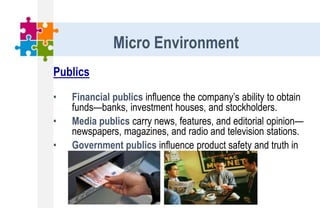
discussion and presentation in reference to a given company –
(e.g. Jumia).
3
•"... the ‘individuals’, ‘organisations’ and
‘forces external to the marketing
management function of an organisation’
that impinge on the marketing
management's ability to develop and
maintain successful exchanges with its
customers"
Definition of Marketing Environment
(Kotler, 1997)
•The marketing environment includes the actors
and forces outside marketing that affect marketing
management’s ability to build and maintain
successful relationships with customers.
Definition of Marketing Environment
Nature of Marketing environment
•The marketing environment of a business firm may
be static or dynamic when the environment forces do
not show a significant change, it is termed as stable
or static environment.
•And when significant changes are seen in the
environment forces it is termed as dynamic
environment.
•But the degree and nature of change is predictable.
Nature of Marketing environment
There are some other forces in the environment which
have considerable influences on the marketing
strategies of a firm are listed below;
(a) Increased Competition
(b) Labour unrest
(c) Social changes
(d) Technological changes
(e) Change in fashion
Components or factors affecting marketing environment
These forces are either internal or external to the firm.
The components of marketing environment or the
forces/factors affecting the marketing environment can
be grouped in two broad categories:
I. Controllable or Internal Marketing Environment
II. Uncontrollable or External Marketing Environment
Controllable or Internal marketing environment
• Marketing environment includes all factors that effect
marketing policies, decisions and operations of a company.
• The internal environment of a firm include controllable factors
or variables such as product design, branding packaging,
pricing, advertising and distribution policies of the firm.
• A firm or a company can achieve its marketing objectives by
selecting a balanced Marketing Mix.
Controllable or Internal marketing environment
•Marketing Mix The policies adopted by manufacturers
to attain success in the marketing constitute the
marketing mix.
•Marketing Mix is considered as an important part of
marketing system of the company.
•It is controllable factor of marketing environment.
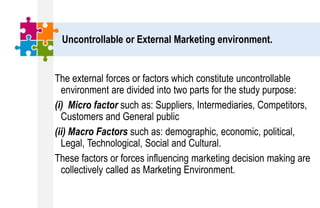
Uncontrollable or External Marketing environment.
The external forces or factors which constitute uncontrollable
environment are divided into two parts for the study purpose:
(i) Micro factor such as: Suppliers, Intermediaries, Competitors,
Customers and General public
(ii) Macro Factors such as: demographic, economic, political,
Legal, Technological, Social and Cultural.
These factors or forces influencing marketing decision making are
collectively called as Marketing Environment.
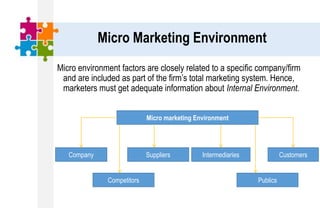
Micro Marketing Environment
Micro environment factors are closely related to a specific company/firm
and are included as part of the firm’s total marketing system. Hence,
marketers must get adequate information about Internal Environment.
Micro marketing Environment
Company Suppliers Intermediaries Customers
Competitors Publics
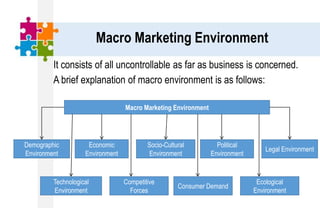
It consists of all uncontrollable as far as business is concerned.
A brief explanation of macro environment is as follows:
Macro Marketing Environment
Demographic
Environment
Economic
Environment
Socio-Cultural
Environment
Political
Environment
Legal Environment
Technological
Environment
Competitive
Forces
Consumer Demand
Ecological
Environment
Macro Marketing Environment
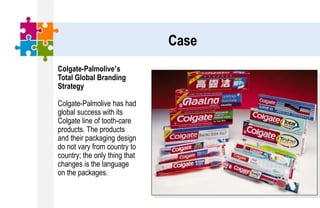
Colgate-Palmolive’s
Total Global Branding
Strategy
Colgate-Palmolive has had
global success with its
Colgate line of tooth-care
products. The products
and their packaging design
do not vary from country to
country; the only thing that
changes is the language
on the packages.
Case
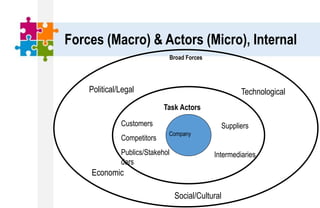
Forces (Macro) & Actors (Micro), Internal
Broad Forces
Political/Legal
Economic
Technological
Social/Cultural
Suppliers
Intermediaries
Customers
Competitors
Publics/Stakehol
ders
Task Actors
Company
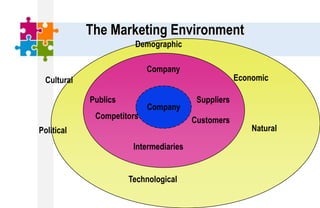
The Marketing Environment
Company
Demographic
Economic
Natural
Technological
Political
Cultural
Company
Customers
Intermediaries
Suppliers
Competitors
Publics
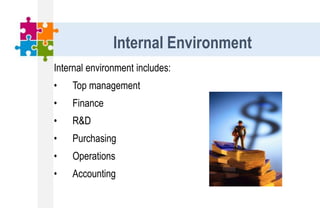
Internal environment includes:
• Top management
• Finance
• R&D
• Purchasing
• Operations
• Accounting
Internal Environment
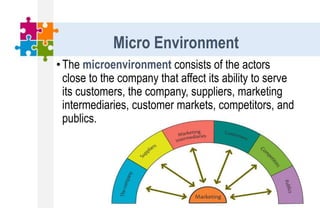
•The microenvironment consists of the actors
close to the company that affect its ability to serve
its customers, the company, suppliers, marketing
intermediaries, customer markets, competitors, and
publics.
Micro Environment
Micro Environment
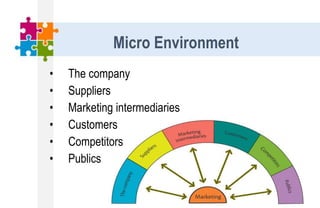
• The company
• Suppliers
• Marketing intermediaries
• Customers
• Competitors
• Publics
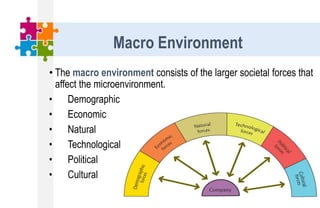
• The macro environment consists of the larger societal forces that
affect the microenvironment.
• Demographic
• Economic
• Natural
• Technological
• Political
• Cultural
Macro Environment
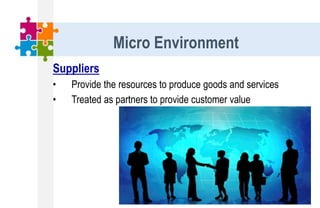
Suppliers
• Provide the resources to produce goods and services
• Treated as partners to provide customer value
Micro Environment
Marketing Intermediaries
• Help the company to promote, sell, and distribute its
products to final buyers
• Include:
• Resellers
• Physical distribution firms
• Marketing services agencies
• Financial intermediaries
Micro Environment
Marketing Intermediaries
• Resellers are the distribution channel firms that help the
company find customers or make sales to them. These include:
• Wholesalers
• Retailers
• Physical distribution firms are the distribution channel firms
that help the company to stock and move goods from their
points of origin to their final destination.
Micro Environment
Marketing Intermediaries
• Marketing service agencies are the marketing research
firms, advertising agencies, media firms, and marketing
consulting firms that help the company target and promote its
products to the right markets.
• Financial intermediaries include banks, credit companies,
insurance companies, and other businesses that help finance
transactions or insure against the risks associated with the
buying and selling of goods.
Micro Environment
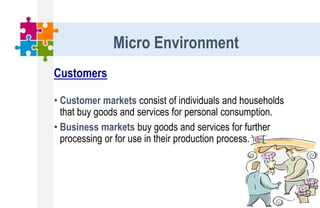
Customers
• Customer markets consist of individuals and households
that buy goods and services for personal consumption.
• Business markets buy goods and services for further
processing or for use in their production process.
Micro Environment
Customers
• Reseller markets buy goods and services to resell at a profit.
• Government markets buy goods and services to produce
public services or transfer goods and services to others who
need them.
• International markets consist of buyers in other countries
including consumers, producers, resellers, and governments.
Micro Environment
Competitors
• Firms must gain strategic
advantage by positioning their
offerings against competitors’
offerings.
• Each firm should consider its
own size and industry position
compared to those of its
competitors.
Micro Environment
Publics
• Any group that has an actual or potential interest in or impact
on an organization’s ability to achieve its objectives:
• Financial publics
• Media publics
• Government publics
• Citizen-action publics
• Local publics
• General public
• Internal publics
Micro Environment
Publics
• Financial publics influence the company’s ability to obtain
funds—banks, investment houses, and stockholders.
• Media publics carry news, features, and editorial opinion—
newspapers, magazines, and radio and television stations.
• Government publics influence product safety and truth in
advertising.
Micro Environment
Publics
• Citizen-action publics include consumer organizations,
environment groups, and minority groups
• Local publics include neighborhood residents and community
organizations
• General publics influence the company’s public image
• Internal publics include workers, managers, volunteers, and
directors
Micro Environment
• Demographic environment
• Economic environment
• Natural environment
• Technological environment
• Political environment
• Cultural environment
Macro Environment
Demographic Environment
• Demography is the study of human populations in terms of
size, density, location, age, gender, race, occupation, and other
statistics.
• Demographic environment is important because it involves
people, and people make up markets.
• Demographic trends include age, family structure, geographic
population shifts, educational characteristics, and population
diversity.
Macro Environment
Demographic Environment
Changing Age Structure of the Population
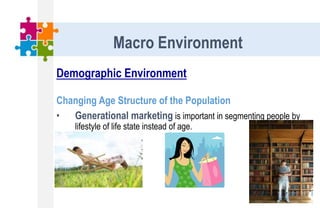
• Generational marketing is important in segmenting people by
lifestyle of life state instead of age.
Macro Environment
Demographic Environment
Changing Age Structure of the Population
• Baby boomers include people born between
1946 and 1964
• Includes most affluent Asians
Macro Environment
Demographic Environment
Changing Age Structure of the Population
• Generation X includes people born between
1965 and 1976. They tend to:
• Have high divorce rates
• Are concerned about the environment
• Respond to socially responsible companies
• Are less materialistic
• Emphasize quality of life
• Consumer organizations, environment groups, and minority groups
Macro Environment
Demographic Environment
Changing Age Structure of the Population
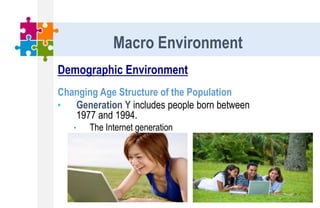
• Generation Y includes people born between
1977 and 1994.
• The Internet generation
Macro Environment
Demographic Environment
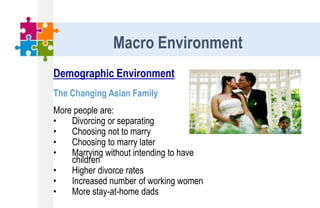
The Changing Asian Family
More people are:
• Divorcing or separating
• Choosing not to marry
• Choosing to marry later
• Marrying without intending to have
children
• Higher divorce rates
• Increased number of working women
• More stay-at-home dads
Macro Environment
Demographic Environment
Geographic Shifts in Population
• Trends include:
• Migratory movements between and within
countries
• Moving from rural to metropolitan areas
• Changes in where people work
• Telecommuting
• Home office
• Divorce or separation
Macro Environment
Demographic Environment
Changes in the Workforce
Trends include:
• More educated
• More white collar
• More professional
Macro Environment
Demographic Environment
Increasing Diversity
• Markets are becoming more diverse
• International
• National
• Trends include:
• Ethnicity
• Gay and lesbian
• Disabled
Macro Environment
Economic Environment
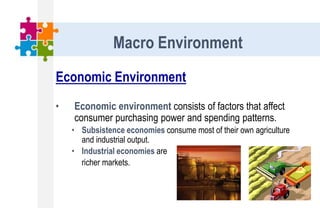
• Economic environment consists of factors that affect
consumer purchasing power and spending patterns.
• Subsistence economies consume most of their own agriculture
and industrial output.
• Industrial economies are
richer markets.
Macro Environment
Economic Environment
Changes in Income
• Value marketing involves ways to offer financially cautious
buyers greater value—the right combination of quality and
service at a fair price.
• Income distribution
• Upper-class consumers
• Middle-class consumers
• Working-class consumers
• Underclass consumers
Changing consumer spending pattern
Macro Environment
Natural Environment
• Natural environment involves the natural resources that are
needed as inputs by marketers or that are affected by
marketing activities.
• Trends
• Shortages of raw materials
• Increased pollution
• Increased government intervention
• Environmentally sustainable strategies
• Green marketing
Macro Environment
Technological Environment
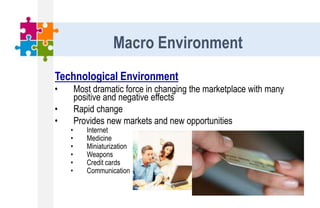
• Most dramatic force in changing the marketplace with many
positive and negative effects
• Rapid change
• Provides new markets and new opportunities
• Internet
• Medicine
• Miniaturization
• Weapons
• Credit cards
• Communication
Macro Environment
Political Environment
Political environment consists of laws, government agencies,
and pressure groups that influence or limit various
organizations and individuals in a given society.
Macro Environment
Political Environment
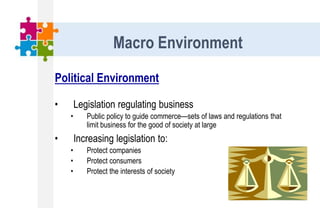
• Legislation regulating business
• Public policy to guide commerce—sets of laws and regulations that
limit business for the good of society at large
• Increasing legislation to:
• Protect companies
• Protect consumers
• Protect the interests of society
Macro Environment
Political Environment
Increased Emphasis on Ethics and
Socially Responsible Actions
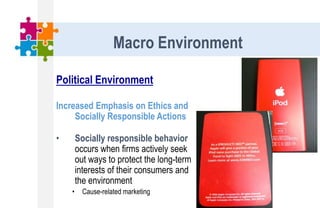
• Socially responsible behavior
occurs when firms actively seek
out ways to protect the long-term
interests of their consumers and
the environment
• Cause-related marketing
Macro Environment
Cultural Environment
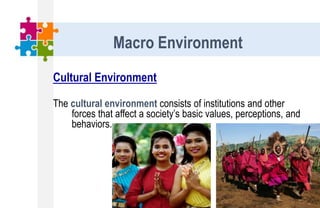
The cultural environment consists of institutions and other
forces that affect a society’s basic values, perceptions, and
behaviors.
Macro Environment
Cultural Environment
Persistence of Cultural Values
• Core beliefs and values have a high degree of
persistence, are passed on from parents to
children, and are reinforced by schools, churches,
businesses, and government.
• Secondary beliefs and values are more open to
change.
Macro Environment
Cultural Environment
Shifts in Secondary Cultural Values
• Major cultural values of a society are expressed in
people’s view of:
• Themselves
• Others
• Organization
• Society
• Nature and the universe
Macro Environment
Cultural Environment
Shifts in Secondary Cultural Values
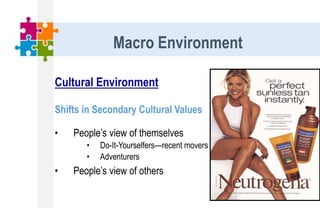
• People’s view of themselves
• Do-It-Yourselfers—recent movers
• Adventurers
• People’s view of others
Macro Environment
Cultural Environment
Shifts in Secondary Cultural Values
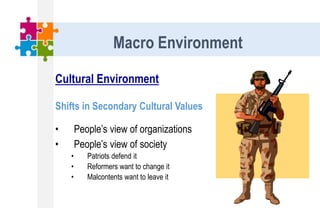
• People’s view of organizations
• People’s view of society
• Patriots defend it
• Reformers want to change it
• Malcontents want to leave it
Macro Environment
Cultural Environment
Shifts in Secondary Cultural Values
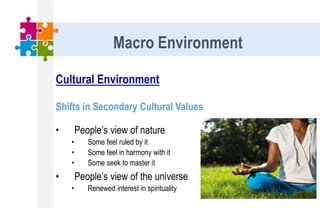
• People’s view of nature
• Some feel ruled by it
• Some feel in harmony with it
• Some seek to master it
• People’s view of the universe
• Renewed interest in spirituality
Macro Environment
God bless you!

Marketing environment 1

  • 1.
  • 2.
    Internal and ExternalForces By the end of the learning sessions, all students should be able to:- 1. Describe the environmental forces that affect the company’s ability to serve its customers 2. Explain how changes in the demographic and economic environments affect marketing decisions 3. Identify the major trends in the firm’s natural and technological environments 4. Explain the key changes in the political and cultural environments 5. Discuss how companies can react to the marketing environment 2
  • 3.
    Internal and ExternalForces By the end of the learning sessions, all students should be able to:- 1. Explain what is a SWOT Analysis, and its purpose within a business. 2. Explain and identify key areas of a Pestel Analysis, and its key function to a business. 3. Explain the key differences between Micro and Macro Environment, and which External Force is currently present within (U). 4. To explain SWOT and PESTELAnalysis through group discussion and presentation in reference to a given company – (e.g. Jumia). 3
  • 4.
    •"... the ‘individuals’,‘organisations’ and ‘forces external to the marketing management function of an organisation’ that impinge on the marketing management's ability to develop and maintain successful exchanges with its customers" Definition of Marketing Environment (Kotler, 1997)
  • 5.
    •The marketing environmentincludes the actors and forces outside marketing that affect marketing management’s ability to build and maintain successful relationships with customers. Definition of Marketing Environment
  • 6.
    Nature of Marketingenvironment •The marketing environment of a business firm may be static or dynamic when the environment forces do not show a significant change, it is termed as stable or static environment. •And when significant changes are seen in the environment forces it is termed as dynamic environment. •But the degree and nature of change is predictable.
  • 7.
    Nature of Marketingenvironment There are some other forces in the environment which have considerable influences on the marketing strategies of a firm are listed below; (a) Increased Competition (b) Labour unrest (c) Social changes (d) Technological changes (e) Change in fashion
  • 8.
    Components or factorsaffecting marketing environment These forces are either internal or external to the firm. The components of marketing environment or the forces/factors affecting the marketing environment can be grouped in two broad categories: I. Controllable or Internal Marketing Environment II. Uncontrollable or External Marketing Environment
  • 9.
    Controllable or Internalmarketing environment • Marketing environment includes all factors that effect marketing policies, decisions and operations of a company. • The internal environment of a firm include controllable factors or variables such as product design, branding packaging, pricing, advertising and distribution policies of the firm. • A firm or a company can achieve its marketing objectives by selecting a balanced Marketing Mix.
  • 10.
    Controllable or Internalmarketing environment •Marketing Mix The policies adopted by manufacturers to attain success in the marketing constitute the marketing mix. •Marketing Mix is considered as an important part of marketing system of the company. •It is controllable factor of marketing environment.
  • 11.
    Uncontrollable or ExternalMarketing environment. The external forces or factors which constitute uncontrollable environment are divided into two parts for the study purpose: (i) Micro factor such as: Suppliers, Intermediaries, Competitors, Customers and General public (ii) Macro Factors such as: demographic, economic, political, Legal, Technological, Social and Cultural. These factors or forces influencing marketing decision making are collectively called as Marketing Environment.
  • 12.
    Micro Marketing Environment Microenvironment factors are closely related to a specific company/firm and are included as part of the firm’s total marketing system. Hence, marketers must get adequate information about Internal Environment. Micro marketing Environment Company Suppliers Intermediaries Customers Competitors Publics
  • 13.
    It consists ofall uncontrollable as far as business is concerned. A brief explanation of macro environment is as follows: Macro Marketing Environment Demographic Environment Economic Environment Socio-Cultural Environment Political Environment Legal Environment Technological Environment Competitive Forces Consumer Demand Ecological Environment Macro Marketing Environment
  • 14.
    Colgate-Palmolive’s Total Global Branding Strategy Colgate-Palmolivehas had global success with its Colgate line of tooth-care products. The products and their packaging design do not vary from country to country; the only thing that changes is the language on the packages. Case
  • 15.
    Forces (Macro) &Actors (Micro), Internal Broad Forces Political/Legal Economic Technological Social/Cultural Suppliers Intermediaries Customers Competitors Publics/Stakehol ders Task Actors Company
  • 16.
  • 17.
    Internal environment includes: •Top management • Finance • R&D • Purchasing • Operations • Accounting Internal Environment
  • 18.
    •The microenvironment consistsof the actors close to the company that affect its ability to serve its customers, the company, suppliers, marketing intermediaries, customer markets, competitors, and publics. Micro Environment
  • 19.
    Micro Environment • Thecompany • Suppliers • Marketing intermediaries • Customers • Competitors • Publics
  • 20.
    • The macroenvironment consists of the larger societal forces that affect the microenvironment. • Demographic • Economic • Natural • Technological • Political • Cultural Macro Environment
  • 21.
    Suppliers • Provide theresources to produce goods and services • Treated as partners to provide customer value Micro Environment
  • 22.
    Marketing Intermediaries • Helpthe company to promote, sell, and distribute its products to final buyers • Include: • Resellers • Physical distribution firms • Marketing services agencies • Financial intermediaries Micro Environment
  • 23.
    Marketing Intermediaries • Resellersare the distribution channel firms that help the company find customers or make sales to them. These include: • Wholesalers • Retailers • Physical distribution firms are the distribution channel firms that help the company to stock and move goods from their points of origin to their final destination. Micro Environment
  • 24.
    Marketing Intermediaries • Marketingservice agencies are the marketing research firms, advertising agencies, media firms, and marketing consulting firms that help the company target and promote its products to the right markets. • Financial intermediaries include banks, credit companies, insurance companies, and other businesses that help finance transactions or insure against the risks associated with the buying and selling of goods. Micro Environment
  • 25.
    Customers • Customer marketsconsist of individuals and households that buy goods and services for personal consumption. • Business markets buy goods and services for further processing or for use in their production process. Micro Environment
  • 26.
    Customers • Reseller marketsbuy goods and services to resell at a profit. • Government markets buy goods and services to produce public services or transfer goods and services to others who need them. • International markets consist of buyers in other countries including consumers, producers, resellers, and governments. Micro Environment
  • 27.
    Competitors • Firms mustgain strategic advantage by positioning their offerings against competitors’ offerings. • Each firm should consider its own size and industry position compared to those of its competitors. Micro Environment
  • 28.
    Publics • Any groupthat has an actual or potential interest in or impact on an organization’s ability to achieve its objectives: • Financial publics • Media publics • Government publics • Citizen-action publics • Local publics • General public • Internal publics Micro Environment
  • 29.
    Publics • Financial publicsinfluence the company’s ability to obtain funds—banks, investment houses, and stockholders. • Media publics carry news, features, and editorial opinion— newspapers, magazines, and radio and television stations. • Government publics influence product safety and truth in advertising. Micro Environment
  • 30.
    Publics • Citizen-action publicsinclude consumer organizations, environment groups, and minority groups • Local publics include neighborhood residents and community organizations • General publics influence the company’s public image • Internal publics include workers, managers, volunteers, and directors Micro Environment
  • 31.
    • Demographic environment •Economic environment • Natural environment • Technological environment • Political environment • Cultural environment Macro Environment
  • 32.
    Demographic Environment • Demographyis the study of human populations in terms of size, density, location, age, gender, race, occupation, and other statistics. • Demographic environment is important because it involves people, and people make up markets. • Demographic trends include age, family structure, geographic population shifts, educational characteristics, and population diversity. Macro Environment
  • 33.
    Demographic Environment Changing AgeStructure of the Population • Generational marketing is important in segmenting people by lifestyle of life state instead of age. Macro Environment
  • 34.
    Demographic Environment Changing AgeStructure of the Population • Baby boomers include people born between 1946 and 1964 • Includes most affluent Asians Macro Environment
  • 35.
    Demographic Environment Changing AgeStructure of the Population • Generation X includes people born between 1965 and 1976. They tend to: • Have high divorce rates • Are concerned about the environment • Respond to socially responsible companies • Are less materialistic • Emphasize quality of life • Consumer organizations, environment groups, and minority groups Macro Environment
  • 36.
    Demographic Environment Changing AgeStructure of the Population • Generation Y includes people born between 1977 and 1994. • The Internet generation Macro Environment
  • 37.
    Demographic Environment The ChangingAsian Family More people are: • Divorcing or separating • Choosing not to marry • Choosing to marry later • Marrying without intending to have children • Higher divorce rates • Increased number of working women • More stay-at-home dads Macro Environment
  • 38.
    Demographic Environment Geographic Shiftsin Population • Trends include: • Migratory movements between and within countries • Moving from rural to metropolitan areas • Changes in where people work • Telecommuting • Home office • Divorce or separation Macro Environment
  • 39.
    Demographic Environment Changes inthe Workforce Trends include: • More educated • More white collar • More professional Macro Environment
  • 40.
    Demographic Environment Increasing Diversity •Markets are becoming more diverse • International • National • Trends include: • Ethnicity • Gay and lesbian • Disabled Macro Environment
  • 41.
    Economic Environment • Economicenvironment consists of factors that affect consumer purchasing power and spending patterns. • Subsistence economies consume most of their own agriculture and industrial output. • Industrial economies are richer markets. Macro Environment
  • 42.
    Economic Environment Changes inIncome • Value marketing involves ways to offer financially cautious buyers greater value—the right combination of quality and service at a fair price. • Income distribution • Upper-class consumers • Middle-class consumers • Working-class consumers • Underclass consumers Changing consumer spending pattern Macro Environment
  • 43.
    Natural Environment • Naturalenvironment involves the natural resources that are needed as inputs by marketers or that are affected by marketing activities. • Trends • Shortages of raw materials • Increased pollution • Increased government intervention • Environmentally sustainable strategies • Green marketing Macro Environment
  • 44.
    Technological Environment • Mostdramatic force in changing the marketplace with many positive and negative effects • Rapid change • Provides new markets and new opportunities • Internet • Medicine • Miniaturization • Weapons • Credit cards • Communication Macro Environment
  • 45.
    Political Environment Political environmentconsists of laws, government agencies, and pressure groups that influence or limit various organizations and individuals in a given society. Macro Environment
  • 46.
    Political Environment • Legislationregulating business • Public policy to guide commerce—sets of laws and regulations that limit business for the good of society at large • Increasing legislation to: • Protect companies • Protect consumers • Protect the interests of society Macro Environment
  • 47.
    Political Environment Increased Emphasison Ethics and Socially Responsible Actions • Socially responsible behavior occurs when firms actively seek out ways to protect the long-term interests of their consumers and the environment • Cause-related marketing Macro Environment
  • 48.
    Cultural Environment The culturalenvironment consists of institutions and other forces that affect a society’s basic values, perceptions, and behaviors. Macro Environment
  • 49.
    Cultural Environment Persistence ofCultural Values • Core beliefs and values have a high degree of persistence, are passed on from parents to children, and are reinforced by schools, churches, businesses, and government. • Secondary beliefs and values are more open to change. Macro Environment
  • 50.
    Cultural Environment Shifts inSecondary Cultural Values • Major cultural values of a society are expressed in people’s view of: • Themselves • Others • Organization • Society • Nature and the universe Macro Environment
  • 51.
    Cultural Environment Shifts inSecondary Cultural Values • People’s view of themselves • Do-It-Yourselfers—recent movers • Adventurers • People’s view of others Macro Environment
  • 52.
    Cultural Environment Shifts inSecondary Cultural Values • People’s view of organizations • People’s view of society • Patriots defend it • Reformers want to change it • Malcontents want to leave it Macro Environment
  • 53.
    Cultural Environment Shifts inSecondary Cultural Values • People’s view of nature • Some feel ruled by it • Some feel in harmony with it • Some seek to master it • People’s view of the universe • Renewed interest in spirituality Macro Environment
  • 54.