Made By:
 Subir K. Majumdar
 Pretam Sarkar
 Sanjana Lakra
 Srishti Dey
An organisation’s success is influenced by factors operating
in it’s internal and external environment; an organisation
can increase it’s success by adopting strategies which
manipulate these factors to it’s advantage. A successful
organisation will not only understand existing factors but
also forecast change, so that it can take advantage of change
within the environments in which it operates.

PEST analysis is used to identify the external forces affecting
an organisation .This is a simple analysis of an organisation’s
Political, Economical, Social and Technological environment.
A PEST analysis incorporating legal and environmental
factors is called a PESTLE analysis.
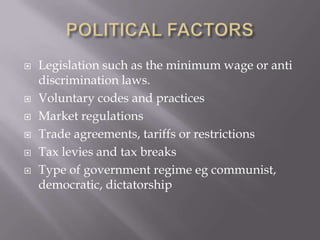
   P   for   POLITICAL FACTORS
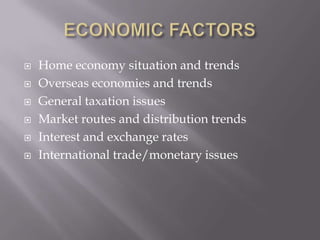
   E   for   ECONOMIC FACTORS
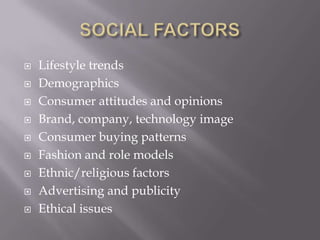
   S   for   SOCIAL FACTORS
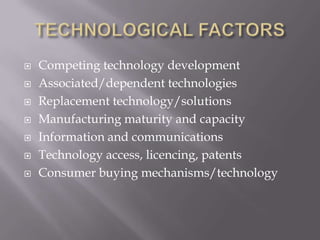
   T   for   TECHNOLOGICAL FACTORS
   Legislation such as the minimum wage or anti
    discrimination laws.
   Voluntary codes and practices
   Market regulations
   Trade agreements, tariffs or restrictions
   Tax levies and tax breaks
   Type of government regime eg communist,
    democratic, dictatorship
   Home economy situation and trends
   Overseas economies and trends
   General taxation issues
   Market routes and distribution trends
   Interest and exchange rates
   International trade/monetary issues
   Lifestyle trends
   Demographics
   Consumer attitudes and opinions
   Brand, company, technology image
   Consumer buying patterns
   Fashion and role models
   Ethnic/religious factors
   Advertising and publicity
   Ethical issues
   Competing technology development
   Associated/dependent technologies
   Replacement technology/solutions
   Manufacturing maturity and capacity
   Information and communications
   Technology access, licencing, patents
   Consumer buying mechanisms/technology
•   Health and Safety Guidelines
   fast food consumption has been shown to increase
    calorie intake, promote weight gain and elevate risk for
    diabetes
   criticised for caloric content, trans fats and portion sizes
   Ecological/environmental issue
   one of the largest consumers of paper products in the
    US leading to millions of pounds of food packaging
    waste littering roadways, clogging landfills and spoiling
    quality of life.
   Home market and international pressure-
    groups
   pushing for increased regulations to make companies
    more responsible
   Wars and conflicts
   war between countries where the company operates
   symbol of capitalism
   low set up costs leading to rapid expansion
   keeping the prices low for the customers.
   franchising facilitates set ups
   McDonald’s corporation provides financing assistance
    and training for new franchise owners to manage cash
    flow and keep businesses profitable.
   Health fears
   customers now opting for more healthier options like
    SUBWAY which offers more variety for health conscious
    customers.

   Emphasis on food safety
   Streamlining of processes to improve
    efficiency
   through technology enhancements such as FPI's Help
    Desk Service, network and application consolidation
    and other technology implementations, operations of
    the company are greatly improved
   Marketing done by means of television
    advertisements
   Implemented technology to improve
    supply chain management
   McDonalds changed its image vastly by evaluating the
    current menu and making changes to it from using
    organic products to revising the whole menu
    entirely by offering salads and vegetarian burgers. The
    accurate and accessible nutrition information help
    guests make informed menu choices.
   Incorporated safety management systems, including
    Good Manufacturing Practices (GMP), a verified Hazard
    Analysis Critical Control Point (HACCP) plan and crisis
    management, food security and other applicable
    programs
   Increase presence in Asian countries
   When the first McDonald's opened in Beijing more than
    a dozen years ago, 40,000 people lined up to observe a
    Big Mac. It is growing faster in China than in the United
    States. It owns & operates more than 600 stores across
    105 cities in China. More than 100 more McDonald's
    stores will be added annually to Chinese cities within
    the coming years.
   Locally focused menu choices
   In India – McAloo Tikki, Paneer Salsa Wrap, McVeggie
   In China - Szechwan-style spicy chicken wings, seafood
    soup, oriental sauces etc
Pest analysis