Presentation by
Primary Information Services
www.primaryinfo.com
mailto:primaryinfo@gmail.com
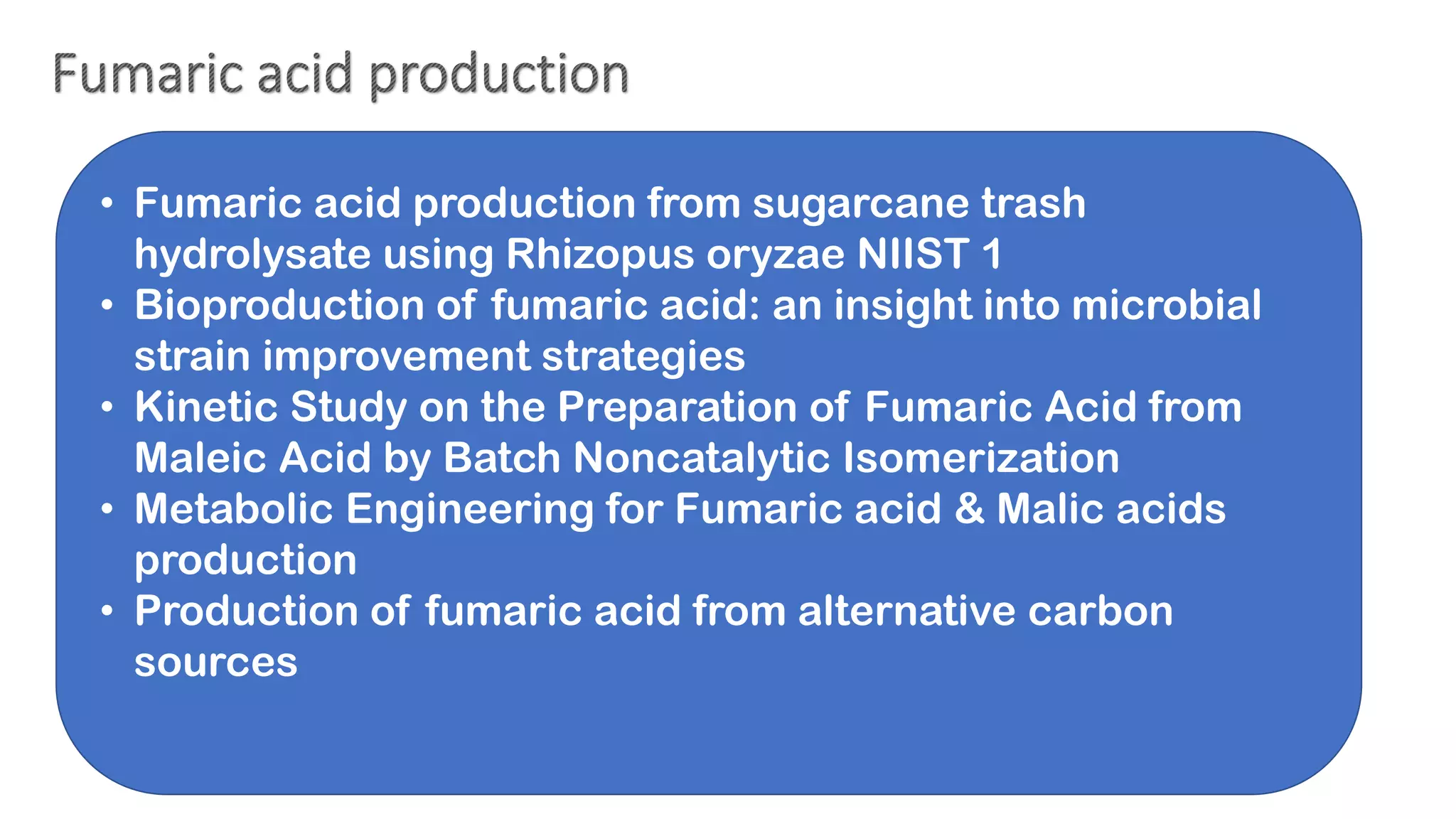
Other names Fumaric acid
trans-1,2-
Ethylenedicarboxylic acid 2-
Butenedioic acid trans-
Butenedioic acid Allomaleic
acid Boletic acid Donitic acid
Lichenic acid
Fumaric acid E297 can be used in
Food, Beverage, Pharmaceutical, He
alth & Personal care
products, Agriculture/Animal
Feed/Poultry. Fumaric Acid used as
an acidity regulator, acidulent,
curing accelerant and a flavoring
agent in wheat and corn tortillas,
sour dough and rye breads,
refrigerated biscuit doughs, fruit
juice and nutraceutical drinks,
gelatin desserts, gelling aids, pie
fillings and wine. Fumaric acid can
be used as a substitute for tartaric
acid and occasionally in place
of citric acid.
• Fumaric acid production from sugarcane trash
hydrolysate using Rhizopus oryzae NIIST 1
• Bioproduction of fumaric acid: an insight into microbial
strain improvement strategies
• Kinetic Study on the Preparation of Fumaric Acid from
Maleic Acid by Batch Noncatalytic Isomerization
• Metabolic Engineering for Fumaric acid & Malic acids
production
• Production of fumaric acid from alternative carbon
sources
Process Flow Diagram
Fumaric acid has a wide
range of applications in
the market. It is used as
a preservative, flavor
enhancer and is also
used as a building block
for resins and polymers.
Therefore, food, plastic,
construction and
personal
products industry are
responsible for high
contribution to the
growth of fumaric acid
market.
Market Scenario
• The global fumaric acid market reached a value of US$ 660.9 Million in 2020. Looking forward, IMARC
Group expects the market to grow at a CAGR of 5.5% during 2021-2026.
• Fumaric acid is consumed in the production of UPR and alkyd resins. Demand for paints is expected to grow
owing to increasing construction activities. Thus, rising construction activities are expected to augment UPR
and paints demand which in turn is expected to drive growth of the fumaric acid market.
• Fumaric acid based UPR is used in manufacturing body panel for heavy and light duty vehicles. Increasing
application in pharmaceuticals is also expected to augment growth of the global market.
• Where does fumaric acid get its energy from?
Also known as trans-butenedioic acid, it is naturally found in eukaryotes, bolete mushrooms, lichens and Iceland
moss. It is also produced by humans when the skin is exposed to sunlight. Similar to malic acid, fumaric acid
helps in the production of energy from food in the form of ATP.

Fumaric acid

  • 1.
    Presentation by Primary InformationServices www.primaryinfo.com mailto:primaryinfo@gmail.com
  • 4.
    Other names Fumaricacid trans-1,2- Ethylenedicarboxylic acid 2- Butenedioic acid trans- Butenedioic acid Allomaleic acid Boletic acid Donitic acid Lichenic acid
  • 6.
    Fumaric acid E297can be used in Food, Beverage, Pharmaceutical, He alth & Personal care products, Agriculture/Animal Feed/Poultry. Fumaric Acid used as an acidity regulator, acidulent, curing accelerant and a flavoring agent in wheat and corn tortillas, sour dough and rye breads, refrigerated biscuit doughs, fruit juice and nutraceutical drinks, gelatin desserts, gelling aids, pie fillings and wine. Fumaric acid can be used as a substitute for tartaric acid and occasionally in place of citric acid.
  • 7.
    • Fumaric acidproduction from sugarcane trash hydrolysate using Rhizopus oryzae NIIST 1 • Bioproduction of fumaric acid: an insight into microbial strain improvement strategies • Kinetic Study on the Preparation of Fumaric Acid from Maleic Acid by Batch Noncatalytic Isomerization • Metabolic Engineering for Fumaric acid & Malic acids production • Production of fumaric acid from alternative carbon sources
  • 8.
  • 10.
    Fumaric acid hasa wide range of applications in the market. It is used as a preservative, flavor enhancer and is also used as a building block for resins and polymers. Therefore, food, plastic, construction and personal products industry are responsible for high contribution to the growth of fumaric acid market.
  • 12.
    Market Scenario • Theglobal fumaric acid market reached a value of US$ 660.9 Million in 2020. Looking forward, IMARC Group expects the market to grow at a CAGR of 5.5% during 2021-2026. • Fumaric acid is consumed in the production of UPR and alkyd resins. Demand for paints is expected to grow owing to increasing construction activities. Thus, rising construction activities are expected to augment UPR and paints demand which in turn is expected to drive growth of the fumaric acid market. • Fumaric acid based UPR is used in manufacturing body panel for heavy and light duty vehicles. Increasing application in pharmaceuticals is also expected to augment growth of the global market. • Where does fumaric acid get its energy from? Also known as trans-butenedioic acid, it is naturally found in eukaryotes, bolete mushrooms, lichens and Iceland moss. It is also produced by humans when the skin is exposed to sunlight. Similar to malic acid, fumaric acid helps in the production of energy from food in the form of ATP.