
MARKETING
ENVIRONMENT
MADE BY:-
SNEH LATA
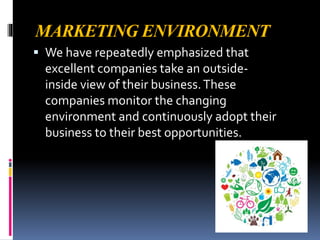
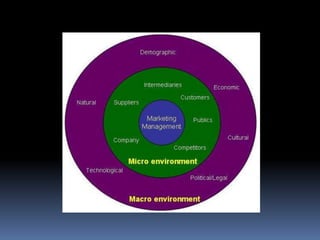
MARKETING ENVIRONMENT
 We have repeatedly emphasized that
excellent companies take an outside-
inside view of their business.These
companies monitor the changing
environment and continuously adopt their
business to their best opportunities.
1.Micro economics
2.Macro economics
TYPES OF
MARKETING
ENVIRONMENT
1.Micro economics
Every company’s primary goal is
to profitably serve and satisfy
specific needs of chosen target
market. Micro economics focus
on company related issues.
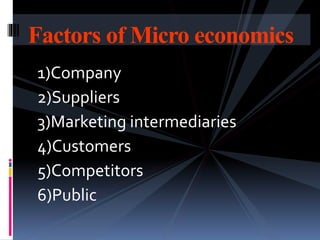
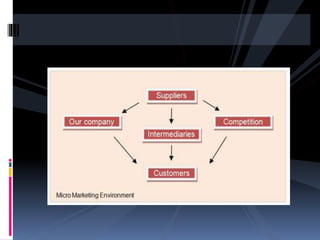
1)Company
2)Suppliers
3)Marketing intermediaries
4)Customers
5)Competitors
6)Public
Factors of Micro economics
1) Company
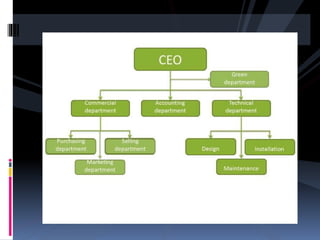
Top management makes the plans, policies,
procedures etc which are convened to all the
department.
Like R & D department focus on problems of designing
safe & attractive product.
a)Finance
b)Purchasing
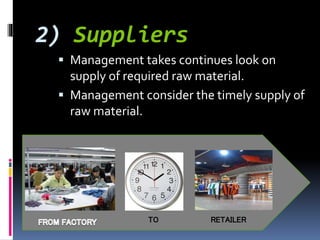
2) Suppliers
 Management takes continues look on
supply of required raw material.
 Management consider the timely supply of
raw material.
TO RETAILER
Marketing intermediaries are firms that aid
the company in promoting, selling and
distributing its goods to final buyers. It help
to find customer for company. For eg-
online shopping , Overseas shopping.
a)Physical distributer firm.
b)Marketing services agencies.
c)Financial intermediaries.
3) Marketing intermediaries
4) Customers
a)Consumer market:- Eg- mobile, bed, shirt,
utensils etc.
b)Business market:- Eg- flour for making bread,
steel for making utensils.
c)Government market.
d)International market:- Eg- carpets,
technology, machinery etc.
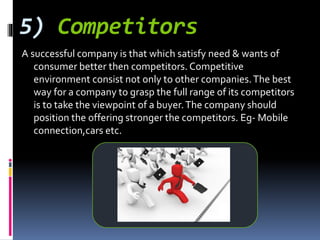
5) Competitors
A successful company is that which satisfy need & wants of
consumer better then competitors. Competitive
environment consist not only to other companies.The best
way for a company to grasp the full range of its competitors
is to take the viewpoint of a buyer.The company should
position the offering stronger the competitors. Eg- Mobile
connection,cars etc.
6) Public
A public is any group that has an actual or
potential interest or impact on a company’s
ability to achieve its objectives.
a)Financial publics.
b)Media publics.
c)Internal publics.
d)Government publics.
e)General publics.
The company and its suppliers, marketing
intermediaries customers, competitors and
publics all operate in a large macro
environment of forces that shape
opportunities which the company must
monitor and respond to.
2. Macro economics
Factors of Macro economics
1)Economic forces.
2)Technological factors.
3)Social-Cultural factors.
4)Demographic factors.
5)Political-Legal environment.
6)Green marketing.
7)Green marketing and
competitiveness.
8)Competitive environment.
9)Natural environment.
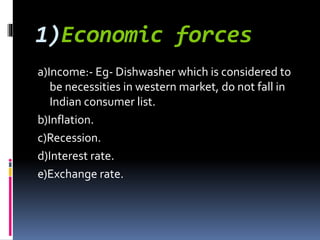
1)Economic forces
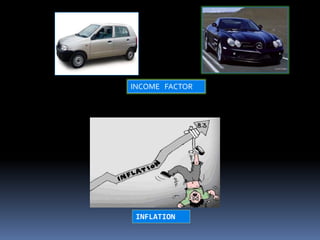
a)Income:- Eg- Dishwasher which is considered to
be necessities in western market, do not fall in
Indian consumer list.
b)Inflation.
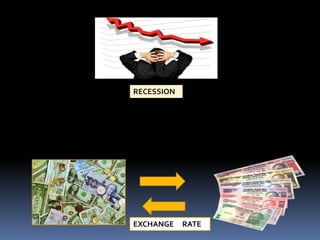
c)Recession.
d)Interest rate.
e)Exchange rate.
INCOME FACTOR
INFLATION
EXCHANGE RATE
RECESSION
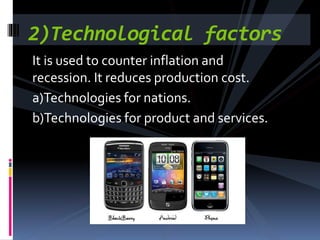
It is used to counter inflation and
recession. It reduces production cost.
a)Technologies for nations.
b)Technologies for product and services.
2)Technological factors
3)Social-Cultural
factors
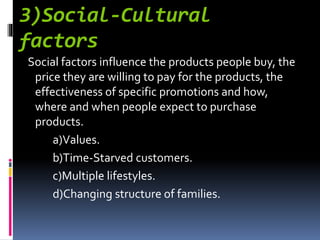
Social factors influence the products people buy, the
price they are willing to pay for the products, the
effectiveness of specific promotions and how,
where and when people expect to purchase
products.
a)Values.
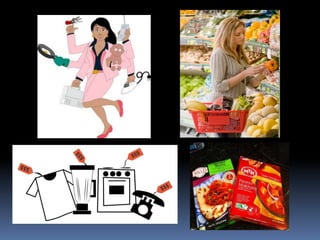
b)Time-Starved customers.
c)Multiple lifestyles.
d)Changing structure of families.
4)Demographic factors
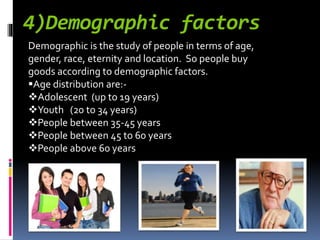
Demographic is the study of people in terms of age,
gender, race, eternity and location. So people buy
goods according to demographic factors.
Age distribution are:-
Adolescent (up to 19 years)
Youth (20 to 34 years)
People between 35-45 years
People between 45 to 60 years
People above 60 years
a)Political legal environment provides the legal
framework within the marketing deparment has to
function.
b)The viability of businesses depends upon their
ability to understand the laws of the land and to
abide by them.
c)Stability of the government is a very important
factor in a company’s decision to locate its
businesses in a country.
5)Political-Legal environment
d)Businesses need government regulations to protect
the interests of society in general, innovators of new
technology, one business from another and
consumers.
e)In return, government needs businesses, because
the market place generates taxes that support
public efforts to provide essential services like
health and education to their people
FOR EXAMPLE-
 NOW GOVERNMENT HAS ALLOWED 100% FDI IN
SERVICE SECTOR.
 RBI HAS HICKED FBI CAP FROM 49% TO 74%.
a)The first opportunity comes from the
fact that the companies will not be
allowed to pollute the environment.
Companies should use pollution free
processors to produce the output.
b)The second opportunity will come to
those companies which will develop the
technologies, which will enable
companies to carry out their processes in
environment friendly ways.
6) Green marketing
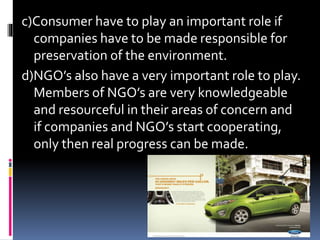
c)Consumer have to play an important role if
companies have to be made responsible for
preservation of the environment.
d)NGO’s also have a very important role to play.
Members of NGO’s are very knowledgeable
and resourceful in their areas of concern and
if companies and NGO’s start cooperating,
only then real progress can be made.
a)Smart companies reduce the
consumption of non-renewable such as
coal, petroleum and natural gas as well
as renewable resources such as water
and wood.
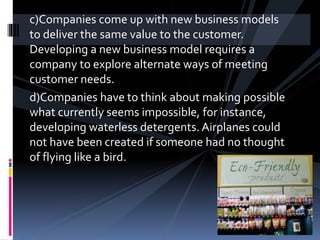
b)To design eco-friendly products,
companies examine product life cycles
and understand consumer concerns. For
eg-Non-synthetic cleaning products.
6) Green marketing and
competitiveness
c)Companies come up with new business models
to deliver the same value to the customer.
Developing a new business model requires a
company to explore alternate ways of meeting
customer needs.
d)Companies have to think about making possible
what currently seems impossible, for instance,
developing waterless detergents. Airplanes could
not have been created if someone had no thought
of flying like a bird.
8)Competitive environment
a)Number of competitors.
b)Relative size.
c)Degree of interdependence.
d)Competition within industry.
e)Competition from new
technologies.
f)Changing customers.
9)Natural Environment
a)Nearly a quarter of the carbon dioxide that makes up
about 80% of all greenhouse gases comes from
electric power plants. Dublin based Airtricity
operates winds farms in the US and the UK that
offer cheaper and greener electricity.
b)Transportation is second only to electricity
generation as a contributor to global warming,
accounting for roughly a fifth of carbon
emissions.Eg-CNG powered vehicles.
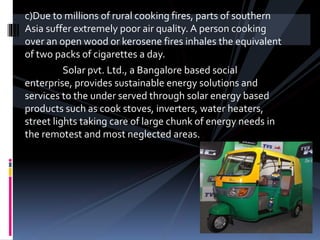
c)Due to millions of rural cooking fires, parts of southern
Asia suffer extremely poor air quality. A person cooking
over an open wood or kerosene fires inhales the equivalent
of two packs of cigarettes a day.
Solar pvt. Ltd., a Bangalore based social
enterprise, provides sustainable energy solutions and
services to the under served through solar energy based
products such as cook stoves, inverters, water heaters,
street lights taking care of large chunk of energy needs in
the remotest and most neglected areas.
In this whole topic we have come to know how
marketing environment factors of MICRO and
MACRO ENVIRONMENT effect an organization
in doing marketing for their good and services.
Marketing environment

Marketing environment

  • 1.
  • 2.
    MARKETING ENVIRONMENT  Wehave repeatedly emphasized that excellent companies take an outside- inside view of their business.These companies monitor the changing environment and continuously adopt their business to their best opportunities.
  • 3.
  • 5.
    1.Micro economics Every company’sprimary goal is to profitably serve and satisfy specific needs of chosen target market. Micro economics focus on company related issues.
  • 6.
  • 8.
    1) Company Top managementmakes the plans, policies, procedures etc which are convened to all the department. Like R & D department focus on problems of designing safe & attractive product. a)Finance b)Purchasing
  • 10.
    2) Suppliers  Managementtakes continues look on supply of required raw material.  Management consider the timely supply of raw material. TO RETAILER
  • 11.
    Marketing intermediaries arefirms that aid the company in promoting, selling and distributing its goods to final buyers. It help to find customer for company. For eg- online shopping , Overseas shopping. a)Physical distributer firm. b)Marketing services agencies. c)Financial intermediaries. 3) Marketing intermediaries
  • 12.
    4) Customers a)Consumer market:-Eg- mobile, bed, shirt, utensils etc. b)Business market:- Eg- flour for making bread, steel for making utensils. c)Government market. d)International market:- Eg- carpets, technology, machinery etc.
  • 13.
    5) Competitors A successfulcompany is that which satisfy need & wants of consumer better then competitors. Competitive environment consist not only to other companies.The best way for a company to grasp the full range of its competitors is to take the viewpoint of a buyer.The company should position the offering stronger the competitors. Eg- Mobile connection,cars etc.
  • 14.
    6) Public A publicis any group that has an actual or potential interest or impact on a company’s ability to achieve its objectives. a)Financial publics. b)Media publics. c)Internal publics. d)Government publics. e)General publics.
  • 15.
    The company andits suppliers, marketing intermediaries customers, competitors and publics all operate in a large macro environment of forces that shape opportunities which the company must monitor and respond to. 2. Macro economics
  • 16.
    Factors of Macroeconomics 1)Economic forces. 2)Technological factors. 3)Social-Cultural factors. 4)Demographic factors. 5)Political-Legal environment. 6)Green marketing. 7)Green marketing and competitiveness. 8)Competitive environment. 9)Natural environment.
  • 17.
    1)Economic forces a)Income:- Eg-Dishwasher which is considered to be necessities in western market, do not fall in Indian consumer list. b)Inflation. c)Recession. d)Interest rate. e)Exchange rate.
  • 18.
  • 19.
  • 20.
    It is usedto counter inflation and recession. It reduces production cost. a)Technologies for nations. b)Technologies for product and services. 2)Technological factors
  • 21.
    3)Social-Cultural factors Social factors influencethe products people buy, the price they are willing to pay for the products, the effectiveness of specific promotions and how, where and when people expect to purchase products. a)Values. b)Time-Starved customers. c)Multiple lifestyles. d)Changing structure of families.
  • 23.
    4)Demographic factors Demographic isthe study of people in terms of age, gender, race, eternity and location. So people buy goods according to demographic factors. Age distribution are:- Adolescent (up to 19 years) Youth (20 to 34 years) People between 35-45 years People between 45 to 60 years People above 60 years
  • 24.
    a)Political legal environmentprovides the legal framework within the marketing deparment has to function. b)The viability of businesses depends upon their ability to understand the laws of the land and to abide by them. c)Stability of the government is a very important factor in a company’s decision to locate its businesses in a country. 5)Political-Legal environment
  • 25.
    d)Businesses need governmentregulations to protect the interests of society in general, innovators of new technology, one business from another and consumers. e)In return, government needs businesses, because the market place generates taxes that support public efforts to provide essential services like health and education to their people FOR EXAMPLE-  NOW GOVERNMENT HAS ALLOWED 100% FDI IN SERVICE SECTOR.  RBI HAS HICKED FBI CAP FROM 49% TO 74%.
  • 26.
    a)The first opportunitycomes from the fact that the companies will not be allowed to pollute the environment. Companies should use pollution free processors to produce the output. b)The second opportunity will come to those companies which will develop the technologies, which will enable companies to carry out their processes in environment friendly ways. 6) Green marketing
  • 27.
    c)Consumer have toplay an important role if companies have to be made responsible for preservation of the environment. d)NGO’s also have a very important role to play. Members of NGO’s are very knowledgeable and resourceful in their areas of concern and if companies and NGO’s start cooperating, only then real progress can be made.
  • 28.
    a)Smart companies reducethe consumption of non-renewable such as coal, petroleum and natural gas as well as renewable resources such as water and wood. b)To design eco-friendly products, companies examine product life cycles and understand consumer concerns. For eg-Non-synthetic cleaning products. 6) Green marketing and competitiveness
  • 29.
    c)Companies come upwith new business models to deliver the same value to the customer. Developing a new business model requires a company to explore alternate ways of meeting customer needs. d)Companies have to think about making possible what currently seems impossible, for instance, developing waterless detergents. Airplanes could not have been created if someone had no thought of flying like a bird.
  • 30.
    8)Competitive environment a)Number ofcompetitors. b)Relative size. c)Degree of interdependence. d)Competition within industry. e)Competition from new technologies. f)Changing customers.
  • 31.
    9)Natural Environment a)Nearly aquarter of the carbon dioxide that makes up about 80% of all greenhouse gases comes from electric power plants. Dublin based Airtricity operates winds farms in the US and the UK that offer cheaper and greener electricity. b)Transportation is second only to electricity generation as a contributor to global warming, accounting for roughly a fifth of carbon emissions.Eg-CNG powered vehicles.
  • 32.
    c)Due to millionsof rural cooking fires, parts of southern Asia suffer extremely poor air quality. A person cooking over an open wood or kerosene fires inhales the equivalent of two packs of cigarettes a day. Solar pvt. Ltd., a Bangalore based social enterprise, provides sustainable energy solutions and services to the under served through solar energy based products such as cook stoves, inverters, water heaters, street lights taking care of large chunk of energy needs in the remotest and most neglected areas.
  • 33.
    In this wholetopic we have come to know how marketing environment factors of MICRO and MACRO ENVIRONMENT effect an organization in doing marketing for their good and services.