BUSINESS LAW UNIT 5
PPTX BY SOURODEEP
NIYOGI
PREPARED BY SOURODEEP NIYOGI
STUDENT OF GEU
INTRODUC
TION OF
LAW
• LAW means rule made by the
authority for the
proper regulation of a community
or society or for correct conduct
in life. Law is different from an
ACT.
• It is an Act of Parliament, a statute
(commonly called a law)
• enacted as primary legislation by a
national or sub-
nationalparliament. It sets out the
main objectives legislation
intended to achieve.
• Eg; contract act, consumer
protection act etc.
WHAT IS
CONSUME
R?
• Consumer refers to any individuals
or households that use
• goods and services generated within
the economy.
• Consumer is defined as someone
who acquires goods or services for
direct use or ownership rather than
for resale or use in production and
manufacturing.
• For example, When your father buys
apple for you and you consume
them, your father as well as yourself
are treated as consumers. The same
thing applies to hiring a taxi to go to
your school.
CONSUME
R LAW
• “MODU” or “consumer law”
regulates privatelaw
relationships between
individual consumers and
the businesses that sell
those goods and services.IT
deal with credit repair, debt
repair, product safety,
service and sales contracts,
bill collector regulation,
pricing, utility turnoffs,
consolidation, personal
loans that may leadto
bankruptcy and much more.
CONCEPT OF CONSUMER
PROTECTION
• Consumer protection means
safeguarding the interest
and rights of consumers. In
other words, it refers to the
measures adopted for the
protection of consumers
from unscrupulous and
unethical malpractices by
the business and to provide
them speedy redressal of
their grievances
CONSUME
R
PROTECTI
ON ACT
• The Consumer Protection Act,
1986 was enacted for better
• protection of the interests of
consumers.
• The provisions of the Act came
into force with effect from 15-
4-87.
• Consumer Protection Act
imposes strict liability on
a manufacturer, in case of
supply of defective goods by
him, and a service provider, in
case of deficiency in rendering
of its services.
HISTORY OF
CONSUMER PROTECTION ACT
• The act was passed in Lok
Sabha on 9th
December,1986 and
it came into force from 1
July 1987. Rajya Sabha
passed on 10th December,
1986 and assented by the
President of India on
24th December, 1986 and
was published in the
Gazette of India on 26th
December, 1986.
FEATURES OF
CONSUMER PROTECTION ACT
• It applies to all goods, services
and unfair trade practices
• unless specifically exempted by
the Central Government.
• It covers all sectors whether
private, public or co-operative.
• It provides for establishment of
consumer protection councils at
the central, state and district
levels to promote and protect the
rights of consumers and a three
tier quasijudicial machinery to
deal with consumer grievances
and disputes.
OBJECTIV
ES
• To protect the
consumer from
abuse.To provide a
venue for grievance
/redress.To ensure a
better quality of
living by improving
the quality of
consumer products
& services.
IMPORTANCE OF
CONSUMER PROTECTION ACT
• Importance from Consumer’s Point of view:
• Unorganised Consumers-In developing countries
like India, consumers are not organised.Ther are
very few consumer organistions which are
working to protect the interest of consumers.
Consumer protection provides power and rights
to these organsation as these organisations can
file a case behalf of customer.
• Consumer Ignorance-It spreads awareness so that
consumer can know about the various redressal
agencies where they can approach to protect their
interests.
• Wide Spread Exploitation of Consumer’s-There is
lot of exploitation of consumers as businessmen
use various unfair trade practices to cheat and
exploit consumers.Consumer protection provides
safe guard to consumers from such exploitation.
IMPORTANCE OF CONSUMER PROTECTION
ACT FROM THE VIEW OF BUSINESS:-
• Businessman Uses Society’s Resources-
Businessmen use the resources of society. They
earned profit by supplying goods and services to
the members of society. They must use
these resources for the benefits of consumers.
• Social Responsbilities-A businessman has social
obligations towards customer. It is responsbility of
businessmen to provide quality goods at
reasonable price. Consumer protection
guides businessman to provide social
responsibilities.
• Government Intervention-If businessman want to
avoid intervention of govt. then they should not
involve in unfair trade practices. Businessman
should voluntarly involve in the activities which
protect the interest of consumer
• Consumer is the Purpose of Business-The
basic purpose of the business is to create more and
more customers and retain them and businessmen
can create more customers only by satisfying the
customers and protecting the interest of
consumers.
SCOPE OF CONSUMER
PROTECTION ACT
• Requirements to performance, composition,
contents, design, construction, finish,
packaging of a consumer product
• Requirements as to kind, class, grade,
dimensions, weights, material
• Requirements as to the methods of
sampling, tests and codes
• used to check the quality of the products
• Requirements as to precautions in storage,
transporting and packaging
• Requirements that a consumer product be
marked with or accompanied by clear and
adequate safety warnings or instructions, or
requirements respecting the form of
warning or instructions
NEEDS OF
CONSUMER PROTECTION ACT
• The necessity of adopting measures to protect the interest of consumers
arises mainly due to the helpless position of the consumers.
• Social Responsibility-
• It is the moral responsibility of the business to serve the interest of
consumers. Keeping in line with this principle, it is the duty of producers and
traders to provide right quality and quantity of goods at fair prices to the
consumers.
• Increasing Awareness-
• The consumers are becoming more mature and conscious of their rights
against the malpractices by the business. There are many consumer
organisations and associations who are making efforts to build consumer
awareness
• Consumer Satisfaction-
• Father of the Nation Mahatma Gandhi had once given a call to manufactures
and traders to “treat your consumers as god”.
• Consumers’ satisfaction is the key to success of business. Hence, the
businessmen should take every step to serve the interests of consumers by
providing them quality goods and services at reasonable price.
RIGHTS OF
CONSUME
R
• There are many right of consumer protection Act
• Right to safety
• Right to information
• Right to choose
• Right to consumer education
• Right to basic Needs
• Right to health environment
• Right to choice
• Right to Seek Redressal
• Right to be heard
RIGHT TO
SEEK
REDRESSA
L
• Right to Seek
Redress: To be
compensated
for misrepresen
tation, shoddy
goods or
unsatisfactory
services.
NO SLIDES
No content in this slide
NO SLIDES
No content in this slide
DISCUSS THE RIGHT OF
CONSUMER PROTECTION ACT:-
RIGHT
TO BE
HEARD
In this right the
consumer will be
approached to the
RIGHT TO
SAFETY
• Right to Safety: To be protected against the
marketing of goods or the provision of services
that are hazardous to health and life.Right to
Information: To be protected against dishonest or
misleading advertising or labeling and the right to
be given the facts and information needed to make
an informed choice.Right to Choice: To choose
products at competitive prices with an assurance of
satisfactory quality.
• Right to Seek Redress: To be compensated
for misrepresentation, shoddy goods or
unsatisfactory services.
• Right to Consumer Education: To acquire the
knowledge and skills necessary to be an informed
customer
• Right to Basic Needs: which guarantee survival,
adequate food, clothing, shelter, health care,
education and sanitation
• Right to health environment: To live and work in
an environment which is neither threatening nor
dangerous and which permits a life of dignity and
well-being.
RIGHT TO
INFORMATI
ON
• Right to Information:
To be protected
against dishonest or
misleading
advertising or
labeling and the
right to be given the
facts and
information needed
to make an informed
choice.
RIGHT TO
CHOOSE
• Right to
Choose: To
choose products
at competitive
prices with an
assurance of
satisfactory
quality.
RIGHT TO CONSUMER
EDUCATION
• Right to
Consumer
Education: To
acquire the
knowledge and
skills necessary
to be an
informed
customer.
RIGHT TO
BASIC
NEEDS
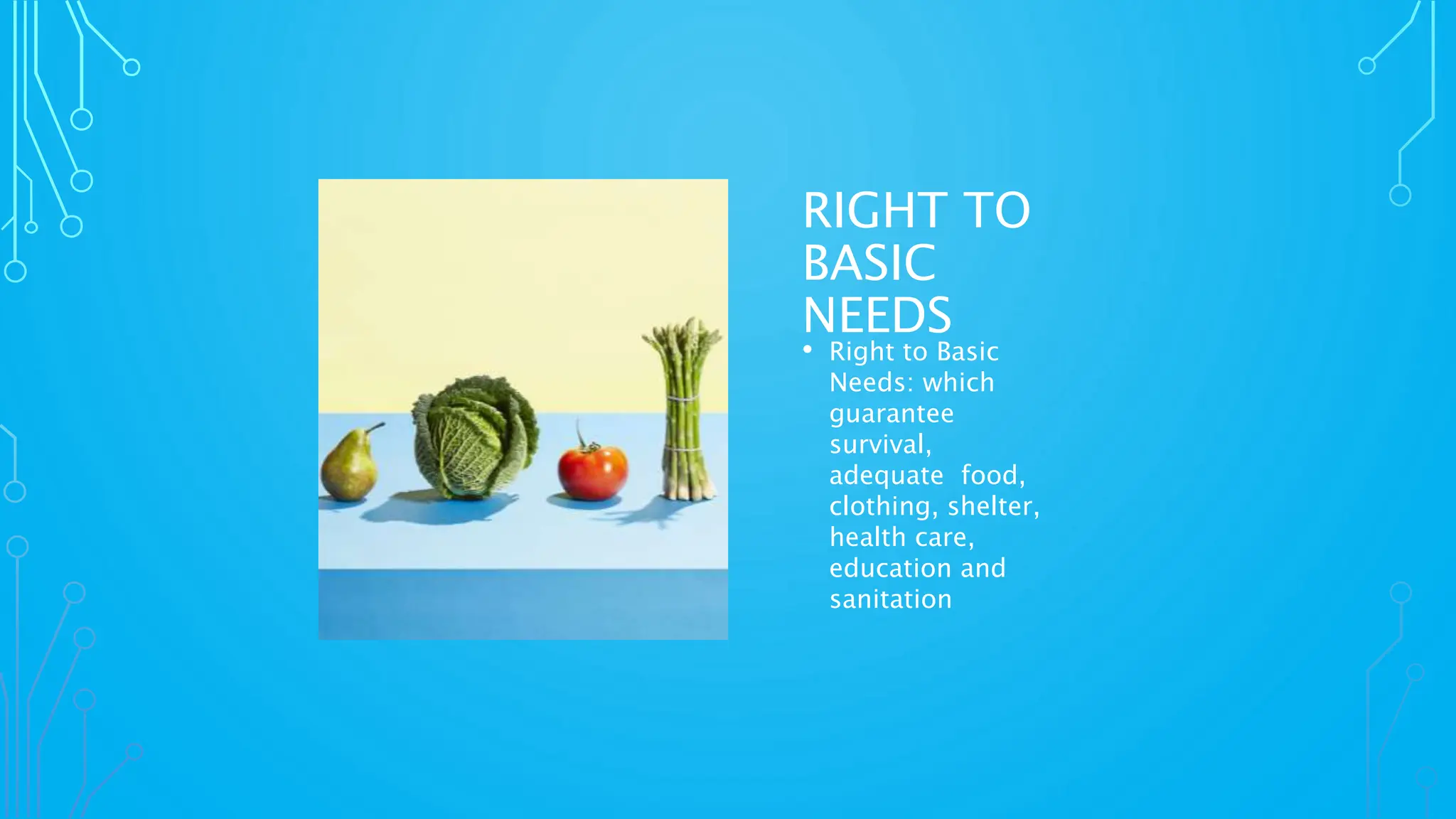
• Right to Basic
Needs: which
guarantee
survival,
adequate food,
clothing, shelter,
health care,
education and
sanitation
RIGHT TO
HEALTH
ENVIRONM
ENT
• Right to health
environment: To live
and work in
an environment
which is neither
threatening nor
dangerous
and which permits a
life of dignity and
well-being.
RIGHT
TO
CHOICE
To choose products at
competitive prices with an
assurance of satisfactory
quality.
FILING A
COMPLAIN
T
• Some Important Terms Defined
in Consumer Protection Act
Who is a consumer?One who
buys goods or hire services for
some value.When or under
what circumstance the
complaints can be filed?False
by traders and manufacturers
If goods are defectiveWithin
what period the complaint can
be filed?The complaint must
be filed within 3 months of
purchase and if some testing
of goods is required then
within 5 months.
FILING A
COMPLAIN
T
• Within what period
the complaint can be
filed?The complaint
must be filed
within 3 months of
purchase and if
some testing of
goods is required
then within 5
months.
SOME RELIEFS OR REMEDIES TO
CONSUMER
• Removal of defects from the
goods.
• Replacement of the goods.
• Refund of price paid.
• Compensation of loss or injury
suffered.
• Removal of deficiency in
service.
• Stopping the sale of hazardous
goods.
THREE TIER UNDER THE CONSUMER
PROTECTION ACT,1986 AND THEIR
JURISDICTIONS
• District
forum
• STATE forum
• National
forum
DISRICT
FORUM
• It consists of a president and two
other members. The president can
be a retired or working judge of
District Court. They are appointed
by state govt.In 1986,it had
jurisdiction to entertain complaints
where the value of goods or services
does not exceeds Rs.5,00,000 but
now the limit is raised to
Rs.20lakh. The agency sends the
goods for testing in lab. If the
aggrieved party is not satisfied by
the judgment of district forum
then they can file an appeal in State
Commission within 30 days
by depositing 25000 or 50% of
penalty amount whichever is less.
STATE
FORUM
• It consists of a president and two
other members. The president must
be a retired or working judge of high
court. They all are appointed by
state govt.In 1986,it had a
jurisdiction to entertain complaints
when the value of goods or
services exceeds Rs.5lakh but now
the limit is raised
upto Rs.1crore.The State
Commission sends the goods for
testing in lab if required. If the
upset party is not satisfied with
the judgment then they can file an
appeal in National
Commission within 30 days by
depositing Rs.3500 or 50% of
penalty amount whichever is less.
NATIONAL
FORUM
• It consists of a president and
four members one of whom
shall be women. They are
appointed by Central Govt.In
1986,it had jurisdiction to
entertain complaints where the
value of goods or services
exceeds Rs.20lakh but now
exceeds Rs.1crore.
• .The National Commission
sends the goods if required.
If aggrieved party is not
satisfied with the judgment
then they can file a complaint
in Supreme Court within 30
days.
ROLE OF
CONSUMER ORGANISATION
• In India there are about 500
consumer organizations working
in
• the field of consumer protection.
The most popular are:
• Consumer Guidance Society of
India(Mumbai),Citizen
Action Group(Mumbai)
• Consumer Education and Research
• Centre(CERC)Ahmedabad
• Common Causes(New
Delhi),Consumer Unity and
Trust Society(CUTS).
THANK
YOU
Thank you for making
presentation of business law
unit 5 by SOURODEEP NIYOGI

Document_from_Sourodeep_Niyogi.pptx file

  • 1.
    BUSINESS LAW UNIT5 PPTX BY SOURODEEP NIYOGI PREPARED BY SOURODEEP NIYOGI STUDENT OF GEU
  • 2.
    INTRODUC TION OF LAW • LAWmeans rule made by the authority for the proper regulation of a community or society or for correct conduct in life. Law is different from an ACT. • It is an Act of Parliament, a statute (commonly called a law) • enacted as primary legislation by a national or sub- nationalparliament. It sets out the main objectives legislation intended to achieve. • Eg; contract act, consumer protection act etc.
  • 3.
    WHAT IS CONSUME R? • Consumerrefers to any individuals or households that use • goods and services generated within the economy. • Consumer is defined as someone who acquires goods or services for direct use or ownership rather than for resale or use in production and manufacturing. • For example, When your father buys apple for you and you consume them, your father as well as yourself are treated as consumers. The same thing applies to hiring a taxi to go to your school.
  • 4.
    CONSUME R LAW • “MODU”or “consumer law” regulates privatelaw relationships between individual consumers and the businesses that sell those goods and services.IT deal with credit repair, debt repair, product safety, service and sales contracts, bill collector regulation, pricing, utility turnoffs, consolidation, personal loans that may leadto bankruptcy and much more.
  • 5.
    CONCEPT OF CONSUMER PROTECTION •Consumer protection means safeguarding the interest and rights of consumers. In other words, it refers to the measures adopted for the protection of consumers from unscrupulous and unethical malpractices by the business and to provide them speedy redressal of their grievances
  • 6.
    CONSUME R PROTECTI ON ACT • TheConsumer Protection Act, 1986 was enacted for better • protection of the interests of consumers. • The provisions of the Act came into force with effect from 15- 4-87. • Consumer Protection Act imposes strict liability on a manufacturer, in case of supply of defective goods by him, and a service provider, in case of deficiency in rendering of its services.
  • 7.
    HISTORY OF CONSUMER PROTECTIONACT • The act was passed in Lok Sabha on 9th December,1986 and it came into force from 1 July 1987. Rajya Sabha passed on 10th December, 1986 and assented by the President of India on 24th December, 1986 and was published in the Gazette of India on 26th December, 1986.
  • 8.
    FEATURES OF CONSUMER PROTECTIONACT • It applies to all goods, services and unfair trade practices • unless specifically exempted by the Central Government. • It covers all sectors whether private, public or co-operative. • It provides for establishment of consumer protection councils at the central, state and district levels to promote and protect the rights of consumers and a three tier quasijudicial machinery to deal with consumer grievances and disputes.
  • 9.
    OBJECTIV ES • To protectthe consumer from abuse.To provide a venue for grievance /redress.To ensure a better quality of living by improving the quality of consumer products & services.
  • 10.
    IMPORTANCE OF CONSUMER PROTECTIONACT • Importance from Consumer’s Point of view: • Unorganised Consumers-In developing countries like India, consumers are not organised.Ther are very few consumer organistions which are working to protect the interest of consumers. Consumer protection provides power and rights to these organsation as these organisations can file a case behalf of customer. • Consumer Ignorance-It spreads awareness so that consumer can know about the various redressal agencies where they can approach to protect their interests. • Wide Spread Exploitation of Consumer’s-There is lot of exploitation of consumers as businessmen use various unfair trade practices to cheat and exploit consumers.Consumer protection provides safe guard to consumers from such exploitation.
  • 11.
    IMPORTANCE OF CONSUMERPROTECTION ACT FROM THE VIEW OF BUSINESS:- • Businessman Uses Society’s Resources- Businessmen use the resources of society. They earned profit by supplying goods and services to the members of society. They must use these resources for the benefits of consumers. • Social Responsbilities-A businessman has social obligations towards customer. It is responsbility of businessmen to provide quality goods at reasonable price. Consumer protection guides businessman to provide social responsibilities. • Government Intervention-If businessman want to avoid intervention of govt. then they should not involve in unfair trade practices. Businessman should voluntarly involve in the activities which protect the interest of consumer • Consumer is the Purpose of Business-The basic purpose of the business is to create more and more customers and retain them and businessmen can create more customers only by satisfying the customers and protecting the interest of consumers.
  • 12.
    SCOPE OF CONSUMER PROTECTIONACT • Requirements to performance, composition, contents, design, construction, finish, packaging of a consumer product • Requirements as to kind, class, grade, dimensions, weights, material • Requirements as to the methods of sampling, tests and codes • used to check the quality of the products • Requirements as to precautions in storage, transporting and packaging • Requirements that a consumer product be marked with or accompanied by clear and adequate safety warnings or instructions, or requirements respecting the form of warning or instructions
  • 13.
    NEEDS OF CONSUMER PROTECTIONACT • The necessity of adopting measures to protect the interest of consumers arises mainly due to the helpless position of the consumers. • Social Responsibility- • It is the moral responsibility of the business to serve the interest of consumers. Keeping in line with this principle, it is the duty of producers and traders to provide right quality and quantity of goods at fair prices to the consumers. • Increasing Awareness- • The consumers are becoming more mature and conscious of their rights against the malpractices by the business. There are many consumer organisations and associations who are making efforts to build consumer awareness • Consumer Satisfaction- • Father of the Nation Mahatma Gandhi had once given a call to manufactures and traders to “treat your consumers as god”. • Consumers’ satisfaction is the key to success of business. Hence, the businessmen should take every step to serve the interests of consumers by providing them quality goods and services at reasonable price.
  • 14.
    RIGHTS OF CONSUME R • Thereare many right of consumer protection Act • Right to safety • Right to information • Right to choose • Right to consumer education • Right to basic Needs • Right to health environment • Right to choice • Right to Seek Redressal • Right to be heard
  • 15.
    RIGHT TO SEEK REDRESSA L • Rightto Seek Redress: To be compensated for misrepresen tation, shoddy goods or unsatisfactory services.
  • 16.
    NO SLIDES No contentin this slide
  • 17.
    NO SLIDES No contentin this slide
  • 18.
    DISCUSS THE RIGHTOF CONSUMER PROTECTION ACT:-
  • 19.
    RIGHT TO BE HEARD In thisright the consumer will be approached to the
  • 20.
    RIGHT TO SAFETY • Rightto Safety: To be protected against the marketing of goods or the provision of services that are hazardous to health and life.Right to Information: To be protected against dishonest or misleading advertising or labeling and the right to be given the facts and information needed to make an informed choice.Right to Choice: To choose products at competitive prices with an assurance of satisfactory quality. • Right to Seek Redress: To be compensated for misrepresentation, shoddy goods or unsatisfactory services. • Right to Consumer Education: To acquire the knowledge and skills necessary to be an informed customer • Right to Basic Needs: which guarantee survival, adequate food, clothing, shelter, health care, education and sanitation • Right to health environment: To live and work in an environment which is neither threatening nor dangerous and which permits a life of dignity and well-being.
  • 21.
    RIGHT TO INFORMATI ON • Rightto Information: To be protected against dishonest or misleading advertising or labeling and the right to be given the facts and information needed to make an informed choice.
  • 22.
    RIGHT TO CHOOSE • Rightto Choose: To choose products at competitive prices with an assurance of satisfactory quality.
  • 23.
    RIGHT TO CONSUMER EDUCATION •Right to Consumer Education: To acquire the knowledge and skills necessary to be an informed customer.
  • 24.
    RIGHT TO BASIC NEEDS • Rightto Basic Needs: which guarantee survival, adequate food, clothing, shelter, health care, education and sanitation
  • 25.
    RIGHT TO HEALTH ENVIRONM ENT • Rightto health environment: To live and work in an environment which is neither threatening nor dangerous and which permits a life of dignity and well-being.
  • 26.
    RIGHT TO CHOICE To choose productsat competitive prices with an assurance of satisfactory quality.
  • 27.
    FILING A COMPLAIN T • SomeImportant Terms Defined in Consumer Protection Act Who is a consumer?One who buys goods or hire services for some value.When or under what circumstance the complaints can be filed?False by traders and manufacturers If goods are defectiveWithin what period the complaint can be filed?The complaint must be filed within 3 months of purchase and if some testing of goods is required then within 5 months.
  • 28.
    FILING A COMPLAIN T • Withinwhat period the complaint can be filed?The complaint must be filed within 3 months of purchase and if some testing of goods is required then within 5 months.
  • 29.
    SOME RELIEFS ORREMEDIES TO CONSUMER • Removal of defects from the goods. • Replacement of the goods. • Refund of price paid. • Compensation of loss or injury suffered. • Removal of deficiency in service. • Stopping the sale of hazardous goods.
  • 30.
    THREE TIER UNDERTHE CONSUMER PROTECTION ACT,1986 AND THEIR JURISDICTIONS • District forum • STATE forum • National forum
  • 31.
    DISRICT FORUM • It consistsof a president and two other members. The president can be a retired or working judge of District Court. They are appointed by state govt.In 1986,it had jurisdiction to entertain complaints where the value of goods or services does not exceeds Rs.5,00,000 but now the limit is raised to Rs.20lakh. The agency sends the goods for testing in lab. If the aggrieved party is not satisfied by the judgment of district forum then they can file an appeal in State Commission within 30 days by depositing 25000 or 50% of penalty amount whichever is less.
  • 32.
    STATE FORUM • It consistsof a president and two other members. The president must be a retired or working judge of high court. They all are appointed by state govt.In 1986,it had a jurisdiction to entertain complaints when the value of goods or services exceeds Rs.5lakh but now the limit is raised upto Rs.1crore.The State Commission sends the goods for testing in lab if required. If the upset party is not satisfied with the judgment then they can file an appeal in National Commission within 30 days by depositing Rs.3500 or 50% of penalty amount whichever is less.
  • 33.
    NATIONAL FORUM • It consistsof a president and four members one of whom shall be women. They are appointed by Central Govt.In 1986,it had jurisdiction to entertain complaints where the value of goods or services exceeds Rs.20lakh but now exceeds Rs.1crore. • .The National Commission sends the goods if required. If aggrieved party is not satisfied with the judgment then they can file a complaint in Supreme Court within 30 days.
  • 34.
    ROLE OF CONSUMER ORGANISATION •In India there are about 500 consumer organizations working in • the field of consumer protection. The most popular are: • Consumer Guidance Society of India(Mumbai),Citizen Action Group(Mumbai) • Consumer Education and Research • Centre(CERC)Ahmedabad • Common Causes(New Delhi),Consumer Unity and Trust Society(CUTS).
  • 35.
    THANK YOU Thank you formaking presentation of business law unit 5 by SOURODEEP NIYOGI